morning rituals
Morning Manifestation Routine in 5 Quiet Minutes
A morning manifestation routine for busy mornings: use five minutes of personalized audio, one clear intention, and a small repeatable cue.
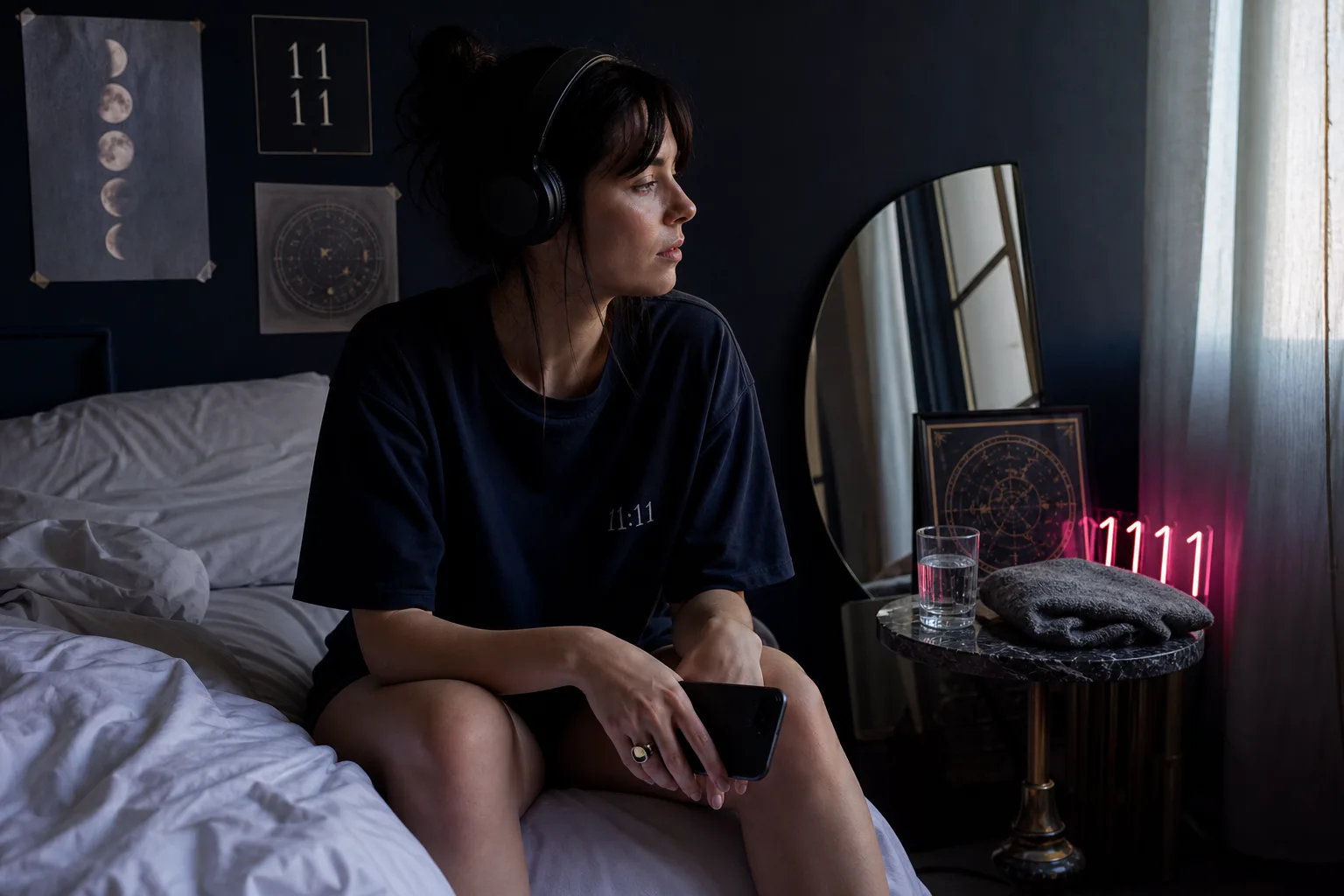
Your phone is on the bedside table. You don’t need a longer morning. A morning manifestation routine can be five minutes: press play on your personalized audio, listen to your Dream-Self Moment, breathe slowly, and choose one small action that matches the self you just heard.
What is a 5-minute morning manifestation routine?
A 5-minute morning manifestation routine is a brief audio practice that helps you rehearse who you’re being before the day starts making claims on you.
The shortness matters. In a 2010 study in the European Journal of Social Psychology, Phillippa Lally and colleagues found that habit automaticity took a median of 66 days, but the early repeat is what made the pattern possible. Five minutes is not a compromise. It’s a design choice.
The routine has one center: listening. Not writing three pages. Not building a perfect morning. Not proving you’re calm. You listen to a short recording that speaks from the version of you who has already moved into the life you intend. Then you let one behavior follow.
The AYA Method is a daily audio manifestation practice. Each day you listen to a short personalized recording — your Dream-Self Moment — narrated from the version of you who has already manifested the life you intend. Listening is the practice. Repetition is the work. The audio is the method.
That definition is deliberately plain. The practice is not made stronger by making it bigger. It gets stronger by becoming repeatable. A routine that survives a rushed Tuesday is more useful than one that only works on a quiet Sunday.
The morning doesn’t need to become sacred before it can become yours.
If you’re new to manifestation, think of this as mental rehearsal with tenderness. You’re not asking the day to obey you. You’re training your attention to recognize the next true step.
Why does audio work better when the morning is crowded?
Audio works well on busy mornings because it gives your attention a place to rest without asking your hands or eyes to do more.
Most mornings are already full of inputs. Pew Research Center reported in 2024 that 91% of U.S. adults own a smartphone, which means many people wake within reach of messages, headlines, weather, work, and other people’s needs. The first voice you hear matters.
Reading can be beautiful, but it asks for focus. Writing asks for space. Audio asks you to receive. That difference is not small at 7:12 a.m., when someone can’t find a sock and the kettle is clicking off. A short recording can meet you while you sit on the edge of the bed.
There’s also a body reason. A 2013 PLOS ONE study by Thoma and colleagues found that listening to music affected stress recovery markers after a stressor. Your Dream-Self Moment is not music therapy, and it shouldn’t be sold as medicine. Still, sound is intimate. Voice enters before argument has fully dressed itself.
Here is the quiet test: can you do it on a morning when you don’t feel ready? If the answer is yes, the routine has a chance.
Audio also protects the practice from becoming another performance. You don’t have to produce insight. You don’t have to feel certain. You only have to listen and return when your mind wanders, which it will. Neuroscience teacher Dr. Andrew Huberman often points to morning light exposure as a way to set circadian timing; even 2 to 10 minutes outside can help many people. Your audio can pair with that same modest window if it fits your life.
How do you set it up before tomorrow morning?
You set it up by choosing one cue, one place, one recording, and one small action before the morning arrives.
Do not make your tired self plan the practice. Plan it the night before, in under three minutes. Behavioral scientist BJ Fogg’s Tiny Habits model uses the idea of attaching a tiny behavior to an existing cue. After you do something you already do, you do the new small thing. That’s enough structure.
Use this setup once:
- Choose the cue: after you sit up, after you start coffee, or after you brush your teeth.
- Choose the place: bed, kitchen chair, bathroom floor, balcony, parked car.
- Choose the audio: your Dream-Self Moment, already ready to play.
- Choose the no-phone rule: no messages until the audio ends.
- Choose one matched action: the smallest visible behavior that belongs to the self you heard.
A matched action should be almost boring. Send the invoice. Drink water before coffee. Put the running shoes by the door. Open the document for 10 minutes. In a 1999 review, Peter Gollwitzer described implementation intentions as “if-then” plans that help behavior happen under real conditions. Your version can be soft: “After I listen, I send the first email.”
| Morning constraint | Best cue | Why it works |
|---|---|---|
| Children wake early | Bathroom door closes | It may be the only private minute |
| Commute starts fast | Car seat before ignition | The body is still for a moment |
| Shared bedroom | Coffee starts | The sound becomes the signal |
| Late sleeper | First light through curtains | No extra alarm needed |
The point is not to control the morning. The point is to remove decisions from it.

What do you do during the five minutes?
You listen first, breathe with the recording, and leave the practice with one small action you can actually do today.
Here is a simple five-minute shape. It is not strict. It is a handrail.
- Minute 0 to 1: sit down, press play, let your shoulders drop.
- Minute 1 to 3: listen to the Dream-Self Moment without fixing your thoughts.
- Minute 3 to 4: breathe slowly and notice which line stayed with you.
- Minute 4 to 5: name one matched action for today.
If your mind wanders, nothing has gone wrong. A 2010 Harvard study by Killingsworth and Gilbert used phone prompts and found people’s minds wandered about 47% of the time. The number is not a shame sentence. It is relief. Wandering is ordinary.
Come back to the sound. Come back to the sentence. Come back to the breath. You’re not trying to win the morning. You’re trying to meet it from a self you remember.
Repetition is not proof that you failed yesterday. It’s how the nervous system learns what you keep choosing.
The one action at the end is what keeps the practice honest. If the audio says you’re someone who treats their body with care, the action might be breakfast before email. If the audio says you speak clearly at work, the action might be one direct sentence in the meeting. If the audio says you’re no longer living by panic, the action might be leaving five minutes earlier.
For a wider frame on how intention, identity, and action work together, read the quiet foundation page on manifestation. Then come back to the morning. Five minutes is where theory either softens into life or doesn’t.
What should you say when your mind argues back?
When your mind argues back, answer with something true enough to stay with, not something inflated enough to impress you.
Skepticism is not the enemy. I came to manifestation late, after years of spreadsheets, forecasts, and rooms where nobody said what they meant. The part of me that asks for evidence is still here. I trust him. He has saved me from a lot of nonsense.
If your audio says, “I’m calm with money,” and your chest tightens because the card payment is due Friday, don’t force a lie over a fear. Try a bridge sentence: “I’m learning to look at money without leaving myself.” That sentence is smaller. It may also be more usable.
Self-affirmation research is careful here. In a 2014 review in the Annual Review of Psychology, Cohen and Sherman described self-affirmation as a process that can help people respond to threat by reconnecting with values. It is not magic wording. It is a return to what you can stand inside.
Use these when the mind gets loud:
- “This is practice, not a verdict.”
- “I don’t have to believe all of it today.”
- “What is the next honest inch?”
- “Can I act like this is possible for five minutes?”
That last question matters. You are not asked to fake certainty. You are asked to rehearse a direction and take one real step. Neville Goddard wrote often about assuming the feeling of the wish fulfilled. I read that now less as pretending and more as inhabiting, briefly, the self who stops negotiating with fear.
A future self becomes more believable when today’s self keeps one small promise.
How do affirmations and a Manifestation Board fit without taking over?
Affirmations and a Manifestation Board can support the morning routine, but they should not replace the audio.
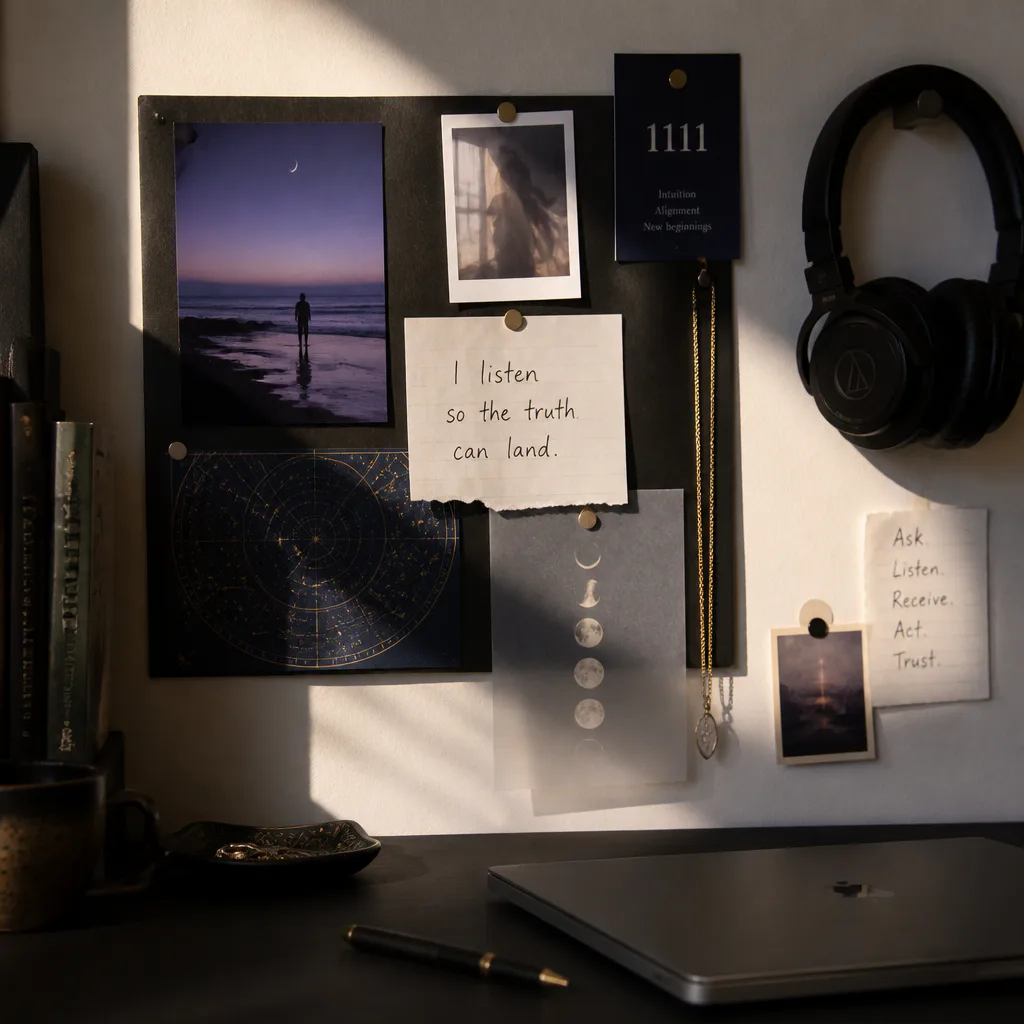
In Aya, the audio is the method. The daily affirmation and Manifestation Board are complements. That distinction keeps the practice clean. If you only have five minutes, listen. If you have six, read the affirmation after. If you have seven, glance at the board and choose one image or phrase that matches today’s action.
Aya’s affirmation writing works best when the line feels close enough to repeat without inner collapse. “I never doubt myself” may sound bright and land false. “I return to myself before I answer” is quieter. It gives the body somewhere to go.
A Manifestation Board is visual memory. It helps you see what you keep saying yes to. But boards can become decoration if they don’t touch behavior. One image of a calm desk is useful only if it leads you to close three tabs, answer the hard message, or stop working at a sane hour.
Some readers also use timing as a reflective cue. If that’s you, astrology and manifestation can be a calendar language, not a command system. The morning still asks the same question: what can you do now?
The support pieces are like a cup beside the bed. Useful. Near. Not the bed itself.
How do you keep the routine real after the first week?
You keep it real by measuring repetition, not mood, and by editing only what blocks the practice from happening.
Seven mornings is enough to learn something, not enough to judge your whole life. Make the review plain. Did you listen? What cue worked? What cue failed? Which line stayed? Which action repeated? No drama. No self-trial.
Habit researchers Wendy Wood and David Neal have written about how repeated behavior in stable contexts becomes cued by the environment. In one often cited Duke University paper, Wood and colleagues found that about 45% of daily behaviors were repeated in the same location while people were thinking about something else. Your bathroom chair, coffee sound, or car seat can become part of the practice.
After one week, adjust only one variable:
- If you skipped because the cue was vague, choose a sharper cue.
- If you skipped because the audio was too long, shorten the recording.
- If you listened but never acted, make the action smaller.
- If you felt resistance, soften the language.
- If it worked, do not improve it yet.
That last one is hard. Many people break a working ritual by decorating it. They add journaling, stretching, candles, cards, a longer recording, and then wonder why Wednesday refuses it. Let a small practice stay small.
Joe Dispenza often speaks about mental rehearsal as a way of teaching the body a future before it has happened. You don’t have to accept every claim in that world to use the practical center: rehearsal changes what you notice, and what you notice changes what you choose.
The practice is working when your day contains one behavior your old morning would have skipped.
Return to the AYA Method when you want the clean version again. Listen. Repeat. Let the audio do its quiet work.
The room is still here, and so are you.