frequencies binaural
528 Hz Manifestation With Dream-Self Audio
Learn a grounded 528 hz manifestation routine that pairs the tone with Dream-Self audio, timing, tracking, and daily listening without superstition.
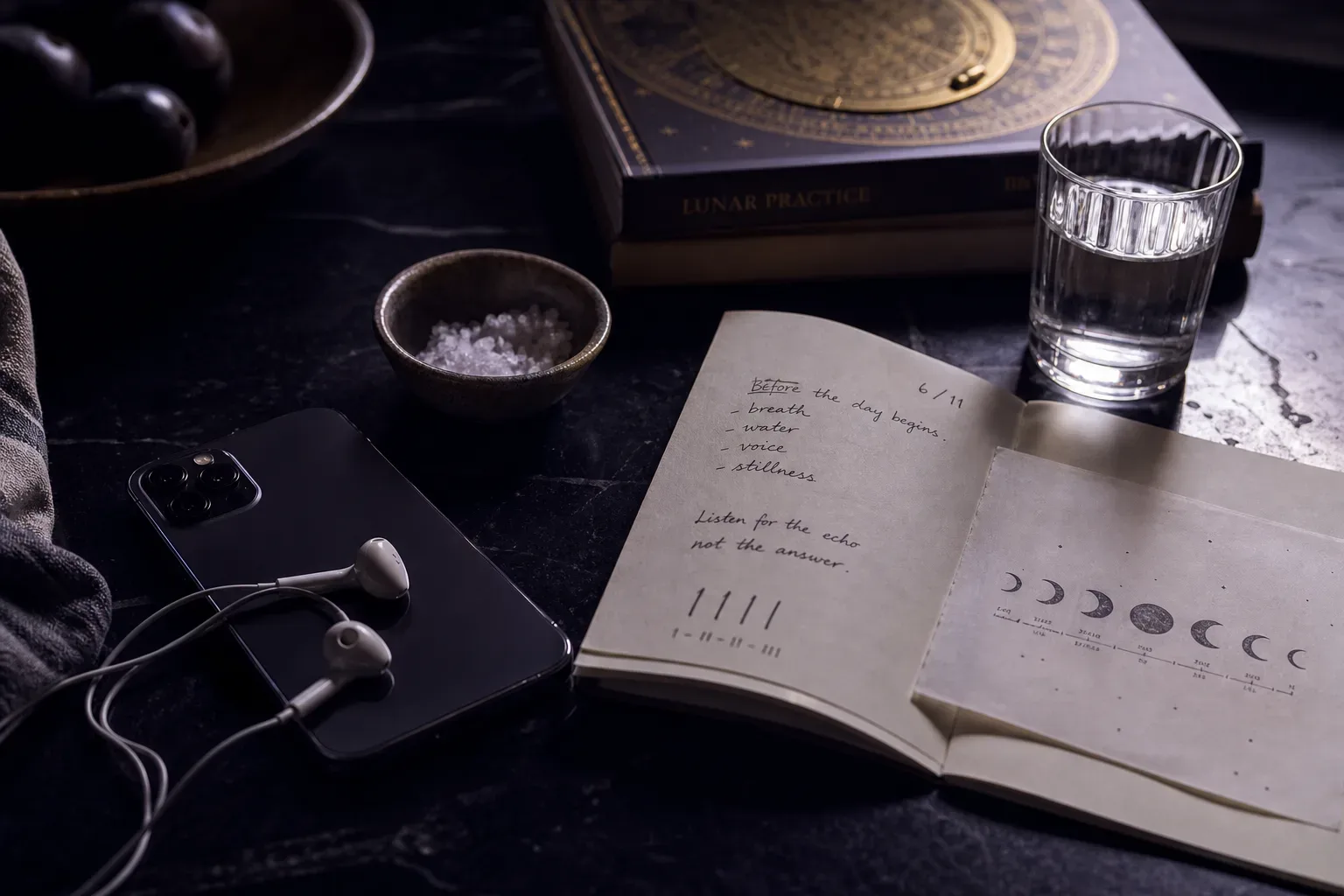
528 hz manifestation works best as an audio cue, not a miracle tone: play a gentle 528 Hz track under or beside your Dream-Self audio, then listen daily with the same intention, timing, and body state. The frequency steadies the room; the personalized narration gives your mind a specific future to rehearse.
What is 528 Hz manifestation actually doing?
528 Hz manifestation is a listening ritual that uses the 528 Hz tone as a repeatable signal for focused intention.
The number has a reputation. In modern Solfeggio-frequency culture, 528 Hz is often called the love frequency or DNA repair frequency, language popularized in the late 20th century by writers such as Leonard Horowitz. That history is interesting. It is not the same as proof. The cleaner claim is smaller and more useful: a consistent tone can mark a consistent state.
There is limited research on 528 Hz specifically. A small Japanese study often cited in frequency circles compared music tuned to 528 Hz with music at 440 Hz and reported changes in stress markers after brief listening sessions. Small means small. Treat it as a signal worth noticing, not a verdict from the mountain.
The wider evidence is stronger around music and the nervous system. Reviews in journals such as the Journal of Behavioral Medicine and Cochrane-style music therapy summaries have repeatedly found that music can reduce anxiety in clinical settings, sometimes after sessions as short as 20 to 30 minutes. The point is not that 528 Hz is magic. The point is that sound can change the conditions in which attention becomes available.
My grandmother would have understood this without naming a frequency. She knew that no one should stir a pot while angry. The spoon carried the mood. So does the track.
A tone does not replace intention; it gives intention a room to stand in.
If you want the wider map of intention work, start with the Manifestation pillar. It keeps the language grounded: what you repeatedly notice, name, rehearse, and choose starts to shape what you can actually do.
Why pair 528 Hz with Dream-Self audio?
You pair 528 Hz with Dream-Self audio because the tone sets the state and the narration supplies the identity.
This is where the AYA Method matters. The AYA Method is a daily audio manifestation practice. Each day you listen to a short personalized recording — your Dream-Self Moment — narrated from the version of you who has already manifested the life you intend. Listening is the practice. Repetition is the work. The audio is the method.
The 528 Hz layer is not the spine. It is the candle on the table. Beautiful, useful, not dinner.
Repetition has a serious body of evidence behind it. Psychologist Phillippa Lally and colleagues, publishing in the European Journal of Social Psychology in 2009, found that habit formation averaged 66 days in their sample, with wide variation from 18 to 254 days. The number is less romantic than 11:11, but it tells the truth. A practice becomes believable because you return to it.
Mental rehearsal has also been studied in sports psychology and rehabilitation. The brain does not confuse imagined action with completed action, but it does recruit overlapping networks when you vividly rehearse movement, choice, and self-perception. Joe Dispenza speaks about rehearsal through meditation in a more expansive register; neuroscience usually says it more carefully. Both point toward one sober fact: what you practice internally can alter what feels available externally.
A Dream-Self audio does something a plain tone cannot do. It names the future in your own language. It might say the apartment is quiet, the invoice is paid, the table is full, the body is rested. That specificity matters.
Frequency can open the gate; language tells you which gate you are standing at.
How do you set up 528 Hz manifestation in 11 minutes?
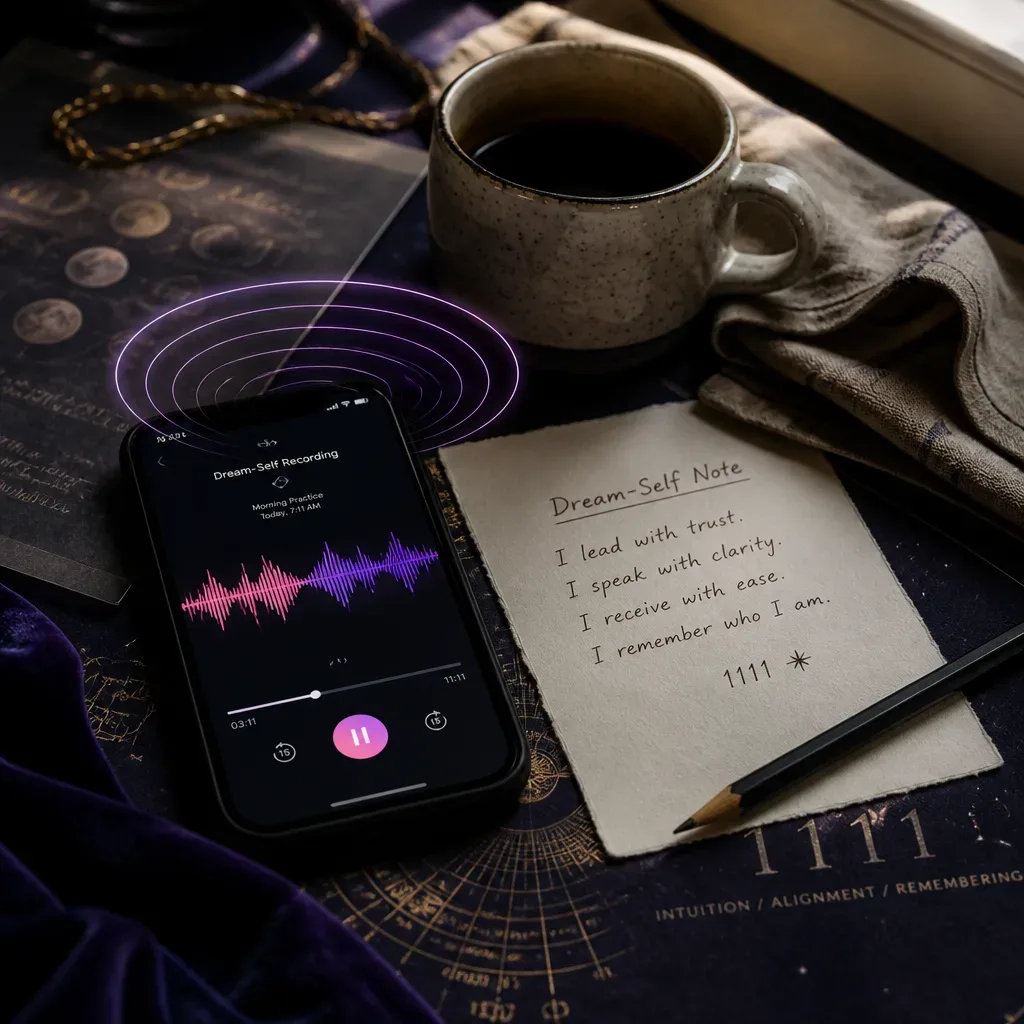
Set it up by making the tone secondary, the Dream-Self audio primary, and the timing simple enough to repeat tomorrow.
Use 11 minutes because it is memorable, not because the clock obeys numerology. Master number 11 has long been associated in numerology with intuition and the signal moment, the quick flash when the dial lines up. On Manifest 11, it works as a ritual container. Eleven minutes is short enough for a weekday and long enough to change the texture of the room.
Here is the clean setup:
- Put your phone face-down or out of sight.
- Start a low-volume 528 Hz track with no lyrics.
- Play your Dream-Self audio clearly over it, or directly after 60 seconds of tone.
- Keep both volumes gentle enough that your jaw stays relaxed.
- After listening, write one sentence beginning with: Today I can act as if…
Sound safety is not decorative. The National Institute for Occupational Safety and Health recommends limiting exposure to 85 dBA over an 8-hour workday. Your session is short, but the principle holds: louder is not more spiritual. If the tone needles your ear, turn it down.
A useful 11-minute structure looks like this:
| Minute | Action | Purpose |
|---|---|---|
| 0-1 | Breathe and let the 528 Hz tone play | Marks the gate |
| 1-9 | Listen to Dream-Self audio | Rehearses identity |
| 9-10 | Stay still without fixing anything | Lets the body register |
| 10-11 | Write one witness line | Converts listening into choice |
That last line matters. A practice without witness becomes a mood. A practice with witness becomes evidence.
If you already use an affirmation, keep it as a complement. The deeper guide to clear phrasing is the Affirmations pillar, especially if your sentence keeps getting swollen with words you do not believe.
What should your Dream-Self audio say over 528 Hz?
Your Dream-Self audio should describe a specific future self in present-tense sensory detail, with enough emotional truth that your body can recognize it.
Do not make it a wish list. Make it a scene. The kitchen test works well: could you set this life on a table? Could you hear the chair move, smell the coffee, feel the clean invoice folder under your hand? A 2010 review in Psychological Bulletin found that mental imagery can influence emotion and behavior more strongly when it is vivid and self-relevant. The future needs texture.
Neville Goddard called this living in the end. I keep some distance from the certainty of his language, but the instruction is useful: rehearse the state of the fulfilled self, not the panic of the wanting self. Wanting keeps checking the oven every 2 minutes. Knowing sets a timer and lets the heat do its work.
Your audio can include:
- A present-tense opening: I wake in a room that already feels like mine.
- A concrete proof: The message has arrived, and I answer it calmly.
- A body cue: My shoulders are low. My breath is unhurried.
- A relational cue: I speak without performing for approval.
- A closing choice: Today I move as the person who can hold this.
Keep the script lean. A 90-second to 4-minute narration is often enough for daily use, especially inside an 11-minute frequency session. Long recordings can become foggy. Precision feeds belief better than volume.
The mind trusts a future it can picture, but the body trusts a future it can feel.
If you track lunar timing or repeated number patterns, keep them as punctuation. The Astrology and manifestation guide is useful here because it treats cycles as timing tools, not excuses to wait forever.
When should you listen: morning, night, or on a signal?
Listen when your nervous system is most available, then protect that time for at least 14 days.
Morning works because the day has not yet collected too many fingerprints. Night works because the mind is less defended. A signal works if it is consistent: 11:11, after coffee, after the school drop-off, before opening email. The point is not the perfect hour. The point is returning on cue.
Sleep researcher Matthew Walker has popularized the importance of pre-sleep routines for memory and emotional processing, and the research field broadly supports the idea that what happens near sleep can shape consolidation. If night listening makes you drowsy in a good way, use it. If it turns into scrolling with a frequency playing sadly in the background, choose morning.
Use this comparison:
| Timing | Best for | Watch for |
|---|---|---|
| Morning | Claiming behavior before the day begins | Rushing through the audio |
| Night | Softening resistance before sleep | Falling asleep before hearing the words |
| 11:11 signal | Creating a ritual gate | Waiting for signs instead of choosing |
| After a daily task | Habit strength | Letting the task become automatic noise |
Fourteen days is a practical first cycle. It is long enough to reveal patterns, short enough that you do not turn the practice into a personality test. If you miss a day, return the next day without drama. The dial did not break.
A lunar month is about 29.5 days, which is why many ritual systems use the moon as a tracking frame. If that language helps you, pair your first 14 days with the waxing half of the cycle. If it does not, use a calendar. The practice does not require theatrical belief.
What should you track without getting obsessive?
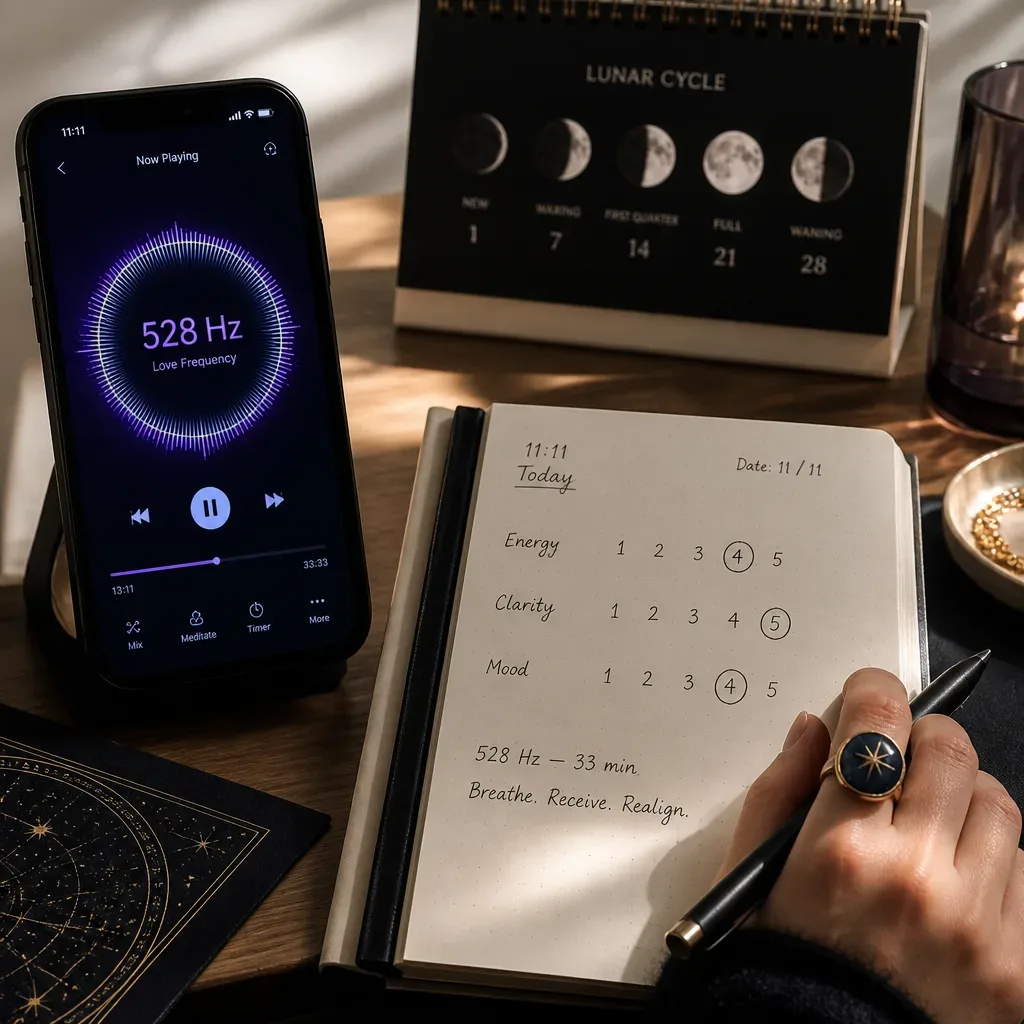
Track only the signals that connect listening to behavior, because obsession turns synchronicity into surveillance.
After each session, write one witness line. Not a page. One line. Tara Brach often teaches the value of pausing and naming what is present; psychology research on affect labeling also suggests that naming emotion can reduce its intensity. The label is a bowl. It holds the heat without spilling it everywhere.
Use a 1-to-5 scale for three things:
- Body steadiness after listening.
- Believability of the Dream-Self scene.
- One aligned action taken within 24 hours.
That third measure keeps the work honest. If your audio describes calm financial order, an aligned action might be opening the bill, sending the invoice, or checking the account without flinching. If your audio describes love that is precise, an aligned action might be making the soup before resentment enters the room.
There is a long history of controversial research around intention and randomness, including the Princeton Engineering Anomalies Research lab and the later Global Consciousness Project. Those projects are debated for good reasons. Use them as cultural context, not as your proof. Your stronger proof is behavioral: did the practice change what you noticed and what you chose?
A sign is not a substitute for a decision.
Review your notes every 7 days. Look for returns: the same fear, the same opening, the same phrase in your Dream-Self audio that suddenly lands differently. When the same line arrives three times, do not make it mystical too quickly. First ask what it is asking you to do.
For a broader definition of how repeated attention becomes lived choice, return to the Manifestation pillar. The cleanest practice is still the one you can measure in your next ordinary action.
What mistakes make 528 Hz manifestation feel flat?
The practice feels flat when the frequency becomes the main character and your lived choice disappears.
The first mistake is volume. A harsh tone makes the body brace. Once the body braces, the mind starts negotiating instead of receiving. Keep the 528 Hz layer low enough that it feels like steam from a pot, not a siren in the hallway. Again, the NIOSH 85 dBA guideline is a useful ceiling, even if most phone speakers will not reach dangerous levels during a short session.
The second mistake is swapping your audio every time your mood changes. A Dream-Self recording needs repetition. Lally’s 2009 habit study did not find that people built automaticity by reinventing the cue every morning. They repeated a behavior in a stable context. Give your recording at least 14 days before you edit it, unless it contains language your body actively rejects.
The third mistake is using angel numbers as permission to avoid the next step. Seeing 11:11 can be a beautiful signal. It can also become a shiny delay. Doreen Virtue popularized much of the modern angel-number vocabulary, though she later publicly distanced herself from that work. Take the numbers lightly. Let them point, not govern.
Avoid these flattening habits:
- Playing 528 Hz while multitasking through six apps.
- Choosing a track with lyrics that fight your narration.
- Treating one strange coincidence as a contract.
- Writing affirmations so grand your body quietly says no.
- Skipping the witness line because you felt something.
A good 528 hz manifestation session is almost plain. Tone. Audio. Breath. One line. One choice. The room changes because you keep arriving in it the same way.
If you want the complete audio structure, use the AYA Method as the spine. Add the tone if it helps. Add one daily affirmation if it sharpens the aftertaste. Let the Manifestation Board hold images when images help. But do not confuse complements for the method.
Put the sound on. Let the better hour recognize you.