evening rituals
After Work Routine: 3-Minute Dream-Self Audio
Build an after work routine with a 3-minute Dream-Self audio, a small reset, and an evening ritual that helps your mind return on cue.
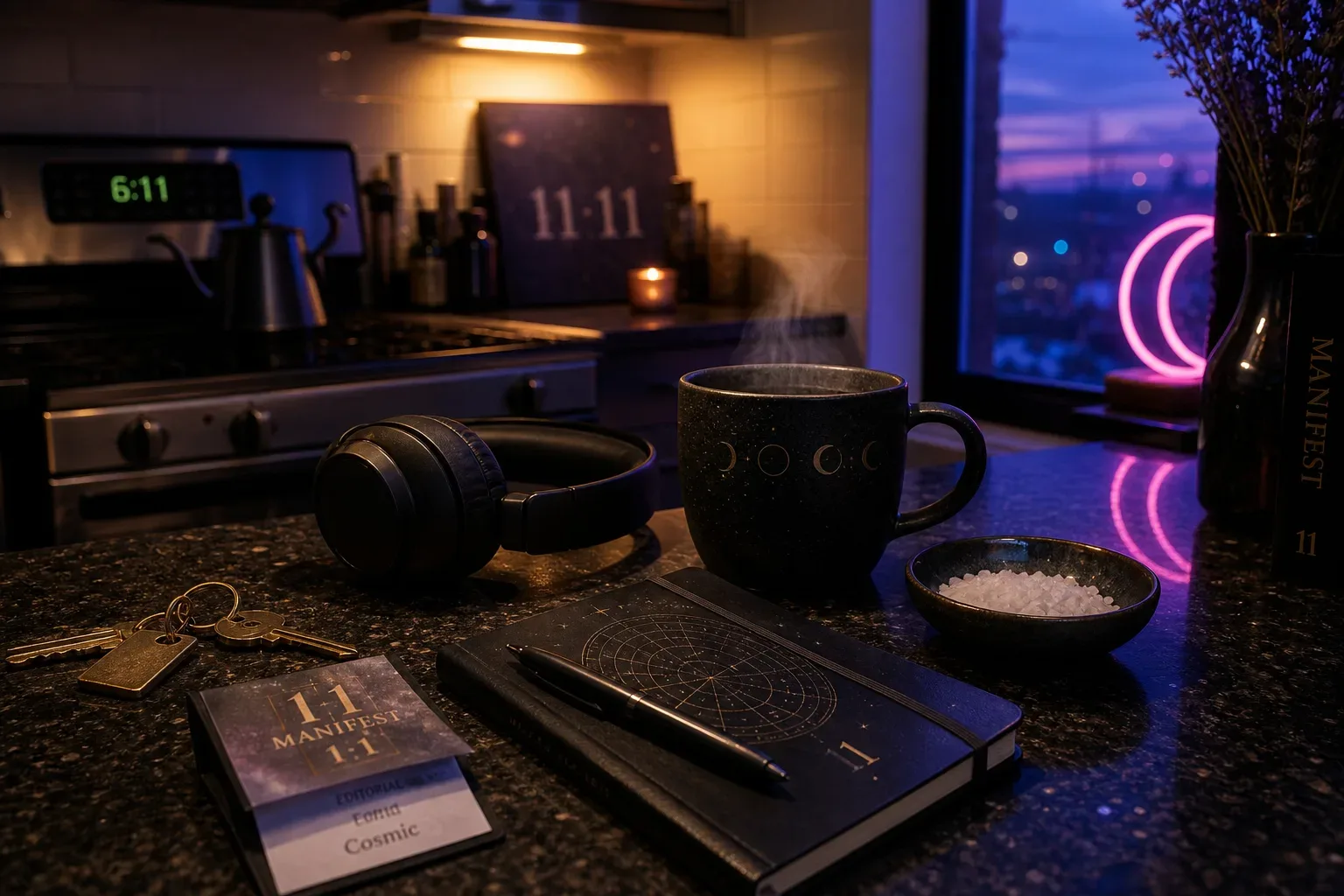
An after work routine works best when it is short enough to repeat and clear enough to change your state. Use a physical transition, listen to a 3-minute Dream-Self audio, then take one small aligned action before the evening gets crowded. The signal has to arrive before the noise returns.
Why does the after-work window matter so much?
The after-work window matters because it is a gate between the identity that performed all day and the identity you are practicing next.
At 6:11 one Tuesday, I stood in my kitchen with my keys still in my hand, staring at a pot I had not yet filled. The stove clock said 6:11. My phone said 6:11. The receipt from the market, folded in my pocket, had a total ending in 11. Most people would call it coincidence. I called it a cue to stop dragging the whole workday into dinner.
The body loves cues. A 2023 Gallup report found that 44% of workers worldwide said they felt a lot of stress the previous day, which means many people cross the threshold home still carrying work chemistry. If you do nothing, the day keeps stirring itself. No one in my grandmother’s kitchen was allowed to stir a pot while angry. She did not cite neuroscience. She had data from three generations of soup.
An after-work ritual does not need incense, velvet, or an hour of silence. It needs a clean signal. Behavioral scientist BJ Fogg has written that tiny habits survive because they attach to existing prompts. Coming home is already a prompt. Closing a laptop is already a prompt. Turning the key in the door is already a prompt.
That is why I like this routine for the ordinary evening, not the cinematic one. You may have children asking for snacks, a train delay still buzzing in your bones, or rice to rinse before anyone becomes unbearable. The practice has to fit inside the real room.
A ritual is not proven by how dramatic it looks. It is proven by whether you return to it when you are tired.
The after-work gate is also mercifully specific. Morning rituals can sprawl. Bedtime rituals can collapse under exhaustion. But after work has a sharp edge: before the second shift of life begins. That edge is where a 3-minute Dream-Self audio can land on cue.
What makes a 3-minute Dream-Self audio the center of the routine?
A 3-minute Dream-Self audio works because it gives your attention one narrated future to rehearse before the evening claims you.
In the AYA Method, the AYA Method is a daily audio manifestation practice. Each day you listen to a short personalized recording, your Dream-Self Moment, narrated from the version of you who has already manifested the life you intend. Listening is the practice. Repetition is the work. The audio is the method.
Three minutes sounds small until you notice what else fits into three minutes. A kettle can begin to sing. A nervous system can stop bracing. A person can remember the difference between being interrupted and being doomed. Dr. Andrew Huberman has often discussed state shifts through breath, attention, and nervous system regulation; the practical point is simple enough for a kitchen timer: attention changes physiology faster when the cue is focused.
The audio matters because it is received, not performed. Affirmations can become another task if you are already depleted. A Manifestation Board can be beautiful, but the eyes tire after a screen-heavy day. The Dream-Self audio enters through listening. You can stand at the counter, wash herbs, or sit in the parked car for 180 seconds.
A 2010 study in the European Journal of Social Psychology found that automaticity for a new habit took a median of 66 days, with wide variation from 18 to 254 days. That number is useful because it tells the truth. Repetition is not a mood. It is a season.
Here is the basic structure:
- Cue: arrive home, close work, or step out of transit.
- Audio: listen to your 3-minute Dream-Self Moment.
- Witness: write or speak one sentence you heard clearly.
- Action: do one small thing that agrees with that identity.
- Closure: mark the end so the brain knows the loop is complete.
This is also where the Manifestation pillar becomes practical instead of decorative. The future self is not a poster on the wall. She is a voice in your ear while you decide whether to answer one more email or feed yourself like someone worth feeding.
How do you set up the routine in 12 minutes?
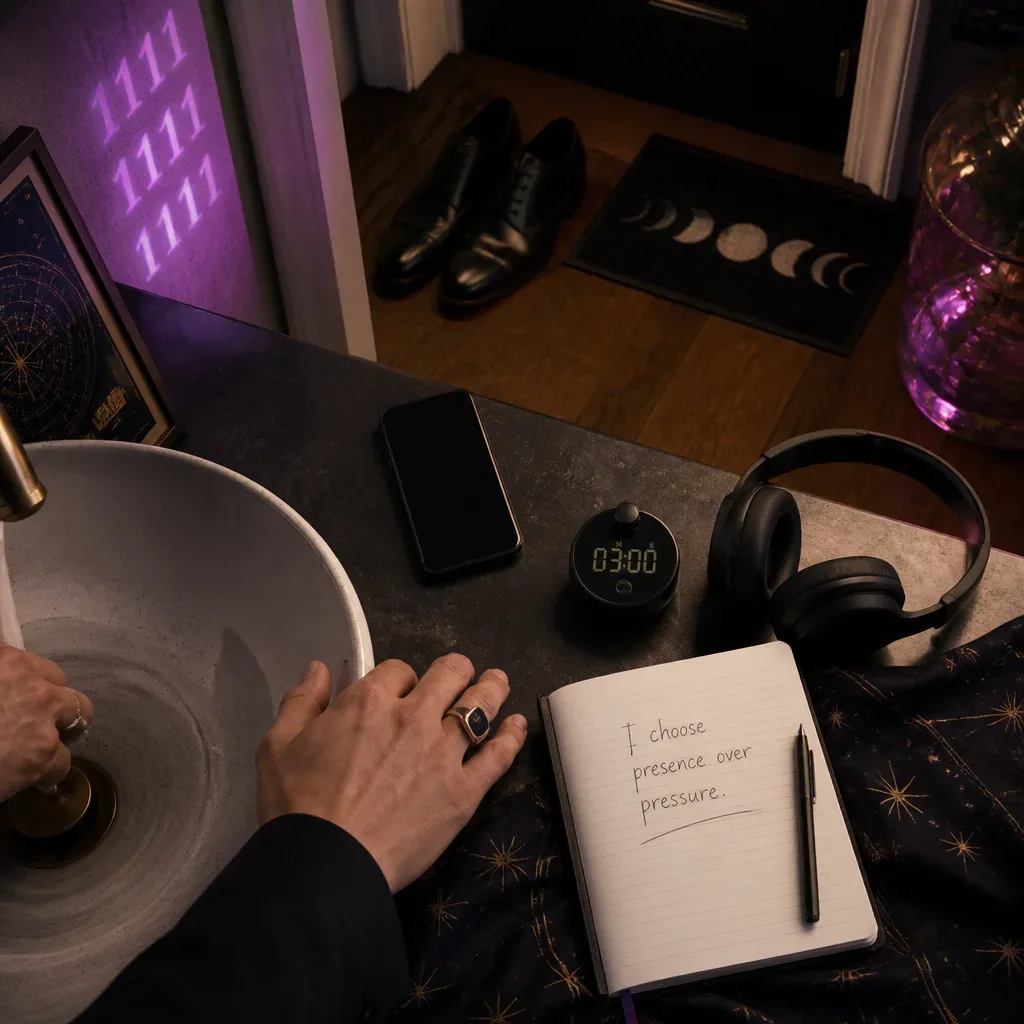
You set it up by giving each minute a job, so the routine does not become another negotiation with your tired self.
I like 12 minutes because it is short enough to protect and long enough to have a beginning, middle, and return. The American Time Use Survey from the U.S. Bureau of Labor Statistics reported that employed people worked an average of about 7.9 hours on days they worked in 2023. After a day that long, the ritual cannot ask for a committee meeting.
Use this as the working template:
| Minute | Move | Why it works |
|---|---|---|
| 0-1 | Put down bag, keys, laptop, or apron | Marks the end of the work role |
| 1-3 | Wash hands, change shoes, or step outside | Gives the body a physical signal |
| 3-6 | Listen to the Dream-Self audio | Places the method at the center |
| 6-8 | Write one sentence from the audio | Turns listening into witness |
| 8-11 | Take one aligned action | Makes the state visible |
| 11-12 | Close with the same tiny sign-off | Builds a repeatable loop |
The aligned action should be almost laughably specific. Chop the onion before checking messages. Put tomorrow’s gym clothes on the chair. Send the two-line reply instead of mentally rehearsing it for 40 minutes. Heat soup. Pay the bill. Step away from the argument you are inventing in your head.
This is not productivity wearing a moon necklace. It is state stewardship. The Pew Research Center reported in 2024 that 90% of U.S. adults own a smartphone, which means most after-work routines now compete with a glowing rectangle trained to harvest attention. If your phone is the first thing you feed, do not be surprised when the evening feels hungry.
Keep the setup plain:
- one place to listen
- one pair of headphones or one quiet speaker
- one notebook line, not a full journal demand
- one repeatable action
- one closing cue
If you already use the Affirmations pillar, choose one line from the audio as your affirmation for the evening. Do not add seven more. Precision has more power than clutter.
What should you do when you arrive home stressed or scattered?
When you arrive home stressed, downshift the body first, then listen, because a flooded system rarely receives a subtle signal.
Stress makes everything feel urgent, even the garlic. The American Psychological Association’s 2023 Stress in America report found that adults commonly described stress as affecting sleep, focus, and emotional regulation. That is not a character flaw. It is a nervous system with too many tabs open.
Start with water. Wash your hands slowly for 20 seconds, the same duration public health guidance has repeated for years because time plus attention changes behavior. I add a pinch of sea salt to a small bowl by the sink sometimes. I will not explain this. Some acts work better without witnesses.
Then choose one of these downshifts before the audio:
- The doorway breath: inhale for 4, exhale for 6, repeat 3 times.
- The counter press: place both palms on the counter for 30 seconds and feel the surface hold you.
- The shoe ritual: remove work shoes and put them in the same place every day.
- The stove pause: stand near the stove without turning it on until your jaw softens.
Dr. Herbert Benson’s relaxation response research, first popularized in the 1970s, showed that simple repeated focus can reduce physiological arousal. You do not need to make the evening mystical to make it measurable. You need repetition, breath, and a cue your body believes.
Then listen. Not while arguing. Not while scrolling. Not while composing a message sharp enough to leave a mark. Listen as if the audio is a guest who arrived exactly on time.
The future self is easiest to hear when the present self stops defending the day.
If you miss the 12-minute version, keep the 3-minute version. If you miss the notebook, keep the audio. If dinner burns slightly because you paused to listen, lower the flame next time. A practice that cannot survive an imperfect Tuesday is not a practice. It is theater.
How do you connect the audio to real evening choices?
You connect the audio to real choices by translating one phrase you hear into one visible behavior before the night ends.
The mistake is treating the Dream-Self Moment as a mood piece. It is more useful than that. If the audio names you as calm, prepared, loved, solvent, disciplined, receptive, or brave, the evening asks for evidence. Tiny evidence counts. Especially tiny evidence.
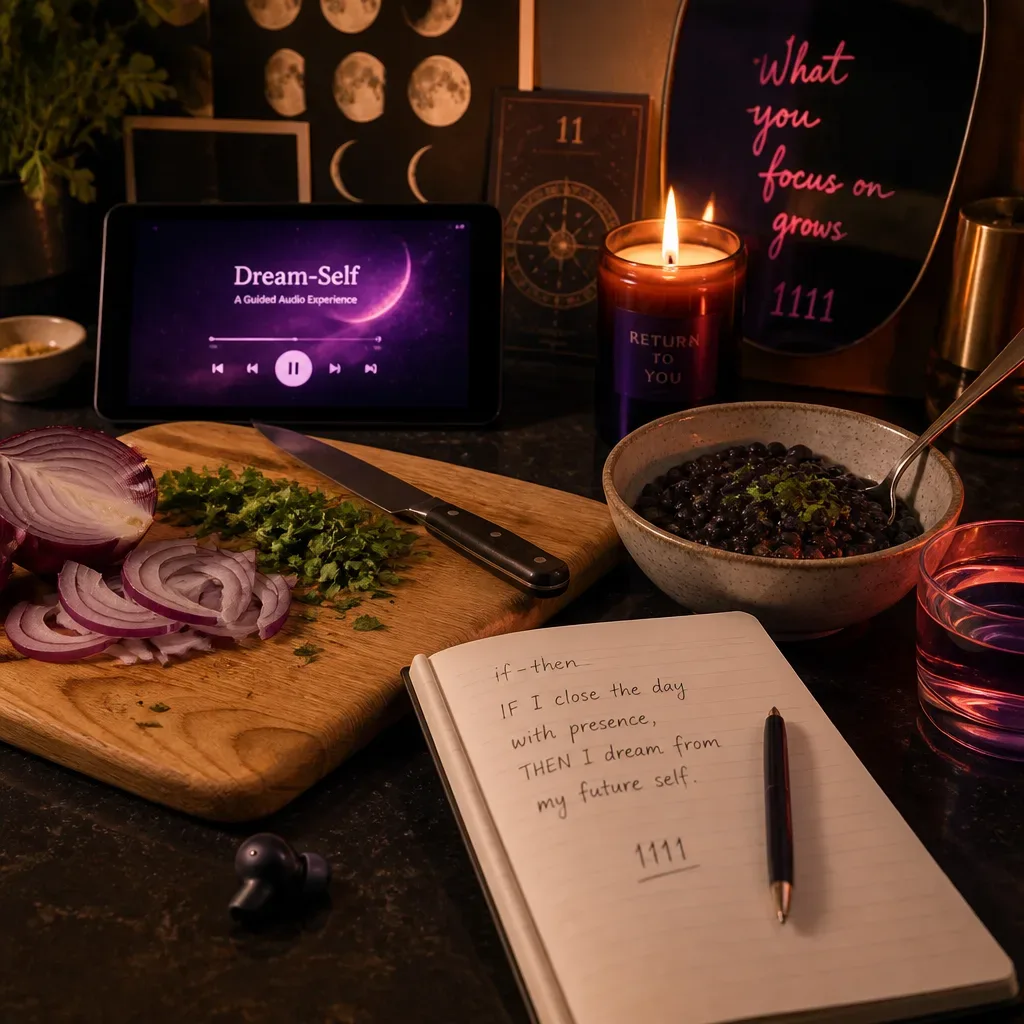
Implementation intention research by psychologist Peter Gollwitzer found that if-then planning can significantly increase follow-through across goals. The formula is not glamorous: if situation X happens, then I will do Y. After work, that might sound like: if I hear the line about being well-resourced, then I will open the bill instead of avoiding it. If I hear the line about devotion, then I will cook the beans instead of ordering from resentment.
Use this translation table:
| Dream-Self phrase | Evening behavior |
|---|---|
| I am clear with my money | Check one balance or pay one small bill |
| I am cared for in my body | Prepare one real plate, not scraps over the sink |
| I choose clean timing | Set a 25-minute timer for one task |
| I receive support | Ask one direct question without apology |
| I protect my attention | Leave the phone in another room for dinner |
This is where Astrology and manifestation can add texture without taking over the stove. A lunar cycle is about 29.5 days, and many people use new moons and full moons as timing markers. Fine. Let the moon be a calendar, not an excuse. The routine still happens on ordinary Wednesdays.
Joe Dispenza often speaks about rehearsing a future state until the body begins to recognize it. Neville Goddard wrote about assuming the feeling of the wish fulfilled. Different rooms, similar dial. The useful question is not whether the phrase sounds grand. The useful question is whether it changes what you do at 7:04 p.m.
A manifestation practice becomes real at the exact point where it changes your next ordinary choice.
How can food, chores, and family fit into the practice?
Food, chores, and family fit when you stop treating them as interruptions and start using them as the room where the practice proves itself.
My first manifestation board was probably my grandmother’s pantry, though no one called it that. Beans in jars. Chiles tied and drying. Rice bought before anyone had to ask. A household arranged around future hunger is already a form of faith. It just wears an apron.
The routine can happen with other people nearby. It may have to. According to the U.S. Census Bureau, roughly 33% of adults live in households with children under 18, and millions more live with partners, parents, roommates, or elders. Silence is not always available. Consistency can be.
If the house is loud, use the parked car. Use one earbud while stirring. Use the bathroom with the fan on. Use the walk from the bus stop to the front door. The sacred is not fragile. It can survive a child asking where the blue cup went.
Here are family-friendly adaptations:
- With children: listen before pickup, or while they wash hands with you.
- With a partner: agree that the first 3 minutes after arrival are not for logistics.
- With roommates: use headphones and a visible cue, like a closed notebook.
- While cooking: listen before the knife comes out, then cook from the state you named.
- While caregiving: make the closing cue tiny, such as rinsing one spoon.
Tara Brach often teaches the power of pausing and naming what is present. That is kitchen wisdom too. Name the irritation before it seasons the sauce. Name the desire before it becomes a complaint. Name the self you are practicing before the evening names you by default.
Daily affirmation can help here if it stays small. One line taped inside a cabinet. One sentence repeated while the kettle heats. The Manifestation Board can sit near your desk or bedroom mirror. They are not the spine. The audio is the spine.
For a broader map of how these practices speak to one another, keep the Manifestation pillar and the Affirmations pillar close, but let the after-work routine remain modest. A good mole is not improved by adding every spice in the market.
How do you keep the after work routine alive for 30 days?
You keep the routine alive by tracking the return, not by demanding a perfect streak.
Thirty days is long enough to reveal patterns and short enough not to become mythology. It is also close to one lunar cycle, which averages 29.5 days. Master number people will notice if day 11 or day 22 feels charged. Let them notice. Synchronicity is a bell, not a boss.
Use a simple 30-day scorecard. Mark only three things: listened, named one sentence, took one action. That is it. No essay. No punishment column. No moral weather report.
| Day marker | Question | Mark |
|---|---|---|
| Listen | Did I play the 3-minute audio? | yes/no |
| Witness | Did I write or speak one sentence? | yes/no |
| Act | Did I take one matching action? | yes/no |
Habit researcher Wendy Wood has written that stable contexts help habits form because they reduce decision-making. This is why the same counter, same chair, same walk, or same parked-car minute matters. The location becomes part of the spell, if you like that word. If not, call it environmental design.
Plan for misses before they arrive. If you travel, listen in the hotel bathroom. If you work late, listen before entering the house. If you forget, listen when you remember and do not perform guilt. Guilt is a terrible project manager. It keeps long hours and produces very little.
On days 7, 14, 22, and 30, read your one-line notes. Look for repeated phrases. Maybe the audio keeps returning you to steadiness. Maybe the same money sentence lights up. Maybe the relationship line makes you exhale every time. The pattern is the message.
By day 30, the goal is not to become a different person by force. The goal is to create a reliable evening gate where your attention can return to the person you are already practicing. For the full method, return to the AYA Method and keep the listening at the center.
The door closes, the audio begins, and the evening learns your name.