sleep science
Best Time to Sleep: When to Play Manifestation Audio
Find the best time to sleep with manifestation audio, why the last 20 minutes matter, and how to make bedtime listening steady.
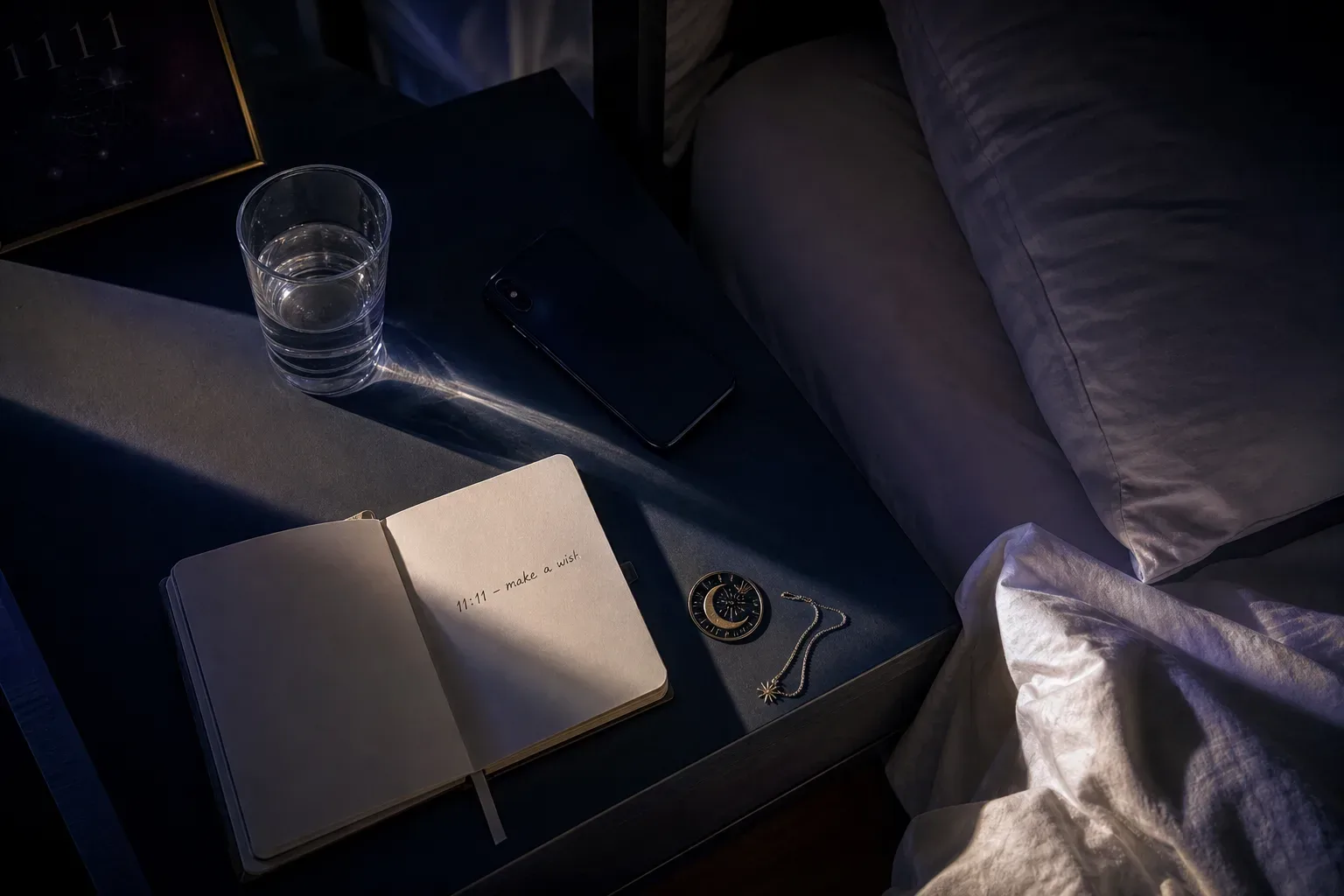
The best time to sleep after manifestation audio is usually 10 to 30 minutes after listening begins, with 20 minutes as the clean middle. Start the recording after lights are low, alerts are off, and the room has stopped asking for decisions. The last signal matters because sleep takes instructions personally.
What is the best time to listen before sleep?
The best time to listen is about 20 minutes before your intended sleep time, once the day has visibly ended.
I like 20 minutes because it is neither ceremonial nor careless. It is close enough to the sleep gate that the body has begun to downshift, and early enough that you can hear the audio rather than abandon it to unconsciousness. The American Academy of Sleep Medicine recommends adults sleep at least 7 hours per night, and the CDC has reported that roughly 1 in 3 U.S. adults do not get enough sleep. A bedtime practice has to respect that pressure. It cannot become another task with perfect lighting and a moral tone.
For manifestation audio, the timing is not about catching a mystical minute on the clock. It is about choosing the final input. If your last 11 minutes are emails, a group chat, and a video that opens into 12 more videos, your nervous system has already been given its assignment. If the last 11 minutes are your Dream-Self Moment, the assignment changes.
In the AYA Method, the AYA Method is a daily audio manifestation practice. Each day you listen to a short personalized recording, your Dream-Self Moment, narrated from the version of you who has already manifested the life you intend. Listening is the practice. Repetition is the work. The audio is the method.
That definition matters at bedtime. Do not turn the practice into a stack of rituals. The daily affirmation and Manifestation Board can support the room, but the audio is the spine. A chosen voice, repeated at the same gate, becomes easier for the mind to recognize.
The final thing you hear before sleep is not background. It is a vote.
Why does the pre-sleep window carry so much weight?
The pre-sleep window matters because attention narrows, body temperature drops, and the brain begins sorting memory and emotion.
Sleep is not a blank room. During the transition from wakefulness into sleep, the brain moves through lighter stages before deeper non-REM sleep. Sleep researchers often describe this as a shift in arousal, not a sudden switch. Dr. Andrew Huberman has frequently pointed to light, temperature, and timing as major regulators of the sleep-wake cycle, with morning light and evening dimness shaping circadian rhythm through the suprachiasmatic nucleus.
That is the science side of the dial. The practice side is simpler: fewer signals are competing. The phone is quieter. The room has fewer demands. The part of you that spent the day negotiating with calendars and other people is less armed. This is why bedtime is powerful and risky. If you bring chaos to it, chaos gets the microphone.
A 2015 National Sleep Foundation consensus statement noted that adults typically need 7 to 9 hours of sleep. Yet many people treat the 30 minutes before bed as disposable. Those minutes are not spare change. They are the bridge into the 7 or 8 hours that follow.
Use the bridge deliberately:
- Put the audio before sleep, not after scrolling.
- Keep volume low enough that the body does not brace.
- Use the same earbuds, speaker, or bedside placement when possible.
- End with darkness, not another app.
- If you wake at 3:33, do not restart the whole practice unless it calms you.
This is also where Manifestation pillar work becomes practical. Manifestation is not louder wanting. It is repeated orientation. The pre-sleep window gives orientation a clean surface.
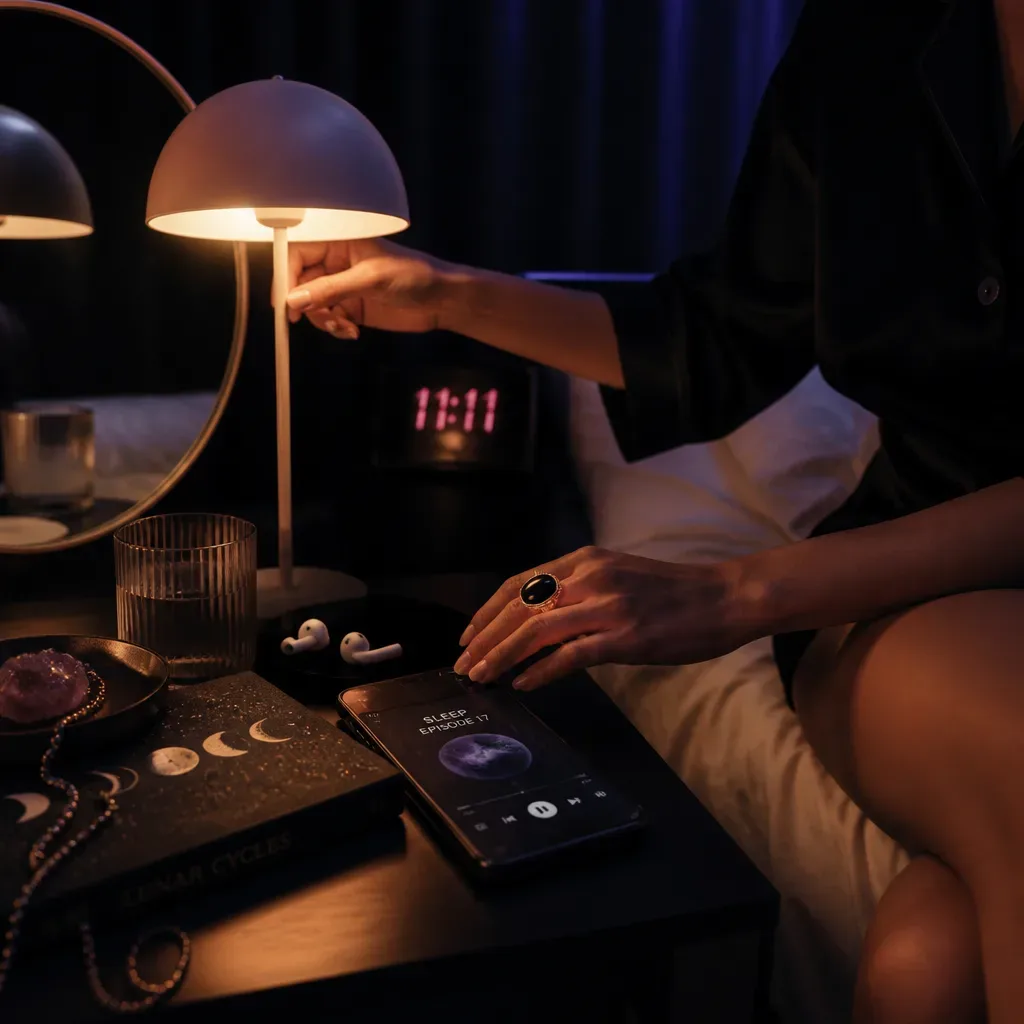
How do you set the timing without making bedtime rigid?
Set the timing by working backward from sleep, then protect only the final 20 minutes.
Rigidity is the enemy of repetition. If a method requires a flawless evening, it will fail the first time someone texts, a child coughs, or dinner runs late. The better rule is a small rule: choose your intended sleep time, then start the audio 20 minutes before it. If you want to be asleep at 10:45, press play around 10:25. If sleep usually takes you 40 minutes, start at the beginning of that wind-down, not the end.
Sleep medicine uses the term sleep latency for the time it takes to fall asleep. Many clinical references consider 10 to 20 minutes a common range for healthy sleep onset, though individual patterns vary. If you consistently fall asleep in under 5 minutes, you may be overtired. If you take more than 30 or 40 minutes, your body may need more wind-down before the audio becomes useful.
Here is the clean version:
- Choose the sleep time you are actually willing to protect.
- Subtract 20 minutes.
- Dim the lights before pressing play.
- Put the phone face down or across the room.
- Listen once.
- Let the practice end without adding more content.
The number 20 is not sacred. It is serviceable. The point is that the recording arrives before the mind disappears and after the day has lost its authority.
If you work with Affirmations pillar, keep the affirmation brief at night. One line is enough. The affirmation is the note on the mirror; the audio is the voice in the room.
A bedtime practice should be small enough to survive an ordinary Tuesday.
What routine should you follow step by step?
Follow a short routine that lowers stimulation first, plays the audio second, and asks for nothing afterward.
The body believes cues that repeat. A 2009 study in Sleep Medicine Reviews described bedtime routines as helpful for sleep outcomes in children, and adult behavioral sleep programs also lean heavily on consistent cues. You do not need to copy a child’s routine, obviously. You do need the same principle: the body relaxes when the sequence becomes familiar.
Use this 20-minute version for seven nights before editing it. Seven is long enough to see a pattern and short enough not to turn into a personality test.
| Minute | Action | Why it works |
|---|---|---|
| 0 | Dim lights and silence alerts | Light and novelty tell the brain to stay available |
| 2 | Set phone face down and press play | The audio becomes the chosen final signal |
| 3 to 12 | Listen to the Dream-Self Moment | Repetition gives the future self a familiar voice |
| 12 to 15 | Breathe naturally, no technique required | The nervous system reads non-effort as safety |
| 15 to 18 | Write one line if useful | A brief note can catch the signal without waking the mind |
| 18 to 20 | Lights out | The practice ends before it becomes stimulation |
Joe Dispenza’s work often speaks about rehearsing a future state, while Tara Brach’s teaching brings attention back to embodied presence. They are very different teachers, but both point toward rehearsal with feeling rather than mental strain. Bedtime audio sits in that overlap. It is rehearsal without a spotlight.
Keep the content emotionally believable. A recording that makes the body argue will keep you awake. If your Dream-Self Moment says something your system cannot yet receive, soften the wording. The nervous system is not impressed by grand declarations. It listens for safety, repetition, and proof.
There is a reason master number 11 gets so much attention in numerology: it is read as a signal number, a threshold, a double mark. You do not have to outsource your life to numbers to notice thresholds. Bedtime is one. The dial is already turning.
Should you listen at 11:11, after midnight, or during a lunar phase?
Use 11:11 or lunar timing as punctuation, not as the structure of the practice.
The cosmic part of this work is allowed to be beautiful. If 11:11 keeps appearing, name it. If the new moon helps you choose a fresh line for your recording, use the season. If Astrology and manifestation gives you language for the month you are in, let it sit beside the bed. Just do not make timing so ornate that repetition collapses.
Numerology gives special status to master numbers 11, 22, and 33. In popular angel-number culture, 11:11 is often treated as a sign of alignment or attention. Doreen Virtue helped popularize angel numbers in the 2000s, though she later publicly distanced herself from much of that work. That history is worth saying out loud. Signals can be meaningful without pretending every source is beyond question.
After midnight is not automatically more powerful. In fact, if midnight listening cuts your sleep to 6 hours, the practice is taxing the body it claims to support. The CDC’s sleep guidance still points adults toward at least 7 hours. The cosmos does not need you under-rested to hear you.
Try this hierarchy:
- First priority: enough sleep.
- Second priority: repeatable listening.
- Third priority: symbolic timing.
- Fourth priority: extra notes, boards, candles, or moon details.
Synchronicity is a signal, not a scheduling system.
If the clock reads 11:11 as you reach for the audio, fine. Smile at the timing. Press play. But do not wait for a master number while your actual nervous system is asking for darkness.
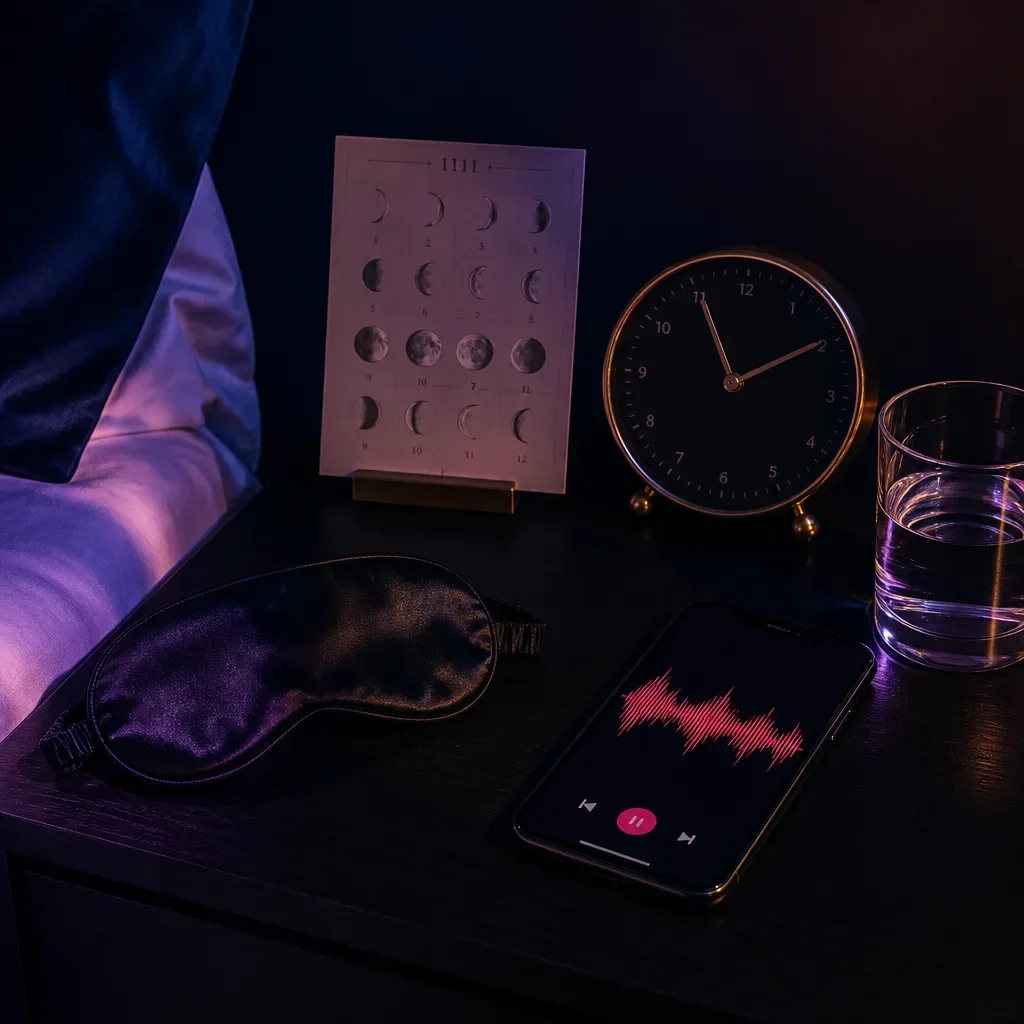
How can you tell if your timing is working?
Your timing is working if sleep comes more easily, the audio stays familiar, and the next morning carries less static.
Measure gently for one week. Not everything sacred needs a spreadsheet, but a few marks can save you from guessing. Cognitive behavioral therapy for insomnia often uses sleep diaries because memory is unreliable after a bad night. You can borrow the idea without making it clinical.
Track only 3 numbers for 7 nights:
- Time you pressed play.
- Estimated time you fell asleep.
- Morning steadiness from 1 to 5.
That is enough. If you press play at 10:20 and fall asleep around 10:40 with a morning steadiness of 4, the dial is close. If you press play at 11:55, fall asleep at 1:00, and wake with a 2, the ritual is not the problem. The timing is.
In small studies on relaxation audio and guided imagery, participants often report lower pre-sleep arousal, though effects vary by content and consistency. The Journal of Behavioral Medicine has published work over several decades linking relaxation practices with stress reduction, and stress is one of the classic thieves of sleep. We do not need to overclaim. A calm repeated cue can help the body stop scanning.
Also watch for resistance. If the audio makes you sad, restless, or strangely annoyed, that may be information. The future self can sound too far away when the present self feels abandoned. Edit the recording so it meets you at the gate, not from a rooftop across town.
A good bedtime recording does not bully the present self into becoming someone else. It lets the future self become less foreign.
What mistakes make bedtime manifestation audio less effective?
The most common mistake is treating the audio as one more piece of content instead of the last chosen signal.
Content keeps asking for reaction. Practice asks for return. If you listen to manifestation audio and then watch 24 minutes of clips, you have not ruined anything, but you have changed the final input. The brain is democratic in the least romantic way. It counts what you repeat.
Another mistake is volume. Louder is not deeper. The World Health Organization has warned that unsafe listening levels can affect hearing, especially with prolonged headphone use. Bedtime audio should be low and close, more like someone speaking from the next pillow than a stage voice.
Avoid these common tilts:
- Playing the audio while answering messages.
- Choosing words that feel fake to your body.
- Restarting the track again and again to get it perfect.
- Saving the practice for only charged nights.
- Using lunar timing as an excuse to skip ordinary nights.
- Treating affirmation writing as equal to the audio when you are using AYA.
If you want a wider base, read the Manifestation pillar and then return to the smaller question: what do I hear before sleep? Theory is useful, but the pillow is honest.
The sleep manifestation guide can sit beside this practice if you want more context around night routines. Still, keep the method clean. Listen. Repeat. Let the board and the sentence support the room without taking over the room.
The practice gets stronger when it stops auditioning for your attention.
The room knows when you have chosen.