audio manifestation
Binaural Beats Manifestation vs Dream-Self Audio
Binaural beats manifestation may calm the mind, but Dream-Self audio gives your desire a personal voice. Here's the quiet difference.
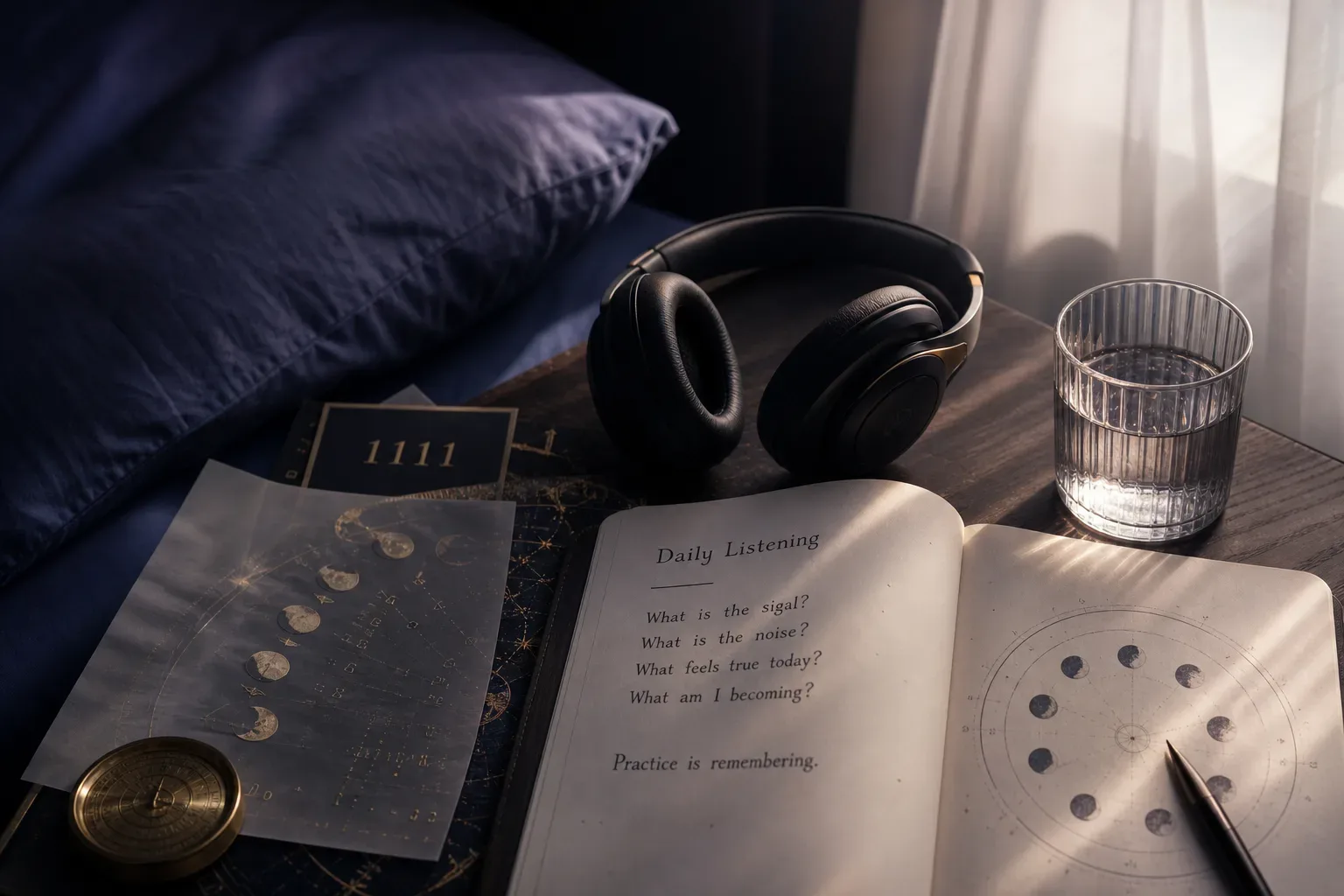
A pair of headphones on the nightstand can hold two very different practices. Binaural beats manifestation uses frequency differences to shift state. Dream-Self audio uses a personal recording to rehearse identity. One may quiet the body. The other tells your mind who you’re becoming, in words you can remember.
What are you actually hearing when you use binaural beats manifestation?
Binaural beats are two slightly different tones played separately into each ear, and the brain perceives a third rhythmic difference between them.
If one ear hears 200 Hz and the other hears 210 Hz, your brain follows the 10 Hz difference. Heinrich Wilhelm Dove described this effect in 1839, long before streaming apps made it feel new. The practice requires stereo headphones because each ear needs its own tone. Without that separation, it becomes ordinary sound.
Most binaural beat tracks are grouped by brainwave bands. Delta is often listed around 0.5 to 4 Hz. Theta around 4 to 8 Hz. Alpha around 8 to 13 Hz. Beta around 13 to 30 Hz. Gamma is often described above 30 Hz. These bands are real categories in EEG research, but a track labeled “theta manifestation” is not the same thing as a measured theta brain state in your own nervous system.
The best evidence is modest, not magical. A 2019 meta-analysis in Psychological Research by Garcia-Argibay, Santed, and Reales reviewed 22 studies and found binaural beats could influence anxiety, attention, memory, and pain perception, with effects shaped by frequency and listening length. That matters. It also means the result is state-based, not desire-based.
A beat can help you become quieter. It cannot know what you came here to remember. If you’re using manifestation as a daily practice, the question isn’t only whether your mind is calm. It’s whether your mind is rehearsing something true enough to live from.
A frequency can soften the room. It cannot write your future self for you.
What is Dream-Self audio doing that binaural beats don’t do?
Dream-Self audio gives your intention a narrated identity, while binaural beats only offer a sound condition around it.
The AYA Method is a daily audio manifestation practice. Each day you listen to a short personalized recording — your Dream-Self Moment — narrated from the version of you who has already manifested the life you intend. Listening is the practice. Repetition is the work. The audio is the method.
That difference is small on the surface and large underneath. Binaural beats may ask the brain to settle near a rhythm. Dream-Self audio asks you to recognize a version of yourself. It uses language, memory, sensory detail, and future narration. Cognitive psychology has studied mental simulation for decades; in a 1999 paper, Shelley Taylor and colleagues wrote about how simulation helps people prepare for action because the mind rehearses steps before the body takes them.
Dream-Self audio also carries self-reference. Functional MRI studies often point to the medial prefrontal cortex when people think about themselves, including future selves. A 2011 study by Hershfield and colleagues found that feeling connected to your future self was linked with better long-term choices. The exact mechanism is still being studied, but the practical lesson is simple: the more real your future self feels, the easier it is to act with her in mind.
This is where affirmations can help, but only as a complement. A daily affirmation can give you one sentence to carry. The Manifestation Board can give you something to see. But in Aya, the audio leads. The Dream-Self Moment is the place where your future self speaks back.
| Practice | Main input | Best use | Limit |
|---|---|---|---|
| Binaural beats | Two tones, one perceived beat | Calm, focus, pre-practice settling | Nonspecific intention |
| Dream-Self audio | Personalized future-self narration | Identity rehearsal and daily manifestation | Requires honest detail |
| Affirmation | One repeated sentence | A small verbal anchor | Can become flat without feeling |
| Manifestation Board | Images and visual cues | Remembering what matters | Can turn performative |
Which practice has stronger evidence for changing state?
Binaural beats have more direct lab research on short-term state changes, while Dream-Self audio draws from evidence on self-talk, mental rehearsal, and future-self connection.
It’s fair to say binaural beats have been studied as an audio stimulus. Some trials use 10 to 30 minutes of listening. Some compare beats with silence or with ordinary tones. Results vary. A 2020 review in Frontiers in Human Neuroscience noted that auditory beat stimulation may affect mood and cognition, but the field still has inconsistent protocols. That means a track can help one person feel focused and leave another person simply bored.
Dream-Self audio is more specific to manifestation, so the evidence comes from neighboring fields. Guided imagery has been studied in sports psychology, health psychology, and stress care. A 2014 review in Journal of Behavioral Medicine described mental imagery as a tool used across behavior change work, though quality varies by study. The common thread is rehearsal. The brain learns from repeated inner scenes, especially when those scenes are emotionally believable and behaviorally close.
There is also research on implementation intentions, the “if-then” plans studied by psychologist Peter Gollwitzer since the 1990s. Meta-analyses have reported medium-to-large effects across goals because specific cues help action happen. Dream-Self audio is not the same as an if-then plan, but it can carry the same principle: a future self becomes easier to inhabit when the mind hears concrete cues.
So the honest answer is not either-or. Binaural beats may be better at preparing the nervous system for quiet. Dream-Self audio is better at naming the self you’re practicing. If your intention has no words, your mind may relax and return to the same old story.
Calm is not the same as belief. Belief needs a picture it can keep returning to.
When should you choose binaural beats, and when should you choose Dream-Self audio?
Choose binaural beats when you need state support; choose Dream-Self audio when you need a personal rehearsal of who you’re becoming.
There are mornings when your mind is noisy before you’ve even touched the phone. A 2023 Pew Research Center report found that 58% of U.S. adults sometimes get news from social media, and many people meet the day through other people’s urgency. If your body is already tight, 3 to 7 minutes of a soft binaural track may help you come back to the room before practice.
But if you only listen to tones, you may leave the meaning empty. Neville Goddard wrote often about assuming the feeling of the wish fulfilled. Joe Dispenza speaks about rehearsing a future emotional state before the outer life has proof. You don’t have to adopt every claim from either teacher to see the shared point: manifestation practices depend on repeated inner identity, not just relaxation.
Use this quiet order if you want both:
- Put on headphones and sit somewhere ordinary, not ceremonial.
- Listen to a low, steady binaural track for 3 to 5 minutes if it helps you settle.
- Stop the track if it pulls attention away from the words.
- Play your Dream-Self Moment once, without multitasking.
- Write one sentence you heard that felt true enough to keep.
A small routine is easier to repeat. Stanford behavior scientist BJ Fogg has written that tiny behaviors attach more easily to existing routines because motivation rises and falls. That matters for manifestation. A practice you do 6 days a week will shape you more than a beautiful ritual you abandon after 2.
You might also bring timing into it. Some people prefer morning because attention is still soft. Others listen at night because the day has lowered its guard. If you work with astrology and manifestation, you might choose moon phases as reflection points, but the daily audio still does the steady work.
What are the risks of relying on binaural beats for manifestation?
The main risk is mistaking a pleasant state for a changed self-concept.
A track can feel special. It can mark the moment. It can make the room seem slower. But manifestation asks for more than atmosphere. It asks what you repeatedly accept as yours. If a binaural beat makes you calm for 20 minutes and then you return to the same inner script, the practice has not gone very far.
There are also practical concerns. Some listeners report headaches, irritation, or restlessness with certain frequencies, especially at higher volume. Many clinical and wellness sources recommend keeping headphone volume below unsafe levels; the World Health Organization has warned that over 1 billion young people may be at risk of hearing loss from unsafe listening habits. Soft is not just prettier. Soft is safer.
Be careful with exaggerated claims. A track named “instant wealth frequency” can pull you into passive waiting. Aya’s view is quieter and stricter. The daily affirmation and Manifestation Board can support you, but they don’t replace listening. The audio is the method because it asks for repetition, self-recognition, and return.
Here are signs binaural beats are helping:
- You feel more settled within 5 to 10 minutes.
- You can hear your Dream-Self audio more clearly afterward.
- You don’t need the track to feel like practice “worked.”
- You keep the volume low and the ritual simple.
And here are signs they may be distracting:
- You’re constantly searching for the “right” frequency.
- You skip the personal narration.
- You feel dependent on a certain track.
- You care more about the sound label than the life you’re rehearsing.
The tool has become too loud when you can no longer hear yourself.
How can you compare them without turning practice into performance?
Compare them by what they help you repeat, not by how mystical they seem.
The simplest test is 7 days. Researchers often use repeated measures because one session can be misleading. Your mood, sleep, cycle, caffeine, and stress can all change the way a sound lands. So give each practice enough repetition to reveal a pattern, but not so much pressure that you start performing calm.
Try this gentle comparison:
| Day | Practice | What to notice | Score from 1 to 5 |
|---|---|---|---|
| 1-3 | Binaural beats only | Did I settle? Did I know what I intended? | Calm and clarity |
| 4-6 | Dream-Self audio only | Did I recognize myself in the future scene? | Belief and memory |
| 7 | Binaural beat, then Dream-Self audio | Did the first make the second easier to hear? | Integration |
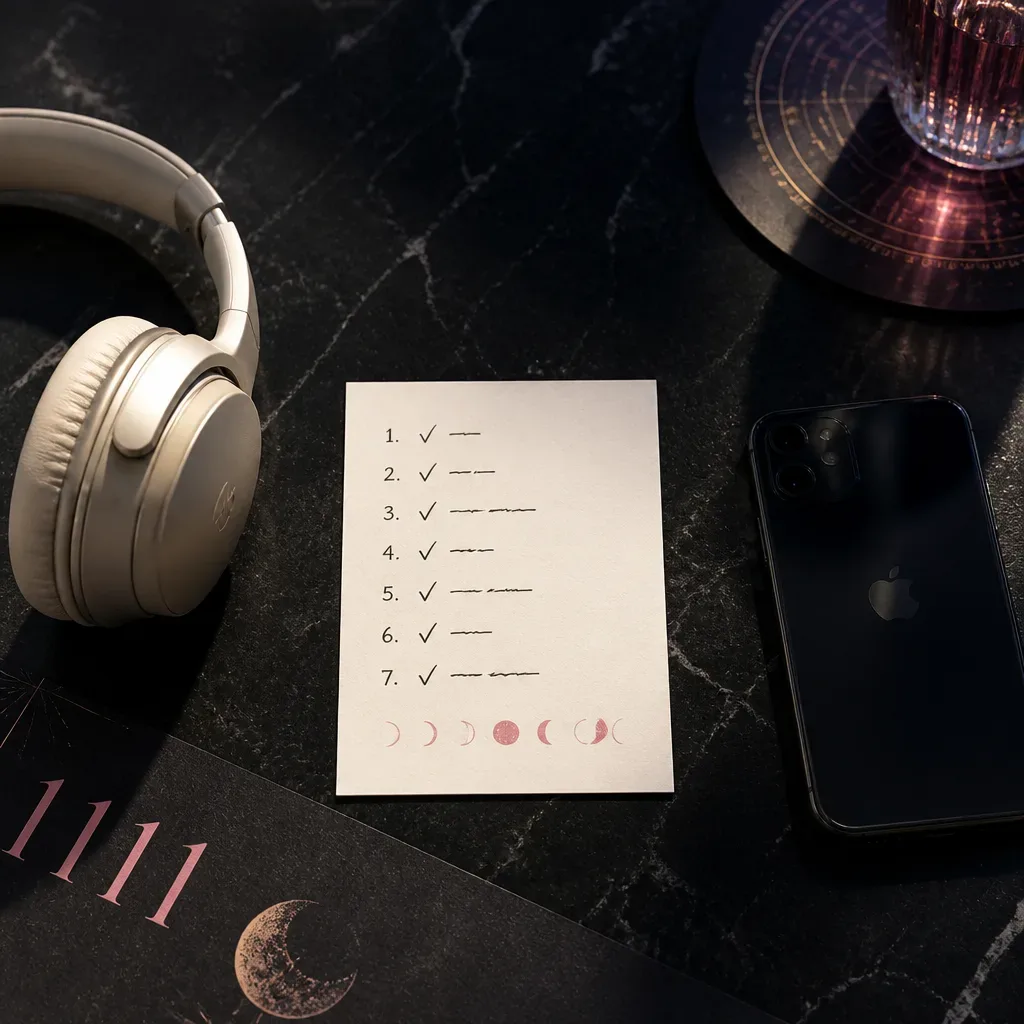
Keep notes short. One line is enough. “I felt softer after 4 minutes.” “The line about my apartment made me cry.” “The beat was pleasant, but I forgot my intention.” Data doesn’t have to be cold. It can be tender and still be useful.
If you want a deeper frame, return to the manifestation pillar and notice how often the practice comes back to attention, repetition, belief, and action. If words are your doorway, the affirmations pillar can help you choose one sentence after listening. If timing gives you meaning, astrology and manifestation can become a calendar, not a substitute.
The comparison may lead to a quiet answer. Binaural beats can prepare the room inside you. Dream-Self audio can speak into that room. One is a condition. The other is a message.
What you repeat becomes familiar. What becomes familiar becomes easier to choose.
Stay close to the voice that sounds like home.