vision boards
Digital Vision Board vs. Dream-Self Audio
Digital vision board or Dream-Self Audio? See what each practice does well, what compounds daily, and how to use both without noise.
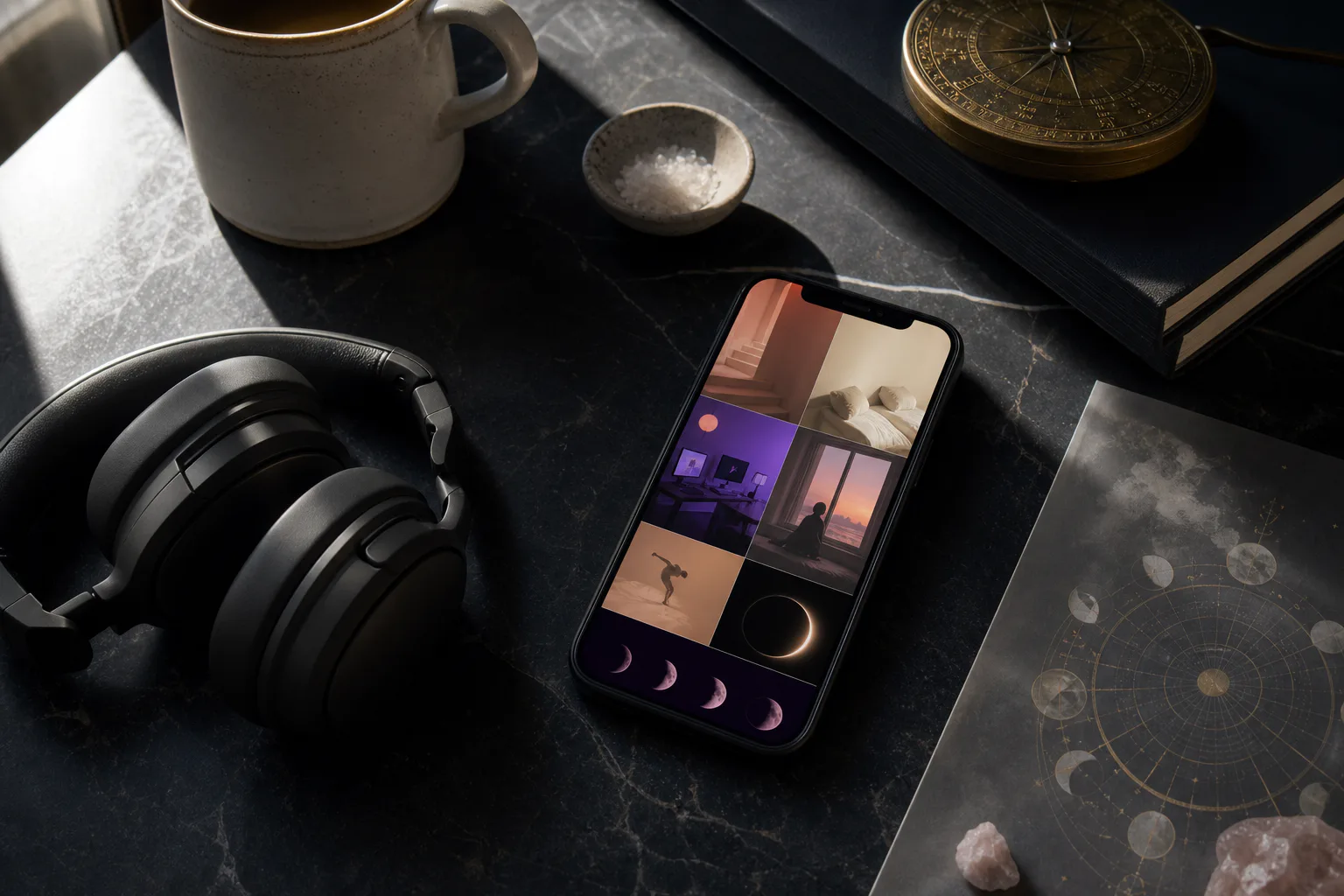
The phone is face-up on the table. A digital vision board helps you see what you’re choosing, but Dream-Self Audio usually compounds more because it asks less from you and repeats inside the body. The board is a cue. The audio is rehearsal. Together, they can become steady.
What does a digital vision board do best?
A digital vision board gives your intention a visible shape you can return to quickly.
It works because the eye is fast. In classic memory research, pictures are remembered better than words alone; Allan Paivio’s dual coding theory, first described in 1971, argued that visual and verbal systems can reinforce each other. Later picture-superiority studies often found stronger recall for images after short delays. That doesn’t make a board magic. It makes it memorable.
A good board also reduces vagueness. Instead of saying, I want a calmer life, you choose a kitchen table without clutter, a glass of water, a window, a page with three lines written on it. The image makes the desire less theatrical and more knowable. Pinterest reported 553 million monthly active users in Q4 2024, which says something plain: people keep returning to saved images when they’re trying to name taste, longing, and direction.
A digital version adds three practical gifts:
- Access: it’s already on the device you touch dozens of times a day.
- Revision: you can remove what was borrowed from someone else.
- Privacy: no one has to ask why that apartment, that body of work, that quiet table is there.
But a board has a limit. It can become a museum of wanted things. You can look at it for 20 seconds and still not feel like the person who lives there. Vision is a doorway, not a home. A digital vision board says, this matters. It doesn’t always teach your nervous system that this is already becoming yours.
For a fuller base on the practice, start with manifestation as a discipline of attention, repetition, and chosen meaning, not as a wish thrown into the dark.
What does Dream-Self Audio do differently?
Dream-Self Audio lets you rehearse identity through a voice you can listen to when effort is low.
The AYA Method is a daily audio manifestation practice. Each day you listen to a short personalized recording — your Dream-Self Moment — narrated from the version of you who has already manifested the life you intend. Listening is the practice. Repetition is the work. The audio is the method.
This matters because sound enters differently than an image. You don’t have to arrange a collage. You don’t have to decide where to look. You receive language, pacing, tone, and sequence. In habit research, Wendy Wood has written that stable cues matter because they reduce the need for fresh decision-making. A 2009 study by Lally and colleagues found that habit automaticity took 66 days on average, with a wide range from 18 to 254 days. Repetition needs mercy.
Audio is merciful. You can listen while washing a cup, lying still, sitting on the edge of the bed. You don’t need a perfect morning. You need three to five minutes where the future self becomes familiar. The future self has to become familiar before it becomes believable.
There is also research around self-talk and psychological distance. Ethan Kross and colleagues found in 2014 that using distanced self-talk can help people regulate emotion under stress. Dream-Self Audio isn’t the same study and shouldn’t be treated as clinical treatment. Still, the principle rhymes: the way you speak to the self changes what the self can tolerate.
A board can remind you. A voice can rehearse you.
Which one compounds when you’re tired?
Dream-Self Audio usually compounds better when you’re tired because it asks for less active construction.
This is the part I trust most as a cook. If dinner requires 19 steps on a Tuesday, it will not happen. If there are beans already cooked, tortillas warm, salt near the stove, the body says yes before the mind can argue. Practice is the same. The lower the friction, the more likely you are to return.
Behavior-change research keeps pointing to this. BJ Fogg’s behavior model, popularized in 2009 and later expanded at Stanford, says behavior happens when motivation, ability, and a prompt meet. When ability is high because the action is easy, you don’t need heroic motivation. A short audio practice fits that pattern. Tap. Listen. Return.
A digital vision board can compound if it becomes a cue rather than a project. Set it as a lock screen. Open it before writing a plan. Review it every Sunday for 7 minutes. But if you keep rebuilding it, the compounding leaks out. Novelty feels productive. Repetition does the quieter work.
| Practice | Best at | Main risk | Compounds when |
|---|---|---|---|
| Digital vision board | Clarifying images and taste | Becoming a pretty archive | You see it at the same cue daily |
| Dream-Self Audio | Rehearsing identity and feeling | Listening without attention | You repeat it even on ordinary days |
| Daily affirmation | Naming one sentence to carry | Becoming too general | It supports the audio, not replaces it |
| Manifestation Board | Holding selected visual cues | Over-editing | It stays simple and true |
The app also includes a daily affirmation and a Manifestation Board as complements. They matter most when they orbit the audio. If everything becomes a main practice, nothing gets repeated enough.
Where does a digital vision board still belong?
A digital vision board belongs at the beginning of clarity and beside the daily practice as a visual anchor.
There are things a voice may not catch first. Texture. Shape. Color. A version of home. A kind of work table. A dress you don’t want for the dress itself, but for the posture it asks of you. I learned this in kitchens. My grandmother could describe a mole for 30 minutes, but one look at the paste in the pot told you whether it was ready.
Images help you notice what is yours and what was inherited without consent. That is not small. A 2023 Pew Research Center report found that 31% of U.S. adults said they were online almost constantly. When your attention is already surrounded by other people’s wants, choosing images deliberately can become a boundary. Not every beautiful thing belongs on your board.
Use a digital vision board for questions like these:
- What kind of room makes my shoulders drop?
- What does enough money look like in daily life, not in spectacle?
- Which image feels true after three days, not three seconds?
- What am I trying to prove by wanting this?
- What would I still choose if no one saw it?
This is where affirmations can help. One sentence can name the thread inside the image. Not I am rich, if that feels false in your mouth. Maybe: I handle money with steadier hands. Wood, Perunovic, and Lee found in 2009 that positive self-statements could make some people with low self-esteem feel worse. The lesson is simple. Choose words your body doesn’t have to reject.
A board is not less sacred because it’s practical. It is a pantry shelf. It shows you what you’ve chosen to keep within reach.
How should you compare them without making it a contest?
Compare them by function, not by drama: the board clarifies, the audio repeats, and repetition is what compounds.
When people ask which one is better, I hear the hidden question: which one will make me finally become consistent? The honest answer is rarely the prettier tool. It is the tool that survives boredom. Gollwitzer and Sheeran’s 2006 meta-analysis of 94 studies found that implementation intentions had a medium-to-large effect on goal attainment. The phrasing was simple: if situation X happens, I will do Y. Your practice needs that kind of plain doorway.
Try this comparison in order:
- Name the cue. After brushing your teeth, before opening messages, or after lunch.
- Choose the practice. Audio for identity rehearsal. Board for visual clarity.
- Set the time. Three minutes is enough to keep the thread alive.
- Track return, not mood. Did you come back today, yes or no?
- Review every 30 days. Keep what feels true. Remove what performs.
If you use astrology, keep it simple. A new moon can be a review date, not a demand to become someone else overnight. You can read more about astrology and manifestation if timing helps you listen, choose, and return. The sky can be a calendar. It doesn’t have to be an excuse.
Princeton Engineering Anomalies Research, often cited in manifestation circles, reported small statistical deviations in random event generator studies over many years; the findings remain debated and are not a promise that thought controls matter. I bring that in carefully. The stronger evidence for daily practice is humbler: attention, memory, emotion regulation, and habit cues.
What you see once can fade. What you hear daily can become a place you know how to return to.
What routine lets both practices support each other?
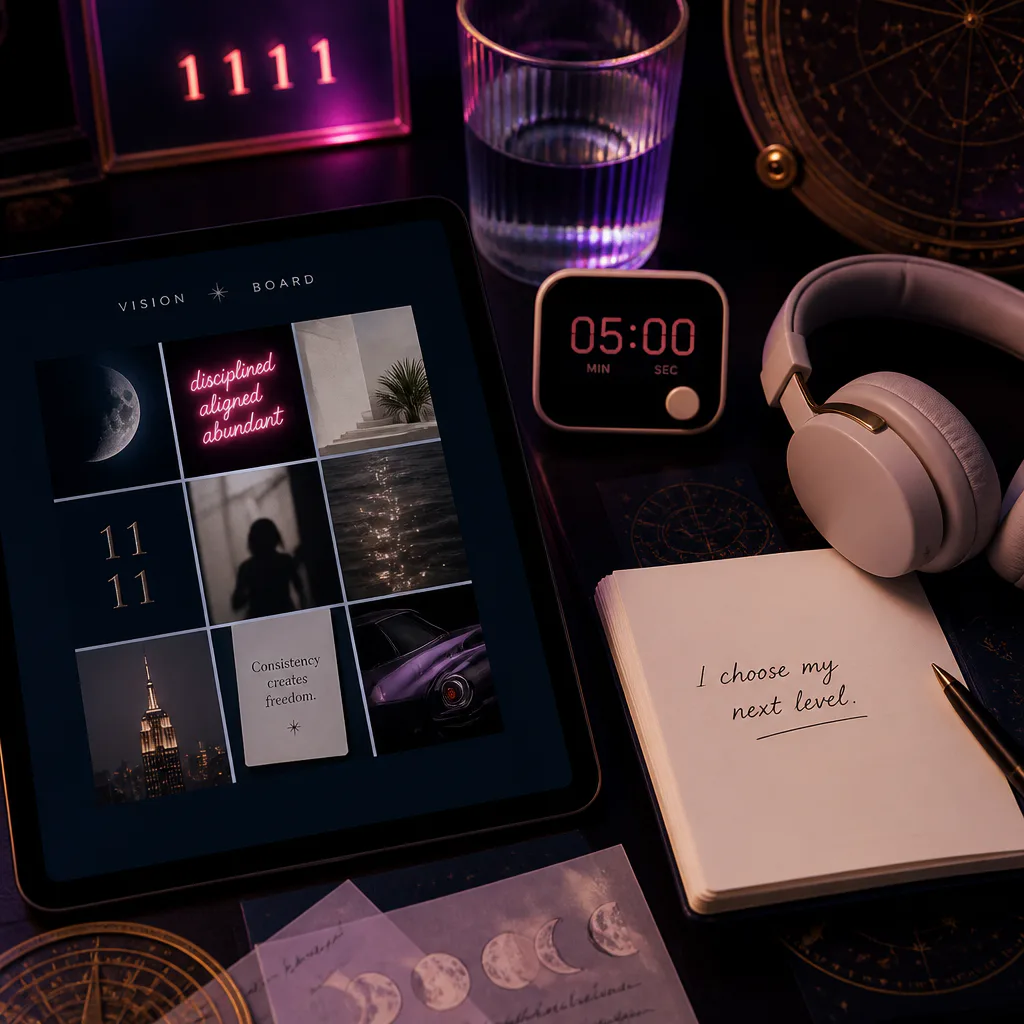
A simple routine lets the digital vision board choose the images and the Dream-Self Audio carry the repetition.
You don’t need a long ritual. Ten minutes once a week and three minutes a day can be enough structure. The American Psychological Association has noted for years that stress affects attention and decision-making. Under strain, a complicated practice will often be abandoned first. So make the practice small enough to survive a hard week.
Here is a quiet weekly rhythm:
- Sunday, 10 minutes: open your digital vision board and remove one image that feels borrowed.
- Choose one image: let it stand for the week.
- Write one sentence: make it plain, present, and believable.
- Listen daily: play your Dream-Self Moment before checking messages.
- Friday, 2 minutes: ask what felt more familiar than before.
This keeps the board from becoming a shrine to wanting. It becomes an ingredient list. The audio becomes the cooking. You can have both, but they do different work. A recipe is not dinner. A board is not embodiment. The repeated act is where the self learns.
Joe Dispenza often speaks about mentally rehearsing a future self, while Neville Goddard taught from the feeling of the wish fulfilled. You don’t have to accept every claim from either teacher to notice the shared thread: repetition with felt specificity changes what you look for and how you act. In behavioral science, that is less mysterious. Attention filters choice.
If you want the larger frame, the Manifestation pillar holds the basics. If words are your doorway, the Affirmations pillar can help you keep language honest. But keep the order clean. Listening is the practice. The board and the sentence serve it.
What should you choose if you only have five minutes?
Choose Dream-Self Audio for the five minutes, then let the digital vision board wait for a weekly review.
Five minutes is not a consolation prize. It may be the honest container. In a 2018 review of future self-continuity research, Hal Hershfield and colleagues described how feeling connected to your future self can affect saving, health choices, and long-term behavior. The point isn’t to obsess over tomorrow. It’s to make the future self less like a stranger.
Dream-Self Audio does that with fewer moving parts. Put in headphones. Let the voice speak from the self who already knows how to live the change. Don’t strain to believe every word. Let recognition arrive in small pieces. Attention compounds when it is repeated with feeling and friction kept low.
Use the digital vision board when you have a little more space. Open it on the first day of the month. Ask whether the images still belong. Keep three to nine images if you tend to overfill things. Specific limits help. Miller’s famous 1956 paper on working memory suggested people can hold about seven items, plus or minus two, though later research narrowed that number. Either way, fewer cues are easier to carry.
So the comparison is tender and clear. If you need clarity, look. If you need return, listen. If you want both, let the board point and let the audio repeat.
The quiet thing you repeat is the thing that starts to know your name.