dream science
Dream Recall Routine: 3 Minutes After Waking
A dream recall routine using 3 minutes after waking: stay still, listen to Dream-Self audio, catch symbols, and record what arrived.
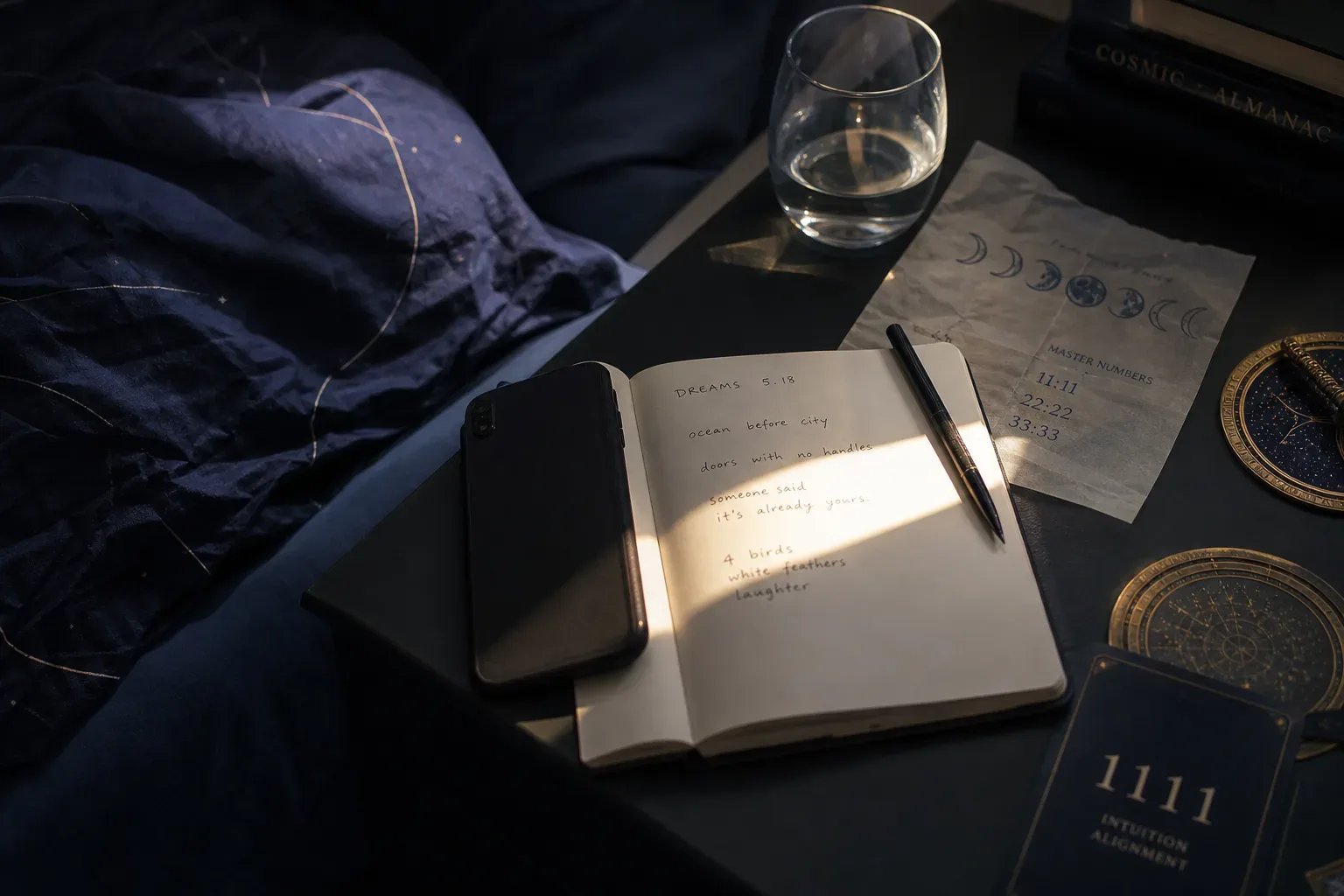
A dream recall routine works best when it happens before your phone, before speech, and before the day edits the evidence. Use the first 3 minutes after waking: stay still, listen to your Dream-Self audio, write fragments, and name one thread. That is enough to keep the gate open.
Why does the first 3 minutes after waking matter?
The first 3 minutes matter because dream memory is unusually fragile at the edge of waking.
Dreams are often held in short-term memory before they make the jump into ordinary recall. Sleep researchers have studied dream reports for decades, and one consistent pattern is practical: people remember more when they wake directly from REM sleep and report immediately. A 2017 review in Neuroscience & Biobehavioral Reviews linked dream recall to arousal, memory encoding, and attention at waking. Translation: the room gets a vote.
This is why checking the phone first is not neutral. A 2023 DataReportal summary estimated that people spend more than 6 hours a day online globally. Your nervous system knows the portal. Once the screen arrives, the dream has competition from messages, weather, news, and whatever number is waiting in your banking app.
A dream not written down is not gone; it is unclaimed evidence.
I like 3 minutes because it is small enough to survive a real morning. Not the polished morning with lemon water and clean counters. The one with a child calling from the hallway at 6:11, a meeting at 9, and a body still negotiating sleep. Three minutes is not romantic. It is useful.
The point is not to become a professional dream analyst by Friday. The point is to give the subtle material a place to land. A routine does not need to be grand to be loyal.
For the broader practice frame, keep Manifestation pillar open as the larger map. Dream recall is one entrance. The morning is the gate.
What exactly should I do in the 3-minute dream recall routine?
Do the same four moves every morning: stillness, audio, fragments, thread.
Here is the sequence I use when the alarm goes off and the house has not fully found me yet. It takes 180 seconds. Use a timer if you like precision, but do not let the timer become the ceremony. The numbers are only there to keep the dial honest.
- 0:00–0:20 — Stay still. Keep your eyes closed or softly open. Do not move your head if you can help it. Ask, “What came with me?”
- 0:20–2:20 — Listen to your Dream-Self audio. Let the voice act as a familiar cue. Do not analyze. Receive.
- 2:20–2:50 — Write 3 to 5 fragments. Use nouns, colors, numbers, places, and body sensations.
- 2:50–3:00 — Circle one thread. Choose the word that feels charged. Leave it alone until later.
Dream recall improves with repetition for many people. In a classic 1970s line of dream-lab research, frequent dream reporters tended to wake more often during the night and showed stronger recall when they reported quickly. More recent studies still point to attention and awakenings as part of the pattern, not a moral trait. You are not bad at dreams. You may simply be late to the notebook.
| Minute | Action | What to capture |
|---|---|---|
| 0:00–0:20 | Stay still | Image, mood, number, body feeling |
| 0:20–2:20 | Listen | Let the Dream-Self Moment set the cue |
| 2:20–2:50 | Write | 3 to 5 raw fragments |
| 2:50–3:00 | Circle | One thread for the day |
Three minutes is enough time to tell your nervous system which life is being rehearsed.
If you already use affirmations, keep them clean and brief. The Affirmations pillar can help you refine language, but in this routine, the audio leads. The affirmation is a complement, not the spine.
How does Dream-Self audio fit without turning the dream into a performance?
Dream-Self audio fits when it acts as the cue, not the judge.
This matters. Dreams can get theatrical fast. A staircase becomes destiny. A dog becomes a warning. A number on a receipt becomes a prophecy by breakfast. The mind loves a pattern, and the Manifest 11 room is honest about that. We notice 11:11. We also ask whether we slept 5 hours.
The AYA Method is a daily audio manifestation practice. Each day you listen to a short personalized recording — your Dream-Self Moment — narrated from the version of you who has already manifested the life you intend. Listening is the practice. Repetition is the work. The audio is the method.
That definition is the anchor. In a dream recall routine, the audio does not replace the dream. It gives the waking mind a stable signal while the dream is still close enough to touch. If the dream is the smoke, the audio is the bowl that keeps it visible for a few more seconds.
The audio is the method; the notebook is the witness.
Dr. Andrew Huberman has often discussed state-dependent learning and the role of attention in memory on the Huberman Lab podcast, drawing from neuroscience research rather than dream mysticism. The practical takeaway is simple: repeated cues can train attention. If the same audio meets you at the same delicate threshold each morning, the brain begins to recognize the assignment.
Do not grade the dream against the audio. If your Dream-Self Moment speaks about calm leadership and your dream was about losing shoes in a train station, write the shoes. The mismatch may be the message. Or it may be Thai food at 10:40 p.m. We can be cosmic and still keep receipts.
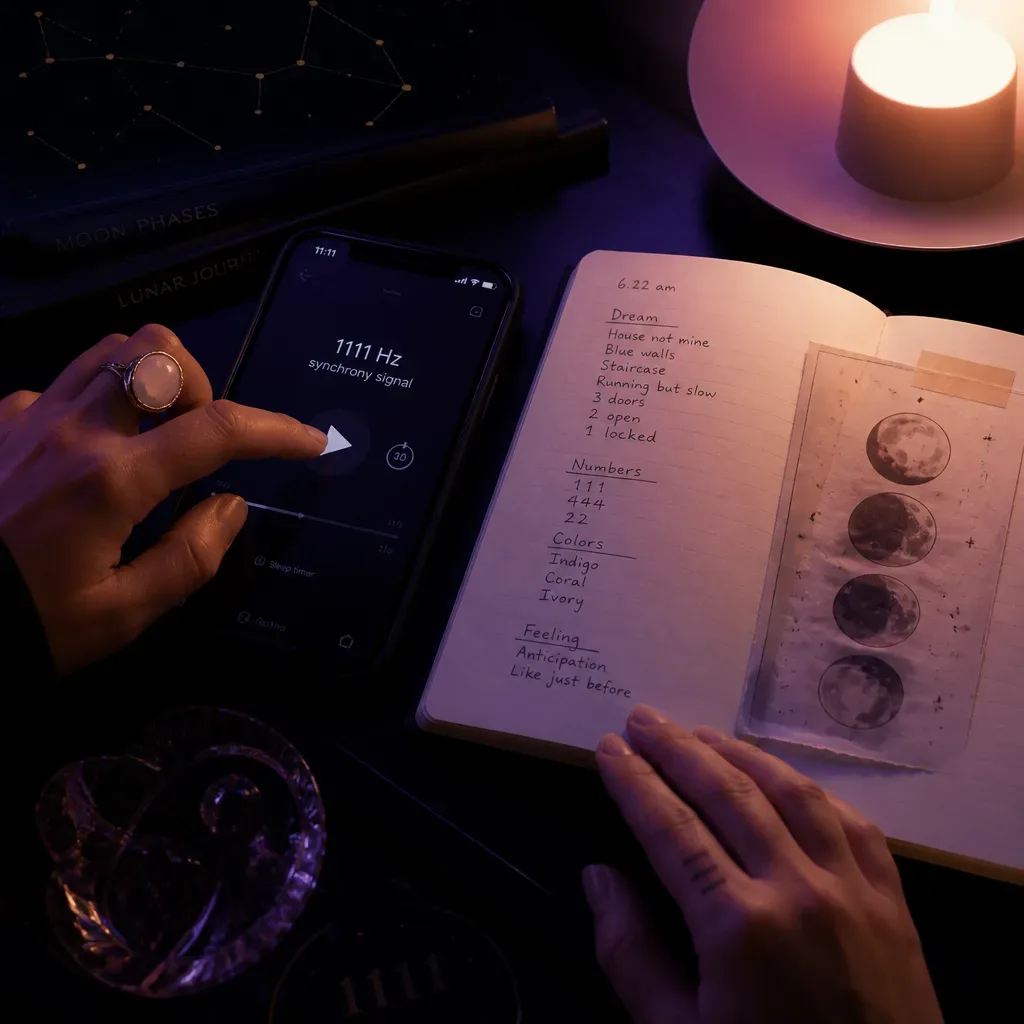
What should I write when the dream is only fragments?
Write fragments exactly as they arrive because fragments are the native language of morning recall.
Full scenes are rare gifts. Most mornings, the material comes in scraps: blue tile, my old boss, 22, elevator, left hand, rain indoors. Good. That is recordable. In dream studies, reports are often coded by characters, emotions, settings, and actions. You can borrow that discipline without turning your bedside table into a lab.
Use a tiny template if your brain freezes:
- Image: what did I see?
- Place: where did it seem to happen?
- Person: who appeared, even briefly?
- Number or word: what repeated or flashed?
- Feeling: what was in the body?
- Thread: what one detail wants a return later?
Specificity beats poetry at 6:07 a.m. “Green hallway, aunt, missing phone, calm” is better than “an intense symbol of transition.” You can interpret later. First, you preserve the signal.
Neville Goddard wrote often about imagination as a lived inner act, not a decoration. Joe Dispenza also frames mental rehearsal as a way the body learns a future state, though his claims are debated and should be read with discernment. Both point toward a useful practice principle: what you repeatedly attend to becomes easier to inhabit.
Here is a small example from my own notebook, because clean advice without a messy receipt is advertising:
6:18. No full dream. Gray room. Number 33 on a door. My daughter laughing. Feeling: relieved. Thread: door.
That entry took less than 40 seconds. Later that day, I noticed I kept postponing one email that would close a project. The door was not mystical proof. It was a good metaphor arriving on cue.
Name the symbol before you name the theory.
Can numbers, moon cycles, or synchronicities belong in the routine?
Yes, but they belong as observations first and interpretations second.
Manifest 11 has a soft spot for master numbers: 11, 22, 33. Numerology traditions often describe 11 as intuition, 22 as structure, and 33 as service or teaching. Treat that as symbolic language, not a court order. If 11:11 appears after a dream about a locked room, write it down. Do not hand your agency to the clock.
Synchronicity, a term Carl Jung used for meaningful coincidence, is useful when it helps you pay attention without panic. The moment something repeats, the mind wants to crown it. Better: record it, watch it, and ask what action it invites. A signal that never changes behavior is just decoration.
Moon timing can also be a clean tracking tool. The lunar cycle runs about 29.5 days from new moon to new moon. Many people find dream tone shifts around full moons, though research is mixed and sleep disruption may explain part of the effect. If you track the moon, track sleep length too. Five hours and a full moon are not the same cause.
For a fuller symbolic framework, read Astrology and manifestation. Use it as weather, not a verdict. The sky may describe the season; you still choose the sentence.
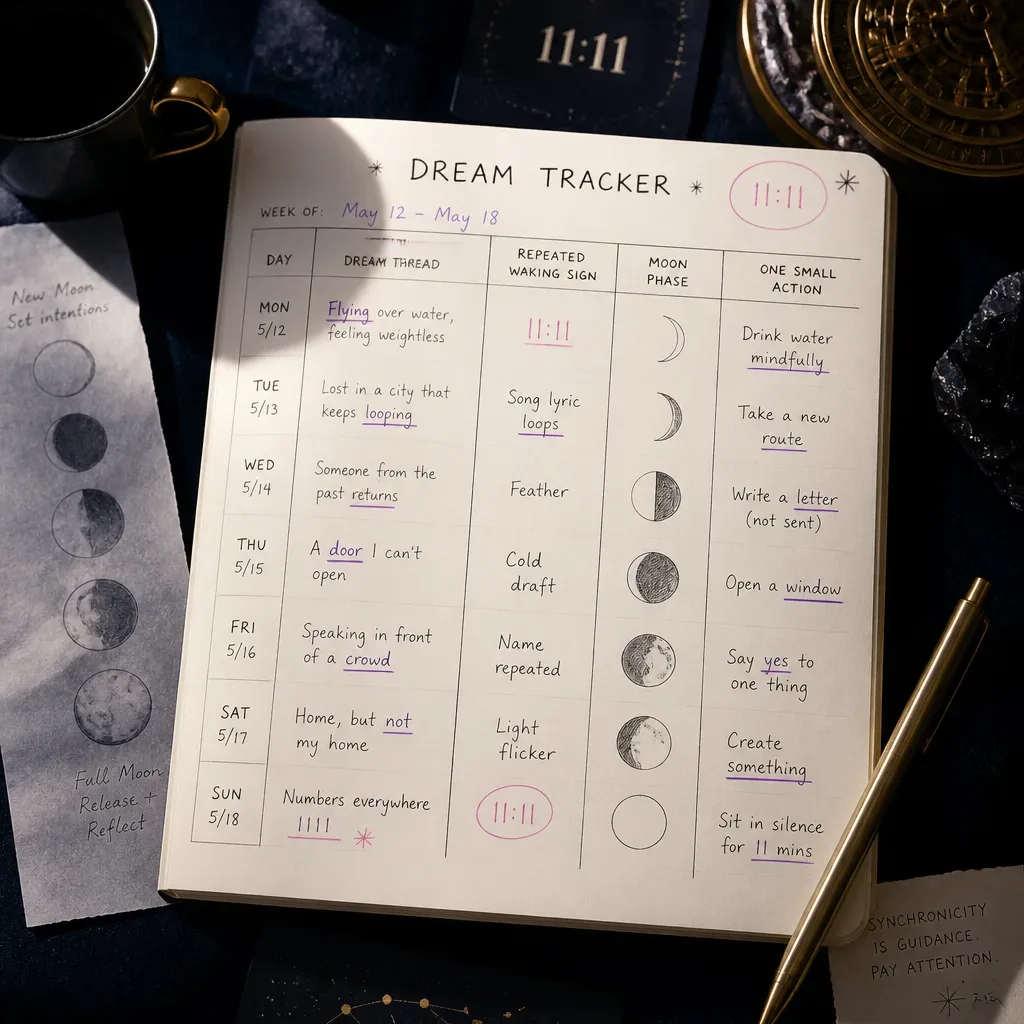
Try a 7-day symbol log:
| Day | Dream thread | Waking repeat | Possible action |
|---|---|---|---|
| 1 | Door | Avoided email | Send the email |
| 2 | Water | Felt overwhelmed | Reduce one input |
| 3 | 22 | Budget reminder | Check numbers |
| 4 | Child | Needed tenderness | Speak more softly |
The sign is not the point; the return is the point.
What if I wake up blank, rushed, or annoyed?
Blank, rushed, and annoyed mornings still count if you record the condition honestly.
This is where most routines fail. They are designed for the person you are on a well-slept Tuesday, not the person you are after a broken night. The National Sleep Foundation recommends adults get 7 to 9 hours of sleep, and many parents, caregivers, shift workers, and anxious humans do not. A dream recall routine has to survive imperfect sleep or it becomes a fantasy object.
On blank mornings, write four things:
- Wake time.
- Sleep estimate.
- First mood.
- First body sensation.
That is the whole entry. “6:42, maybe 6 hours, irritated, jaw tight” is data. After 10 days, patterns start to show. Maybe your recall improves after 7.5 hours. Maybe alcohol erases it. Maybe Sunday dreams are louder. Specific numbers remove shame from the room.
If you are rushed, play only the first 60 to 90 seconds of your Dream-Self audio and write one word. The full the AYA Method practice is listening daily to the Dream-Self Moment, but a hard morning may ask for the smallest viable return. Do not dramatize the miss. Return on cue.
If you are annoyed, do not sweeten it. The dream record is not a gratitude performance. Write, “Nothing. Angry. Back hurts.” Tara Brach often teaches the value of naming what is present as part of mindful awareness. The same rule works here. Naming is not surrender. Naming is contact.
A blank page can still be a doorway if you stop treating it like a failure.
How do I keep this routine for 7 days without making it precious?
Keep it visible, short, and slightly too easy to skip with dignity.
Seven days is enough to see whether your recall responds to repetition. It is not enough to build a religion around your pillow. Choose a notebook, put a pen on top of it, and place your phone where the audio can play without dragging you into notifications. The setup should take less than 30 seconds the night before.
Use this 7-day plan:
- Days 1–2: Record anything, including blanks.
- Days 3–4: Add one thread word each morning.
- Day 5: Notice repeated people, places, numbers, or emotions.
- Day 6: Compare dream thread with waking behavior.
- Day 7: Choose one small action based on the clearest pattern.
Behavior design researcher BJ Fogg has argued that tiny habits work because they reduce friction and attach to existing prompts. Waking is already a prompt. The Dream-Self audio is the cue inside the prompt. The notebook is the proof that you were there.
If you want a second layer, add one sentence at night: “If I dream, I will remember one detail.” Studies on prospective memory suggest intention can improve later recall in some contexts, especially when the cue is specific. Keep it plain. No performance language. No bargaining with the ceiling.
This is also where the Manifestation Board can help as a complement. If a symbol repeats across the week, add an image or word to your board after the fact. Do not build the board to force the dream. Let the dream earn its place.
For a wider practice architecture, pair this with Manifestation pillar and keep your affirmation language clean through Affirmations pillar. The morning audio remains the spine. The rest are mirrors placed where they help.
Tomorrow morning, meet the first image before the world names it for you.