aya method deep dive
Dream-Self Moment: Aya’s 3-Minute Future-Self Audio
A clear guide to the dream-self moment, Aya’s three-minute future-self audio: what it is, why listening works, and how to use it daily, gently.
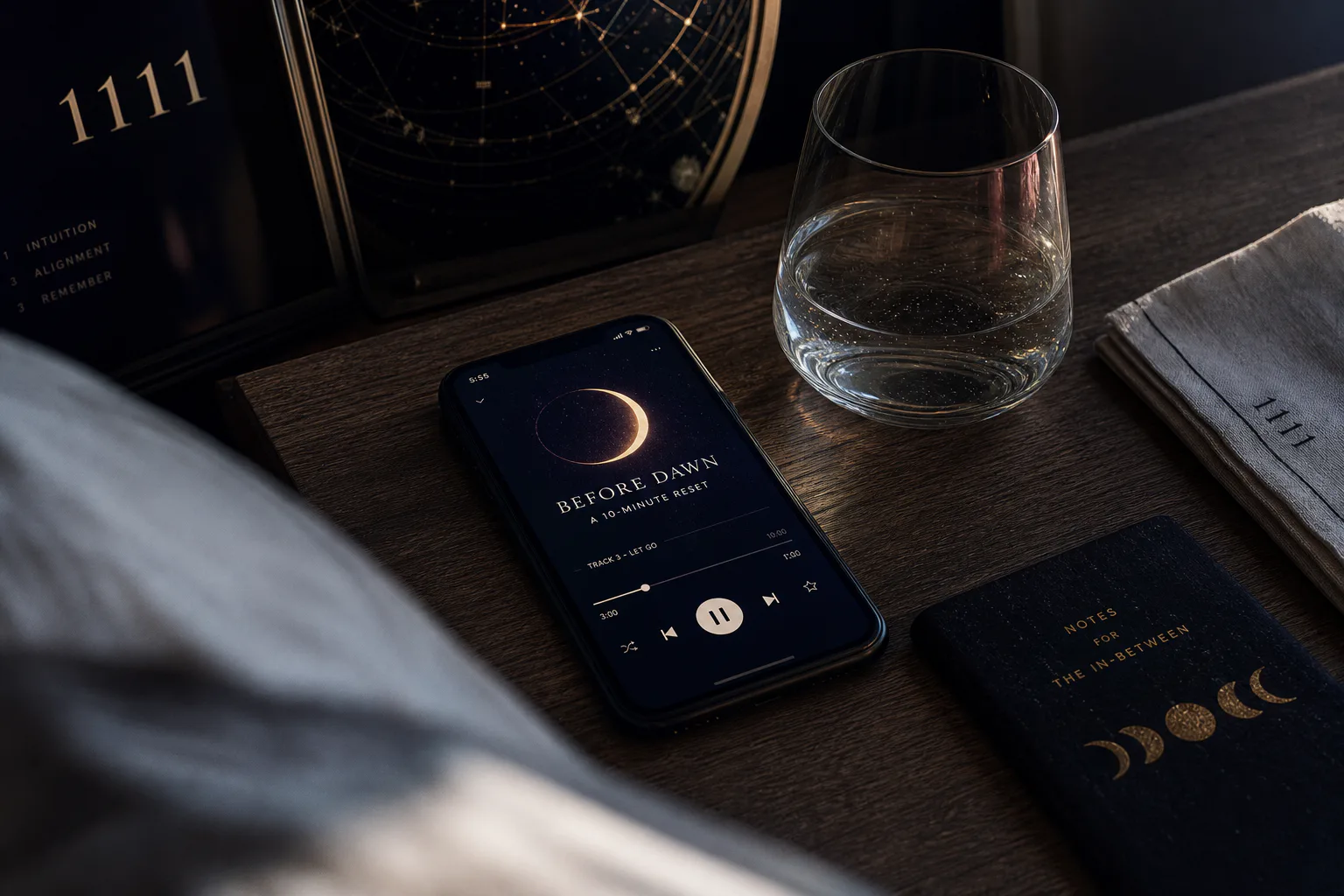
A phone on the nightstand. Three minutes. A dream-self moment is Aya’s personalized future-self audio: a short recording narrated from the version of you who has already manifested the life you intend. You listen daily, not to hype yourself, but to rehearse what you’re learning to recognize as true.
What is a dream-self moment?
A dream-self moment is the core audio in Aya: a brief, personalized recording spoken from your future self back to you now.
Here is the exact center of it: the AYA Method is a daily audio manifestation practice. Each day you listen to a short personalized recording — your Dream-Self Moment — narrated from the version of you who has already manifested the life you intend. Listening is the practice. Repetition is the work. The audio is the method.
That last sentence matters. The audio is not a decoration around the practice. It is the practice. A daily affirmation may help. A Manifestation Board may give you something visible to return to. But the dream-self moment is the place where your future self becomes audible, specific, and repeatable. In habit research, repetition tied to a stable cue is one of the most reliable ways to build automaticity; Phillippa Lally’s 2009 study in the European Journal of Social Psychology found that habit formation averaged 66 days, though the range was 18 to 254 days.
A dream-self moment also has a shape. It doesn’t shout goals at you. It speaks as if some part of you already knows the room, the work, the love, the steadiness, the choice. It may mention how you wake. How your calendar feels. How you answer a hard email. How you no longer negotiate with the old fear for an hour before doing the thing.
A dream-self moment is not a pep talk. It is a memory from a life you are practicing how to choose.
This is why the wording is personal. Generic lines can be soothing, but personal detail gives the mind more to hold. Cognitive psychology has studied episodic future thinking for more than 15 years; Daniel Schacter and colleagues wrote in 2007 that imagining the future uses many of the same memory systems we use to reconstruct the past. Aya places that mental movement inside a small daily audio, so you don’t have to invent the scene every morning.
Why does Aya make it only three minutes?
Three minutes is long enough to enter the scene and short enough to repeat on a real day.
Most people don’t fail at manifestation because they lack desire. They fail because the practice is too large for the life they actually have. A 30-minute ritual can be beautiful. It can also disappear the first time a child wakes early, a meeting moves, or your body says no. BJ Fogg’s behavior model from Stanford is plain about this: tiny behaviors are more likely to happen when ability is high and the prompt is clear.
Three minutes asks less from you. It can live beside brushing your teeth. It can sit between the alarm and standing up. It can happen in a parked car before the school gate opens. The length is not a compromise. It is a design choice. If a practice needs your life to be calm before it counts, it will not stay with you.
Audio also uses the body differently than reading. A 2018 Pew Research Center report found that audiobook listening had grown steadily in the United States, with 18 percent of adults reporting they had listened to one in the previous year. That number has only made audio feel more ordinary: people listen while walking, cleaning, commuting, folding tiny socks at 10:17 p.m. A dream-self moment fits into the life you already have.
There is a quiet advantage in not needing to look at a screen. Visual practice has its place, and manifestation often includes images, notes, and written intentions. But closing your eyes for three minutes can reduce the performance of it. No perfect handwriting. No curated board. No need to feel photogenic about your own becoming.
Three minutes can still be enough to change state. Breathing studies often use short protocols; Andrew Huberman has discussed cyclic sighing research from Stanford, including a 2023 Cell Reports Medicine study where five minutes of daily breathwork improved mood and reduced physiological arousal more than mindfulness meditation in that sample. Aya’s audio is not breathwork, but the time scale is similar: small, repeated, body-friendly.
How is a dream-self moment different from an affirmation?
A dream-self moment gives you a narrated future-self scene, while an affirmation gives you a sentence to repeat.
Both can be useful. They are not the same thing. Affirmations often work by giving language to a belief you want to strengthen. The classic self-affirmation research from Claude Steele in 1988, and later work by Geoffrey Cohen and David Sherman, suggests that affirming core values can reduce defensiveness and help people act with more openness under stress.
But a dream-self moment does something wider. It includes voice, timing, sensory detail, and identity. Instead of repeating, I am confident, you may hear a scene where your future self describes walking into the meeting, pausing before speaking, and noticing that your hands are steady. The body receives a cue. The mind receives a picture. The self receives a role.
| Practice | What it is | Best use | Aya’s role |
|---|---|---|---|
| Dream-self moment | Three-minute personalized future-self audio | Daily identity rehearsal | Core method |
| Daily affirmation | One focused sentence | Returning to one clear belief | Complement |
| Manifestation Board | Visual collection of desired life cues | Seeing what matters | Complement |
| Journaling | Written reflection | Sorting thoughts and patterns | Optional support |
The difference is also emotional. Some affirmations feel false when the gap is large. In small studies, self-affirmation can help when it connects to real values, but forced positive statements may backfire for people with low self-esteem; Joanne Wood and colleagues reported this in Psychological Science in 2009. A dream-self moment can soften that gap by making the desired life sound lived, not demanded.
The sentence asks you to believe. The scene lets you recognize.
This is why Aya doesn’t make the affirmation a pillar. It can be useful, especially after listening, when one line from the audio wants to stay with you. But the audio carries the method. If the affirmation is the thread you put in your pocket, the dream-self moment is the voice that handed it to you.

What happens in the mind when you listen every day?
Daily listening trains attention, memory, and choice by giving the mind the same future-self cue again and again.
No one needs to pretend that three minutes of audio magically does the rest of your life for you. It doesn’t. What it can do is rehearse a pattern. Mental rehearsal has been studied in sports, health, and behavior change for decades. A 1994 paper by Pascual-Leone and colleagues found that mental practice of a piano exercise produced measurable changes in motor cortex representation, though physical practice produced stronger results. The lesson is simple: rehearsal is not nothing.
A dream-self moment uses rehearsal in a quieter way. You hear yourself acting from a desired identity before the day asks you to prove the old one. That matters because attention is selective. The brain filters more than it receives. When your audio names one future-self behavior, such as leaving work on time or asking for the fee without apology, that behavior can become easier to notice later.
There is also the matter of implementation. Peter Gollwitzer’s research on implementation intentions, often summarized as if-then planning, shows that linking a cue to a behavior can improve follow-through across many studies. One meta-analysis by Gollwitzer and Sheeran in 2006 found medium-to-large effects across 94 independent tests. Aya’s audio is not an if-then plan by itself, but it can make the chosen self more available when the cue arrives.
You might hear, I answer clearly, not quickly. Later, a text comes in. Your old self reaches for urgency. Then the line returns. Not as a command. As a remembered option. That is the quiet work.
Neuroscientists often speak carefully about visualization because inner imagery varies. Some people see vivid pictures; some barely see any. Audio helps here. You do not have to see everything. You can hear it. A 2015 study in Cortex estimated that aphantasia, the inability to voluntarily form mental images, exists in a small minority of people, though exact rates vary. For them, sound, language, and bodily feeling may be more accessible than visual imagery.
What you repeat becomes easier to reach for.
How do you use a dream-self moment without pretending?
You use it honestly by listening for one believable next behavior, not by forcing instant certainty.
Pretending usually sounds tight in the body. You know the feeling. The jaw gets busy. The mind starts cross-examining every line. But manifestation, at its best, is not denial. It is practice in choosing from the self you are becoming while still paying rent, answering emails, and making dinner. The manifestation pillar on Aya says the practice is about inner rehearsal and outer action, not waiting for life to arrange itself while you do nothing.
A simple way to listen is to choose one line as your daily carry. Not the grandest line. The truest one. If the audio says, I move through money with steadiness, and that feels too far away, listen for the smaller part: steadiness. Then ask what steadiness would do before lunch. Research on self-regulation often points to specificity; in behavior change, vague intentions tend to fade faster than concrete ones.
Try this small sequence:
- Press play before input. Listen before messages, news, or social feeds. A 2023 DataReportal report estimated average daily social media use at more than 2 hours globally, so beginning before the scroll matters.
- Let one line find you. Don’t hunt for the perfect sentence. Notice which line stays.
- Name one visible action. Make it small enough to do today: send the invoice, drink water, open the draft, say no cleanly.
- Do not audit your belief all day. Belief is not a mood you have to monitor every hour.
- Return tomorrow. Repetition is the work, especially on ordinary days.
This keeps the practice grounded. It also respects the nervous system. People often speak about future-self work as if the only problem is mindset. But if you are tired, threatened, underpaid, or postpartum, your body may not accept a bright sentence just because you said it. The audio gives you a soft doorway instead of a demand.
Neville Goddard often wrote about feeling the wish fulfilled. Many people quote that line without mentioning the discipline under it: repetition, attention, and dwelling in the state until it feels natural. A dream-self moment gives that old idea a modern container. Three minutes. Same voice. Same return.
What should you listen for inside the audio?
Listen for the part of the future self that feels specific enough to practice today.
Specificity is kinder than scale. I am rich may leave your mind arguing. I check my account without flinching may give you something true to rehearse. I am loved can feel too wide on a hard morning. I let the right people be close may land more softly. The useful line is not always the prettiest line. It is the one that creates a next choice.
There are four kinds of cues worth noticing:
- Body cues: relaxed shoulders, a slower breath, unclenched hands.
- Behavior cues: sending, asking, resting, finishing, leaving.
- Relational cues: receiving help, telling the truth, not over-explaining.
- Time cues: mornings, Mondays, paydays, bedtime, the first five minutes after work.
The time cues matter more than people think. Temporal landmarks have been studied in motivation research; Katherine Milkman and colleagues wrote about the fresh start effect in 2014, showing that dates like Mondays, birthdays, and new months can increase goal-related behavior. If you work with astrology and manifestation, you might use a moon phase or transit as a reflective timing cue. But the daily audio remains the anchor. The sky can mark a moment. Your listening keeps the practice home.
You can also listen for resistance. Not to shame it. To learn from it. If one line makes you tense every day, it may be too far from what your system can hold right now, or it may be exactly where the old identity is trying to stay in charge. Write it down. Ask what version would feel 5 percent more believable. Specific numbers help because the mind can work with them. Ten minutes. One email. One boundary. One glass of water.
The future self becomes useful when she becomes specific.
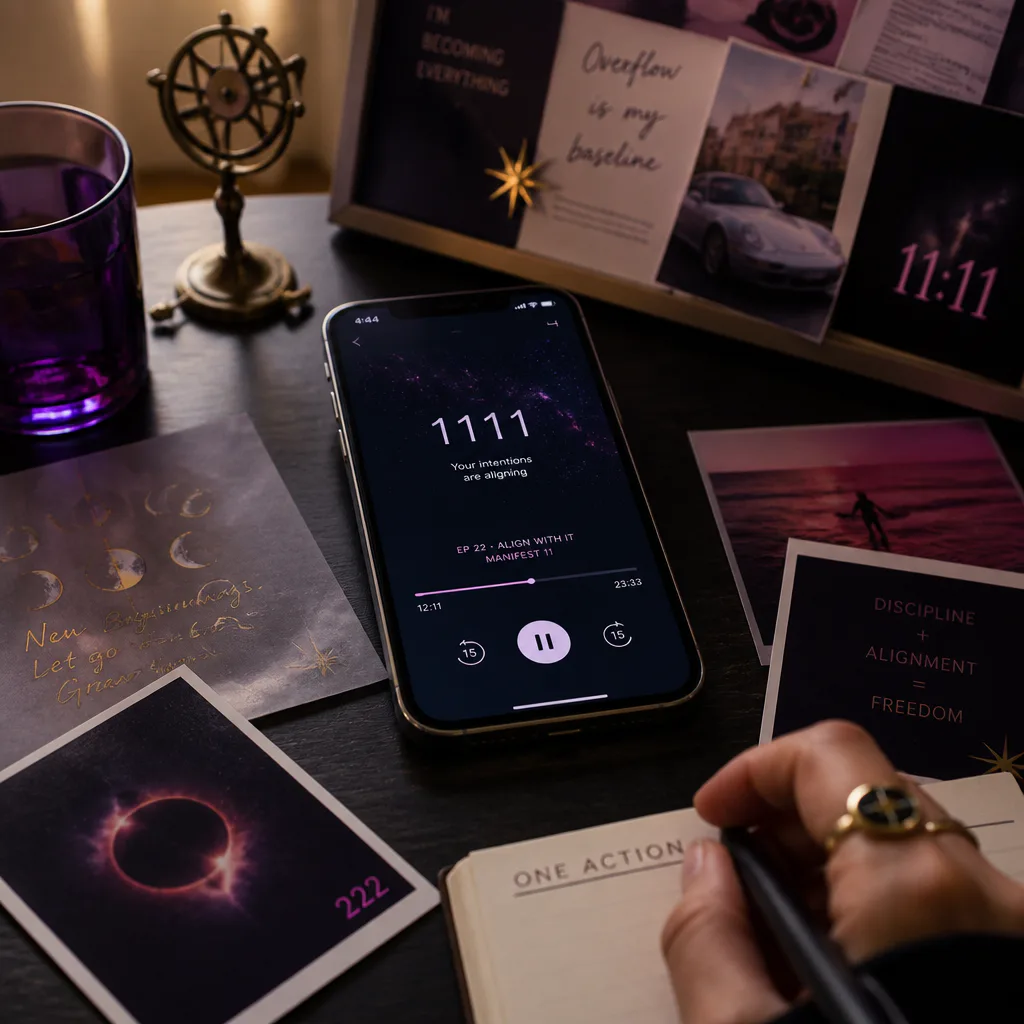
How is it different from a vision board or Manifestation Board?
A dream-self moment is heard daily, while a Manifestation Board is seen and returned to as a visual support.
Vision boards have a long history in modern manifestation culture. They can help because the eye likes reminders. A picture on a wall or in an app can make desire visible on a day when language feels thin. But images can also become performance. You can spend hours arranging the board and still avoid the one action the future self would take before noon.
Aya’s Manifestation Board is a complement because seeing can support hearing. It is not the pillar. The method is the audio. This distinction protects the practice from becoming too heavy. If you only have three minutes, you listen. If you have more time, you can add the visual layer, a note, or the daily affirmation. But you don’t have to earn the method by doing more.
| If you have… | Return to… | Why it helps |
|---|---|---|
| 3 minutes | Dream-self moment | Keeps the core practice intact |
| 5 minutes | Audio plus one action | Links identity to behavior |
| 10 minutes | Audio plus board review | Adds visual memory cues |
| 15 minutes | Audio, board, brief notes | Helps you track patterns |
Cognitive load matters here. George Miller’s famous 1956 paper suggested that working memory has strict limits, often remembered as 7 plus or minus 2 items, though newer research argues the number is closer to 4 chunks. Either way, too many daily requirements can crowd the mind. Aya keeps the method singular so you can actually repeat it.
A board may show the apartment, the offer letter, the soft Sunday, the strong body, the clean kitchen. The dream-self moment tells you who you are inside those images. It might say, I don’t rush my own becoming. It might say, I take the next clean step. It might say, I let my life be simpler than my fear expected.
The best visual reminder does not replace the voice. It points you back to it.
When does a dream-self moment start to feel true?
It usually starts to feel true after repeated listening turns one or two lines into familiar choices.
There is no honest universal timeline. Some people feel a shift in the first week because the audio gives words to something they already knew. Others need a month before the resistance softens. Lally’s 2009 habit study is useful here again: the average was 66 days, but the range was wide. That range is permission. You are not late because it takes time.
Watch for small signs instead of dramatic proof. You pause before answering. You notice a job post you would have ignored. You stop explaining yourself twice. You choose sleep over one more scroll. You send the draft at 80 percent. These are not small because they are meaningless. They are small because they are repeatable.
Joe Dispenza often speaks about rehearsing a future until the body no longer lives only from the past. You don’t have to take every claim from any teacher as doctrine to see the practical point: the body remembers patterns. A dream-self moment gives it a new pattern to hear. The work is not to become someone else. It is to stop abandoning the self you keep hearing.
There is also a private tenderness to the moment when a line becomes yours. At first, it may sound like Aya. Then it sounds like a possibility. Then, one morning, it sounds like you. Not because the whole life has arrived. Because one behavior did. One sentence. One steadier breath. One clean refusal. One quiet yes.
If you want a marker, use 30 days as an observation window, not a verdict. Listen daily. Note the line that stayed. Note one action. After 30 entries, patterns will be visible. In clinical and coaching settings, self-monitoring has been associated with better behavior change; a 2011 review in Psychological Bulletin found that prompt self-monitoring and feedback improved goal progress across studies.
A dream-self moment becomes true the way a path becomes visible: by being walked, softly, more than once.
Stay with the voice that feels like home.