evening rituals
Evening Journal Prompts for Dream-Self Audio
Use evening journal prompts to name what became true, then turn the clearest details into a short Dream-Self audio you can hear tomorrow.
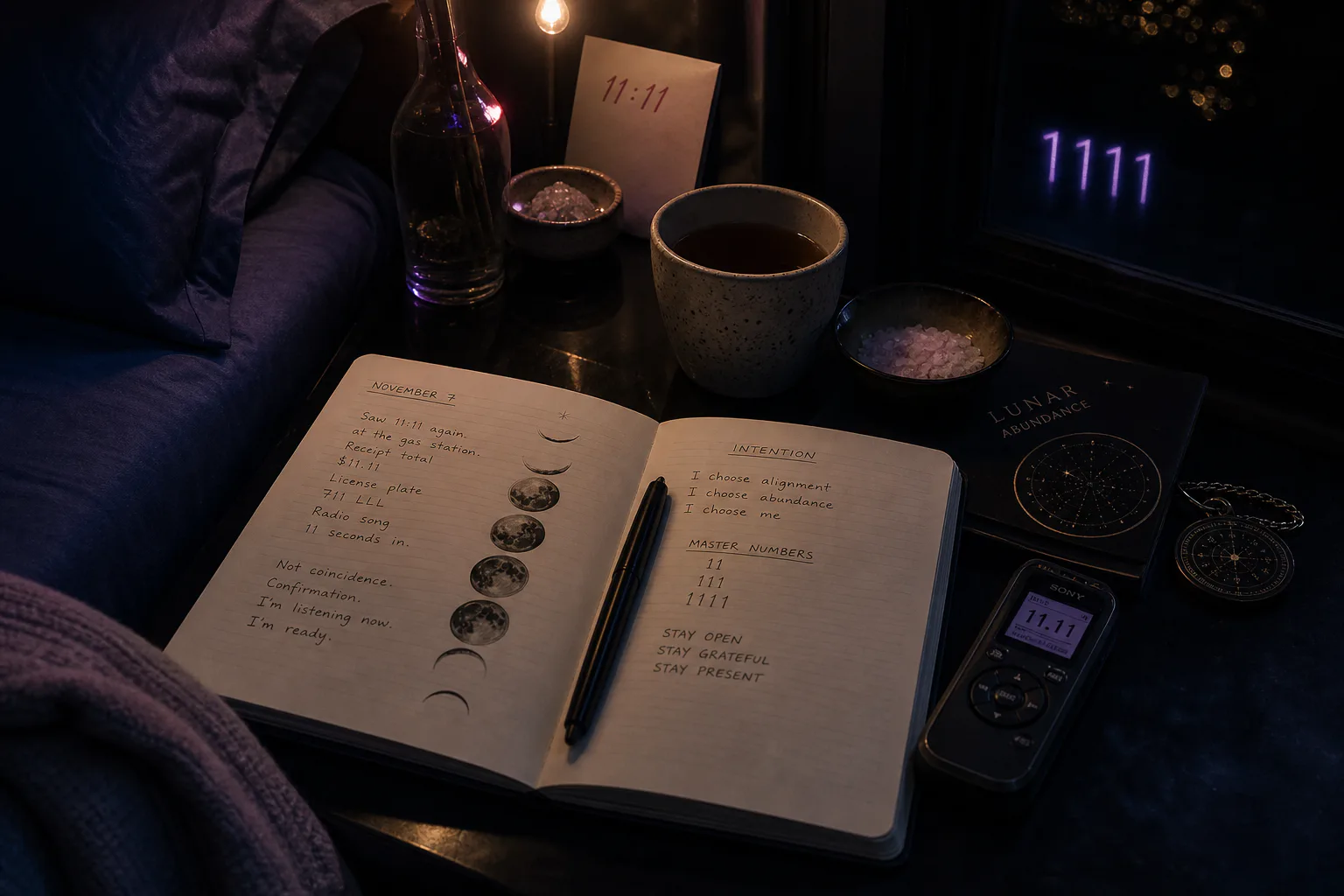
The notebook is open beside the bed. Use evening journal prompts to gather one true scene, one felt shift, and one future-self sentence, then shape them into a short Dream-Self audio. The journal finds the language. The audio carries it back to you tomorrow.
What makes an evening prompt usable for audio?
A usable prompt gives you details that can be heard, not slogans that only look good on paper.
The best evening journal prompts are small enough to answer when you’re tired. At night, the mind is less interested in performance. It tells the truth in fragments. A chipped mug. A text you didn’t send. The way your shoulders dropped when the house finally went quiet. Those details are not decoration. They are the material.
Expressive writing research gives you a useful boundary. In a 2005 review in Advances in Psychiatric Treatment, Karen Baikie and Kay Wilhelm described classic writing studies that used 15 to 20 minutes of writing across 3 to 5 sessions. That is not a rule for your bedside table. It is a reminder that change often begins with a short, contained act.
A prompt is not a command. It is a small bowl for what already wants to be named.
Here are five prompts that tend to become audio well:
- What did I want today that I did not say out loud?
- What tiny proof did I see that this life is becoming more mine?
- If my future self could describe tonight, what would she notice first?
- What am I ready to stop rehearsing before sleep?
- What sentence would feel true if I heard it in a calm voice tomorrow?
When you answer, write in first person. Use present tense when you can. If you are learning manifestation as a daily practice, this matters because vague wanting rarely gives the mind a place to land. Specificity is mercy. It tells the body, “Here. This is what we mean.”
How do you write the prompts without forcing belief?
You write close to what feels believable, then let repetition widen the edge.
This is where many night practices get too shiny. You may write, “I am completely calm,” while your jaw is tight and your inbox is still loud in your head. The sentence may be pretty. It may also be too far away. In 2009, Joanne Wood, W.Q. Elaine Perunovic, and John Lee published work in Psychological Science showing that broad positive self-statements can make some people with low self-esteem feel worse, not better.
So make the sentence softer. Instead of “I am completely calm,” try, “I know how to return to myself for one minute.” Instead of “Everything is solved,” try, “I can take the next clean step.” The future self sounds real when she is allowed to speak in ordinary details.
This is also how affirmations can serve the practice without taking it over. One daily affirmation may steady the mind. It may give you a phrase to carry. But in the AYA way, it is a complement. The audio remains the center.
A simple test helps. Read the line out loud once. Notice your body.
| If the line feels like this | Try this instead |
|---|---|
| Too big | Make the time frame smaller |
| Too perfect | Add one ordinary detail |
| Too vague | Name the room, object, or action |
| Too harsh | Change it into a sentence you would say to a child |
Neville Goddard wrote often about feeling the wish fulfilled, including in Feeling Is the Secret in 1944. Whether you read him literally or poetically, the useful part is this: feeling is not theater. It is recognition. Your line should feel like a door you can touch, not a stage you must perform on.
Which evening journal prompts turn into a Dream-Self Moment?
The strongest prompts create a scene your future self can narrate in the present tense.
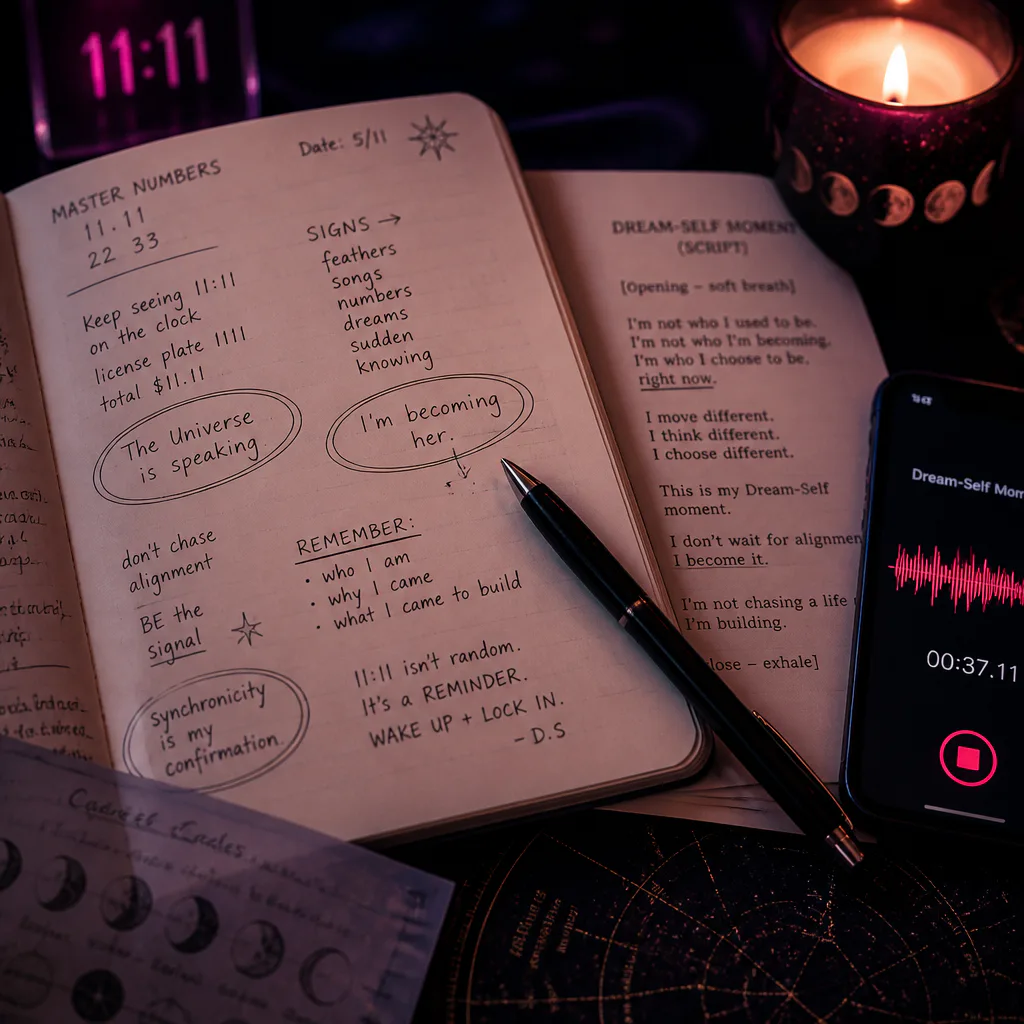
The AYA Method is a daily audio manifestation practice. Each day you listen to a short personalized recording — your Dream-Self Moment — narrated from the version of you who has already manifested the life you intend. Listening is the practice. Repetition is the work. The audio is the method.
That definition matters because the journal is not asked to carry everything. It only gathers what the audio needs. A Dream-Self Moment works best when it can be heard by the body, not admired by the mind. You are not writing a manifesto. You are writing a voice note from the life that is becoming real.
Try this 12-minute sequence tonight:
- Three minutes: Write what happened today without making it meaningful.
- Three minutes: Name what you wanted under the surface.
- Three minutes: Write as your future self, beginning with “I remember when…”
- Two minutes: Circle one scene and one sentence.
- One minute: Read the sentence slowly, as if recording it.
Laura King’s 2001 research on writing about “best possible selves” found links with improved mood and health-related outcomes in student samples. Small studies are not destiny. Still, they suggest that imagining a desired future becomes more useful when it is written clearly and personally.
Here are three prompt-to-audio examples:
- Prompt answer: “I want to stop feeling behind.” Audio line: “I wake knowing there is enough time for the true things.”
- Prompt answer: “I want my work to feel seen.” Audio line: “My work reaches the right eyes because I keep showing it with care.”
- Prompt answer: “I want love to feel safe.” Audio line: “I let tenderness arrive slowly, and I do not run from being known.”
How do you choose the right details before recording?
Choose the details that make the future feel physically ordinary.
A Dream-Self audio needs texture. Not excess. Texture. The sound of the kettle. The clean shirt over the chair. The message waiting on the phone. Specific details help memory and attention. Cognitive research has long shown that concrete words are easier to remember than abstract ones; Allan Paivio’s dual coding theory, first developed in the 1970s, is one common explanation for why images and words together tend to stick.
This is why a line like “I am successful” may not land. It floats. A line like “I close my laptop at 4:30 because the work is done and paid for” has a chair, a clock, a breath. If the words feel too shiny, bring them back to the sink, the bed, the calendar.
You can also borrow timing from your own sky. If you like to use astrology and manifestation, keep it gentle. A moon phase, a Venus transit, or a birth-chart note can give the evening a frame. It should not become a test you can fail. The practice must still be able to meet you on a regular Tuesday.
I learned this in kitchens before I learned it in journals. My grandmother did not say, “We are secure.” She counted tortillas. She checked the salt. She knew care by its weight in the palm. Your audio can do the same. It can make the invisible more touchable.
Use this filter before you record:
- Can I see it?
- Can I hear it?
- Can I feel it somewhere in the body?
- Would I say this to myself kindly at 7 a.m.?
- Does it ask me to listen, not strain?
How do you shape journal lines into audio language?
You turn your best lines into a brief present-tense narration from the self who already knows.
Keep it short. The American Academy of Sleep Medicine and Sleep Research Society recommend at least 7 hours of sleep for most adults, and a night ritual should protect that, not steal from it. Aim for 90 seconds to 3 minutes of audio language. Enough to enter. Not so much that it becomes another task.
Start with the scene. Then add the inner knowing. Then add one sentence of proof. The voice should sound intimate, like someone standing in your kitchen after the house has quieted.
A simple structure:
- Arrival: “I am here now, in the life I once asked for.”
- Scene: “The morning light is on the table, and the message I hoped for is already answered.”
- Body: “My chest is soft. My hands are steady.”
- Proof: “I kept showing up in small ways, and the small ways became real.”
- Return: “I know this life because I am living it.”
Peter Gollwitzer’s 1999 work on implementation intentions showed that “if-then” planning can improve follow-through across many contexts. Your Dream-Self audio is not an if-then plan, but it can borrow the clarity. “When I wake, I listen before I check my phone.” That one sentence protects the practice.
Do not over-edit. If you polish until the sentence no longer sounds like you, put one imperfect line back in. The self you can believe is more useful than the self you think you should become.
The app also includes a daily affirmation and Manifestation Board, and both can hold little pieces of the same language. But they are not the pillars. They are companions. For the wider frame, keep the AYA Method close: the audio is the method.
What should you do the next morning?
You listen before you negotiate with the day.
Morning is when the journal becomes practice. You do not need a longer routine. You need a clean return. Before messages, before news, before you begin solving everyone else’s weather, listen to the Dream-Self Moment once. The point is not to chase a feeling. The point is to become familiar with the voice of the life you intend.
In the 2017 National Health Interview Survey, 14.2% of U.S. adults reported using meditation in the previous 12 months, up from 4.1% in 2012, according to the National Center for Complementary and Integrative Health. Many people are seeking repeatable inner practices. Audio works here because it removes the need to invent words when you’re still half-asleep.
If the recording feels awkward, good. New truth often sounds strange at first. Joe Dispenza’s work often emphasizes mental rehearsal and repeated inner states; you do not have to adopt every claim to see the practical point. Repetition teaches recognition. What you hear daily becomes easier to choose.
You can keep the morning simple:
- Sit up or stay lying down.
- Put one hand somewhere steady, like your ribs or the blanket.
- Listen once without checking whether it is working.
- Choose one sentence to carry.
- Move into the day with one small matching action.
If your sentence is “I speak clearly and I am received,” the matching action might be sending the email you drafted. If it is “I let tenderness arrive slowly,” the action may be answering kindly instead of disappearing. Manifestation becomes less abstract when it has a next gesture.
How can you keep the ritual honest over time?
You keep the ritual honest by reviewing what repeats, what softens, and what no longer feels true.
Once a week, read the last seven nights. Do not grade yourself. Look for ingredients. A repeated fear. A repeated desire. A sentence that keeps arriving in different clothes. Patterns are not always dramatic. Sometimes they are as plain as, “I want more rest,” written four nights in a row.
In health behavior research, self-monitoring is one of the more consistently used behavior change techniques; a 2012 taxonomy by Susan Michie and colleagues helped name it among dozens of measurable techniques. Your journal is a form of gentle self-monitoring. Not surveillance. Witnessing.
After seven days, ask:
- Which line still feels alive?
- Which line feels like performance?
- What proof did I see this week, even if it was small?
- What does my Dream-Self audio need less of?
- What does it need more of?
You may find that one audio can stay for a week. You may also find that a single sentence needs to change. Both are allowed. The practice is daily, but the language can breathe.
There is a reason I keep sea salt beside my notebook. Salt tells the truth. Too much, and the soup is hard to eat. Too little, and everything tastes far away. Your words are the same. Enough is enough.
For deeper reading on the larger practice, you can return to the Manifestation pillar, the Affirmations pillar, or the quiet timing notes inside astrology and manifestation. But tonight, keep the page simple.
One sentence. One scene. One voice you can hear again in the morning.
Stay close to the words that feel like home.