money manifestation
Financial Anxiety Affirmations: 3-Minute Audio Reset
Use financial anxiety affirmations inside a 3-minute future-self audio reset to calm money panic, choose the next move, and keep reality in view.

Financial anxiety affirmations work best when they are heard, repeated, and tied to one concrete money action. A 3-minute future-self audio gives your nervous system a cue, your attention a direction, and your next decision a cleaner starting point. It is not denial. It is a reset before the numbers enter the room.
Why do financial anxiety affirmations work better when you hear them?
Audio financial anxiety affirmations work because the voice becomes a cue before your anxious thinking takes the microphone.
Money stress is rarely just math. The American Psychological Association reported in 2023 that money remained one of the top stressors for U.S. adults, with 63 percent naming it as a significant source of stress. When the body reads a balance, bill, or payment deadline as threat, the brain narrows. You do not need a louder slogan at that point. You need a calmer signal.
Reading affirmations can help, especially when the wording is believable. But during a spike, reading asks for effort. You have to find the page, track the sentence, and keep yourself from arguing with it. Audio removes several steps. One tap. One voice. One gate.
This is why the AYA Method matters here. The AYA Method is a daily audio manifestation practice. Each day you listen to a short personalized recording, your Dream-Self Moment, narrated from the version of you who has already manifested the life you intend. Listening is the practice. Repetition is the work. The audio is the method.
The finance part of me likes that last sentence. A method has to be repeatable, or it is just a mood with good lighting. In my old world, we trusted processes that worked on dull Tuesdays, not only in pitch meetings. A 3-minute audio reset earns its place the same way: it has to be usable before rent, before the card statement, before the invoice that arrived on cue.
A money practice is only real if it can survive contact with the actual number.
Self-affirmation theory, introduced by Claude Steele in 1988, suggests people can respond less defensively to threat when they reconnect with valued identity. A 2016 study in Social Cognitive and Affective Neuroscience found self-affirmation activated brain regions associated with valuation and future orientation. That is not mystical accounting. It is attention returning to the part of you that can choose.
What should a 3-minute future-self audio include?
A 3-minute future-self audio should include regulation, identity, reality, and one next financial action.
The recording does not need poetry. It needs structure. Three minutes is long enough to shift state and short enough to repeat. Dr. Andrew Huberman has often discussed how breathing patterns can affect autonomic arousal, and slow exhale-focused breathing is one of the simplest ways to downshift. Even 60 seconds can change the room.
Use this frame:
- First 30 seconds: return to the body. Name the breath, the jaw, the shoulders, the floor.
- Next 60 seconds: speak from future identity. Not fantasy. Identity. I am someone who can look directly.
- Next 60 seconds: name the money behavior. I check once. I write the number. I choose the next clean move.
- Final 30 seconds: close the loop. One action, one time, one quiet instruction.
Here is the dial to keep it honest:
| Audio element | Useful wording | Avoid |
|---|---|---|
| Body cue | My feet are on the floor, and I can exhale slowly | Money cannot touch me |
| Identity | I am becoming precise with money | I am rich already |
| Reality | I can look at the balance without becoming the balance | The debt is gone |
| Action | I send one message, pay one bill, or update one line | Everything works out somehow |
Financial anxiety often comes with time distortion. A 2022 Bankrate survey found that 56 percent of U.S. adults could not cover a 1,000 dollar emergency expense from savings. When the buffer is thin, the mind starts sprinting into next month, next year, worst case. Your audio should bring the date back to today.
If you use financial anxiety affirmations, keep them specific enough to pass the mirror test. If you would roll your eyes while brushing your teeth, do not put that sentence in your recording. The subconscious may be subtle. Your skepticism is not.
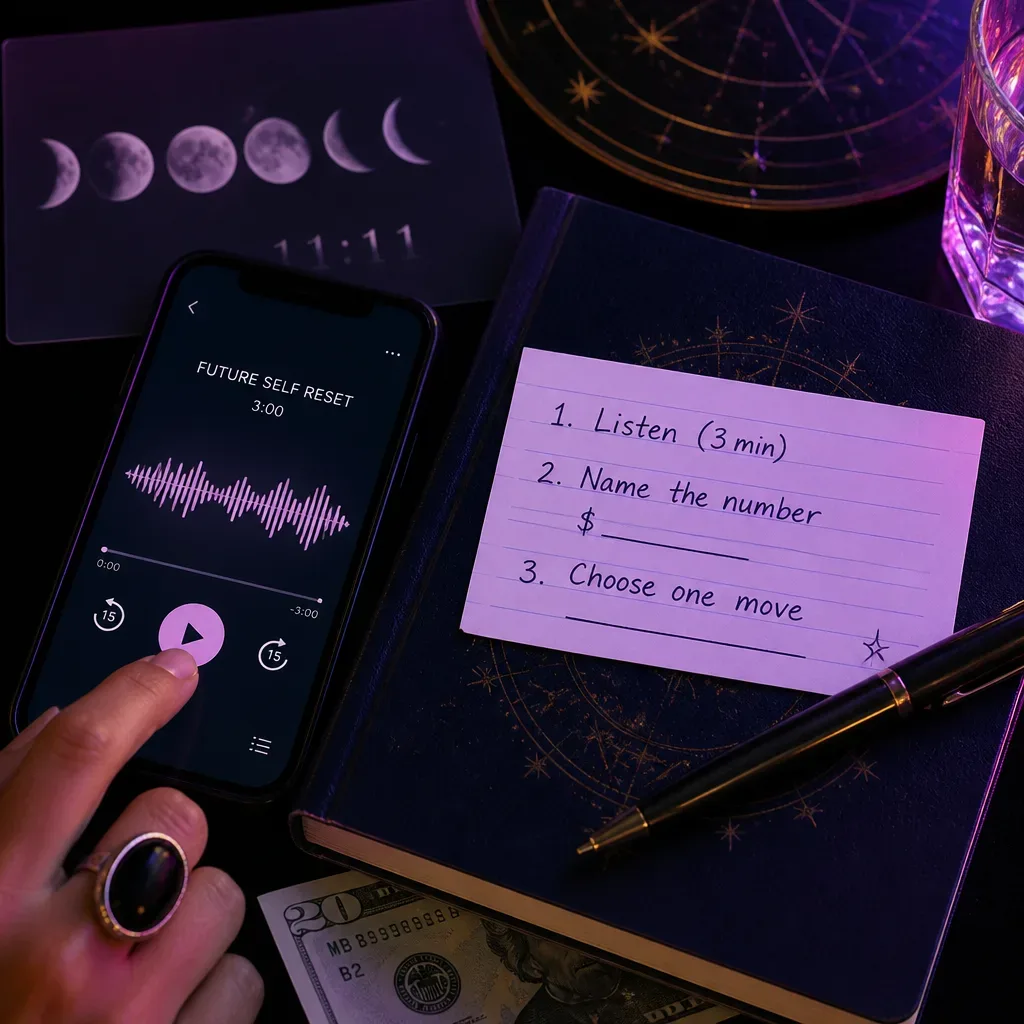
How do you do the 3-minute reset exactly?
You do the reset by listening first, looking second, and acting third.
The order matters. If you open the banking app first, your body may already be in court by the time the practice begins. Start with the audio. Three minutes is not indulgent. It is shorter than the average social media session; DataReportal estimated in 2024 that global users spent about 2 hours and 23 minutes per day on social platforms. You have the time. The question is whether the time has a job.
Use this exact sequence:
- Minute 0:00 to 0:30, stop the spiral. Sit or stand still. Press play. Let the first lines cue your breath. No checking, no calculating, no mental trial.
- Minute 0:30 to 1:30, hear your future self. The voice speaks as someone who has learned steadiness. Not someone above money. Someone clean with money.
- Minute 1:30 to 2:30, hear the action. The recording tells you what type of move comes next: check, list, pay, pause, ask, cancel, schedule.
- Minute 2:30 to 3:00, commit to one number. One balance, one payment, one due date, one email. Not the entire financial life.
After the audio, write one sentence before touching the app: The number is information, not identity. That sentence is not cute. It is a firewall.
Then look. If the number is better than feared, do not spend the relief immediately. If the number is worse than hoped, do not punish yourself with a second mistake. Behavioral economists Daniel Kahneman and Amos Tversky showed in prospect theory that losses tend to feel heavier than gains of the same size. Expect the sting. Do not let it drive.
A clean move is small enough to complete and meaningful enough to count. Examples include paying 25 dollars toward a card, moving a bill date, canceling a subscription, sending a client reminder, or opening a budgeting sheet for 10 minutes. The practice is not the payment. The practice gets you steady enough to make the payment.
Calm is not the absence of pressure. Calm is pressure with a steering wheel.
What should your financial anxiety affirmations actually say?
Your affirmations should sound like a truthful future self, not a sales page shouting over your nervous system.
The best lines are grounded, active, and slightly ahead of your current state. Neville Goddard wrote about assuming the feeling of the wish fulfilled, but useful assumption is not pretending the rent is paid when it is not. It is rehearsing the identity that pays attention, tells the truth, and takes the next move on time.
Try lines like these:
- I can look at money without making it a verdict on my life.
- I check the number once, breathe, and choose the next clean move.
- I am allowed to be learning and still be responsible.
- I do not need panic to prove that I care.
- I can make a 10-minute money decision without rewriting my future.
- I return to precision before I return to prediction.
Notice the verbs. Look. Check. Breathe. Choose. Learn. Return. These are not decorative. They are instructions. A 2015 meta-analysis in Health Psychology Review found that implementation intentions, the if-then plans studied by Peter Gollwitzer and others, had reliable effects on behavior across health contexts. Money behavior benefits from the same plain machinery.
So your audio might say: If I feel the rush to avoid the account, then I press play first. If I see a number I dislike, then I write it down once. If I want to buy something to change my state, then I wait 11 minutes. Yes, 11. The master number has a reputation for signal and intuition, but here it also works because it is specific.
Specific beats inspired when the card is already in your hand.
You can read more about the broader mechanics on the Manifestation pillar, but keep the money version honest. You are not asking the sky to reconcile your ledger. You are training the part of you that meets the ledger.
How does this fit with manifestation without becoming magical accounting?
It fits when manifestation is treated as attention, identity, and repeated action rather than a substitute for financial reality.
Money manifestation gets sloppy when people confuse symbol with settlement. Seeing 11:11 on the stove clock does not pay a bill. It may, however, interrupt the spiral long enough for you to make the call you avoided for 9 days. I will take that trade. The signal is not the result. The signal is the nudge back to position.
In the AYA ecosystem, the audio holds the practice. The daily affirmation and Manifestation Board can support it, but they are complements. They are not the spine. The spine is listening to the Dream-Self Moment daily, then letting the repetition shape what you notice and what you do.
Joe Dispenza often speaks about mental rehearsal and the body learning a future state before the outer result arrives. I keep a sober reading of that idea. Rehearsal is powerful when it changes behavior. Athletes have used imagery for decades; a 2012 review in Frontiers in Human Neuroscience discussed motor imagery as a measurable practice in training and rehabilitation. The useful question is not whether the image is dramatic. The useful question is whether your next rep changes.
For financial anxiety, the rep is simple. Listen. Look. Act. Repeat. If a lunar cycle helps you review spending every 29.5 days, use it. If astrology and manifestation gives you a calendar language for reflection, fine. But do not outsource the invoice to the moon.
Synchronicity is punctuation, not payroll.
A good money practice respects both worlds: the seen and the scheduled. The seen includes your balance, APR, due date, income, cash buffer, and subscriptions. The scheduled includes when you listen, when you review, and when you make the next move. The mirror can be cosmic. The spreadsheet still needs formulas.

When should you use the reset during the day?
Use the reset at the gate where financial anxiety usually takes over.
For some people, the gate is morning. For others, it is the grocery aisle, the banking app, the Sunday night bill review, or the 4:44 p.m. slump when the mind starts inventing disasters. The right time is not spiritually impressive. It is behaviorally strategic.
Pick one anchor for 7 days. Seven is long enough to see a pattern and short enough that your resistance does not draft a constitution. In habit research, context matters. Wendy Wood and David Neal have written extensively about habits being cued by stable environments. Same chair, same headphones, same time, same first sentence. The body starts to recognize the dial.
Good gates include:
- Before checking account balances
- Before paying bills
- Before opening a credit card statement
- Before a planned purchase over a set threshold, such as 50 dollars
- Before a money conversation with a partner, client, landlord, or lender
- After receiving unexpected financial news
Do not use the audio to postpone action. That is the trap. If you listen three times and still do not open the bill, the practice has become velvet avoidance. One listen. One look. One move.
The threshold rule helps. Decide in advance: any purchase over 50 dollars gets the 3-minute reset. Any balance check gets the reset first. Any debt decision over 100 dollars gets the reset and one written line. The numbers can change, but the rule should not negotiate while you are activated.
This is where the Affirmations pillar is useful as a library, not a hiding place. Borrow language that steadies you. Then bring it back into audio, because the method is heard. The page can inspire the sentence. The recording carries it into the nervous system.
What signs show the reset is working?
The reset is working when your money behavior becomes more direct, less avoidant, and easier to repeat.
Do not measure this by whether money appears overnight. That is a bad metric and a worse teacher. Measure the boring signals. Did you check the account without spiraling for 30 minutes? Did you make the call? Did you stop one impulse purchase? Did you open the statement on the day it arrived? The room changes by inches before it changes by category.
Track 5 numbers for 14 days:
- How many times you listened before a money action
- How many accounts or bills you checked directly
- How many avoided tasks you completed
- How many impulse purchases you paused
- How many minutes you spent in anxiety after the reset
The last number matters. If panic used to last 45 minutes and now it lasts 18, that is not nothing. In finance, compounding rarely looks cinematic at first. A 1 percent better decision repeated often enough becomes visible. The same is true for attention.
You may also notice synchronicities. A number repeats. A client replies after 11 days. A refund lands the same morning you finally reviewed the budget. Name it if it helps. Just do not confuse the wink with the work. The wink is a witness. The work is what you do next.
If anxiety stays severe, widen the support. The National Institute of Mental Health estimates that anxiety disorders affect about 19.1 percent of U.S. adults each year. Financial stress can sit on top of clinical anxiety, trauma, job loss, family pressure, or compulsive spending. Audio practice can support care. It should not replace care.
A final analyst note: review the evidence in your own life. Run the practice for 30 days. Keep notes. No enthusiasm required. If the mornings you listen lead to slightly better decisions before noon, pay attention. Slightly better compounded is still better.
The number is information, and you are still here.