love manifestation
Manifesting Specific Person? Try Future-Self Audio
Manifesting specific person can tighten your focus around control. Future-self audio helps you practice the love, safety, and choice you actually want.

The phone is face down. You still know where it is. Manifesting specific person usually asks, “How do I get them?” Future-self audio asks, “Who am I when love is already safe?” The second question is cleaner, kinder, and less likely to turn desire into control.
Is manifesting a specific person really about love, or control?
Manifesting a specific person is usually about love on the surface and control underneath.
I don’t say that to shame you. Wanting someone is human. Missing someone is human. Checking whether they watched your story is also human, though it rarely helps. Pew Research Center reported in 2020 that about 30% of U.S. adults had used a dating app, and anyone who’s dated through a screen knows the strange ache of waiting for a sign.
The trouble starts when a spiritual practice becomes a surveillance practice. You stop listening to yourself. You start reading delays, emojis, old photos, and silence like sacred text. Neville Goddard wrote often about assuming the wish fulfilled, but a wish can become cramped when it depends on one person losing their own freedom.
There is a difference between desire and demand. Desire says, “This is what I want.” Demand says, “This is the only shape love is allowed to take.” One leaves you with breath. The other leaves you with a locked jaw.
A useful comparison is simple:
| Practice focus | What it trains | Common risk | Cleaner question |
|---|---|---|---|
| Manifesting a specific person | Attention on one outcome | Obsession, checking, pressure | What do I really want to feel and live? |
| Future-self audio | Attention on the self who receives love well | Avoiding real grief if used carelessly | Who am I when I no longer beg? |
| General love manifestation | Openness to many forms | Vagueness | What kind of love is true for me? |
This is why the broader practice of manifestation matters. It isn’t meant to make you smaller. It should return you to choice. “If your practice makes you less free, it isn’t devotion. It’s a loop.”
Specific people can still be part of the heart. They just can’t become the whole sky.
What does future-self audio do differently?
Future-self audio rehearses the state of being loved without assigning another person the job of proving it.
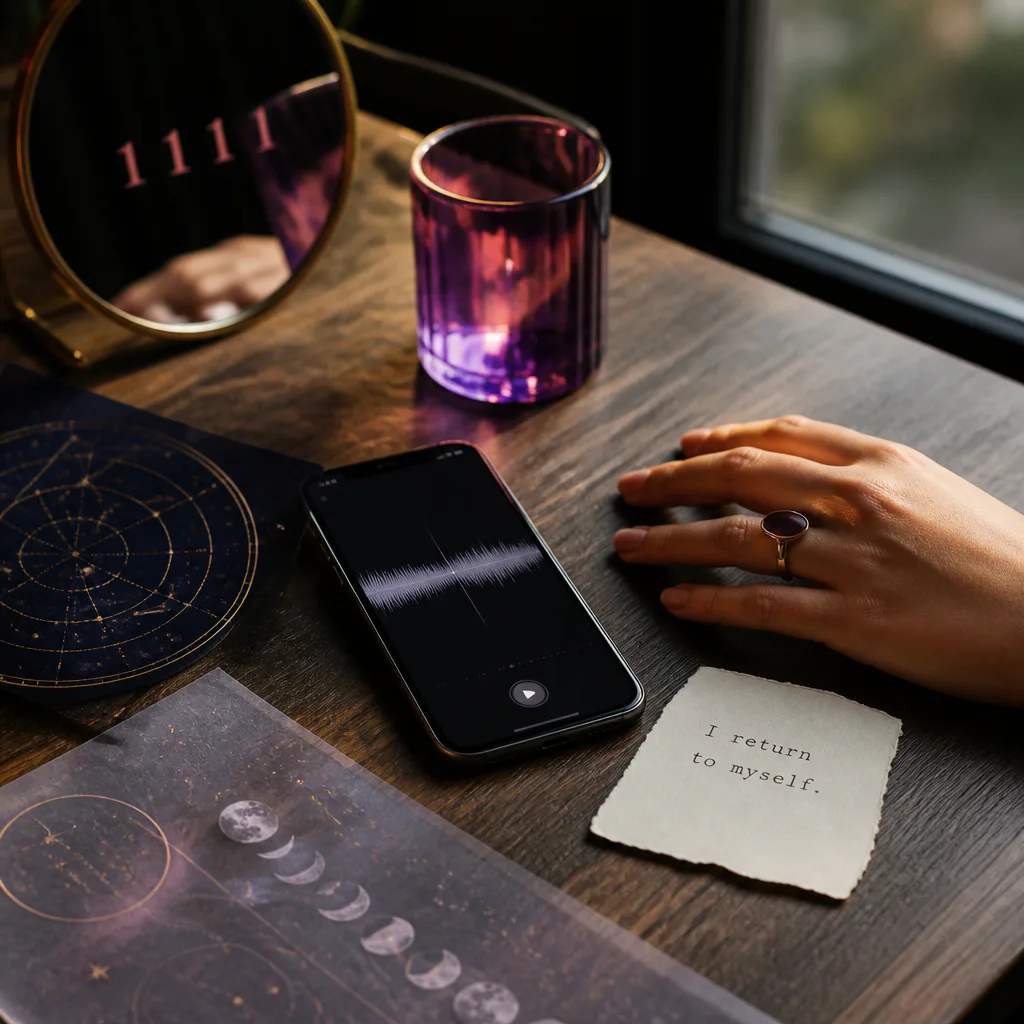
The AYA Method is a daily audio manifestation practice. Each day you listen to a short personalized recording — your Dream-Self Moment — narrated from the version of you who has already manifested the life you intend. Listening is the practice. Repetition is the work. The audio is the method.
That last sentence matters. The audio is not decoration. It gives the mind something repeatable and sensory. In sports psychology, mental rehearsal has been studied for decades; a 1994 meta-analysis by Driskell, Copper, and Moran found mental practice had a positive effect on performance, especially when combined with physical practice. Love isn’t a tennis serve. Still, rehearsal changes familiarity.
Instead of saying, “Alex texts me tonight,” your recording might say, “I wake with no need to chase. I choose people who choose me clearly. My body knows what respect feels like.” That is not a trick. It’s a new home base.
Joe Dispenza often talks about rehearsing a future self until the body begins to recognize it. You don’t need to accept every claim around that work to see the practical point: repeated inner scenes can shape attention and behavior. Dr. Andrew Huberman has also spoken about visualization working best when paired with action and clear cues, not fantasy alone.
Future-self audio differs from old specific-person loops in 4 quiet ways:
- It shifts the subject from them to you.
- It trains a daily state, not a one-time wish.
- It reduces the urge to check for proof.
- It makes room for consent, timing, and reality.
A recording can hold your desire without putting a cage around another person. That’s the line.
How does this compare with affirmations, scripting, and vision boards?
Future-self audio is more embodied than a sentence and less outcome-tight than scripting one person’s behavior.
Affirmations have their place. The affirmations page can help if you need language that is short, steady, and repeatable. But a single line can become brittle when your nervous system doesn’t believe it. A 2009 study by Wood, Perunovic, and Lee in Psychological Science found that positive self-statements could make some people with low self-esteem feel worse, especially when the statement was too far from what felt true.
That doesn’t mean affirmations don’t work. It means they need honesty. “I am loved by everyone I want” may feel false at 1:00 a.m. “I am learning not to chase what can’t meet me” may land better. The body can work with that.
Scripting is useful when it clarifies. It becomes less useful when it turns into legal language against reality. If you write ten pages about one person apologizing, texting, visiting, choosing, staying, and changing, you may feel calm for ten minutes. Then the phone is quiet again. The loop restarts.
Vision boards can help you see what you’re practicing. In Aya, the Manifestation Board is a complement. It gives the eye something to return to. But audio does something different. It meets you through listening, which is intimate and hard to fake. You can close your eyes. You can stop performing.
Here’s the cleaner comparison:
- Affirmations: best for one clear sentence you can repeat daily.
- Scripting: best for naming desire and noticing hidden standards.
- Manifestation Board: best for visual memory and gentle reminders.
- Future-self audio: best for entering the felt identity of someone already living differently.
Research on implementation intentions by psychologist Peter Gollwitzer, first developed in the 1990s, found that “if-then” plans improve follow-through across many goals. Future-self audio can work in a similar practical way. It can encode cues: “When I want to check their profile, I put the phone down and return to myself.”
“The practice that saves you is often the one that interrupts you before you abandon yourself.”
What if I still want this exact person?
You can want this exact person and still stop making them the center of your practice.
This is the honest middle. You don’t have to become falsely detached. You don’t have to say, “I don’t care,” when you care so much that your chest hurts. In the Journal of Behavioral Medicine, expressive writing studies have repeatedly found that naming emotional truth can support well-being, though effects vary by person and context. Denial is not the same as peace.
Try telling the truth in two layers:
- Surface desire: “I want this person.”
- Deeper desire: “I want mutual love, repair, tenderness, attraction, honesty, and consistency.”
The second layer is where your practice belongs. The first layer is allowed to exist. It just doesn’t get to drive the car.
There is also the matter of consent. A real relationship includes two inner worlds. If your practice depends on someone feeling what they don’t feel, choosing what they don’t choose, or returning before they’re ready, you’re no longer practicing love. You’re practicing pressure in private.
This is where future-self audio can become a safer container. Your Dream-Self Moment might include language like:
I don’t chase. I don’t shrink. I let love arrive with a clear face. If it’s them, it’s honest. If it isn’t, I’m still home in myself.
That sentence doesn’t cut the cord with desire. It loosens the knot. It lets reality breathe.
You can also keep the wider map nearby. The piece on astrology and manifestation can be useful if you like timing and symbolism, but timing should never become an excuse to wait in pain. A chart can offer reflection. It can’t replace a direct conversation.
One specific number helps here: if you listen for 5 minutes a day, that’s 35 minutes a week of practicing steadiness instead of scanning. Over 8 weeks, that’s nearly 5 hours. Not dramatic. Real.
How do I write a future-self audio prompt for love?
Write it from the self who is already safe in love, not from the self trying to make someone comply.
Start small. A good audio prompt is not a spell against another person’s will. It’s a room you can enter. Research by psychologist Gabriele Oettingen on mental contrasting, developed over more than 20 years, suggests that people do better when they pair desired futures with present obstacles. So name the love. Then name the pattern you’re leaving.
Use this 6-part structure:
- Set the scene. Where are you when love feels calm?
- Name your body. What has softened?
- Name your standard. What do you no longer accept?
- Name your behavior. How do you act now?
- Leave room for the person. If it’s them, let it be mutual.
- End with self-return. You are not waiting to be chosen into existence.
A sample prompt might sound like this:
I am in my kitchen on a quiet morning. My phone is near me, but it doesn’t own me. I am loved clearly. I don’t decode silence. I receive affection that is steady, spoken, and kind. If this love comes through the person I once hoped for, it comes freely. If it comes another way, I recognize it. I already know how to be chosen by myself.
That prompt gives Aya something grounded to shape into audio. It includes desire, but it doesn’t make another person a puppet. It has sensory detail. It has standards. It has a boundary.
You can refine the language using affirmations if you want one line to carry after listening. Keep it true enough that your body doesn’t fight it. In small clinical and coaching settings, practitioners often find that believable statements are easier to repeat than grand claims. That matches common sense.
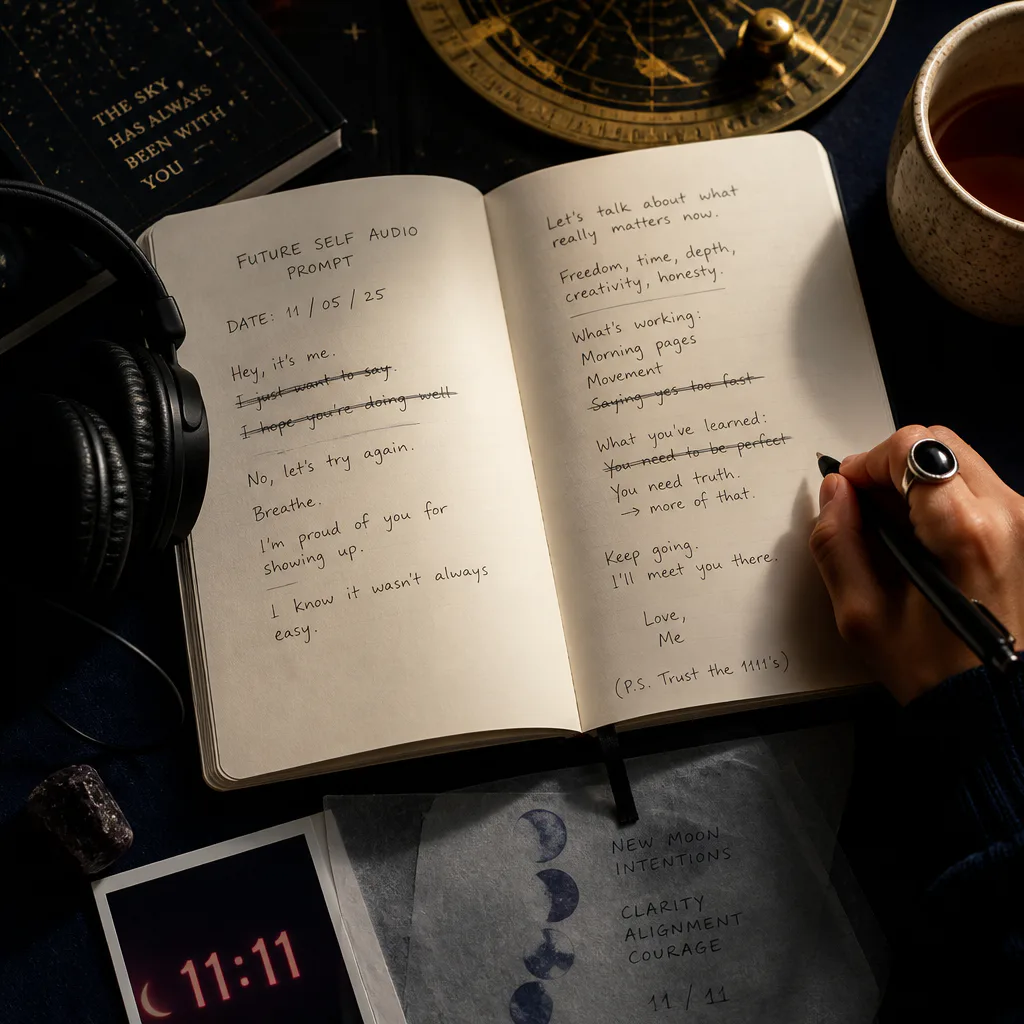
A clear love prompt should include these elements:
- Mutuality
- Safety
- Specific behavior from you
- Freedom for the other person
- A standard you can act on today
- A closing line that returns you to now
“Love that requires self-abandonment is not a manifestation. It’s a warning.”
When should I stop trying to manifest a specific person?
Stop when the practice makes you anxious, smaller, or unavailable to your own life.
There are signs. You listen only to get a text. You use every tarot pull, transit, dream, and number as evidence that they’re coming back. You feel punished by silence. You ignore people who are kind because they aren’t the person you picked. That is no longer devotion. It’s fixation.
The American Psychological Association has noted that rumination is associated with depression and anxiety symptoms, especially when thoughts repeat without problem-solving. Specific-person manifestation can become rumination with prettier language. If you’re replaying the same imagined reunion 40 times a day, the issue may not be faith. It may be a loop that needs care.
A practical stop rule helps:
| If this is happening | Try this instead |
|---|---|
| You check their profile more than once a day | Listen to your audio before opening any app |
| You feel worse after scripting | Write one honest grief sentence, then stop |
| You avoid dating or living | Choose one real-world action within 24 hours |
| You excuse poor treatment | Read your standards out loud |
| You feel unable to function | Talk to a therapist or trusted support person |
This isn’t anti-hope. It’s pro-life. Your life, specifically. The one happening while you wait.
If there has been harm, manipulation, repeated rejection, or a clear no, the cleanest practice is to honor reality. Manifestation is not a way around consent. It is not a way to rename obsession as devotion. It should help you see more clearly, not less.
You might still grieve. Grief is not failure. In fact, grief may be the first honest thing after months of trying to stay “certain.” Let it be simple. Let it be plain. Then listen again, not for them, but for the self who comes back.
What does a daily future-self practice look like instead?
A daily future-self practice is short, repeatable, and tied to one real action.
You don’t need a long morning ritual. You don’t need to wake at 5:00. You need a few minutes where your attention is not rented out to the person you’re waiting for. A 2009 study in the European Journal of Social Psychology by Lally and colleagues found that habit automaticity took a median of 66 days, with wide variation. So make the practice small enough to survive ordinary days.
Try this for 7 days:
- Listen once a day. Choose the same cue: after brushing teeth, before coffee, or before sleep.
- Put the phone down after listening. Don’t check for proof for at least 10 minutes.
- Take one matching action. Reply honestly. Rest. Make a plan. Stop chasing.
- Write one line. “Today I returned when I wanted to reach.”
- Repeat tomorrow. Don’t grade the day too harshly.
If you’re using the AYA Method, the Dream-Self Moment is the center. The app also includes a daily affirmation and Manifestation Board, but those are supports. The listening is the practice. Let the audio become the place where your future self speaks before the old fear starts negotiating.
You can pair it with the wider manifestation foundation if you need language for belief, desire, and action. You can also read astrology and manifestation if symbols help you reflect. Just keep the order clean: listen first, live next, interpret last.
A quiet metric can help more than a dramatic sign. Track these 3 things for one week:
- How many times did I check for proof today?
- Did I choose one action that respected me?
- Did my body feel 1% more settled after listening?
One percent is enough. In finance, where I spent years before I ever wrote about this work, small repeated movements mattered more than heroic guesses. Love practice is not so different. Tiny returns compound.
“Your future self isn’t louder than your fear. She is steadier.”
Put the phone down softly. Come back here.