mindset
Mental Diet Manifestation With 3-Minute Audio
Use mental diet manifestation with a 3-minute future-self audio to interrupt old inner talk, rehearse identity, and keep your attention trained daily.

Mental diet manifestation is the practice of editing your repeated inner talk so it matches the identity you are claiming. A 3-minute future-self audio makes that practical: you listen daily, interrupt the old sentence, rehearse the new self-concept, then take one small action that proves your attention changed.
What is mental diet manifestation, really?
Mental diet manifestation is attention hygiene: you stop feeding the inner phrases that keep returning you to the same self.
Neville Goddard used the phrase “mental diet” in lectures that still circulate because the idea is annoyingly simple. You become loyal to the assumptions you keep entertaining. Not every thought matters. The recurring ones do. The sentence you repeat 40 times before breakfast has more influence than the quote you saved once at 11:11.
A mental diet is not forced positivity. That usually lasts about as long as a scented candle in a draughty room. It is a disciplined relationship with the sentences you allow to become atmosphere. Cognitive behavioral therapy has used related principles for decades; a 2012 meta-analysis in Cognitive Therapy and Research found that changing distorted thinking patterns is associated with reductions in anxiety and depression symptoms across many studies.
The manifestation part begins when your chosen inner language is tied to a desired identity. For a broader foundation, the Manifestation pillar explains the difference between wishful thinking and a practiced state. The short version: thought alone is not a throne. Thought becomes useful when it changes what you notice, tolerate, attempt, and repeat.
A mental diet is not about never having a dark thought. It is about refusing to let that thought become your daily narrator.
This is where audio earns its place. Reading a line can help. Hearing a future-self version of your own life gives the mind a stronger signal. Spoken language carries pacing, tone, and emotional weight. In a 2020 review on auditory imagery and memory, researchers noted that sound can cue vivid mental simulation more directly than abstract text for many people. The dial moves when the body believes the sentence has arrived.
Why use a 3-minute future-self audio instead of more willpower?
A 3-minute future-self audio works because it gives your attention a repeatable cue before willpower gets tired.
Willpower is a dramatic employee and a poor manager. It arrives in costume, swears it can handle everything, then disappears around 4:30 p.m. Attention needs a smaller system. Three minutes is short enough to repeat and long enough to change the room inside your head.
The psychology supports this. Phillippa Lally’s 2009 study in the European Journal of Social Psychology tracked habit formation and found an average of 66 days for a behavior to become automatic, with wide variation from 18 to 254 days. The useful detail is not the magic number. It is the fact that repetition in a stable context matters.
That is why the AYA Method is built around listening. The AYA Method is a daily audio manifestation practice. Each day you listen to a short personalized recording, your Dream-Self Moment, narrated from the version of you who has already manifested the life you intend. Listening is the practice. Repetition is the work. The audio is the method.
The daily affirmation and Manifestation Board can support the practice, but they are complements. I say this as a vision-board purist who has lost entire afternoons to cutting out a chair from a magazine because the chair “felt like the next season.” The board helps you witness desire. The affirmation helps you name it. The audio trains the state.
A 3-minute audio also lowers the entry fee. Stanford neuroscientist Dr. Andrew Huberman often points to the relationship between state, attention, and learning: the nervous system learns differently depending on arousal and focus. You do not need a heroic morning. You need one clean, repeatable gate.
Here is the basic comparison:
| Practice | Time needed | Best use | Risk |
|---|---|---|---|
| Future-self audio | 3 minutes | Rehearsing identity through sound | Listening while distracted |
| Written affirmation | 30 seconds | Naming the replacement thought | Repeating words with no felt shift |
| Manifestation Board | 10–30 minutes weekly | Clarifying desire visually | Turning desire into décor |
| Journaling | 5–15 minutes | Finding the old sentence | Overanalyzing the signal |
How do you set up the 3-minute practice?
Set up the practice by attaching the audio to one daily cue, listening without multitasking, then choosing one replacement sentence.
Do not begin with a new life schedule. That is how people build a ritual that collapses by Wednesday. Choose a moment already standing in the room: after brushing your teeth, after your walk, before the first message check, or before coffee. A 2022 Pew Research Center report found that 31% of U.S. adults say they are online “almost constantly.” Your attention is already being claimed. The practice needs a gatekeeper.
Use this 3-minute structure for the first 7 days:
- Minute 0:00–0:30: arrive. Put the phone on do-not-disturb. Sit or stand still. Let the body register that something different is happening.
- Minute 0:30–2:30: listen. Play the future-self audio. Do not answer messages, tidy, or make breakfast during it. If you are walking, walk slowly.
- Minute 2:30–3:00: name the sentence. Ask, “What thought argues with this?” Write down the loudest one.
- Afterward: choose one action. Make it visible and small. Send the invoice. Open the document. Put on the shoes. Drink the water.
The replacement sentence matters. It should be believable enough to enter, but pointed enough to change the weather. “I am a billionaire by Friday” may entertain the ego while alarming the nervous system. “I can act like someone who is trusted with more money today” gives you something to do before noon.
If your focus is language, pair this with the Affirmations pillar. Affirmations are strongest when they are not decorative. A good affirmation is a clean instruction under pressure.

The 3-minute practice also benefits from tracking. Not an elaborate spreadsheet with 19 tabs. Use 3 marks: listened, old sentence, confirming action. In small behavior-change studies, self-monitoring consistently improves follow-through; a 2011 review in Psychological Bulletin found that monitoring progress is associated with better goal attainment, especially when recorded or shared.
The future self does not need you to perform certainty. She needs you to stop rehearsing the opposite.
What should the future-self audio actually say?
The audio should describe your future self in present-tense sensory detail, with enough specificity to guide behavior today.
A weak script floats. A strong script lands. It does not merely say, “I am confident.” It says, “I speak clearly in the meeting, pause before answering, and let silence do its work.” The mind can practice that. The body can recognize it. The next meeting becomes a testable scene, not a fog machine.
Joe Dispenza often teaches that mental rehearsal can influence emotional state and behavior, and while some of his claims are debated, the underlying idea has support in performance psychology. Athletes have used imagery rehearsal for decades. A 2017 review in Frontiers in Psychology described motor imagery as a recognized tool for improving skill learning when paired with physical practice. Manifestation needs the same honesty: inner rehearsal should meet outer repetition.
A good 3-minute future-self audio includes four parts:
- Identity: who you are being, not just what you are getting.
- Scene: where this identity shows up in ordinary life.
- Signal: one emotional cue that tells you the new state has arrived.
- Behavior: one or two actions that prove the state is not just theatre.
Here is a simple script frame:
I am the version of myself who...
I notice this most clearly when...
My body feels...
Today I prove it by...
When the old sentence appears, I answer with...
Keep numbers inside the audio when they matter. “I write for 25 minutes before checking my phone” is stronger than “I am disciplined.” “I save $11 every morning” may sound tiny, but tiny repeated actions have a way of becoming receipts. Master number 11 is often associated with intuition in numerology; whether you treat that as symbol or signal, the point is attention. You noticed. Now give the noticing a task.
Avoid making the audio a demand letter to reality. The tone should sound like a future self speaking from steadiness, not a frightened self bargaining at midnight. Tara Brach’s work on mindful awareness is useful here: naming what is present reduces its grip. Your audio can be aspirational and honest at the same time.
How do you handle intrusive or negative thoughts during the day?
Handle negative thoughts by labeling them as old mental weather, then returning to the audio’s replacement sentence and one physical action.
This is the part nobody puts on the pretty post. You can listen at 7:11 a.m. and feel clean as glass. By 10:04, an email arrives with the emotional tone of a tax audit. The old sentence returns. “See? Nothing changes.” Congratulations. You have met the material.
The goal is not to win a courtroom argument with every thought. That gives the thought a larger office. Use a short protocol:
- Name it: “This is the old sentence.”
- Locate it: jaw, chest, stomach, throat.
- Answer it: repeat the replacement line once.
- Move: take one action that belongs to the future self.
Neuroscience does not require mysticism here. The brain strengthens patterns through repetition and salience. A 2018 review in Nature Reviews Neuroscience discussed prediction as a central function of the brain: it uses past patterns to anticipate what comes next. Your mental diet changes the predictions you keep rehearsing.
Some readers like to pair this with timing systems: moon phases, master numbers, repeated dates. That is not required, but it can be useful if it helps you witness cycles instead of panic inside them. The Astrology and manifestation guide treats timing as a reflective tool, not a substitute for practice. A new moon can mark a beginning. It cannot answer your emails.
Synchronicity is not an instruction to do nothing. It is a tap on the glass: pay attention here.
If the thought is severe, persistent, or connected to trauma, bring in support. Mental diet practice is not a replacement for therapy, medication, or professional care. The Journal of Behavioral Medicine has published for decades on stress, cognition, and health behavior; the consistent theme is that mind and body talk to each other. Sometimes the wisest manifestation move is booking the appointment.
How do you know your mental diet is working?
You know it is working when your default reactions, choices, and self-description begin to shift before the outer result fully arrives.
Most people look for proof in the loudest place. The bank account. The message. The offer. The apology. Those matter, of course. But mental diet manifestation usually changes the smaller gates first. You pause before spiraling. You recover in 12 minutes instead of 2 days. You apply for the thing before you feel ordained by thunder.
Track these 5 indicators for 14 days:
- You catch the old sentence faster.
- Your replacement line feels less theatrical.
- You take the confirming action with less negotiation.
- You choose different inputs: fewer complaint loops, fewer doom scrolls.
- Other people start reacting to your steadier state.
There is research behind this kind of tracking. A 2015 study in Social Psychological and Personality Science found that self-affirmation can help people maintain openness to threatening information, especially when core values are activated. That does not mean a sentence fixes everything. It means identity-based language can change how defensively we meet reality.
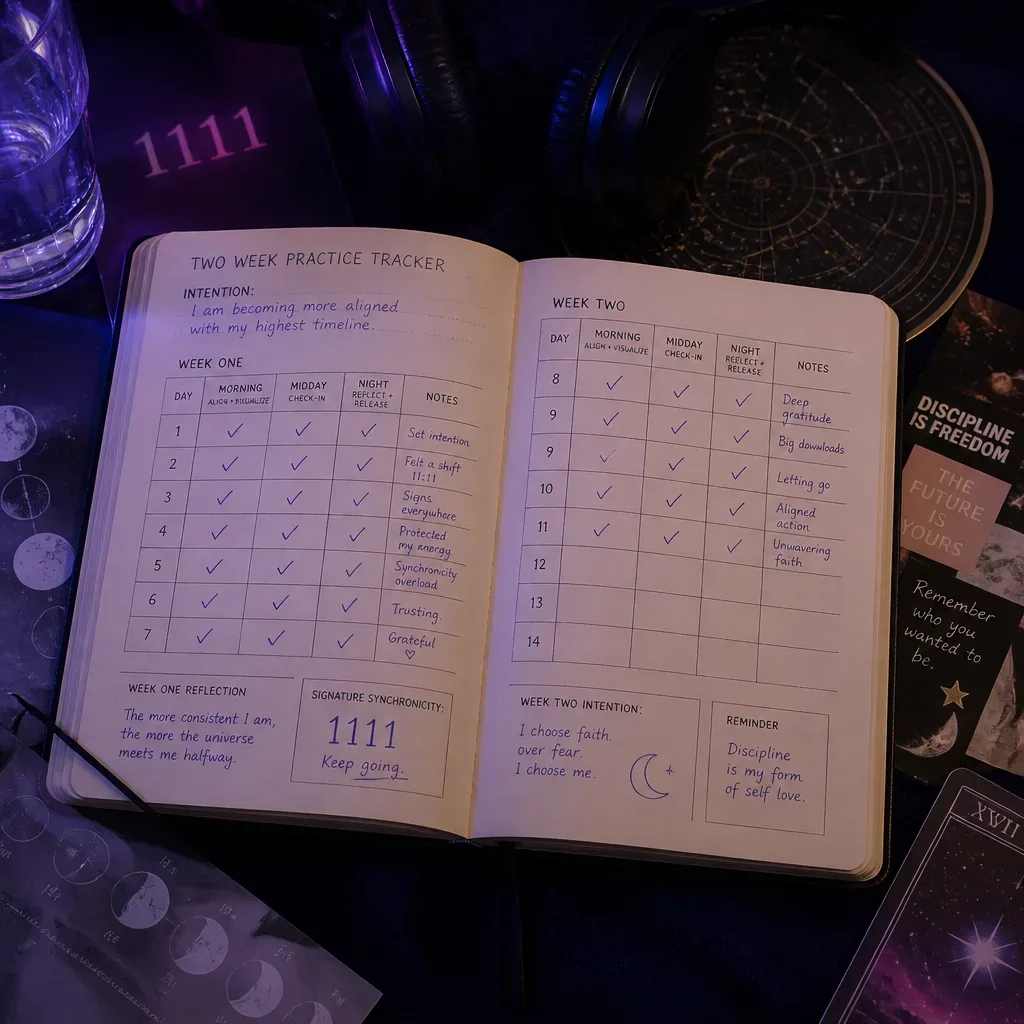
Use a simple scorecard:
| Day | Listened? | Old sentence caught? | Confirming action taken? | One note |
|---|---|---|---|---|
| 1 | Yes/No | Yes/No | Yes/No | What changed? |
| 7 | Yes/No | Yes/No | Yes/No | What repeated? |
| 14 | Yes/No | Yes/No | Yes/No | What arrived quietly? |
This is also where a Manifestation Board can help as a complement. Put the board where it can witness your choices, not where it can flatter your taste. Mine have been embarrassingly accurate and rudely slow. One board took 4 years to make sense. The object was not magic. It was a record of what I had finally admitted I wanted.
If you want the wider map, return to the Manifestation pillar and then refine the language through the Affirmations pillar. The method stays simple: audio first, words second, images third. The order matters because your nervous system needs to hear the new identity before your aesthetic starts decorating it.
What is the 7-day mental diet audio plan?
The 7-day plan is to listen daily, record the old sentence, choose one replacement line, and take one confirming action before the day closes.
Seven days will not rebuild an entire self-concept, but it will reveal your pattern. That is already useful. In podcast interviews, I have learned that people rarely change because they found a giant answer. They change because a smaller question would not leave them alone. “What do I keep rehearsing?” is one of those questions.
Use this plan:
- Day 1: audit the noise. Listen to the audio. Write the old sentence exactly. Do not improve it for public relations.
- Day 2: choose the replacement. Make it believable, specific, and active.
- Day 3: remove one input. Mute an account, pause a thread, or stop rereading the thing that feeds the old identity.
- Day 4: add one confirming action. Make it boring enough to repeat.
- Day 5: listen during resistance. Use the audio when the old sentence is loud, not only when you feel polished.
- Day 6: tell the truth. What result are you secretly demanding as proof?
- Day 7: review the receipts. Look for changed reactions, not just changed circumstances.
The number 7 has symbolic weight in many traditions: weekly cycles, rest cycles, lunar quarter phases of about 7.4 days. You do not need to worship the number. Use it as a container. Humans respond to containers. A 2010 study on implementation intentions by Peter Gollwitzer and colleagues found that “if-then” planning reliably increases goal follow-through across contexts. So write one: “If I start rehearsing the old sentence, then I listen again or repeat my replacement line once.”
Keep the practice clean. Do not add 14 rituals because day 2 felt good. The mind will try to turn clarity into a shopping list. Stay with the audio. The AYA Method works in the same direction the signal is already pointing. Useful when the signal is being subtle.
The middle space is not proof that nothing is happening. It is where the new instruction learns how to hold.
Tomorrow, press play before the old sentence finds the microphone.