audio manifestation
Passive Manifestation: 3-Minute Audio for Busy Days
Passive manifestation can be simple: listen to one short future-self audio for three minutes a day, even when your life is loud.

The kettle clicks off. A child coughs from the next room. Passive manifestation means you listen to one short future-self audio for three minutes, without forcing a mood or adding another task. It works best when it becomes small, daily, and easy enough to keep.
What is passive manifestation, really?
Passive manifestation is manifestation practiced through receiving, not performing.
It is not laziness. It is not pretending your rent paid itself. It is a way of letting the nervous system hear a new self-story when your hands are already full. If traditional manifestation asks you to write, visualize, speak, or plan, passive manifestation begins with listening. The body can be tired. The room can be noisy. The practice can still happen.
The phrase matters because many people quit spiritual routines for one simple reason: they ask too much of the morning. A 2010 University College London study by Phillippa Lally and colleagues found that habit formation took an average of 66 days, with wide variation from 18 to 254 days. The easier the action, the more likely it is to survive real life.
Passive does not mean vague. A 3-minute audio gives the mind a clear track to follow. You are not scrolling. You are not chasing a perfect state. You are letting a chosen identity become familiar by repetition. A sentence heard every day can become a place you return to.
The AYA Method is a daily audio manifestation practice. Each day you listen to a short personalized recording — your Dream-Self Moment — narrated from the version of you who has already manifested the life you intend. Listening is the practice. Repetition is the work. The audio is the method.
A practice you can keep on a bad day is worth more than a beautiful practice you abandon by Thursday.
Why does a three-minute audio practice fit busy days?
Three minutes works because it is short enough to enter the day before the day argues back.
Most people do not need a longer ritual. They need less friction. According to the American Time Use Survey from the U.S. Bureau of Labor Statistics, adults with children under 6 spent about 2.6 hours per day caring for household children in 2023. That number does not include the mental tabs open in the background: lunch boxes, school forms, messages, laundry, the thing you forgot at the shop.
When a practice asks for 30 minutes, silence, candles, and perfect focus, it becomes fragile. It can only happen in the rare version of your life. A 3-minute audio can happen in the kitchen, in a parked car, on a walk to the bus stop, or after a meeting when you have not yet stood up.
Audio also reduces the need to generate language. This is useful. In a 2018 Pew Research Center report, 6 in 10 adults said they sometimes felt too busy to enjoy life. Busy minds do not always want another blank page. They want a voice to follow.
| Practice type | Time asked | Effort level | Best for |
|---|---|---|---|
| Long scripting | 20 to 45 minutes | High | Quiet weekends, deep reflection |
| Spoken affirmations | 2 to 10 minutes | Medium | Mornings with privacy |
| Vision board review | 1 to 5 minutes | Low | Visual reminders |
| Passive audio | 3 minutes | Low | Busy days, tired days, caregiving days |
The point is not that shorter is always better. The point is that shorter is harder to refuse. If a practice can live inside the life you already have, it has a chance to become real.
For more context on the wider practice, keep the manifestation pillar nearby. But for busy days, begin here: press play, listen, return.
How do you set up passive manifestation before the day gets loud?
You set it up by choosing one cue, one audio, and one place where the practice will not need a decision.
The cue matters more than the time. Dr. BJ Fogg at Stanford has written for years about tiny habits and the value of attaching a new behavior to an existing one. You do not need a heroic morning. You need an anchor. After I put the kettle on. After I buckle my seat belt. After I close my laptop at 5:30. After I brush my teeth.
Choose a cue that already happens at least 5 days a week. The more ordinary, the better. A 2022 report from DataReportal estimated that the average internet user spends close to 7 hours online each day, which means attention is already being rented out in small pieces. Your cue is a way of taking back one piece.
Then remove the tiny obstacles. Put the app where your thumb can find it. Use headphones if your home is loud. Keep the volume gentle. If you are driving, start it before you move or wait until parked. Passive manifestation should make the day simpler, not less safe.
A clean setup can look like this:
- One listening cue: after the kettle, before the first message.
- One audio: your Dream-Self Moment.
- One posture: sitting, standing, walking slowly, or lying down.
- One rule: no judging the session while it is happening.
- One finish: carry one sentence into the next task.
This is where the AYA Method is useful because the audio is already the center. The app also includes a daily affirmation and a Manifestation Board, but those are complements. They can support the practice. They are not the practice.
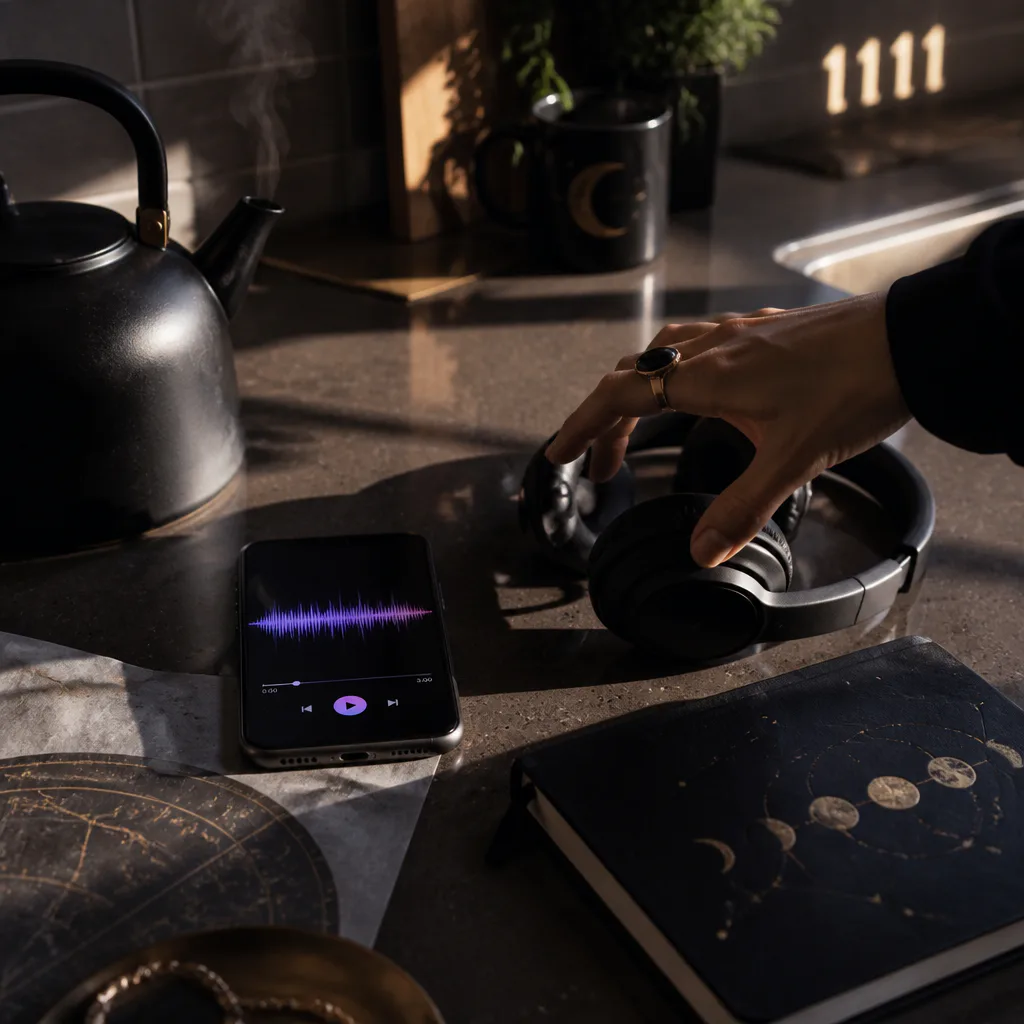
The method has to be small enough to meet you while the rice is boiling.
What do you actually do during the three minutes?
During the three minutes, you listen without trying to manufacture a feeling.
That is harder than it sounds. Many of us turn even rest into a job. We check whether we are doing it correctly. We measure ourselves against a version of calm we saw online. But the nervous system learns from repetition, not self-criticism. Dr. Andrew Huberman often speaks about the brain changing through repeated attention and behavior; the simpler the repetition, the less drama it needs.
Here is the whole practice:
- Press play. Let the first few seconds be plain. No ceremony needed.
- Soften your jaw. This gives the body a small signal that it does not have to fight the moment.
- Listen for the voice of your future self. Do not chase images. Let words land.
- Notice one true-enough sentence. True enough is enough.
- Return to the next task slowly. Do not grab your phone in the first second after the audio ends.
Three minutes is about 180 seconds. That is shorter than many songs. As a musician, I trust that number. A song can change the room in 180 seconds. Not by explaining everything. By repeating a phrase until the body knows where to stand.
Neville Goddard taught the importance of assuming the feeling of the wish fulfilled, often before sleep. Joe Dispenza has written about rehearsing a future self until the body begins to recognize it as familiar. You do not have to adopt every claim from either teacher to take the practical thread: repeated inner rehearsal changes what you notice, choose, and tolerate.
If your attention wanders, that is not failure. In mindfulness research, including studies published in journals such as Psychological Science, attention often wanders repeatedly; the training is in returning. Passive manifestation uses that same mercy. You return to the voice. You return to now.
What should you listen for in your Dream-Self Moment?
Listen for identity, evidence, and one next ordinary action.
A good future-self audio is not only a list of things you want. It speaks from the version of you who has already become steady with them. That means the recording should not just say, I have the job, the home, the relationship, the art, the money. It should also tell you who you are being there. Calm with choices. Honest with time. Clear with desire. Kind with limits.
Psychologist Hazel Markus introduced the idea of possible selves in 1986 with Paula Nurius. The concept is simple: people carry mental pictures of who they might become, who they hope to become, and who they fear becoming. Those pictures influence motivation. A Dream-Self Moment gives the hoped-for self a voice you can hear daily.
Listen for three layers:
| Layer | What it sounds like | Why it matters |
|---|---|---|
| Identity | I am the kind of person who keeps my word to myself. | It names who you are becoming. |
| Evidence | I notice how I handle money with more care. | It trains attention toward proof. |
| Next action | I send the message. I rest before I snap. | It keeps the practice grounded. |
This is why passive manifestation is not escape. It has to come back to your calendar, your body, your bank app, your children, your craft. If the audio never touches ordinary life, it becomes decoration.
You can pair the audio with affirmations, especially if one line keeps returning. Keep it short. One affirmation after the audio is plenty. More is not always more. Sometimes more is just noise wearing good clothes.
Your future self should sound less like a billboard and more like someone who knows your kitchen.
How do affirmations, boards, and astrology fit without taking over?
They fit as supports, not as replacements for the audio practice.
A daily affirmation can sharpen one line from the Dream-Self Moment. A Manifestation Board can give the eyes a clear symbol to return to. Astrology and manifestation can add timing, reflection, and language for cycles. But if you are practicing the AYA Method, the audio remains the method. Listening is the center. The other pieces gather around it.
This distinction protects the practice from becoming too heavy. A 2021 American Psychological Association survey found that 32 percent of adults reported being so stressed by the pandemic that they struggled to make basic decisions, such as what to wear or eat. Even outside that crisis period, decision fatigue is real enough in daily life. Too many tools can become another pile on the chair.
Use complements only when they make the audio easier to keep. If your affirmation helps you remember the sentence, use it. If the board helps you see what matters, glance at it. If astrology helps you notice a monthly rhythm, reflect with care. If any tool makes you feel behind, put it down for a while.
Here is a simple order for busy days:
- Listen to the 3-minute Dream-Self Moment.
- Keep one sentence.
- If useful, repeat one daily affirmation.
- If useful, glance at the Manifestation Board.
- Take one ordinary action that matches the audio.
That last step can be small. Drink water before coffee. Send the invoice. Close the tab. Say no without a speech. The action does not need to be dramatic to be honest.
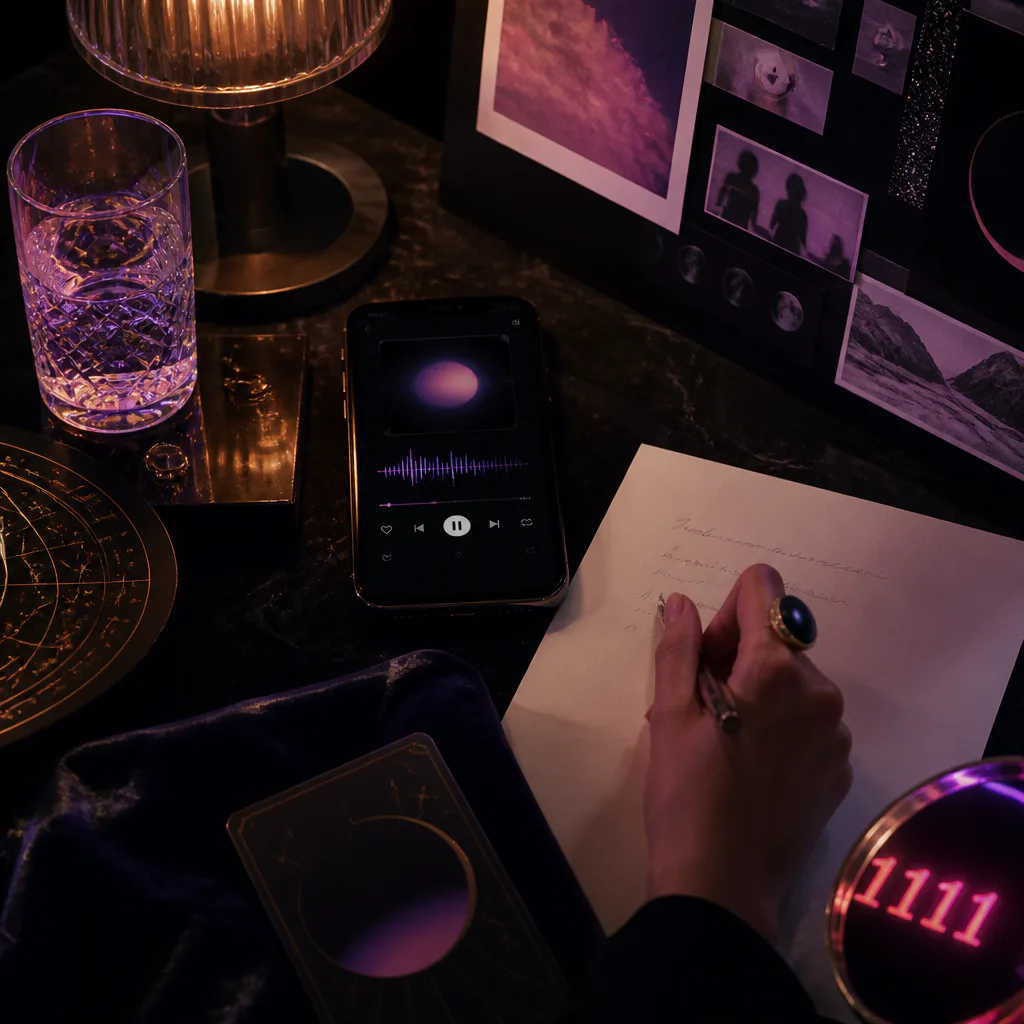
If you want a broader map of tools, this quiet guide to manifestation techniques can help. Just remember the hierarchy for this practice: audio first, complements second.
What if nothing seems to happen at first?
If nothing seems to happen, keep the practice small and look for quieter forms of evidence.
The first signs may not be cinematic. You may pause before saying yes. You may notice a job listing you would have ignored. You may stop telling the old story quite so quickly. You may rest for 10 minutes instead of pushing until you become sharp with everyone in the house. These are not tiny things. They are the roots.
Research on self-affirmation, including work by Claude Steele and later studies in the Journal of Personality and Social Psychology, suggests that reflecting on valued identities can reduce defensiveness and support better choices under stress. The exact mechanism is still studied, and no single practice should be treated like a cure. But identity-based reflection has a serious research history.
Give the practice a fair container. Try 21 days if that feels doable, or 66 days if you want to borrow the habit-study average from Lally’s research. Track only one thing: Did I listen today? Not whether it felt special. Not whether the sky opened. Just whether you returned.
A simple tracker can stay plain:
| Day | Listened? | One sentence I kept |
|---|---|---|
| 1 | Yes | I can move slowly and still move. |
| 7 | Yes | I tell the truth sooner now. |
| 14 | No | I begin again without drama. |
| 21 | Yes | My life recognizes my steadiness. |
Missed days are not moral evidence. They are missed days. Start again the next time the kettle clicks, the car parks, the baby sleeps, or the room gives you three minutes back.
The future does not need you to perform certainty. It needs you to return.
The room is still enough for three minutes.