manifestation 101
Scripting Manifestation: Make a 3-Minute Audio
Scripting manifestation gets easier when your future page becomes audio. Learn the quiet 12-minute process for writing, recording, and listening daily.
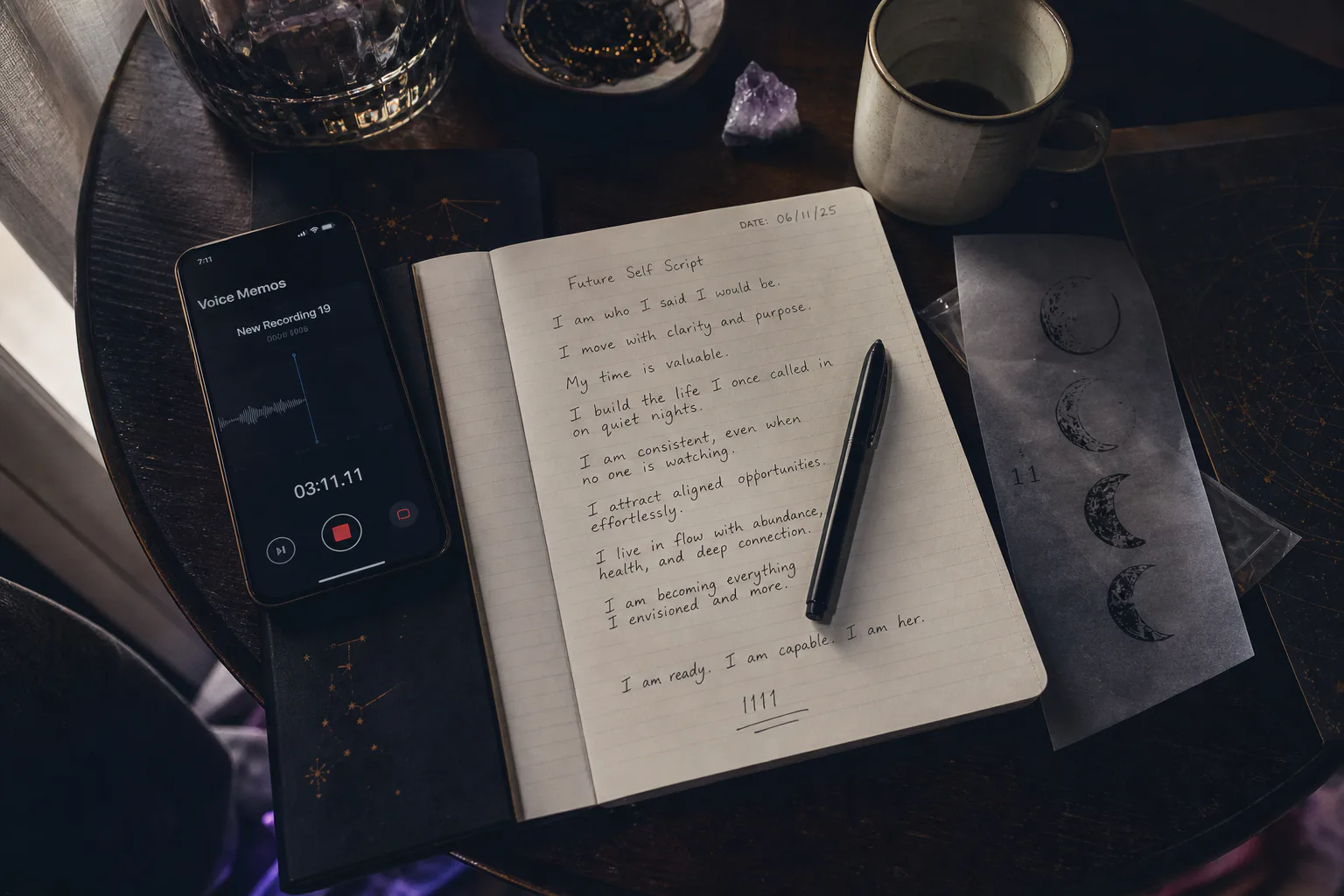
A notebook. A phone. Three quiet minutes. Scripting manifestation means writing one future page as if your intended life is already ordinary, then recording it so you can hear it every day. Keep it specific, believable, and short enough to repeat without making a ceremony of it.
What is scripting manifestation, really?
Scripting manifestation is future-self writing made practical: one page, present tense, written as a lived scene.
The old version is simple. You write as the person who already has the thing, has made the choice, has kept the promise. Not as a wish. Not as a list of demands. As a day. A Tuesday, even. The coffee is getting cold. The inbox is not frightening. The money conversation is calm. Specificity is the kindness here.
In manifestation, the question is often not whether you want something. You usually know that part. The better question is whether you can rehearse being the person who relates to that desire differently. Research on mental rehearsal has been around for decades; a 1995 study by Pascual-Leone found that mental practice could change motor-cortex maps in a way that partly resembled physical practice. That does not mean writing replaces action. It means attention trains.
Scripting manifestation becomes more useful when it moves from fantasy into evidence. One sentence can be soft and exact: I answer the message before lunch. Another can name a feeling: I feel steady enough to tell the truth. A third can name behavior: I open the document for 20 minutes. The future gets easier to meet when it has furniture in it.
A script is not magic because it is dramatic. It is useful because it is repeatable.
If you are new to this, use one page. Around 350 to 450 words is enough. The American Speech-Language-Hearing Association often places conversational speech near 150 words per minute, and many guided practices speak slower, closer to 120. That gives you a clear 3-minute audio without rushing your own nervous system.
Why turn your future page into audio?
Audio makes the script easier to repeat, and repetition is where the practice begins to matter.
A page can be beautiful and still stay closed. I say this as a person who owns notebooks with very sincere first pages and absolutely nothing after page four. Audio lowers the threshold. You can listen while walking around the block, sitting on the edge of the bed, or waiting for water to boil. Three minutes fits inside ordinary life.
The AYA Method is a daily audio manifestation practice. Each day you listen to a short personalized recording — your Dream-Self Moment — narrated from the version of you who has already manifested the life you intend. Listening is the practice. Repetition is the work. The audio is the method. You can read more about the AYA Method if you want the full frame.
This matters because the brain learns through repeated pairing. Dr. Andrew Huberman has often described learning as a mix of attention, repetition, and sleep-related consolidation. The details differ by task, but the principle is plain: what you revisit has more chance to become familiar. The point is not to force belief. The point is to stop making your desired self feel like a stranger.
There is also a voice effect. A 2017 study in Scientific Reports found that hearing one’s own voice activates self-related processing differently than hearing other voices. Even when the recording feels awkward at first, it is still yours. Your voice carries evidence. It says: someone in this room is willing to speak this future out loud.
Your future page becomes more real when it has your breath inside it.
How do you write the 3-minute scripting page?
Write one ordinary scene from the future, then edit it until your body can stay with every line.
Start smaller than your ego wants. If the intention is a new home, do not begin with the grand entrance. Begin with keys in a bowl. If the intention is love, do not begin with a sweeping declaration. Begin with the way you speak honestly and do not apologize for having needs. If the intention is work, begin with the first email you send without shrinking.
In expressive writing research, James Pennebaker’s studies often used 15 to 20 minutes of writing across several days and found modest benefits for stress-related outcomes in some groups. Your scripting page is shorter, but the same lesson helps: words become clearer when they name what is actually felt. You are not decorating the page. You are telling the truth from a later room.
Use this 6-part frame:
- Name the scene in one line.
- Write in present tense.
- Add three sensory details.
- Name one choice your future self makes.
- Name one feeling in the body.
- End with one small action you can take today.
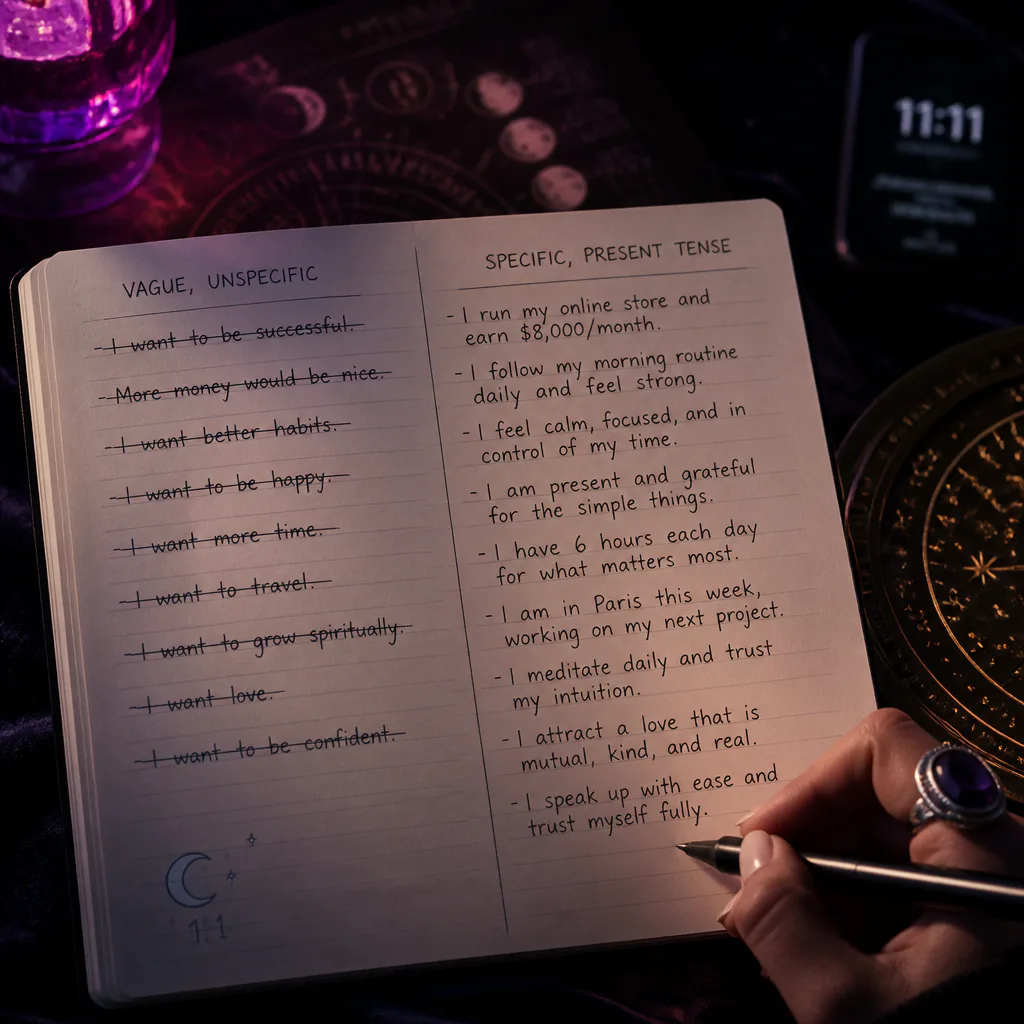
Here is the difference between a cloudy script and a usable one:
| Cloudy line | Usable line |
|---|---|
| I have my dream life. | I wake at 7:10 and my calendar has space between calls. |
| I am confident. | I send the proposal before I can over-edit it again. |
| I am loved. | I say what I mean and the room stays kind. |
| Money comes easily. | I check the number, make the transfer, and breathe normally. |
The usable line is not less spiritual. It is more honest. In cognitive behavioral work, specificity is often used because vague thoughts are hard to test. A sentence like I am safe in every way may be too large for your body today. A sentence like I can answer one hard message and remain here may be enough.
What should you say when you record it?
Record the script as if you are speaking from a calm future, not performing for an audience.
Your phone microphone is enough. Do not wait for the perfect setup. Do not buy a new device unless buying a device is your favorite way to avoid beginning. Sit somewhere you will not be interrupted for 5 minutes. Read once silently. Then press record and speak at a pace that feels slightly slower than normal.
A 3-minute audio at 125 words per minute is about 375 words. That number is useful because it keeps the script from becoming a speech. You want one clear scene, not a life story. If you write 900 words, you will either rush or stop listening by day three. The practice should feel returnable.
Try this recording shape:
- First 20 seconds: arrive in the scene.
- Next 60 seconds: describe what is different now.
- Next 60 seconds: name how you act from this self.
- Next 30 seconds: speak one steady belief.
- Final 10 seconds: name today’s next small action.
You can borrow the clarity of affirmations, but keep the script more lived than a slogan. An affirmation may say: I trust myself to begin. A scripting audio says: I open the file at 9:00, write the first ugly paragraph, and do not ask it to be brilliant. Both can help. The audio carries the scene.
If you stumble, keep going. Small speech errors make the recording human. In podcasting, I have learned that the perfect take is often the one that sounds least alive. Let one breath stay. Let one pause remain. Your future self does not need studio polish. She needs to be hearable.
How do you listen so it becomes a daily practice?
Listen once a day at the same anchor point, and keep the first version for seven days before changing it.
The anchor point matters more than the mood. Listen after brushing your teeth. Listen before opening email. Listen during the first three minutes of a walk. A 2020 study in the British Journal of Health Psychology found that habit formation is helped by stable cues and repeated context. You do not have to feel inspired. You just have to know where the practice lives.
The app can support this kind of return because it is built around audio first. The daily affirmation and Manifestation Board can complement the listening, but they are not the center. If you use a board, let it hold visual proof. If you use a short affirmation, let it carry one sentence from the script. The listening remains the practice.
Here is a quiet 7-day way to begin:
- Day 1: record and listen once.
- Day 2: listen before checking messages.
- Day 3: write down one line that felt true.
- Day 4: take the small action named at the end.
- Day 5: listen while walking.
- Day 6: notice one place you resisted the script.
- Day 7: edit only the line that no longer fits.
Seven days is not a sacred number. It is a clean test. In a well-known 2009 European Journal of Social Psychology study by Phillippa Lally and colleagues, habit automaticity took a median of 66 days, with wide variation. That finding is often simplified online, but the useful part is humbling. Repetition takes time. A week only tells you whether the practice is gentle enough to continue.

How do you keep scripting manifestation from becoming make-believe?
You keep it real by pairing every future line with a present behavior, however small.
The danger of scripting is not that it is too mystical. The danger is that it can become a private theater where nothing changes after the curtain falls. A good script makes the next step easier to see. If your future page says you are someone who cares for her body, the present behavior might be drinking water before the second coffee. Tiny, yes. Also measurable.
Implementation intention research by psychologist Peter Gollwitzer has shown that if-then plans can improve follow-through across many behaviors. The format is almost embarrassingly plain: If it is 8:30, then I open the invoice. If I start spiraling, then I put both feet on the floor. Your scripting audio can end with this kind of line. It brings the future back into the room.
You can also use timing as a mirror. Some people like to write or record with moon phases or birth-chart seasons in mind. If that language helps you reflect, keep it grounded. Astrology and manifestation can be a symbolic calendar, not an excuse to wait for permission. The date can support the practice. It cannot do the listening for you.
A useful script has three kinds of proof:
- Emotional proof: the line feels possible enough to hear.
- Sensory proof: the scene has real details.
- Behavioral proof: one action can happen today.
There is no need to bully yourself into belief. The quieter test is better: can you listen without abandoning yourself? If the answer is no, soften the line. Make it smaller. Make it true enough for Tuesday.
What do you do after the first week?
After seven days, revise one layer at a time: the scene, the language, or the action.
Do not rewrite the whole thing just because you got bored. Boredom is sometimes the first sign that the nervous system is no longer treating the future as alarming. Stay a little longer. Repetition often becomes plain before it becomes useful. In meditation research, even brief daily practices are studied in 8-week windows because attention changes slowly and unevenly.
Use this review table at the end of the week:
| Question | If yes | If no |
|---|---|---|
| Did I listen at least 5 of 7 days? | Keep the same anchor. | Choose an easier time. |
| Did one line feel false? | Rewrite only that line. | Leave the script alone. |
| Did I take the small action? | Add the next small action. | Make the action smaller. |
| Did the scene still matter? | Keep recording. | Choose a more honest scene. |
This is also where a broader practice can help. If you want the full foundation, start with the manifestation guide and notice what kind of desire keeps returning. If your script is mostly made of self-talk, the affirmations guide can help you sharpen the sentence. If you want the audio container, return to the AYA Method and let the Dream-Self Moment hold the daily repetition.
Keep your old recordings. Date them. Future you may laugh softly at the voice you used. Good. That means you stayed. In my own folders, there are versions of me trying very hard to sound calm. I have affection for her. She was practicing before she had proof.
The page is waiting to be heard.