love manifestation
Self Love Affirmations From Your Future Self
Self love affirmations can sound steadier when they come from your future self. Hear 33 quiet lines for repair, desire, trust, and return.

Your phone is face down. The room is still. Self love affirmations work best when they sound like care you can almost believe: short, specific, and repeated daily, ideally in a voice that feels like your future self speaking back to you with steadiness you don’t have to force.
Why do self love affirmations feel different when they come from your future self?
They feel different because the speaker matters as much as the sentence.
A self love affirmation can fail when it sounds like a task. You stand in the bathroom and say, I love myself completely, while your body says, not yet. That gap is not moral weakness. It is information. In a 2009 study by Joanne Wood, W. Q. Elaine Perunovic, and John Lee, very positive self-statements made some people with low self-esteem feel worse, not better. The words were too far from what they could accept.
Your future self gives the sentence a softer place to stand. Instead of demanding belief now, the voice says, I remember when this was hard. It makes room for the distance. It lets the affirmation be directional, not fake. A true affirmation doesn’t need to shout over doubt. It needs to stay near you long enough for your nervous system to notice.
This is where audio matters. The AYA Method is a daily audio manifestation practice. Each day you listen to a short personalized recording — your Dream-Self Moment — narrated from the version of you who has already manifested the life you intend. Listening is the practice. Repetition is the work. The audio is the method.
Self-affirmation theory began with Claude Steele’s 1988 work on the self-system. Later reviews, including Cohen and Sherman’s 2014 Annual Review of Psychology paper, found that affirming core values can help reduce defensiveness under threat. That does not mean every pretty sentence heals everything. It means the mind responds when a statement protects a valued sense of self.
Here is the quiet distinction: self love affirmations are not proof that you already feel whole. They are practice for how you’ll speak to yourself while you’re becoming honest again.
Which self love affirmations are easiest to believe first?
The easiest ones are the lines that don’t ask you to perform certainty.
Start with affirmations that name permission, not perfection. If you have been burned out, heartbroken, or overtrained in being useful, your system may not trust grand language. Kristin Neff’s research on self-compassion, first widely measured in 2003, separates self-kindness, common humanity, and mindful awareness. Those three parts are useful here. The line can be kind. It can admit difficulty. It can stay present.
Try these first. Read them slowly. Choose only the ones that feel close enough.
- I don’t have to earn gentleness today.
- I can be unfinished and still be worthy of care.
- I am allowed to need time.
- I can tell the truth without leaving myself.
- My softness is not a problem to solve.
- I can return to myself in one small choice.
- I don’t have to become someone else to be loved.
- I can be proud of staying.
- I am safe to be honest with myself now.
- My needs are not too much because they exist.
- I can receive care without apologizing for it.
The wording matters. In behavior science, a cue becomes more useful when it is specific. Lally’s 2009 habit study followed 96 people and found automaticity rose with repeated action in stable contexts, though the time varied widely from 18 to 254 days. Your affirmation is not magic. It is a cue. It tells you how to speak before the old reflex takes over.
A small test helps. If the line makes your chest tighten, soften it. Change I love every part of myself to I am learning not to abandon myself. Change I am fully healed to I can be kind to the part that is still healing. The truest sentence is often the quieter one.
| If this feels too far | Try this instead |
|---|---|
| I love myself completely | I can be kinder to myself today |
| I am healed | I can care for the part that still hurts |
| I am confident | I can take one steady breath before I answer |
| I deserve everything | I don’t have to reject what is good for me |

How do I turn affirmations into a future-self audio practice?
You turn them into practice by making the voice personal, brief, and repeatable.
Writing self love affirmations is one thing. Hearing them is another. Auditory processing studies often show that spoken language carries emotional cues beyond the words themselves, including tone, pace, and pause. A 2019 review in Frontiers in Psychology noted that voice can influence social and emotional perception within milliseconds. This is why one sentence from the right voice can land differently than the same sentence on a screen.
Use a future-self frame. Not fantasy. Not performance. Just a wiser version of you speaking from a little further ahead. You don’t need to describe a perfect life. You need to describe a steadier relationship with yourself.
A simple recording structure can hold you:
- Open with recognition. Say where you are now without shame. I know mornings have felt tender lately.
- Name the future self. Let the voice speak from after the repair. I am speaking from the version of you who no longer bargains with her worth.
- Choose three affirmations. Keep them under 12 words each if you can.
- Add one lived detail. A cup on the table. A hand on the heart. A door closing softly.
- End with one instruction. Drink water. Answer slowly. Stay here.
Keep it short. The AYA app is built around a Dream-Self Moment because the practice has to fit inside a real day. The daily affirmation and Manifestation Board can support the work, but the audio is the method. If you want the wider frame, the manifestation guide explains how intention, repetition, and attention can work together without pretending life is simple.
Your voice does not need to sound polished. I know this as someone who once edited sentences until they had no breath left in them. After I left the magazine, I recorded letters to my future self before coffee. They were rough. They worked because I believed the speaker might be real.
A future-self affirmation is a letter with a pulse.
What are 22 self love affirmations your future self might say?
These affirmations work best when you hear them as a voice coming home to you.
You can borrow all 22, but you do not need all 22 today. In working memory research, George Miller’s famous 1956 paper proposed that people can hold about 7 items, plus or minus 2, though later research suggests the number is often closer to 4. Fewer lines are easier to remember. The point is not volume. It is return.
For repair:
- I forgive the version of me who survived by disappearing.
- I can come back without punishing myself for leaving.
- I don’t need to explain my tenderness to be worthy of care.
- I can stop calling my needs inconvenient.
- I am allowed to rest before everything is fixed.
For desire:
- Wanting more tenderness does not make me ungrateful.
- I can want love that feels calm in my body.
- I do not have to shrink to be chosen.
- My longing is allowed to tell the truth.
- I can receive without rehearsing loss.
For trust:
- I can hear my own no before it becomes resentment.
- I can hear my own yes without asking everyone first.
- I know the difference between fear and wisdom more often now.
- I can move slowly and still be moving.
- My body is allowed to be part of the answer.
For daily return:
- I am still here.
- This breath counts.
- I can begin again without drama.
- I am not behind in becoming myself.
- I can be loved in ordinary clothes.
- I am learning the sound of my own care.
- I don’t have to leave myself to keep anyone close.
The affirmations guide goes further into wording, repetition, and why believable language often works better than bright slogans. A 2016 study in Social Cognitive and Affective Neuroscience by Cascio and colleagues found that self-affirmation activated brain regions linked with self-related processing and valuation. That is not a promise. It is a clue: the brain treats self-relevant words as meaningful input.
Choose the sentence that makes you exhale. That is often the one your future self would keep.
How should I use self love affirmations when love feels complicated?
Use them to stay truthful, not to make pain look prettier.
Love can make self-talk strange. You may want to be generous, but you may also be tired. You may want closeness, but your body may be braced. This is where self love affirmations can become boundary language. Not a wall. A room with a door that opens from the inside.
Pew Research Center reported in 2023 that 30% of U.S. adults had used a dating site or app, and younger adults reported even higher use. That number matters because many people are practicing intimacy through fast signals: likes, pauses, replies, silence. A future-self affirmation can slow the signal down. It can ask, What do I know before I check my phone again?
Try these in love:
- I don’t have to confuse intensity with care.
- I can be patient without becoming available for harm.
- I can like someone and still listen to myself.
- I can wait for consistency without begging for it.
- I can want devotion and keep my dignity.
- I am allowed to choose the love that can choose me back.
If you use timing practices, charts, or symbolic seasons, keep self-respect at the center. Astrology and manifestation can be a reflective tool, but it should never overrule what your body already knows. A transit does not get to talk you out of your boundary. No symbol is wiser than your direct knowing.
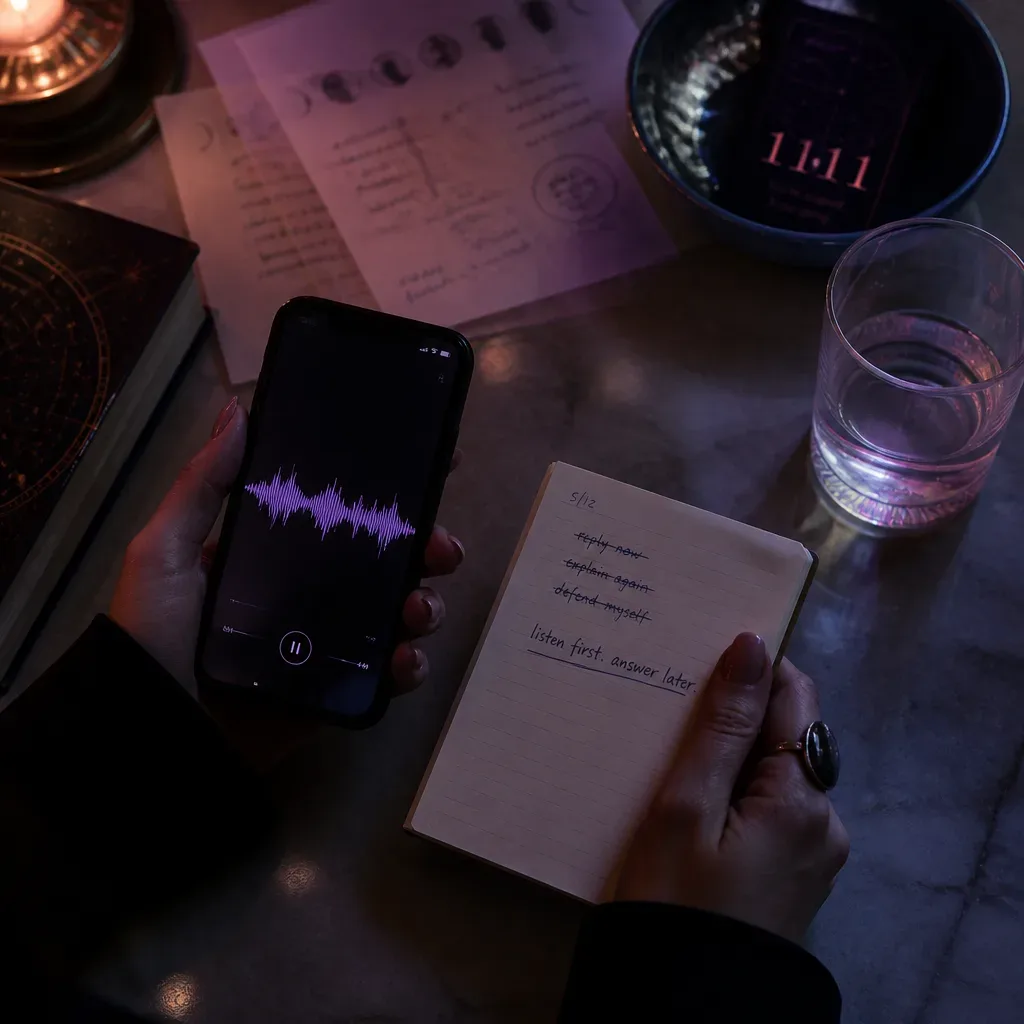
There is a useful pattern here. The affirmation should bring you closer to action. If it makes you passive, rewrite it. I trust love will find me may sound soft, but I can notice love that is kind when it arrives gives you a role. It gives you eyes.
In the Journal of Behavioral Medicine, self-compassion has been linked in several studies to lower perceived stress and better health behaviors, though effects vary by population and method. This matters because self love is not only a feeling. It changes what you tolerate at 9:17 p.m. when the message arrives.
What makes a self love affirmation safe enough to repeat?
A safe affirmation is believable, bodily, specific, and kind.
Before you repeat any line for 7 days, test it. Say it once. Notice your jaw, shoulders, stomach, and breath. The body often answers before the mind edits. Dr. Andrew Huberman has popularized the idea that breath and state are linked, and the physiology is well established: slower exhalations can engage parasympathetic pathways. You do not need to turn this into a project. Just pause long enough to know if the sentence softens or tightens you.
Use this small checklist:
- Believable: Could 5% of you accept it today?
- Bodily: Does it help your breath, face, or hands soften?
- Specific: Does it name a real pattern in your life?
- Kind: Would you say it to someone you love?
- Repeatable: Can you hear it every morning without rolling your eyes?
A good affirmation does not bully you into brightness.
If a line feels unsafe, lower the claim. I am lovable may be too much on some mornings. Try I am willing to stop speaking to myself like I am disposable. That still protects you. It may even protect you better. In trauma-informed care, pacing matters; many clinicians use the phrase window of tolerance, popularized by Dan Siegel, to describe the zone where a person can process without becoming overwhelmed.
You can also pair the line with one tiny act. Say I can care for my body today, then drink water. Say I can let myself be seen slowly, then send the honest text. The action makes the sentence real. The sentence makes the action easier to find.
For a broader map of intention practice, you can return to manifestation and then come back to one line. Large maps are useful. Small doors are where you enter.
How do I choose the one affirmation for today?
Choose the line that meets the exact place where you are most tempted to leave yourself.
Not the prettiest line. Not the one that would look best on a card. The one that interrupts the old move. If your old move is apology, choose My needs are not too much because they exist. If your old move is overgiving, choose I can be generous without abandoning myself. If your old move is silence, choose I can tell the truth in a calm voice.
Implementation intention research by Peter Gollwitzer, developed in the 1990s, shows that if-then plans can help people act on goals more reliably. Use that here. Make the affirmation situational: If I start to chase reassurance, then I will listen to my future self for 3 minutes. Specificity keeps the practice from floating away.
Here is a quiet 5-day rotation:
| Day | Future-self line | Use it when |
|---|---|---|
| Monday | I can be unfinished and still be worthy of care | You want to prove yourself |
| Tuesday | I can hear my own no before resentment | You feel pressure |
| Wednesday | I don’t have to shrink to be chosen | You want to edit your truth |
| Thursday | I can begin again without drama | You miss a habit |
| Friday | I can receive without rehearsing loss | Something good arrives |
If you miss a day, do not make the missed day the story. In Lally’s 2009 habit study, missing one opportunity did not erase habit formation. That finding is merciful. It lets you return without ceremony.
One line is enough when you actually hear it. One breath is enough when it brings you back now.
Put the phone down. Stay near yourself.