mindset
Self Worth Manifestation: 3-Minute Audio
A quiet 3-minute self worth manifestation practice using personalized audio, small repetition, and one clear sentence for feeling enough today, with no early alarm or performance.

The kettle clicks off. Self worth manifestation is a 3-minute audio practice for feeling enough before the proof arrives. You listen to a short future-self recording, let one true sentence land, and take one small action from that steadier place. The practice is short because repetition matters more than drama.
What does self worth manifestation actually mean?
Self worth manifestation means rehearsing your enoughness as a present truth, not as a prize you earn later.
Self-worth is not the same as confidence. Confidence often rises and falls with a task. You can feel confident making dinner and still feel small when you open your inbox. Self-worth sits deeper. The Rosenberg Self-Esteem Scale, first published in 1965, uses 10 items to measure global self-regard, including the simple line, I feel that I am a person of worth. That sentence is quiet. It is also hard for many people to say.
Manifestation, at its cleanest, is the practice of rehearsing identity before circumstance confirms it. If you want the broader frame, the manifestation pillar names the practice as attention, feeling, repetition, and action. For self worth manifestation, the focus narrows: you are not trying to become more impressive. You are practicing the feeling of not needing to perform for your right to be here.
The AYA Method is a daily audio manifestation practice. Each day you listen to a short personalized recording — your Dream-Self Moment — narrated from the version of you who has already manifested the life you intend. Listening is the practice. Repetition is the work. The audio is the method.
That matters because enoughness often fails as an idea but returns as a sound. You can argue with a sentence on a page. It is harder to argue with a voice that arrives slowly and says your name. Enough is not a mood. It is a place you return to with a cue.
Why use audio when your mind is already loud?
Audio helps because it gives your attention a steady track to follow when your inner speech keeps interrupting.
Most of your day is already narrated. You hear the voice that says you should have answered sooner, looked better, earned more, been calmer with the child, been sharper in the meeting. In cognitive psychology, inner speech is often described as a normal part of self-regulation; small studies using experience sampling have found that people report inner speech in a meaningful share of waking moments. The problem is not that the mind speaks. The problem is that it often repeats the harshest line.
A 3-minute recording does something humble. It replaces the loudest voice for 180 seconds. Dr. Andrew Huberman has often spoken about neuroplasticity in terms of focus and repetition: the nervous system changes through repeated, attentive states, not through one grand declaration. You do not need to win a debate with your old story. You need to give the body a new cue often enough that it stops bracing.
There is also rhythm. As a musician, I trust rhythm more than mood. A bass line does not ask the drummer to feel ready. It arrives at the same place again and again. Audio works like that. It gives time a shape. Two minutes of listening can hold the sentence longer than your willpower can.
Audio gives the mind a voice to borrow until its own voice softens.
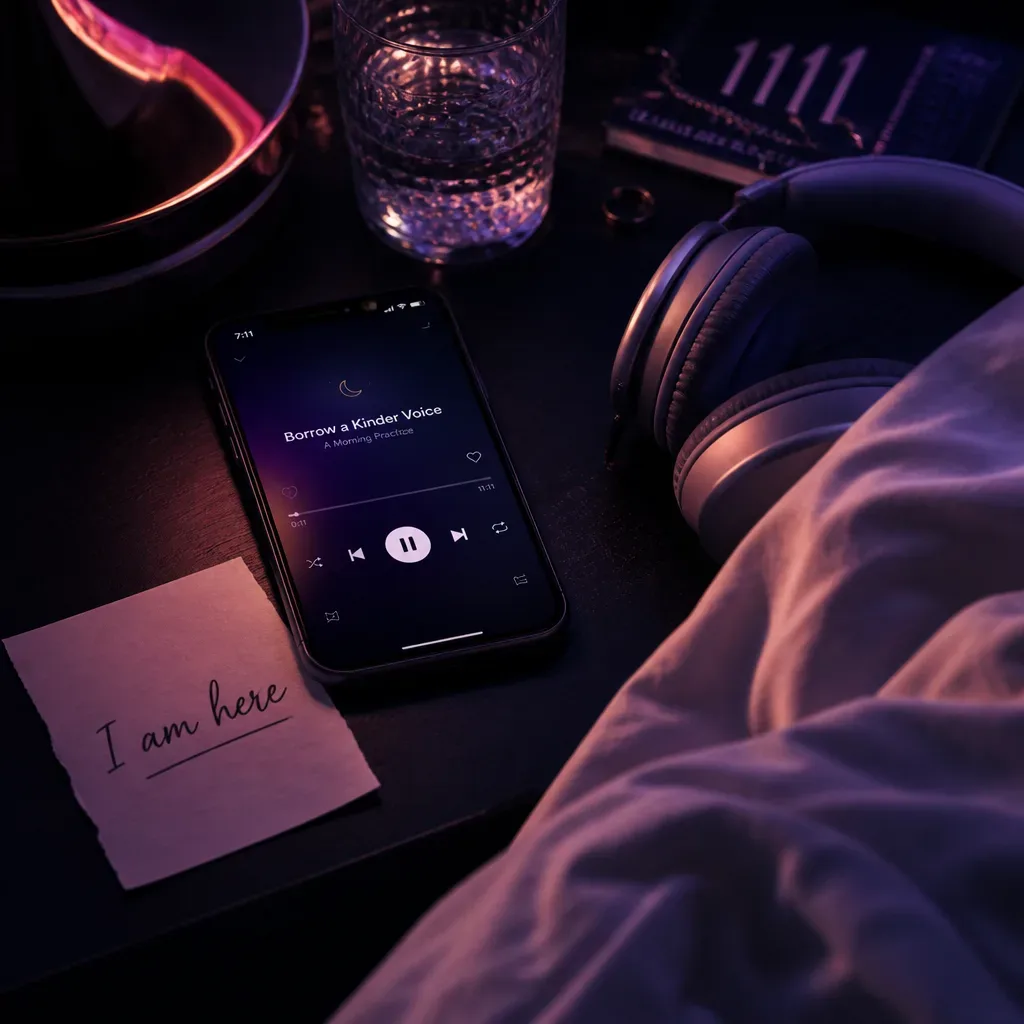
How do you do the 3-minute practice?
You do it by settling, listening, and closing with one small action that treats you as already enough.
Use a timer if you like. Use the car before you go inside. Use the bathroom if the house is loud. A 2022 Gallup report found that stress remained at historically high levels worldwide, and parents, caregivers, and workers often have very little clean space in a day. The point is not to build a perfect room around the practice. The point is to make the practice small enough to survive real life.
Here is the simple shape:
- Settle for 30 seconds. Put both feet down. Let the tongue rest. Breathe out longer than you breathe in, three times.
- Listen for 2 minutes. Play your Dream-Self Moment, or another short future-self audio, without checking messages.
- Close for 30 seconds. Say one sentence aloud. Then do one small thing that matches it.
| Minute | What you do | What it teaches |
|---|---|---|
| 0:00-0:30 | Breathe and arrive | I do not have to rush to be worthy |
| 0:30-2:30 | Listen to the audio | I can receive a steadier version of myself |
| 2:30-3:00 | Repeat one sentence and act | My worth can move into the next choice |
The closing action must be small. Drink water before you answer the message. Put your shoulders down before the call. Open the document and write one bad first line. A 2018 review in the journal Health Psychology Review noted that tiny behavior changes are more likely to repeat when they are tied to clear cues. The cue here is the audio. The action is the receipt.
You do not become enough by winning an argument with your nervous system.
What should the recording say so it feels true?
The recording should say one specific, believable truth from the future self who no longer begs to be chosen.
Do not start with a sentence your body hates. If I am completely worthy of everything sounds too far away, use something nearer. The self-affirmation research tradition, often traced to Claude Steele in 1988, suggests that people can protect a stable sense of self by reflecting on values that matter to them. The sentence does not need to be huge. It needs to be livable.
Try lines like these:
- I do not need to earn tenderness by overworking.
- I can be learning and still be worthy of respect.
- I let one person be disappointed without abandoning myself.
- I am allowed to take up the space my life requires.
- I return to myself before I perform for anyone else.
If you use affirmations, keep them close to the audio. The daily affirmation is a complement. It can carry the main sentence into the day, but it does not replace the listening. In self worth work, writing can sharpen the line. Audio lets the line reach places that are tired of being corrected.
A true sentence can be small and still change the room. Neville Goddard called a related practice living in the end, meaning you rehearse from the fulfilled state rather than begging from lack. For this topic, the fulfilled state is simple: you are not auditioning for your own kindness.

What if you do not believe it yet?
You do not need to believe the whole recording; you only need to stay with the part that feels one inch true.
This is where many people quit. The audio says, I trust myself, and the mind answers, No you do not. Fine. Let it answer. Then listen again tomorrow. In randomized studies led by Geoffrey Cohen and colleagues in 2006, brief values-affirmation writing exercises improved academic outcomes for some students under stereotype threat, with effects measured across a school term. That does not mean every affirmation fixes every wound. It means short identity cues can matter when they meet the right context and repetition.
If the sentence feels false, scale it down:
- Change I love myself to I am willing to stop speaking to myself like an enemy.
- Change I am chosen to I can choose one honest thing today.
- Change I am enough to I am practicing enoughness for 3 minutes.
There. Now the body has less to fight.
Joe Dispenza often teaches mental rehearsal as a way of practicing a future state before outer events change. You do not have to accept every claim around that work to see the practical piece: rehearsal is familiar to athletes, actors, and musicians. Before a show, I used to run the first song in my head. Not to become magic. To become available when the count-in came.
You do not need to believe the whole future. You need to rehear one honest piece of it.
How does this fit with a bigger manifestation practice?
The 3-minute audio is the center; images, writing, timing, and reflection can support it without taking its place.
If you already keep a board, use it lightly. The Manifestation Board can help you see what you are practicing, but seeing is not the same as listening. A photo of a calm home, a paid invoice, or a healthy body can be useful. Still, the daily return is the audio. The voice is where the self-worth cue becomes intimate.
For a wider map of desire, identity, and action, read the main piece on manifestation. If you like working with lunar timing, birth charts, or symbolic seasons, astrology and manifestation can give you a reflective calendar. Use those tools as mirrors, not judges. No chart gets to decide whether you deserve care.
A simple weekly rhythm can help:
- Daily: listen to the 3-minute self worth audio.
- Daily: repeat one affirmation after listening.
- Twice a week: check your Manifestation Board and remove anything that feels like performance.
- Once a week: write three lines about where you acted as if you were already enough.
Specific numbers keep the practice kind. Three minutes daily is 21 minutes a week. That is less than one long scroll at night for many people; Pew Research Center reported in 2024 that a large share of adults say they are online almost constantly. You are not adding a second life. You are taking back a very small piece of this one.
The practice is not there to make you impressive. It is there to make you honest enough to stop leaving yourself.
What changes after 7 days?
After 7 days, you may notice less argument inside the first minute and one or two kinder choices in ordinary places.
Keep the expectation modest. A week is not a personality transplant. It is 21 minutes of rehearsal. In behavior science, repetition under the same cue is one reason habits become easier; a 2009 study by Phillippa Lally and colleagues found that habit formation varied widely, with an average of 66 days in that sample. Seven days is not the finish. It is enough time to see whether the cue is becoming familiar.
Track three things, not ten:
- Did I listen today?
- Which sentence felt most true?
- What did I do afterward that treated me as worthy?
If nothing changes, adjust the sentence before you blame yourself. Maybe the audio is too grand. Maybe the voice moves too fast. Maybe you need to hear your future self speak about the exact place you feel unworthy: money, parenting, work, love, body, age. Specific shame needs specific tenderness.
This is where the wider AYA Method practice can help, because the Dream-Self Moment is personalized. It is not a poster on a wall saying be confident. It is your future self speaking into the part of the day where you usually disappear.
Self worth manifestation is not self-improvement with softer lighting. It is the refusal to keep treating your own life as something you have to earn.
You were enough before the sentence finished.