mindset
Shadow Work Manifestation in 3 Minutes
Shadow work manifestation can be small and steady: a 3-minute future-self audio practice to meet hidden fears without making them the center of your day.
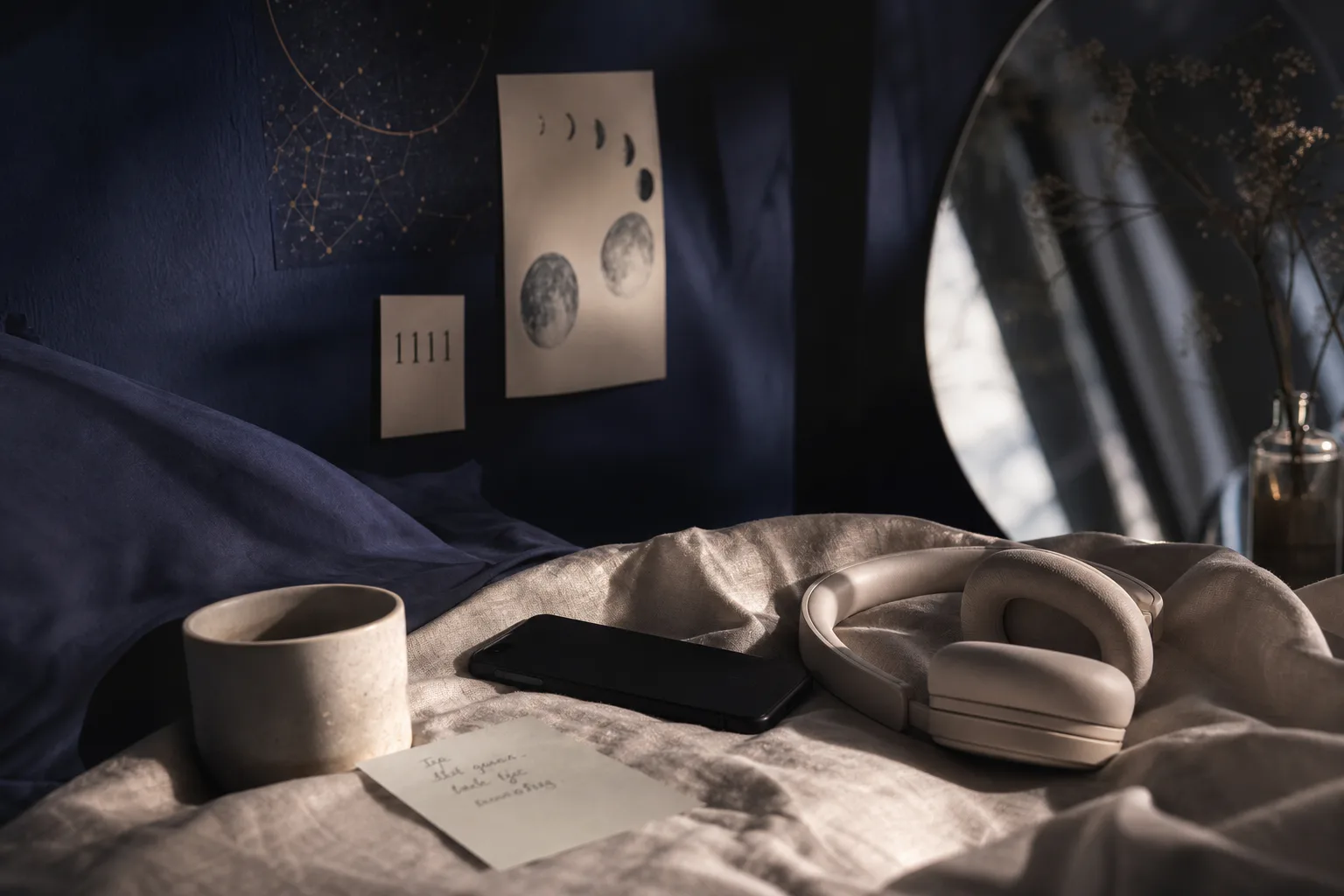
A cup sits beside the bed. Your phone is face down. Shadow work manifestation can begin with one 3-minute future-self audio: you notice the hidden fear, listen to the version of you who already moved through it, and let your body learn that the new life is safe enough to approach.
What is shadow work manifestation?
Shadow work manifestation is the practice of bringing hidden resistance into contact with the future you say you want.
Carl Jung used the word shadow for the parts of the psyche we reject, deny, or cannot yet see clearly. In Aion, first published in 1951, he wrote about the shadow as a moral problem, not a cute personality quirk. That matters. Shadow work is not aesthetic. It is the quiet work of telling the truth.
In manifestation, the shadow often sounds practical. It says, “If I earn more, I’ll be resented.” It says, “If I’m seen, I’ll be punished.” It says, “If I leave this job, I’ll lose who I am.” Those sentences can sit beneath a goal for years. A 2022 American Psychological Association report found that money remained a significant source of stress for 65% of U.S. adults, which is one reason career and income intentions can carry old fear.
The shadow does not block the life you want; it protects the life you know.
This is where manifestation becomes more honest. You are not forcing belief. You are asking what part of you still thinks the old pattern is safer. Then you give that part a repeatable future-self signal.
Shadow work manifestation usually holds three things at once:
- the desire you can name
- the fear you would rather skip
- the future-self scene your body can tolerate today
The last one is important. If the scene is too large, the body may reject it. If it is small enough, the mind can test it. In behavioral research, small cues often matter; BJ Fogg’s behavior model, published through Stanford work, places ability and prompt beside motivation. Tiny can be serious.
Why use a 3-minute future-self audio?
A 3-minute future-self audio works because it gives your attention one clear place to return.
The AYA Method is a daily audio manifestation practice. Each day you listen to a short personalized recording — your Dream-Self Moment — narrated from the version of you who has already manifested the life you intend. Listening is the practice. Repetition is the work. The audio is the method.
Three minutes is not magic. It is humane. The University College London habit study by Lally and colleagues, published in 2010, found that habit formation varied widely, with an average of 66 days for a behavior to become automatic. That number is often misused, but it teaches one clean thing: repetition needs to be livable.
Three minutes is not a shortcut. It is a size your nervous system may believe.
A longer practice can become a performance. A short audio is harder to dramatize. You press play. You listen. You notice the sentence your body resists. You stop before the mind turns it into a trial.
Here is the simple difference:
| Practice | Main question | Best use | Risk |
|---|---|---|---|
| Journaling | What am I hiding? | Naming patterns | Overthinking |
| Affirmations | What do I choose to repeat? | Rehearsing a thought | Saying what you do not believe |
| Future-self audio | What does safety sound like? | Training identity through listening | Avoiding the shadow if the script is too clean |
The audio matters because voice reaches you differently than text. A 2019 review in Frontiers in Psychology noted that auditory imagery and inner speech are closely tied to memory and self-reference. You have heard yourself into old identities. You can begin to hear yourself into a new one.
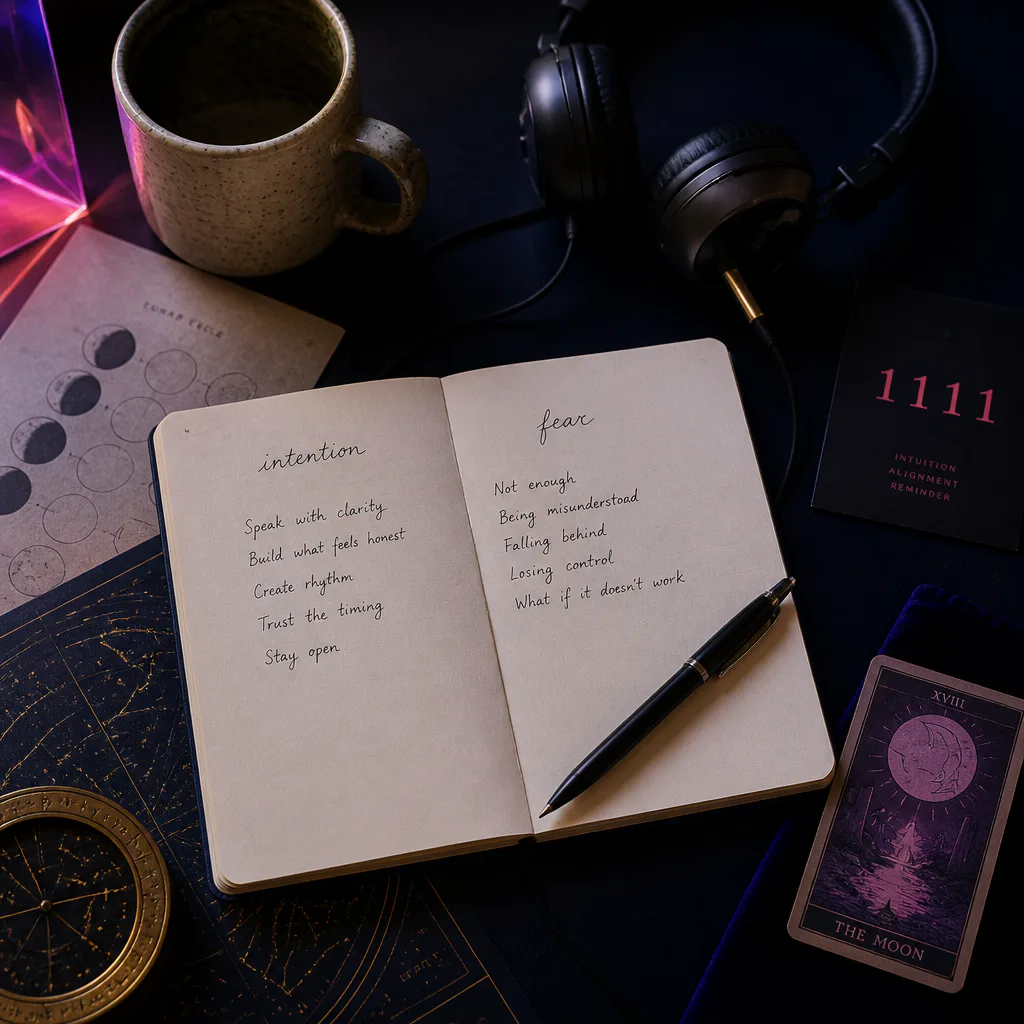
How do you do shadow work manifestation without spiraling?
You keep the practice narrow, timed, and anchored in the body.
The point is not to open every old door. It is to notice the one door that stands between you and the next honest step. James Pennebaker’s expressive writing studies often used 15 to 20 minutes of writing across 3 to 5 sessions. That structure helped because it had edges. Shadow work needs edges too.
Use this 12-minute frame before or after your 3-minute audio:
- Write the intention in one sentence. “I am ready to be visible in my work.”
- Write the shadow reply. “If I’m visible, people will expect more from me.”
- Choose one scene. You finish the presentation. You close the laptop. You are still safe.
- Listen for 3 minutes. Do not argue with the audio.
- Name the body response. Tight throat. Warm chest. Numb hands. Nothing is wrong.
- Write one repair line. “I can be seen and still go slowly.”
If your mind starts building a court case against you, stop. That is not depth. That is rumination. A 2008 paper by Nolen-Hoeksema and colleagues linked rumination with higher risk for depression and anxiety symptoms. The practice should make more space inside you, not less.
You do not heal a hidden fear by shouting over it.
This is also why the future-self audio should sound kind. Not grand. Not perfect. Kind. If it says, “You never doubt yourself now,” the shadow may know you are lying. If it says, “You still feel the old fear sometimes, and you do the next true thing anyway,” the body may stay in the room.
What should you listen for in your shadow?
Listen for the fear that has a job.
Most shadow patterns began as protection. Maybe you learned to stay useful because love felt conditional. Maybe you learned to stay small because attention came with criticism. Maybe you learned to leave first because staying once hurt too much. In attachment research, Bowlby’s early work from the 1960s still shapes how psychologists understand protective strategies formed through relationship.
Shadow work manifestation asks a softer question than “What is wrong with me?” It asks, “What did this part of me learn to prevent?” That question changes the room. You are no longer trying to cut out resistance. You are listening to the intelligence inside it.
There are 4 common shadow replies that show up around intentions:
- Visibility fear: “If I am seen, I will be attacked.”
- Receiving fear: “If I receive more, I will owe more.”
- Rest fear: “If I slow down, everything will fall apart.”
- Change fear: “If I become different, I will lose my people.”
A future-self audio can include the shadow without centering it. For example: “I remember when being seen felt dangerous. I move slowly. I choose the rooms that can hold me.” That is different from pretending there is no fear.
Mental contrasting research by Gabriele Oettingen, including work on WOOP published in the 2010s, found that pairing a desired future with a present obstacle can support goal action more than fantasy alone. This is the sober part of manifestation. The obstacle is not evidence against the desire. It is information.
The shadow is not the enemy of the future self. It is the part asking whether the future will still keep you safe.
How do affirmations, boards, and timing fit without taking over?
They can support the practice, but the audio stays at the center.
The daily affirmation can give the mind one sentence to carry. The Manifestation Board can give the eye one image to return to. But neither one replaces the listening. In this practice, the 3-minute future-self audio is the method because it lets your intended identity arrive as a voice, a scene, and a felt repetition.
If you use affirmations, let them be honest enough for the shadow. Instead of “I am fearless,” try “I can feel fear and still tell the truth.” Instead of “Everything is easy,” try “I can take one clean step.” A 2015 study in Social Cognitive and Affective Neuroscience found that self-affirmation activated brain regions linked to self-processing and valuation. The sentence matters. So does whether you believe it enough to stay present.
If you use a visual board, choose images that make your body breathe, not brace. One photo of a calm desk may do more than 30 images of a life that feels like pressure. The nervous system is specific. It responds to cues.
Some readers also track timing through astrology and manifestation. If that helps you listen with rhythm, keep it simple. Use the moon, a transit, or a weekly marker as a prompt for reflection, not as a reason to avoid action. Princeton’s former PEAR lab studied mind-matter claims for decades before closing in 2007; its findings remain debated. What is not debated is that attention changes behavior.
Return to the manifestation pillar when you need the larger frame. Then come back to the audio. Small is where the practice becomes real.
What changes if you repeat it for seven days?
Seven days gives your body enough repetition to reveal a pattern.
Do not expect a new personality by day seven. Expect better data. You may notice that the same sentence tightens your stomach. You may notice you avoid listening after a good day, not a bad one. You may notice your shadow is less afraid of success than of being responsible for keeping it.
A 2009 study by Phillippa Lally’s team showed that missing one day did not ruin habit formation, which is useful here. If you skip a day, return without punishment. Shame is not discipline. It is just another old manager trying to keep control.
Try this seven-day rhythm:
| Day | Focus | One question |
|---|---|---|
| 1 | Name | What fear answers my intention first? |
| 2 | Body | Where do I feel the no? |
| 3 | Scene | What small future moment feels believable? |
| 4 | Voice | Which line in the audio do I resist? |
| 5 | Repair | What does the shadow need to hear? |
| 6 | Action | What is one step I can take in under 10 minutes? |
| 7 | Review | What feels less charged now? |
This is where the AYA Method fits naturally. You listen daily, not to force belief, but to make the intended self familiar. The app also includes a daily affirmation and Manifestation Board, but those are complements. The audio carries the practice.
Joe Dispenza often speaks about rehearsing a future self, while Neville Goddard wrote about assuming the feeling of the wish fulfilled. You do not have to accept every claim from either teacher to use the practical overlap: repeated inner rehearsal can shape attention, choices, and identity. Dr. Andrew Huberman has also spoken often about neuroplasticity depending on attention, repetition, and rest.
Listening is how the future stops sounding theoretical.
End the seventh day with one line only. Not a verdict. Not a plan for your whole life. One true line you can carry into tomorrow.
The part of you that hid is allowed to come home slowly.