reality shifting
Shifting Script Template for a 3-Minute Audio
Use this shifting script template to write a focused 3-minute Dream-Self audio with identity, scene, emotion, and repetition built in.
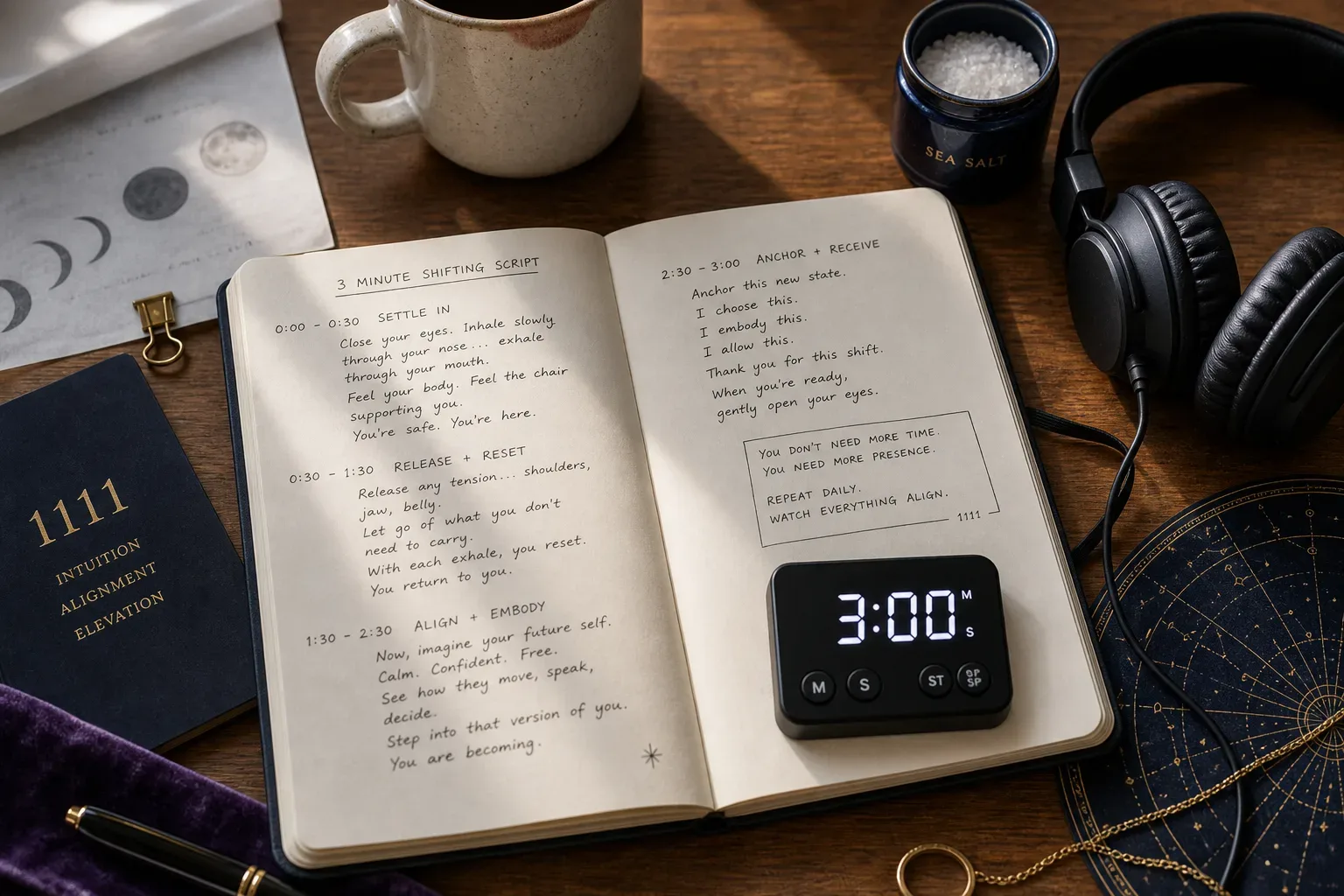
A shifting script template gives your Dream-Self audio a clean structure: identity, scene, feeling, evidence, and return. For a 3-minute recording, write 360 to 450 words, speak slowly, and make one future moment sound ordinary enough that your nervous system can practice it daily.
The timer said 3:00 exactly the first morning I tested this. Not 2:59. Not 3:01. Three minutes, clean as a cut lime. I had flour on one wrist, headphones on, and a script that sounded less like fantasy and more like someone had finally set the table correctly.
That is the point. A shifting script is not a glittery escape hatch. It is a written signal for the self you are practicing until the room starts to recognize her.
What should a shifting script template include?
A shifting script template should include one identity line, one lived scene, sensory proof, emotional tone, and a closing return phrase.
The mistake most people make is writing a whole new life when they need one precise moment. A 3-minute Dream-Self audio is only 180 seconds. At a calm narration pace of 125 to 150 words per minute, that gives you roughly 360 to 450 words. That is not a lot of space. Good. Constraint makes the signal stronger.
Think of it like seasoning broth. You do not add every spice you own. You choose the ones that tell the truth. In reality shifting, the script is the recipe, but the audio is the heat. Without daily listening, the words stay on the page.
Here is the simple frame:
| Script part | Purpose | Example line |
|---|---|---|
| Identity | Names who is speaking | “I am the woman who keeps her word to herself.” |
| Scene | Places the shift in time and room | “It is morning, and the blue cup is warm in my hands.” |
| Sensory proof | Gives the mind texture | “I hear the kettle click off.” |
| Emotional evidence | Shows the body believes it | “My chest feels open, not rushed.” |
| Return phrase | Makes the audio repeatable | “I come back to this version of me easily.” |
The research is not as theatrical as the internet, but it is useful. A 1994 meta-analysis by Driskell, Copper, and Moran found that mental practice improves performance, especially when paired with physical practice. The effect was strongest when rehearsal was specific. Specificity is the gate.
For the wider frame, the Manifestation pillar explains how intention, attention, and repetition work together. Your script is the intention. Your listening is the repetition. Your ordinary choices become the evidence.
A script is not powerful because it is long. It is powerful because the self inside it can be recognized on cue.
How do you write the first 30 seconds?
The first 30 seconds should establish the fulfilled identity before adding any details.
Start with the voice of the version of you who already lives the shift. Not begging. Not explaining. Not negotiating with old evidence. The opening is a gate, and it needs to swing cleanly.
Use present tense. Use first person. Keep it plain enough to believe after a difficult Tuesday. Neville Goddard often taught from the premise of “living in the end,” but the useful part for a modern audio script is practical: speak from the state, not toward it. You are not performing hope. You are rehearsing identity.
A strong opening might sound like this:
- “I wake as the version of me who trusts my own timing.”
- “My body knows this room. My life has already turned toward what I chose.”
- “I move through the morning with the quiet certainty of someone who arrived.”
- “I do not chase the sign. I witness the signal and act from it.”
Notice the scale. No fireworks. No castles. No frantic list of outcomes. In my grandmother’s kitchen, a mole began with one pan and one flame. If you crowded the pan, the chiles steamed instead of toasted. Same rule here.
Thirty seconds is usually 60 to 75 spoken words. That means your opening can be four or five sentences. Give it one master number if that helps you anchor the rhythm. I like 11 words for a first line when it happens naturally, not as a superstition but as a bell: “I wake as the version of me who keeps her word.” Eleven words. The dial clicks.
If you want affirmation support after recording, keep it to one sentence from the audio and read the Affirmations pillar for structure. The affirmation is a garnish. The audio is the meal.
What is the full 3-minute shifting script template?
The full 3-minute template moves through six short sections that create a complete Dream-Self Moment.
Use this as a working draft. Replace the bracketed language with your own details. Read it aloud once before recording. If your mouth trips over a sentence, the sentence is not ready.
3-minute Dream-Self audio script
0:00 to 0:30, identity
“I wake as the version of me who [names the shift]. I know what has changed because my body meets the morning differently. I am not waiting for permission. I am living from the choice I already made. The room feels familiar because this reality has been calling my name.”
0:30 to 1:05, place
“I am in [specific room or location]. I notice [one object], [one sound], and [one texture]. The light falls across [surface]. My hands are [doing one simple action]. This moment is ordinary, which is how I know it is real. Nothing has to shout to be true.”
1:05 to 1:40, emotional evidence
“In my body, I feel [emotion] and [emotion]. My breath has slowed. My shoulders know they are allowed to drop. I carry myself like someone who trusts the next step. I do not need every sign at once. I can follow one clear signal.”
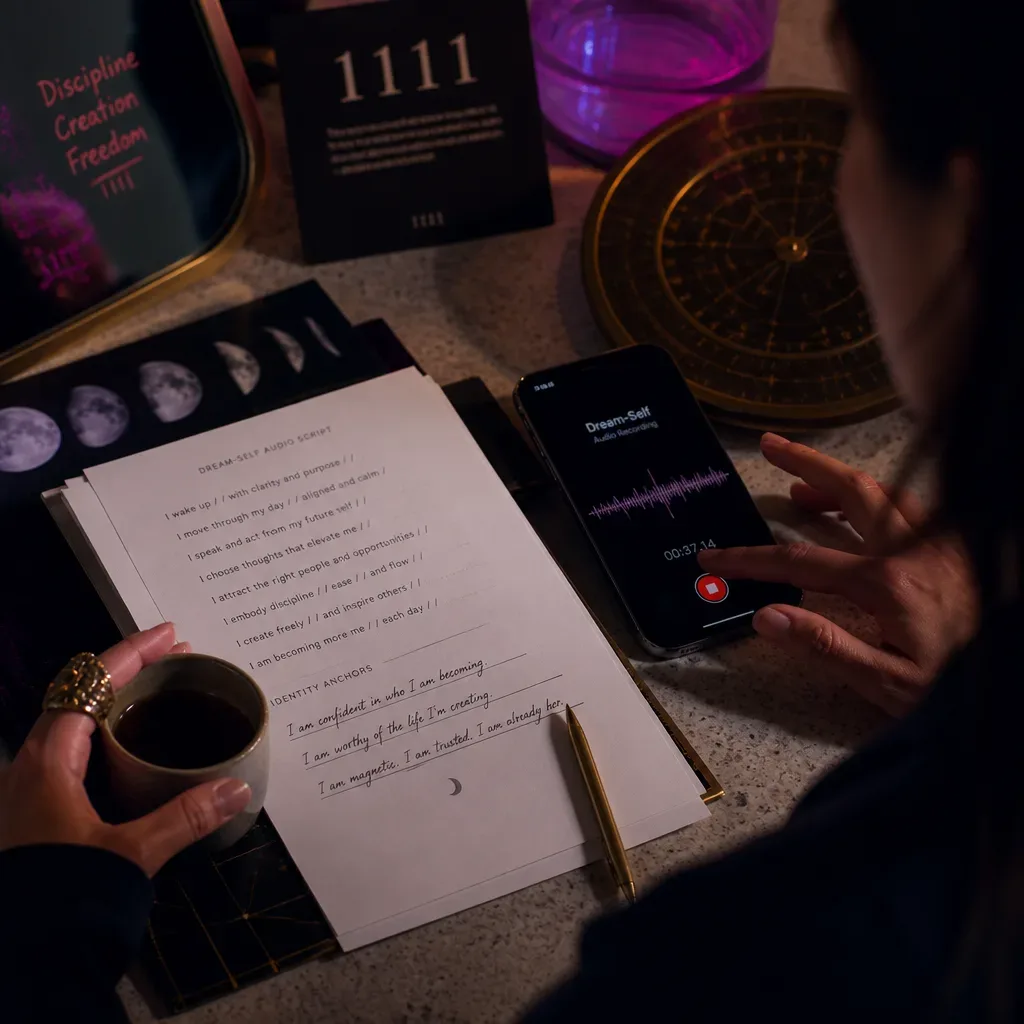
1:40 to 2:15, behavioral proof
“Today, I choose from this identity. I answer [situation] as this version of me. I speak to [person or subject] with steadiness. I take the small action that proves the shift is no longer theoretical: [action]. I let the evidence be simple.”
2:15 to 2:45, future memory
“Later, I will look back and recognize this as the season when the dial lined up. I will remember how calm it felt at first. Not dramatic. Not loud. Just precise. A return to the self I kept meeting in flashes.”
2:45 to 3:00, return phrase
“I come back to this version of me easily. I hear the signal. I answer with my life. I am here now.”
A 2021 review in Psychological Bulletin found that self-talk can influence performance and emotional regulation, especially when phrased with clear task relevance. That matters here. “I am successful” is vague. “I answer the email before noon with a steady chest” gives the body an assignment.
The future becomes easier to practice when it has a room, a sound, and something warm in your hands.
How should you record the audio so it works as a daily practice?
Record the audio slowly, intimately, and without trying to sound impressive.
The voice should feel like someone trusted is speaking from inside the chosen reality. You can record it yourself, or use a voice that helps the message land. The key is pacing. Most audiobooks are narrated around 150 words per minute, but a manifestation audio benefits from more air. Three minutes is not a race. It is a small chapel with a timer.
Before recording, do three things:
- Put your phone on airplane mode.
- Read the script once while standing, so your breath can find the lines.
- Mark three pauses with a slash, especially after identity sentences.
Then record in one take if you can. If you stumble, pause and continue. A tiny human sound is not failure. The nervous system often trusts the real voice more than the polished one. Andrew Huberman has often discussed how repetition and state shape learning; the practical translation is simple: if you listen in a consistent state, the cue becomes easier to access.
The AYA Method gives this structure a daily home: The AYA Method is a daily audio manifestation practice. Each day you listen to a short personalized recording, your Dream-Self Moment, narrated from the version of you who has already manifested the life you intend. Listening is the practice. Repetition is the work. The audio is the method.
That definition matters because it keeps the hierarchy clean. The daily affirmation and Manifestation Board can support the work, but they do not replace the listening. In my kitchen, the shopping list is useful and the serving plate is beautiful. The cooking still happens over heat.
If you track timing, aim for:
| Recording element | Time | Word count |
|---|---|---|
| Identity opening | 30 seconds | 60 to 75 words |
| Sensory scene | 35 seconds | 70 to 85 words |
| Emotional evidence | 35 seconds | 70 to 85 words |
| Behavioral proof | 35 seconds | 70 to 85 words |
| Future memory | 30 seconds | 60 to 75 words |
| Return phrase | 15 seconds | 25 to 40 words |
The audio does not need to impress the old self. It needs to be recognizable to the new one.
How do you make the script feel believable without making it small?
Make the script believable by using physical evidence, not by shrinking the desire.
Believability is not the same as modesty. You do not have to ask for less. You have to write the desired reality in a way your body can enter. “I am famous, adored, and untouchable” may sound dramatic, but the body has nowhere to stand. “I sit at the studio table, signing the contract with a steady hand” gives the nervous system a chair.
Psychologist Ethan Kross has written about self-distancing and inner speech, including how language changes emotional regulation. One relevant lesson: the mind responds differently when an experience is framed with enough distance to be held. Your Dream-Self audio should be intimate, but not frantic. Let the future speak like it has nothing to prove.
Use the “ordinary proof” test. For each desire, ask: what would be normal if this were already true?
For example:
- If I were financially steady, I would open my banking app without bracing.
- If I trusted love, I would answer the message without staging a trial in my head.
- If I lived as a working artist, I would protect two hours before checking the room for approval.
- If my body felt safe, I would eat breakfast at the table, not standing at the sink.
The ordinary detail is not boring. It is the receipt. Pew Research reported in 2024 that a large share of adults use digital tools daily for planning, reminders, or media, but repetition alone does not create meaning. Meaning comes from the cue you choose to repeat. Set the cue carefully.
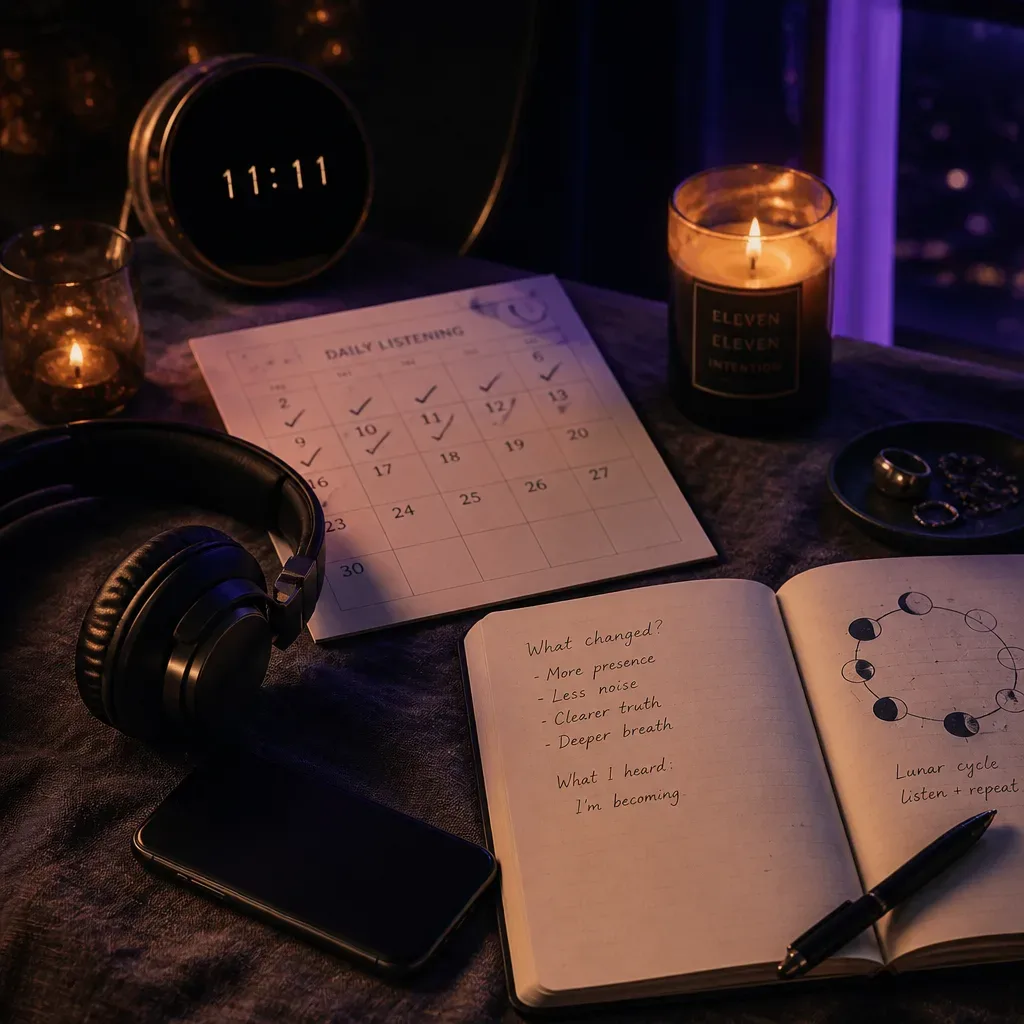
This is also where timing practices can become helpful without running the show. Some readers pair a script with lunar cycles or numerology. If 11:11 keeps appearing, you can treat it as a reminder to listen, not as a command. The Astrology and manifestation guide explains how symbolic timing can support a practice without taking responsibility away from your choices.
How often should you listen before rewriting the script?
Listen daily for at least 11 days, and ideally 30, before deciding the script has done its work.
Eleven days gives you enough repetition to notice resistance, boredom, and small behavioral changes. Thirty days gives you a fuller cycle. In habit research, the popular “21 days” claim is too neat; a 2009 study by Lally and colleagues in the European Journal of Social Psychology found that habit formation averaged 66 days, with wide variation. A Dream-Self audio is not the same as a habit, but the point holds: repetition needs time.
Do not rewrite every time your mood changes. That is like opening the oven every two minutes and blaming the bread for not rising. Keep the same recording long enough for the signal to meet you in different weather.
Track only three things:
- Did I listen today?
- What line stayed with me?
- What small action matched the identity?
That is enough. You are not grading the invisible. You are witnessing the visible.
After 11 days, revise only if the script feels vague, inflated, or emotionally false. Keep any line that still lands in the body. Remove sentences that sound like performance. Add one concrete behavior if the audio feels dreamy but not actionable.
For a broader reality-shifting frame, anchor this practice inside the Manifestation pillar and return to the Affirmations pillar when you need one clean sentence for the day. If symbols are part of your timing, revisit Astrology and manifestation as a calendar, not a cage.
A good shifting script does not drag you out of your life. It teaches your life where to meet you.
What are the most common mistakes in a 3-minute shifting script?
The most common mistakes are writing too much, using vague emotion, skipping the body, and changing the audio too soon.
The first mistake is crowding. A 3-minute recording cannot hold your career, love life, childhood healing, apartment, wardrobe, creative calling, and every apology ever owed to you. Choose one shift per audio. You can make another recording later. The gate narrows so the signal can pass.
The second mistake is writing in decoration instead of evidence. Words like “perfect” and “everything” often hide a lack of detail. Replace them with sensory facts. What is on the table? What do you hear? What does your hand do first? In expressive writing research, James Pennebaker’s work has often used 15 to 20 minute writing sessions to help people process experience, but your script is different. It is not confession. It is rehearsal.
The third mistake is trying to force emotion. If calm is too far away, write “less braced.” If joy is too bright, write “willing.” Precision beats drama. My mother used to say no one should stir a pot while angry because the food would hear it. I cannot prove that in a journal. I can tell you the beans tasted better when the room softened.
The fourth mistake is treating signs as substitutes for action. Seeing 222 three times in a week may feel like a wink. Fine. Name it. Then answer the email, make the call, clean the desk, record the audio. Synchronicity is punctuation, not the paragraph.
Use this final check before recording:
- Is the script 360 to 450 words?
- Does it name one identity shift?
- Does it include one ordinary scene?
- Does it include at least three sensory details?
- Does it ask for one behavior today?
- Can I listen to it for 11 days without rolling my eyes?
If the answer is yes, record. The room does not need more theory. It needs your voice, steady enough to return to.
Put the salt beside the notebook and press record.