affirmations
Sleep Affirmations That Work Better as Dream-Self Audio
Sleep affirmations can help at night, but dream-self audio gives your mind a fuller future to rehearse while the body gets quiet.
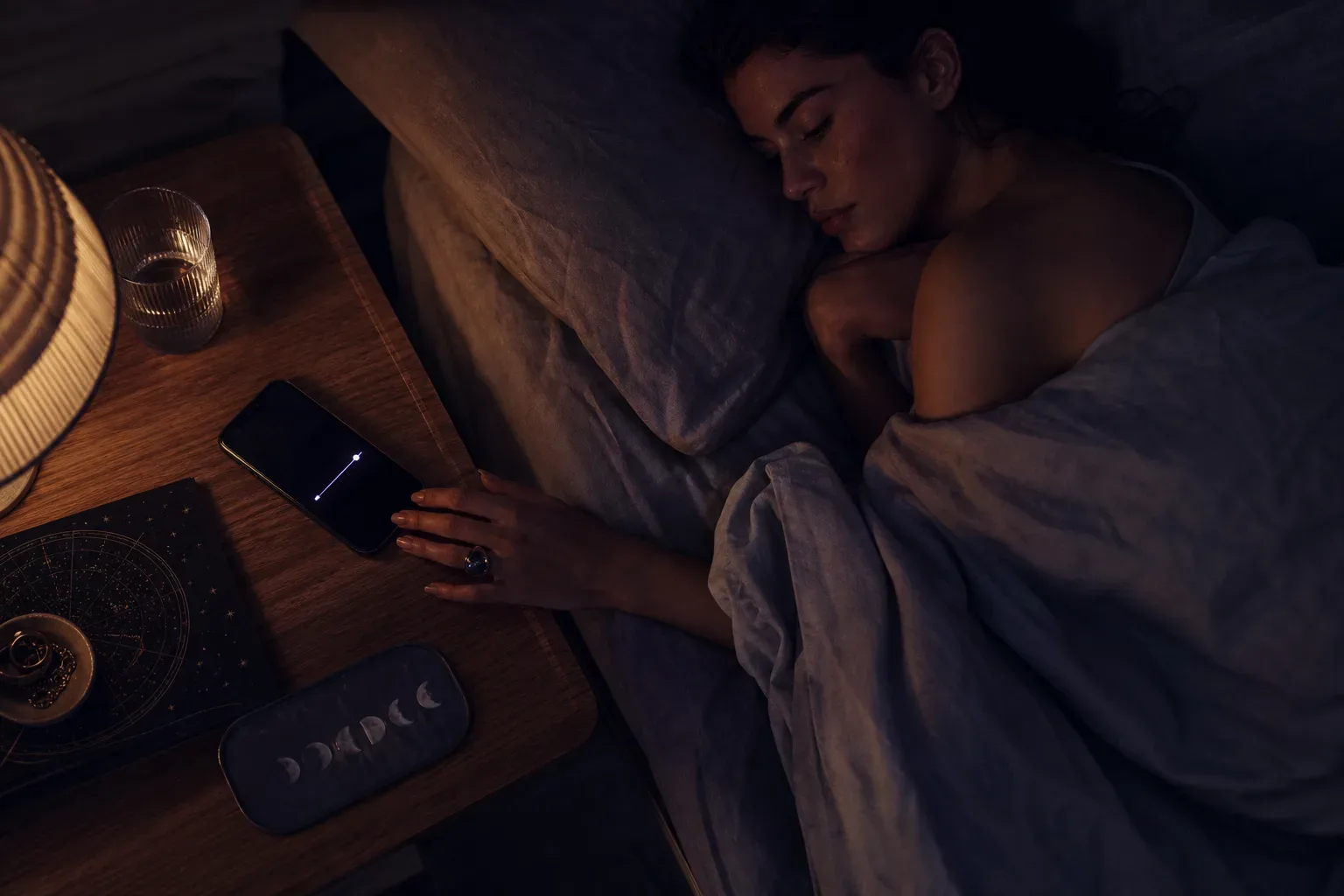
The room is dark. Your phone is face down. Sleep affirmations work best when they don’t ask you to argue with yourself. A short dream-self audio can do more because it gives your mind a believable voice, a future scene, and a soft rhythm to return to as you fall asleep.
Why do sleep affirmations sometimes feel too thin at night?
Sleep affirmations can feel thin because a single sentence often asks the mind to believe before the body feels safe.
At night, you’re not only thinking. You’re also listening for danger, remembering the day, and letting the nervous system decide whether it’s safe to let go. The American Academy of Sleep Medicine recommends at least 7 hours of sleep for most adults, but the last 20 minutes before sleep can shape whether that rest arrives easily or not. A sentence like I am calm may be true in theory. It may still feel far away at 11:43 p.m.
That doesn’t mean affirmations are empty. It means timing and form matter. In a 2009 paper in Psychological Science, Joanne Wood and colleagues found that positive self-statements could make some people with low self-esteem feel worse when the statements felt too distant from their current self-belief. The body hears the gap. The mind starts its small courtroom. Then the affirmation becomes another place to fail.
Dream-self audio gives the affirmation a room to live in. Instead of repeating I am loved ten times, you hear a future version of yourself describing an ordinary evening where love is already present. The kettle is on. The message has been answered. Your chest is not braced. The sentence has furniture now. It can rest.
A sentence can soothe you. A voice can meet you.
If you’ve used affirmations before, you already know repetition matters. But sleep asks for something gentler than force. It asks for fewer words, slower pacing, and less performance. The point is not to convince yourself. The point is to stop interrupting the part of you that already knows how to receive.
What makes dream-self audio different from ordinary sleep affirmations?
Dream-self audio is different because it speaks from the self who already lives the change, not the self trying to earn it.
The AYA Method is a daily audio manifestation practice. Each day you listen to a short personalized recording — your Dream-Self Moment — narrated from the version of you who has already manifested the life you intend. Listening is the practice. Repetition is the work. The audio is the method. You can read more about the AYA Method if you want the full frame.
This matters at night because the brain is highly responsive to sound. A 2015 review in Frontiers in Psychology described music and auditory stimulation as linked with arousal regulation, mood, and autonomic activity. You don’t need a complicated claim to see the plain truth: a harsh voice at night changes the room. A kind voice changes it too.
Ordinary sleep affirmations often use short declarations. Dream-self audio uses a remembered future. It may say: I wake in the morning and I don’t check for proof that I’m behind. I know what matters. I move slowly. I trust the one next step. This is still affirmation. But it has sequence. It has breath. It has a narrator who isn’t begging.
Here is the difference in a simple way:
| Practice | What you hear | What it asks of you | Best use |
|---|---|---|---|
| Written sleep affirmations | Short repeated lines | Believe the sentence | Quick reminders |
| Spoken affirmations | Lines in a calming voice | Receive the sentence | Bedtime settling |
| Dream-self audio | A future self speaking from lived truth | Enter the scene gently | Nightly manifestation practice |
Neville Goddard often taught the felt reality of the wish fulfilled, especially before sleep. Joe Dispenza also speaks often about rehearsing a new self until the body recognizes it as familiar. You don’t have to adopt every claim from either teacher to use the practical part: the mind changes more readily when it can feel the scene, not just read the label.
How do you write sleep affirmations as dream-self audio?
You write them by turning a desired belief into a small future scene that your body can almost believe tonight.
Start with one theme. Not ten. The National Sleep Foundation has reported that consistency in bedtime routines helps cue sleep, and consistency is harder when your script tries to fix your whole life in one recording. Choose one door: safety, self-worth, love, money, creativity, body trust, grief, or rest.
Then write from the future self, in first person, present tense. Keep it plain. If the line sounds like something you’d never say in the morning, soften it. Sleep does not need a speech. It needs truth with the volume turned down.
Try this 5-step structure:
- Name the settled state. I live with more trust in my body now.
- Add one ordinary proof. I notice it when I pause before saying yes.
- Describe the evening feeling. At night, I don’t replay every small mistake.
- Let the future self speak kindly. I know I don’t have to be perfect to be safe.
- Close with one return line. I’m here. I’m listening. I’m already becoming familiar to myself.
In self-affirmation theory, Claude Steele’s early work in the 1980s described affirmation as a way to preserve a sense of integrity under threat. Later research, including studies by David Creswell and colleagues, linked self-affirmation with lower stress responses in some settings. For sleep, the threat is often quiet but sharp: I didn’t do enough. I said it wrong. I’m not loved enough. Your script should answer that threat without fighting it.
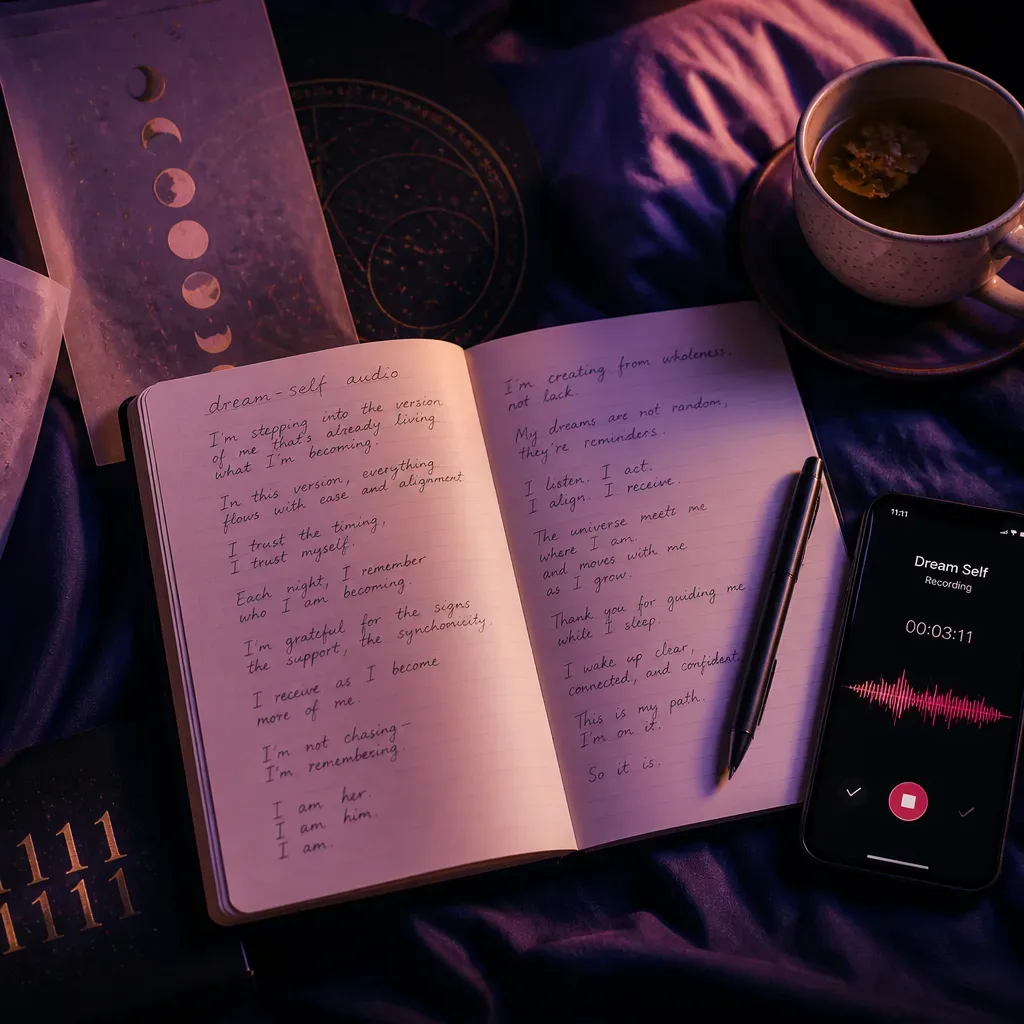
A useful night script might be 250 to 500 words, which becomes about 3 to 5 minutes when read slowly. Speak at about 100 words per minute or less. Leave pauses after the sentences you most want the body to hear. A pause is not empty. A pause is where the nervous system checks whether the words are safe.
How should you listen before sleep without turning it into another task?
You listen by making the practice small enough that you can keep it even on the nights when you’re tired.
Use the same point in your evening. After brushing your teeth. After turning the light low. After placing the phone face down. The cue matters. In habit research, Wendy Wood has written that repeated behavior in stable contexts becomes more automatic over time; one 2019 paper in Current Directions in Psychological Science describes how context cues help habits run with less conscious effort. Night practice should lean on cues, not willpower.
Keep the audio short. Three to eight minutes is enough. If you’re using the AYA Method, the Dream-Self Moment is designed to be listened to daily, not mastered. The app also includes a daily affirmation and Manifestation Board, but those are complements. At night, the audio is the thing. Listening is enough.
Set the volume low. If you have to concentrate to catch every word, it’s too low. If the voice startles you, it’s too high. You want a level that lets the words arrive without demanding alertness. Dr. Andrew Huberman has often discussed non-sleep deep rest protocols and the role of guided audio in shifting the body toward rest; the common thread is simple: voice can help attention stop gripping.
Use this small checklist:
- Put the recording where you can press play without scrolling.
- Choose headphones only if they feel comfortable in bed.
- Avoid adding music if it makes the track feel too dramatic.
- Don’t restart when your mind wanders.
- Don’t measure whether it worked the next morning.
The night practice is not a test. It is a return.
If you wake during the night, you can play the same recording again, but don’t force it. The goal is not more input. The goal is a familiar path back to the self you’re practicing becoming.
What should your sleep affirmation audio include and leave out?
Your sleep affirmation audio should include believable future details and leave out pressure, perfection, and language that makes your body brace.
The best night words are ordinary. They don’t announce a new identity with bright lights. They show you living it. Instead of I am completely healed, try: I notice that I speak to myself more gently when the old fear appears. Instead of Everyone chooses me, try: I no longer chase warmth from people who make me small. The second version gives the body something specific to recognize.
Specificity matters because the brain uses imagery and memory networks when imagining future events. Research on episodic future thinking, including work by Daniel Schacter and Donna Addis, has shown that imagining the future draws on memory systems. In plain language: the future becomes easier to feel when it contains concrete pieces your mind can assemble.
Include:
- A present-tense voice from the future self.
- One or two sensory details, such as sheets, light, breath, or morning air.
- A sentence that names safety without forcing joy.
- One small proof of changed behavior.
- A closing line you can remember when half-asleep.
Leave out:
- Grand claims your body rejects.
- Long lists of desires.
- Comparisons with other people.
- Urgency.
- Any instruction that makes rest feel earned.
If your wider practice includes manifestation, keep the night recording focused on the felt state rather than the full plan. Daytime can hold the notes, the choices, the calendar, and the visible reminders. Night holds the voice. This is also where astrology and manifestation can stay soft if it’s part of your life: a moon phase may mark the evening, but it doesn’t need to take over the bed.
A good test is physical. Read one line aloud and notice your jaw, throat, and belly. If the body tightens, revise the line by 20 percent. Not all the way down to doubt. Just closer to true.
How long before sleep affirmations start to feel real?
Most people should give sleep affirmations or dream-self audio at least 7 to 14 nights before judging the practice.
One night can soothe you. Repetition teaches familiarity. A 2009 study by Phillippa Lally and colleagues in the European Journal of Social Psychology found that habit formation varied widely, with an average of 66 days for a behavior to become automatic. That number is not a rule for your audio. It is a reminder to stop demanding proof from night one.
You may notice small signs first. You don’t spiral as long after a difficult message. You catch one cruel thought before it becomes a full story. You fall asleep 10 minutes earlier twice in one week. You wake and remember one line from the recording before reaching for your phone. Small signs count. Quiet changes often arrive without a performance.
If the words still feel false after a week, don’t blame yourself. Edit. Lower the claim. Make it more sensory. Bring the future closer. A recording that says I am fully confident in every room may become: I enter the room and remember I don’t have to disappear. That is not smaller in a bad way. It is more usable.
You can track the practice without making it stiff:
| Night | What to notice | Keep it under |
|---|---|---|
| 1 to 3 | Does the voice feel safe? | 30 seconds |
| 4 to 7 | Which line stays with you? | 1 minute |
| 8 to 14 | Is sleep or self-talk changing slightly? | 2 minutes |
| 15 onward | What needs revising? | 5 minutes |
The affirmations pillar can help if you want to understand why wording matters. For dream-self audio, the rule is even simpler: the line must feel close enough for the body to stop arguing.
When are sleep affirmations not enough on their own?
Sleep affirmations are not enough when insomnia, trauma, anxiety, or medical symptoms need skilled care alongside the practice.
If you regularly lie awake for hours, wake with panic, or feel afraid of sleep itself, please don’t turn affirmations into a private burden. The American College of Physicians recommends cognitive behavioral therapy for insomnia, often called CBT-I, as a first-line treatment for chronic insomnia. That is real support. Audio can sit beside it. It should not replace care.
The same is true if nighttime brings intrusive memories or intense body fear. A dream-self recording should never force you to relive pain or pretend it is gone. It can say: I am learning safety in small pieces. I let help reach me. I don’t have to solve this alone tonight. Those words leave the door open.
There is also a practical boundary. Don’t use sleep audio while driving, cooking, or doing anything that needs alertness. Keep it for bed, rest, or a safe seated pause. If you’re using headphones, choose a setup that won’t disturb your sleep position. The Centers for Disease Control and Prevention has linked insufficient sleep with higher risk for conditions including diabetes, heart disease, and depression, so protecting actual rest matters more than finishing any practice perfectly.
Dream-self audio is not magic as spectacle. It is intimacy repeated. It is your own future self becoming less strange to you, night after night. Some evenings, you’ll hear every word. Some evenings, you’ll miss the whole middle. That still counts.
You don’t have to believe the whole future tonight. You can let one sentence come closer.
If you want a simple place to begin, choose one true theme, write 300 words from the future self, record slowly, and listen for 7 nights. Then change only what needs softening. The method is not in the drama. It is in the return.
The room is still, and the voice is yours.