vision boards
Vision Board Ideas for Dream-Self Audio
Use these vision board ideas to name 9 life areas, choose true images, and turn each one into Dream-Self audio you can hear daily, without forcing.
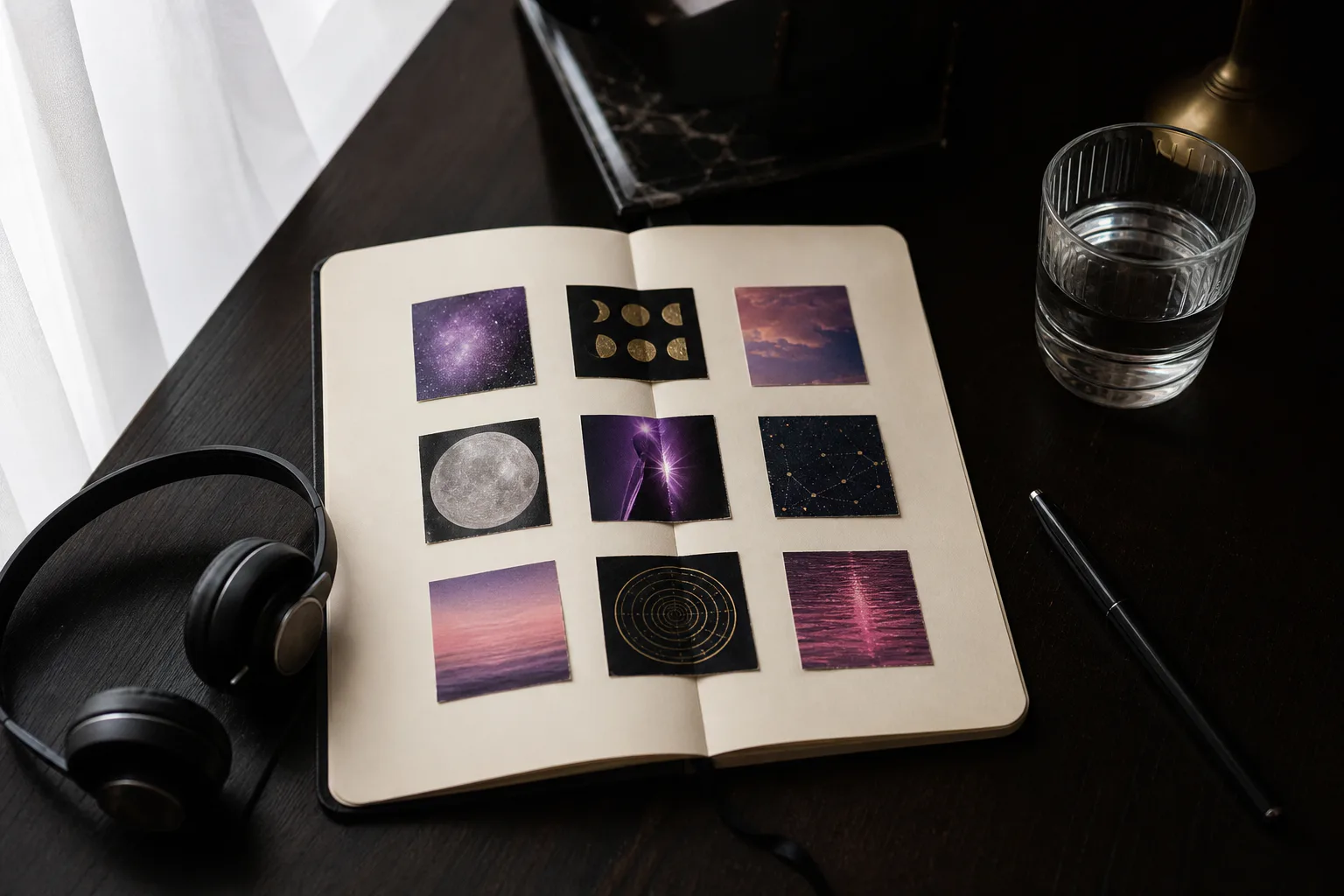
A vision board can become more useful when you stop treating it as decoration and start using it as source material for audio. These vision board ideas name 9 life areas you can picture, write in present tense, and voice inside your Dream-Self Moment so the practice feels specific, daily, and real.
What makes a vision board idea worth keeping?
A vision board idea is worth keeping when you can recognize yourself inside it.
The image has to do more than look good. It has to return you to a true direction. A clean kitchen may mean steadiness. A passport may mean choice. A small desk by a window may mean work that does not cost your body. The board is not asking you to prove anything. It is asking you to see what keeps calling.
Psychologist Edwin Locke and Gary Latham reviewed more than 35 years of goal-setting research and found that specific, difficult goals tend to improve performance more than vague goals, especially when commitment is present. A vision board does not create commitment by itself. But it can make the goal less foggy. Fog is hard to practice. A named image is easier to return to.
This is where audio matters. The AYA Method is a daily audio manifestation practice. Each day you listen to a short personalized recording — your Dream-Self Moment — narrated from the version of you who has already manifested the life you intend. Listening is the practice. Repetition is the work. The audio is the method.
A vision board is the picture; the audio is the rehearsal. The app also includes a daily affirmation and a Manifestation Board, but those are complements. They can support the work. They are not the center of it.
Use this quick test before you keep an image:
- Can I say what this image means in 10 words?
- Does it point to a life I actually want, not one I want to be seen wanting?
- Can I describe it in the present tense?
- Does it ask for one next action within 7 days?
A life area earns space on the board when it can become a sentence you believe enough to repeat.
Which 9 life areas belong on a Dream-Self vision board?
The strongest 9 life areas are the ones that shape your daily body, time, money, relationships, and sense of meaning.
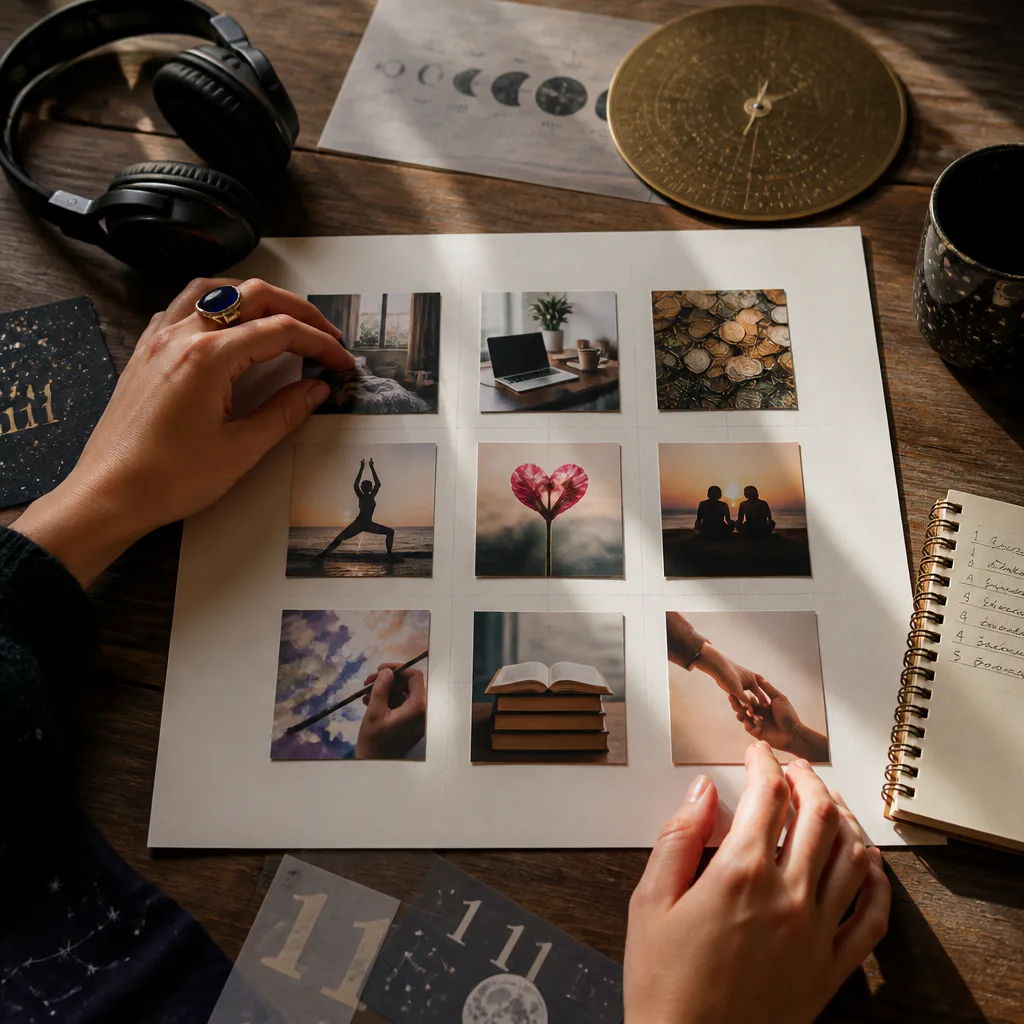
Here are 9 vision board ideas to voice in Dream-Self audio. You do not need all 9. In a 2022 Pew Research Center survey, 53% of employed U.S. adults said they quit a job in 2021 partly because of low pay, 63% cited no advancement, and 57% cited feeling disrespected. Life areas overlap. Work affects sleep. Money affects love. Home affects courage.
- Home: The room where your nervous system stops bracing. Voice it as: I walk into my home and feel my breath slow.
- Work: The way your gifts meet structure, pay, and respect. Voice it as: My calendar has room for focused work and real recovery.
- Money: The numbers you can face without shrinking. Voice it as: I check my accounts calmly every Friday.
- Body: Strength, rest, care, and medical truth. Voice it as: I keep promises to my body in small ways.
- Love: The quality of being known. Voice it as: I speak honestly and stay soft enough to listen.
- Friendship: The people who make life less performed. Voice it as: I make plans with people who feel like home.
- Creativity: The private thing that wants time. Voice it as: I protect 30 minutes for the work that is mine.
- Learning: The skill, language, study, or craft that stretches you. Voice it as: I practice before I judge myself.
- Service: The way your life helps someone else breathe easier. Voice it as: I give from steadiness, not from guilt.
If you want a broader frame for intention work, the manifestation guide can help you separate wishful thinking from a daily practice you can repeat. Your board can be beautiful. It just has to be honest first.
How do you choose images without copying someone else’s life?
You choose images by listening for recognition, not envy.
There is a difference between an image that opens you and an image that makes you perform. The first one feels quiet. The second one makes you tense. Social platforms make this harder. Pew reported in 2024 that majorities of U.S. adults use YouTube and Facebook, while younger adults use Instagram and TikTok at high rates. That means your eyes are trained daily by other people’s symbols.
So slow down before you save. If the image is a villa, ask what you are really asking for. Privacy? Sunlight? A place where no one interrupts you? If the image is a wedding table, ask whether it is marriage, belonging, family repair, or being chosen. The real desire is usually smaller and more exact than the picture.
Try this 3-pass method:
- Save freely for 15 minutes. Do not analyze yet.
- Name the feeling in one plain word. Safe. Clear. Desired. Paid. Strong. Rested.
- Replace any image that only signals status. Keep the ones that feel like your real day, not a public announcement.
Research on mental imagery is mixed, but small studies in sport psychology have long shown that imagery paired with physical practice can support performance better than imagery alone. The lesson is useful here. Do not stare at a board and wait. Let the image become language. Let the language become one action.
A borrowed dream always asks you to leave yourself. A true image brings you back.
How do the images become words for your Dream-Self Moment?
The images become audio when you translate them into sensory present-tense scenes.
Do not write slogans first. Write scenes. The brain responds to detail. Dr. Andrew Huberman has often discussed how goal pursuit relies on attention, reward, and state. The practical point is simple: your practice should give your attention something concrete to hold. Not perfect. Concrete.
Use this table when you move from board to audio:
| Board image | Hidden desire | Dream-Self audio line |
|---|---|---|
| A quiet bedroom | Rest | I wake before my phone and feel rested enough to move slowly. |
| A desk with sunlight | Focused work | I sit down at 9 and know the first task. |
| A dinner table | Belonging | I eat with people who let me be real. |
| A bank app screenshot | Financial steadiness | I look at my numbers without leaving myself. |
| Running shoes by the door | Body trust | I keep the promise before the day gets loud. |
For affirmations, one clear line can be enough. For Dream-Self audio, let the line live inside a moment. You are not only saying, I am calm. You are hearing the kettle click, feeling your feet on the floor, noticing that you did not rush to check messages.
The more ordinary the scene, the easier it is to believe. You do not need a cinematic future. You need a future that can enter Tuesday.
This is also why the Manifestation Board works best as a companion. It holds the visual cues. The audio carries the daily return. One is seen. One is heard. Listening is what repeats.
What if one life area feels too painful to picture?
If one life area feels painful, make the image smaller until your body can stay with it.
Not every board should start with the biggest want. If money has been frightening for 10 years, a luxury image may not help. It may create distance. Start with a receipt folder, a calm spreadsheet, or a hand writing one number down. If love feels tender, do not begin with a wedding photo. Begin with two mugs on a table, or your own hand on your own chest.
The Journal of Behavioral Medicine has published research connecting expressive writing with health-related outcomes, though effects vary by study and person. The common thread is not fantasy. It is contact. You name what is real without flooding yourself. A vision board can do the same when it is built with care.
Here is a gentler scale:
- Too much: I am debt-free, married, famous, healed, and fearless.
- Closer: I answer one money email without panic.
- Closest: I open the email, breathe, and stay.
In astrology and manifestation, timing is often treated as symbolic support. Even there, the practice still has to meet your actual life. A date, moon phase, or season can help you mark a beginning. It cannot feel the feeling for you.
You are allowed to want quietly. You are allowed to begin with the smallest true picture.
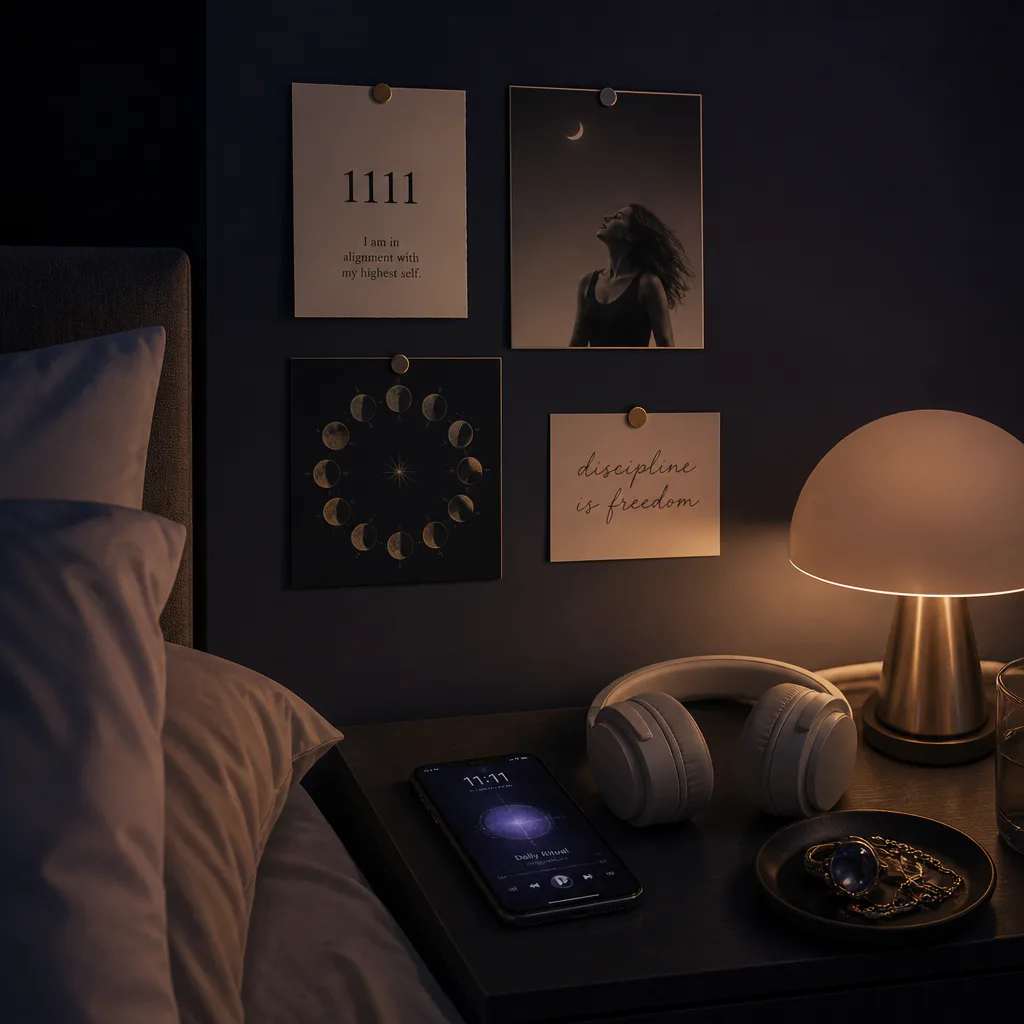
How do you keep a vision board from becoming visual noise?
You keep a vision board alive by limiting it, reviewing it, and connecting it to one daily audio practice.
More images do not mean more clarity. Too many pictures can become a wall you stop seeing. In attention research, cognitive load theory points to a simple truth: working memory is limited. The often-cited range is around 4 chunks of information at a time, revised from the older 7 plus or minus 2 model by Nelson Cowan in 2001. Your board should respect that.
Try a monthly board edit. I like 20 minutes, once a month, not every morning. Ask three questions: What came true? What no longer feels like mine? What still makes me stand a little straighter? Remove images without drama. Your old desire does not need to be shamed for becoming old.
You can use this rhythm:
- Daily: Listen to your Dream-Self Moment.
- Weekly: Choose one board image and take one related action.
- Monthly: Remove, refine, or keep each image.
- Quarterly: Rewrite the audio if your life has moved.
The board points. The audio returns. The action proves you were listening.
If your visual practice has become crowded, read a broader note on vision board manifestation and then come back to one image. One is enough when it is true.
What should you do with these 9 vision board ideas today?
Choose one life area today, write one present-tense scene, and let it become something you hear.
Start with the area that has the most charge. Not the most glamorous one. The one you keep thinking about while doing dishes or driving home. If it is work, choose the image of a clean calendar. If it is love, choose the image of a conversation where your jaw is not tight. If it is money, choose the image of looking directly.
Then write 5 lines. Keep them plain. A 2015 summary of Gail Matthews’ Dominican University goal research is often cited for finding that writing goals and sending updates to a friend improved completion rates compared with thinking alone. The exact percentages are debated online, but the direction is useful: written, witnessed goals tend to behave differently than private fog.
Use this final prompt:
- I am in the life area of ______.
- I see ______.
- I hear ______.
- My body feels ______.
- The next small action I take is ______.
If your board includes a daily affirmation, let it be one sentence beside the larger audio. If your board lives inside the app, let the Manifestation Board hold the images while the Dream-Self Moment carries the repetition. For the full method, return to the AYA Method. The audio is not an add-on. It is the practice.
You do not need 9 new lives. You need one true place to begin.
Softly, choose the image that already knows your name.