aya method deep dive
28 Day Manifestation Challenge With Dream-Self Audio
A quiet 28 day manifestation challenge using Dream-Self audio, small daily notes, and repetition you can keep even on crowded days.

Your headphones are on before the kettle finishes. This 28 day manifestation challenge is simple: listen to Dream-Self audio once a day for 28 days, write one line after, and watch for small choices that match the life you intend. No earlier alarm. No performance. Just return.
Why does a 28 day manifestation challenge work with audio?
It works because repetition gives your nervous system a familiar picture to return to, and audio makes that picture easier to receive.
Twenty-eight days is not a magic number. It is four clean weeks. Long enough to see patterns. Short enough that you can hold it in your hand. The often-quoted 21-day habit idea came from older popular writing, not strong habit science. In a 2009 study in the European Journal of Social Psychology, Phillippa Lally and colleagues found that a new behavior took a median of 66 days to feel automatic, with a range from 18 to 254 days. So 28 days is not the finish line. It is the first room.
Audio matters because it asks less of you. You do not have to invent belief at 6:40 a.m. while a child asks where her blue cup is. You listen. That is small. Small is not weak. Small is how a practice survives real life.
The AYA Method is a daily audio manifestation practice. Each day you listen to a short personalized recording — your Dream-Self Moment — narrated from the version of you who has already manifested the life you intend. Listening is the practice. Repetition is the work. The audio is the method.
Neville Goddard called this kind of inner rehearsal the feeling of the wish fulfilled. Joe Dispenza writes often about mental rehearsal and identity, though his claims are debated in scientific circles. A grounded version is enough here: your brain responds to repeated cues. Dr. Andrew Huberman has said many times that attention and repetition are central to neuroplasticity. You are giving your attention one true place to land, once a day, for 28 days.
A manifestation practice does not need to be loud to be real.
What should you prepare before Day 1?
Prepare one intention, one audio, one listening cue, and one place to write the smallest possible note.
Start narrow. Not because your life is small, but because your attention is human. The manifestation practice becomes cleaner when you choose one center. A new role. A calmer home. A paid creative offer. A kinder body image. A relationship pattern you are ready to stop repeating. Pew Research Center reported in 2023 that 73% of U.S. adults said family time was one of the most important things in their lives; this is a reminder that your intention may be ordinary and still sacred.
Write your intention in present-tense language, but do not make it theatrical. Try: I am paid well for work that does not drain me. Or: I trust myself in love. Or: I live in a home that feels steady. Your words should sound like you. If the sentence makes you roll your eyes, soften it.
Then set up your Dream-Self audio. Keep it short enough that you will not bargain with it. Three to seven minutes is enough for many people. In mindfulness research, even brief daily practices have been studied; a 2018 randomized trial in Behaviour Research and Therapy found that short app-based mindfulness training reduced distress for some participants over several weeks. You are not trying to become a different person in one sitting. You are becoming easier to hear.
Use this simple setup table before Day 1:
| Choice | Quiet rule | Example |
|---|---|---|
| Intention | One area only | Career steadiness |
| Audio | Short and personal | 5-minute Dream-Self Moment |
| Cue | Already in your day | After morning tea |
| Note | One sentence | I asked for the fee clearly |
| Review | Weekly | Days 7, 14, 21, 28 |
Do not build a system so elaborate that it collapses by Day 3. A good practice has a low door.
How do you do the daily practice for 28 days?
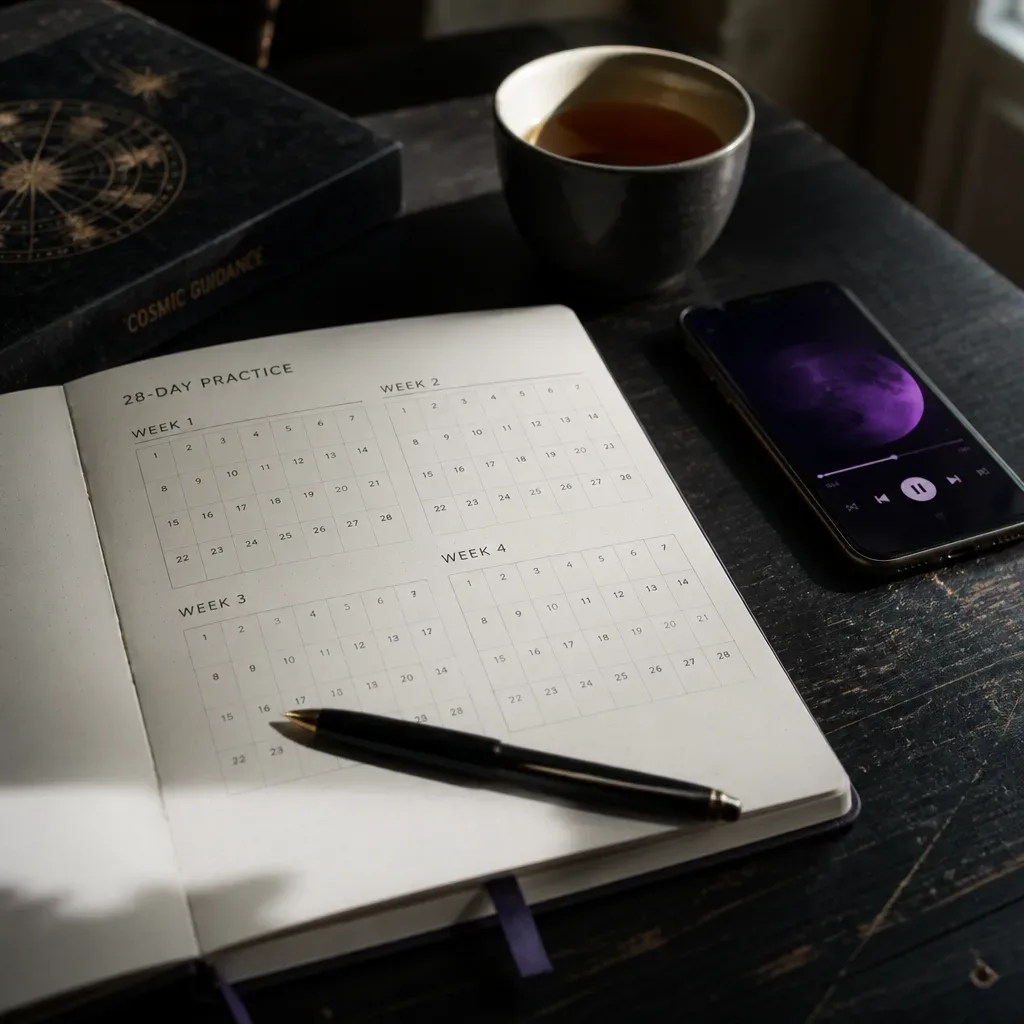
You listen once, you write once, and you let the day show you where the audio wants to become behavior.
Here is the whole daily rhythm:
- Put on your Dream-Self audio.
- Let your body settle for three slow breaths.
- Listen all the way through.
- Write one sentence immediately after.
- Choose one tiny matching action before the day ends.
That fifth step matters. Manifestation is not pretending. It is practicing perception, identity, and action until they stop feeling separate. The affirmations you use can support this, but they are not the center here. The daily affirmation is a complement. The audio is the method.
A tiny matching action should be almost too simple to respect. If your Dream-Self audio speaks from creative confidence, send one pitch. If it speaks from financial steadiness, look at the number you avoid. If it speaks from being loved well, do not text the person who only gives you crumbs. According to the American Psychological Association, implementation intentions, often phrased as if-then plans, have shown consistent effects across behavior-change studies since Peter Gollwitzer’s work in the 1990s. A clear cue helps the self remember.
Your one-line note is evidence. Not proof that the world has obeyed you. Proof that you are meeting yourself differently. Some days it will be plain: I listened while folding laundry. Some days it will have teeth: I noticed I wanted to undercharge again. Both count.
If you like structure, use this 28-day frame:
- Days 1 to 7: listen and notice resistance.
- Days 8 to 14: listen and take one small matching action.
- Days 15 to 21: listen and remove one old pattern.
- Days 22 to 28: listen and choose from the Dream-Self first.
The work is not to believe perfectly. The work is to return before disbelief becomes the whole room.
What happens in each week of the challenge?
Each week has a different texture: beginning, friction, choice, and integration.
Week 1 is for hearing. You may feel tender, bored, skeptical, or strangely calm. All of that is allowed. The first seven days often reveal the sentence under the sentence: I want this, but I do not think it can be mine. That is useful. A 2010 paper by Killingsworth and Gilbert in Science found that people’s minds wandered about 47% of the time in sampled moments, and mind-wandering was linked with lower happiness. Your audio is a daily way of calling the mind home.
Week 2 is for contact with reality. This is when you take small matching actions. You apply. You ask. You rest. You stop checking the old door. You have one honest conversation. If your intention is relational, this is where astrology and manifestation can be used softly, as timing and reflection, not as a substitute for choice.
Week 3 is often the uncomfortable one. The old self does not always leave politely. You may want to skip the audio because it is starting to touch something real. In stress research, consistency is usually more protective than intensity. A 2019 review in Journal of Behavioral Medicine noted that regular mindfulness-related practices were associated with improved stress outcomes, though effects varied by study quality and population. Keep your standard low: listen.
Week 4 is for choosing from the new seat. Not announcing. Not proving. Choosing. By Day 28, you may not have the full outer result yet. But you should have data: what you avoid, what opens, what you keep asking for, what your body believes first.
Use the weekly reviews like this:
| Review day | Question to ask | What to look for |
|---|---|---|
| Day 7 | What did I resist hearing? | Old beliefs |
| Day 14 | What action did I take? | New behavior |
| Day 21 | What pattern tried to return? | Protection habits |
| Day 28 | What now feels more normal? | Identity shift |
A month can show you the doorway. It does not have to carry the whole house.
How do you handle doubt, missed days, and no visible signs?
You handle them by treating them as part of the practice, not proof that the practice is failing.
Doubt is not an emergency. It is often a memory wearing a serious face. If you have wanted something for a long time, your mind may protect you by lowering expectation. That does not make you broken. It makes you practiced at bracing. Research on negativity bias, discussed by psychologists such as Roy Baumeister, suggests that negative information often weighs more heavily than positive information. So yes, one quiet disappointment can feel louder than five small openings.
When you miss a day, do not make the missed day more important than the return. Write: missed yesterday; came back today. Then listen. The streak is useful only if it helps you. It is not a god. In behavior-change work, self-compassion has been linked with better recovery after lapses; Kristin Neff’s research on self-compassion has been cited thousands of times since the early 2000s.
If there are no visible signs, look smaller. Did you speak differently? Did you pause before shrinking? Did you notice the old story sooner? Did you feel less desperate for someone else’s approval? These are signs too. They are not decorations. They are evidence of a self becoming more available to her own life.
You can also adjust the audio if it feels too far away. The sentence I am fully booked with dream clients may be too sharp for your system on Day 4. Try: I am learning to be seen and paid with steadiness. The Manifestation pillar goes deeper into this balance between desire and daily evidence.
If a sentence makes your body leave the room, choose a truer sentence.

How do affirmations and a Manifestation Board fit without taking over?
They fit as quiet complements, not as the main practice.
The daily affirmation can give you one sentence to carry after the audio ends. It is the line in your pocket. If your Dream-Self Moment is the full voice, the affirmation is the small echo. For example: I choose the fee that respects my work. Or: I am safe to be chosen by what is true. Written affirmations have mixed research support, especially when they are too far from a person’s current self-concept. A well-known 2009 study by Wood, Perunovic, and Lee found that very positive self-statements could make some people with low self-esteem feel worse. This is why tone matters.
A Manifestation Board can help you see what you are practicing. Keep it honest. A room. A phrase. A number. A face that looks like rest. Do not use it to punish your current life. Use it as a visual note from the future self you are rehearsing in audio. If you want more language for written support, the affirmations guide can help you make sentences that do not feel fake.
Here is the order I suggest for the 28 days:
- Dream-Self audio first.
- One-line note second.
- Daily affirmation if useful.
- Manifestation Board only when you want a visual reminder.
This order protects the method. It also protects you from turning a quiet practice into homework with glitter on it. The app can hold the complements. You only have to keep returning to the audio.
What should you do on Day 28?
On Day 28, you review the evidence, name the shift, and decide whether to continue, refine, or rest.
Read every one-line note from the beginning. Slowly. You are looking for repetitions. Not just results. Repetitions reveal identity. Maybe you asked for more money three times. Maybe you stopped apologizing before saying what you need. Maybe you cried on Day 9 and sent the email on Day 12. A 2021 meta-analysis in Psychological Bulletin found that self-monitoring is associated with behavior change across health studies, especially when paired with clear goals. Your notes are a soft form of self-monitoring.
Then answer three questions:
- What now feels more believable than it did on Day 1?
- What action did I take that the old version of me avoided?
- What does my Dream-Self want me to practice for the next 28 days?
You may keep the same audio. You may record a new one. You may narrow the intention. You may take three days off and listen without notes. The point is not to become someone who completes challenges. The point is to become someone who can hear her true life and move with it.
If you want a next step, choose one of these:
| If Day 28 feels like | Choose this next |
|---|---|
| Clear and steady | Repeat for another 28 days |
| Too broad | Narrow the intention |
| Tender | Keep audio, drop extra notes for 7 days |
| Complete | Create a new Dream-Self Moment |
| Confusing | Review your notes with one trusted person |
A 28 day manifestation challenge is not a test of worth. It is a container. You enter it with headphones, a sentence, and the willingness to notice what changes when you stop abandoning the future self at the first sign of doubt. For another practical frame, you can pair this with gentle manifestation techniques that keep action close to attention.
The future self is not far away. She is the voice you practice recognizing.
Put the headphones down softly. The room is still yours.