aya method deep dive
Manifestation Goals: What to Put in Dream-Self Audio
Manifestation goals can feel crowded. Learn what to put in your Dream-Self audio when you want career, love, money, peace, and a real life.
When your manifestation goals all feel urgent, put only the desires that belong to one believable life into your Dream-Self audio. Name the season, choose 3 to 5 core outcomes, anchor them in daily scenes, and record the version of you who has already become steady enough to hold them.
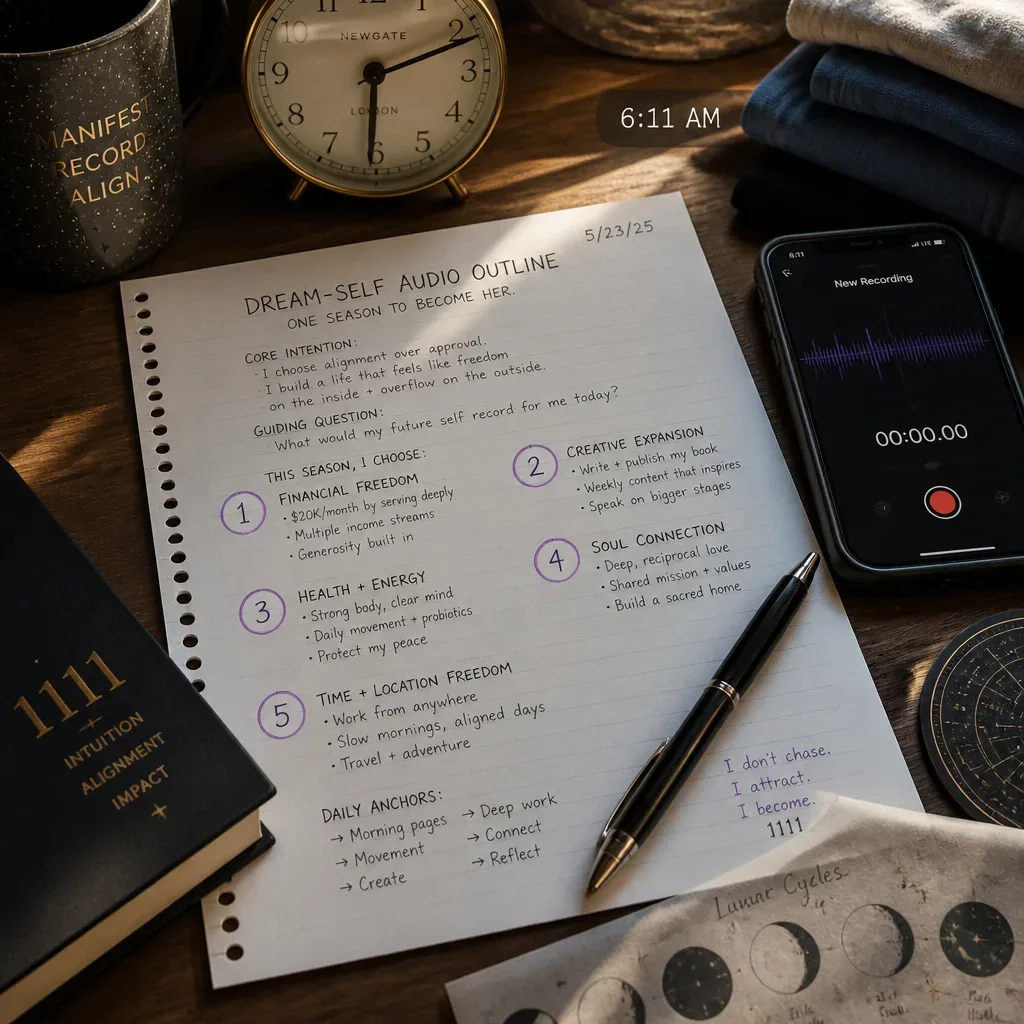
I know the feeling. At 6:11 one morning, my son was asking for socks, the kettle was doing its small metal scream, and I had a note open with 19 things I wanted. Money. Work. Health. Patience. A clean fridge, which felt spiritual at the time.
Wanting everything is not the problem. A crowded signal is the problem.
What should manifestation goals do inside Dream-Self audio?
Manifestation goals should give your audio a clear identity to rehearse, not a long list of prizes to chase.
In the AYA Method, the core practice is audio: each day you listen to a short personalized recording, your Dream-Self Moment, narrated from the version of you who has already manifested the life you intend. Listening is the practice. Repetition is the work. The audio is the method. The daily affirmation and Manifestation Board can help, but they orbit the recording. They are not the sun.
That distinction matters when you want everything. If your audio says, “I have the house, the partner, the clients, the body, the book deal, the healing, the passport stamp, and the miraculous calendar,” your mind hears inventory. Inventory does not become identity. Locke and Latham’s 2002 review of goal-setting research found that specific, challenging goals improve performance across more than 400 studies, but the useful part is not pressure. It is direction.
Your Dream-Self audio is direction with a pulse.
A good goal in audio answers three questions:
- What has arrived? Name the result without apologizing for wanting it.
- Who am I now? Describe the identity that can live there without flinching.
- How does an ordinary day prove it? Put the result into a scene your nervous system can recognize.
For example, “I earn well from music again” is a goal. “I check my account after a morning session and feel calm because my creative work now pays the household bills on time” is a Dream-Self Moment. One is a headline. The other is a room you can enter.
A goal becomes believable when it has a floor, a light source, and someone breathing normally inside it.
The Manifestation pillar covers the broader theory of naming a desired reality. Dream-Self audio is narrower and more practical. It asks: if the dial lined up, what would Tuesday sound like?
How do you choose when you want everything at once?
Choose the goals that belong to the same season, then let the rest wait outside the studio door.
The nervous system is not offended by desire. It is offended by contradiction. You can want a slower life and a global launch. You can want love and solitude. You can want wealth and anonymity. But if all of them enter the same 3-minute audio with no hierarchy, the recording starts to sound like five people fighting over one microphone.
Start with season. A season is usually 28 to 90 days in practice, which is why lunar cycles and quarterly planning both have staying power. One lunar cycle is about 29.5 days; one business quarter is about 91 days. Different languages, same human need: a container.
Ask yourself, “What is the master signal right now?” Not the most glamorous goal. The one that would make the others easier.
Use this sorting table before you write:
| Desire | Put it in this audio if… | Save it for later if… |
|---|---|---|
| Money | It creates safety, time, or choice in this season | It is mainly comparison or panic |
| Love | You are ready to practice receiving and relating | You want a person to fix your self-worth |
| Career | It changes your daily rhythm and contribution | It only sounds good on a bio page |
| Health | It supports the life you are building | It is punishment wearing clean clothes |
| Home | It gives your body a stable base | It is a fantasy of never being challenged |
In Dominican University research often attributed to Dr. Gail Matthews, people who wrote goals and shared progress were reported to complete more than those who only thought about goals. The exact percentages are debated because the study was small and not a massive clinical trial, but the principle is useful: articulation changes behavior.
So write everything first. Then cut.
A clean Dream-Self audio can hold 3 to 5 manifestation goals. Three is elegant. Five is the upper shelf. Eleven is a numerology signal, yes, but eleven goals in one recording is usually not a master number. It is a committee meeting.
If you cannot cut, group. “I am well-paid, well-loved, and well-rested” can hold money, relationship, and health under one identity: the person who no longer survives by scattering themselves.
What belongs in the first 30 seconds of the recording?
The first 30 seconds should name the identity, the season, and one undeniable proof that the life has arrived.
Audio has a gate. Musicians know this. The first bar tells the body whether to lean in or check the phone. When I played bass on tour, the audience often decided within 8 to 12 seconds if the room was with us. Not forever, but enough. Attention is a narrow door.
Your opening should not clear its throat.
Use a direct first line such as:
- “I wake up in the life I used to ask for, and it feels steady.”
- “My work is paid well, my body is trusted, and my home is peaceful.”
- “I have become the kind of person who can receive love without rehearsing loss.”
- “The money is no longer a siren; it is a system.”
Notice the structure. Identity first. Then evidence. Then feeling.
Andrew Huberman has often discussed how attention and repetition shape neural circuitry, especially through salience and dopamine. You do not need to turn your audio into a neuroscience lecture. You only need to respect that the first moment tells the brain, “This matters.” In meditation research, even brief daily practices can change perceived stress over 8 weeks; mindfulness-based stress reduction programs, popularized by Jon Kabat-Zinn, commonly use that 8-week frame.
The opening is not decoration. It is the dial tone.
Here is a simple 30-second template:
- Identity: “I am the version of myself who…”
- Season: “This is the season where…”
- Proof: “I notice it when…”
- Body cue: “My shoulders drop because…”
- Relational cue: “The people close to me can feel…”
Keep the first sentence under 20 words. If you need two breaths to say it, it is not an opening. It is a speech.
The Affirmations pillar can help you sharpen a single sentence, but your Dream-Self audio needs more than a sentence. It needs motion. It needs a morning, a message, a receipt, a quiet kitchen, a calendar that no longer looks like a threat.
How do you make multiple goals sound like one life?
Make every goal report back to the same future self, the same emotional weather, and the same daily rhythm.
This is where many recordings go strange. The money section sounds like a finance podcast. The love section sounds like a film trailer. The health section sounds like a punishment note from a gym wall. The career section arrives wearing a blazer it hates. No wonder the listener does not believe it.
One life has one atmosphere.
Pick a governing sentence before you write. It might be:
- “I am no longer rushing to prove I deserve my own life.”
- “I receive more because I can now hold more with care.”
- “My success is organized enough to be kind.”
- “I am visible without becoming available to everyone.”
The best manifestation goals do not compete for attention; they agree on who you are becoming.
Then translate each goal through that sentence.
If the governing sentence is “My success is organized enough to be kind,” your goals might sound like this:
| Goal area | Crowded wording | Coherent Dream-Self wording |
|---|---|---|
| Money | “I make $12,000 a month and never worry again” | “My monthly income is steady enough that I pay, save, give, and breathe” |
| Career | “Everyone knows my work” | “The right rooms know my work, and I show up prepared” |
| Love | “My perfect partner arrives” | “I am loved in a way that fits my real days, not my performance” |
| Health | “I look completely different” | “My body has become a trusted instrument, not a project I insult” |
Specificity still matters. If $12,000 is the number, say it. Edwin Locke and Gary Latham’s research supports measurable goals because vague goals like “do your best” often underperform. But numbers should serve the scene. Say what the number changes: rent paid early, debt reduced by $500 a month, a childcare bill handled, two studio days protected.
Numerology people talk about 11 as intuition, 22 as the builder, and 33 as service. Treat those as symbolic prompts, not courtroom evidence. If you keep seeing 11:11 while drafting, fine. Use it as a bell. Then write a better sentence.
Synchronicity is punctuation. Practice is grammar.
You can also use Astrology and manifestation timing as a reflective tool. A new moon can mark intention. A Saturn transit can ask for structure. But your audio still needs a life that can be lived by a person with laundry.
What details should you include, and what should you leave out?
Include sensory, behavioral, and relational details; leave out panic, comparison, revenge, and micromanaged outcomes.
Your Dream-Self Moment should feel like evidence, not advertising. The detail does not need to be cinematic. It needs to be true enough for the body to stop arguing. Tara Brach often teaches the value of embodied presence in emotional practice. That matters here because a sentence that never enters the body becomes décor.
Use the “3 proofs” method:
- A sensory proof: What do you see, hear, touch, or smell?
- A behavioral proof: What do you do differently now?
- A relational proof: How do people experience you differently?
For a career goal, sensory proof might be the sound of your laptop closing at 4:30 because the day is complete. Behavioral proof might be sending invoices every Friday. Relational proof might be your child noticing you no longer answer messages at dinner. This is not small. A 2023 Pew Research Center report found that about 62% of workers with jobs that can be done from home were working from home at least some of the time, which means boundaries are now part of the manifestation for many people, not a side issue.
Leave out anything that makes your audio brittle.
Do not record, “My ex regrets everything.” Record, “I am so well-loved and self-respecting that old rooms no longer call me back.” Do not record, “My rival fails.” Record, “My work reaches the right audience on its own strength.” Do not record, “I get this exact apartment or nothing.” Record, “I live in a home with morning light, safe locks, fair rent, and enough space to think.”
If the sentence needs someone else to lose before you can breathe, it is not ready for your audio.
Joe Dispenza speaks often about rehearsing a future emotional state until the body recognizes it. You do not have to adopt his whole framework to use the practical point: the body learns through repetition. A bassist does not become steady by reading about tempo. You play the line until the hands stop negotiating.
The same is true here. Record details you can rehearse without bracing.
How should you structure the full Dream-Self script?
Structure the script as one coherent scene: arrival, proof, integration, gratitude, and return to today.
A 2 to 5 minute recording is enough for most people. At a calm speaking pace of 130 to 150 words per minute, that gives you roughly 300 to 700 words. That is not much. Good. Constraint makes the signal cleaner.
Here is a practical structure:
-
Opening identity, 20 to 40 words
“I am living the season I used to sense before I could explain it.” -
Main life scene, 120 to 220 words
Describe one ordinary day where the goals are already integrated. Include place, time, body, and action. -
Goal proof, 150 to 250 words
Name 3 to 5 manifestation goals through evidence: paid invoice, loving conversation, strong body, peaceful home, visible work. -
Emotional integration, 60 to 120 words
Describe how you now respond to old triggers. -
Return line, 20 to 40 words
Speak to the present self with calm instruction: “Keep listening. Keep moving. The rhythm is already changing.”
The AYA practice works because repetition reduces the drama of belief. You do not need to feel electric every morning. In fact, electric can be suspicious. In a 2018 review in Behavior Research and Therapy, mental imagery was discussed as emotionally powerful because the brain often responds to imagined scenes more strongly than verbal thought alone. Audio gives that imagery a container you can repeat.
Write in present tense or remembered certainty. “I am” works. “I remember when I used to worry about this” also works. Avoid constant future tense. “I will” keeps the gate slightly ahead of you. The Dream-Self voice speaks from arrival.
Here is a compact sample:
I wake before the alarm and the room is still. My work is paid clearly now. I know because the invoices are sent on time, the account holds more than enough for the month, and I no longer make every decision from alarm. My body feels like an instrument I maintain with respect. I move, eat, rest, and return without punishment. Love is present in my real life, not only in the version I perform for strangers. The people close to me feel my steadiness. My calendar has space. My creative work has a clean path. I used to think I wanted everything. Now I can feel the pattern: I wanted a life I could stay inside.
That last sentence is the signal.
How do you record and listen without turning it into another task?
Record it plainly, listen daily, and keep the ritual small enough that your real life cannot reject it.
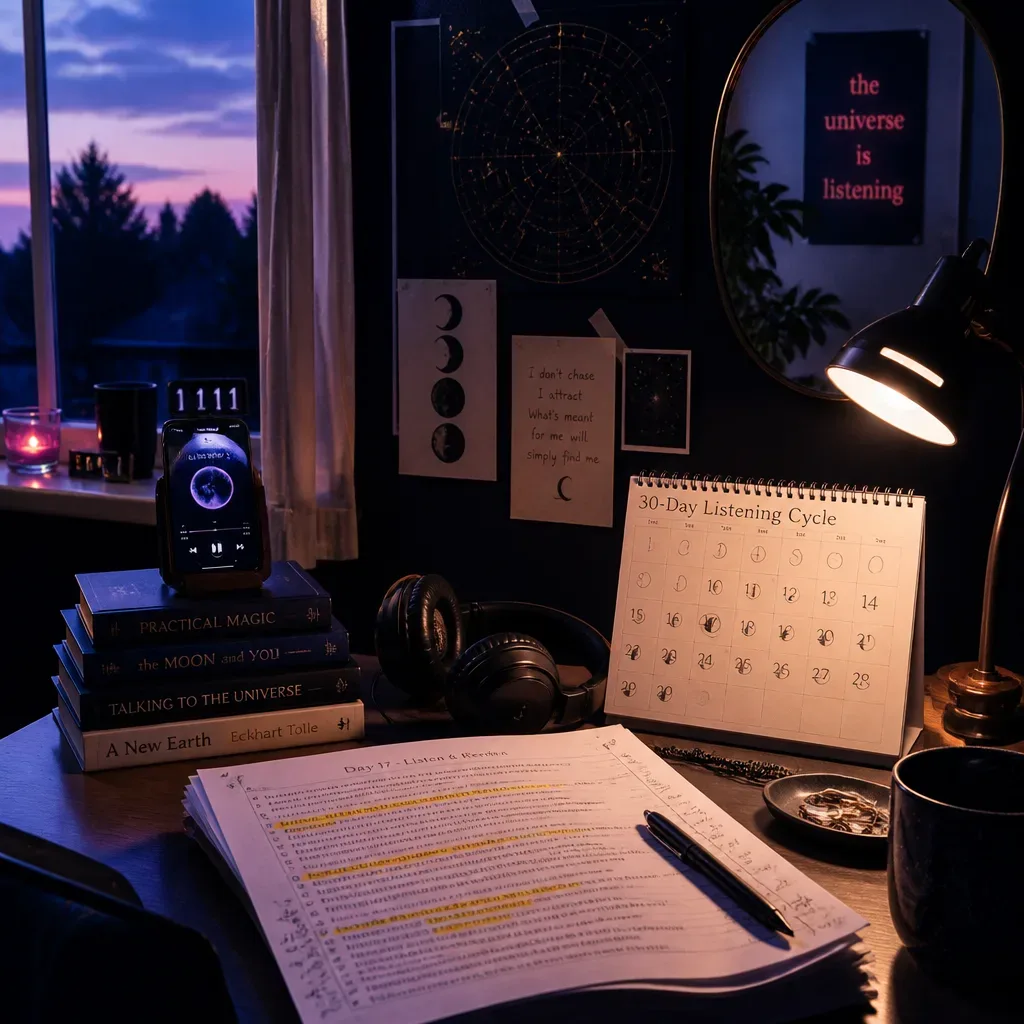
You do not need a studio. I say this as someone who has paid rent through studios and also recorded voice notes under a blanket while a child watched cartoons too loudly in the next room. Use your phone. Sit close to the mic. Speak slower than feels natural. Smile slightly if the recording sounds too stern; the voice changes when the face changes.
Technical basics help:
- Record in a quiet room with soft surfaces.
- Keep the script between 300 and 700 words.
- Leave 1 second of silence before the first line.
- Use your natural voice, not a guru voice.
- Re-record only if the mistake changes the meaning.
The daily listening matters more than the perfect take. Habit researchers often cite context cues and repetition as key ingredients in behavior change. A 2009 study by Lally and colleagues in the European Journal of Social Psychology found habit formation took anywhere from 18 to 254 days, with an average of 66 days. That wide range is a mercy. It means you are not failing on day 6. You are early.
Attach the audio to an existing cue:
- After brushing your teeth.
- Before opening email.
- During a morning walk.
- In the parked car before work.
- While sitting with coffee before the house starts asking questions.
This is why the AYA Method insists that listening is the practice. Not decorating a board for 3 hours and disappearing for 3 weeks. Not writing 40 affirmations and resenting them by Thursday. The recording is short enough to return to, which is the whole point.
A practice that cannot survive an ordinary Tuesday is not a practice yet.
If you use a daily affirmation, let it be one line pulled from the audio. If you use a Manifestation Board, let it visually echo the same season. Complements. Useful satellites. The audio remains the spine.
What if your goals change after you record it?
Revise the audio when the season changes, not every time your mood changes.
Desire has weather. Some mornings the signal is clean. Other mornings you want a new city, a different face, a second life, and a breakfast that cooks itself. Do not hand the microphone to every mood. Give your recording enough time to work on you.
A practical revision rhythm is every 28 to 30 days. That gives you a full lunar cycle and enough ordinary evidence to notice what still feels true. If you prefer business structure, revise quarterly. Either way, set a date. The date keeps you from tinkering as avoidance.
Change the audio when:
- A goal has clearly arrived and now needs integration.
- A goal no longer belongs to your honest life.
- A number has become clearer through real-world feedback.
- The emotional center has shifted from safety to visibility, or from healing to building.
- The recording feels like a costume rather than a future memory.
Do not change the audio because you felt nothing on Tuesday. Nothing is allowed. Athletes repeat drills without fireworks. Musicians play scales without prophecy. Parents make breakfast without applause. Repetition is often quiet because quiet is how the groove enters the body.
The Manifestation pillar gives the big map, and the AYA Method gives the daily sound. Between them sits your responsibility: tell the truth about what you want, then practice becoming the person who can hold it without grabbing.
If you want everything, you may not need a bigger audio. You may need a truer season.
Name the life that is actually calling, and let the rest wait its turn.