affirmations
Affirmations for Anxiety: 3-Minute Audio Practice
Affirmations for anxiety can steady your attention when worry gets loud. Try this 3-minute future-self audio practice, softly and daily.
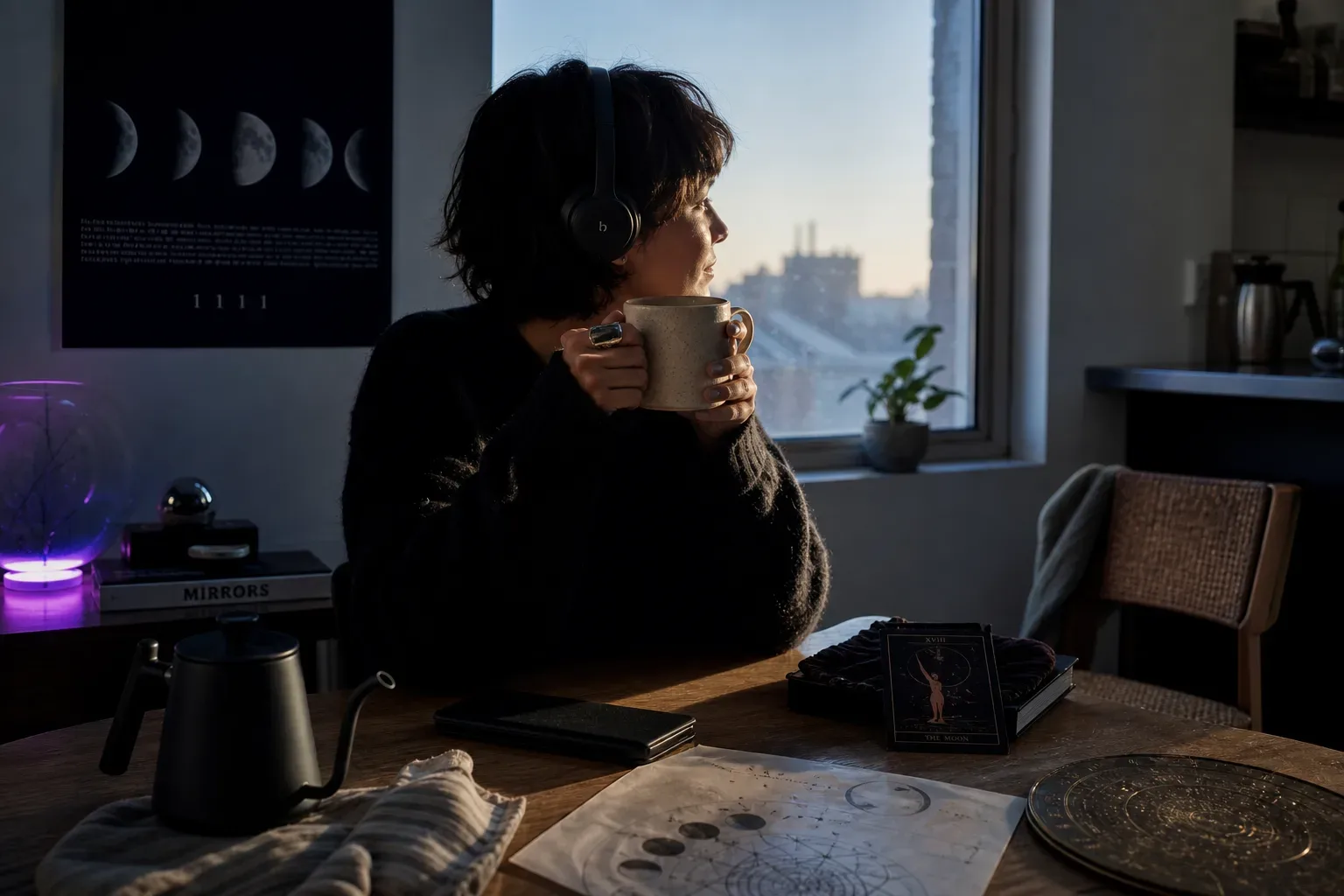
The kettle clicks off. Your chest is already doing its small weather. Affirmations for anxiety work best when they don’t argue with fear. A 3-minute future-self audio gives your mind one steady voice, one believable sentence, and one small next action to return to, before worry takes the whole room.
What makes affirmations for anxiety different from ordinary positive thinking?
Affirmations for anxiety need to feel true enough for your nervous system to accept.
An anxious mind often rejects big claims. If you say, “I’m completely calm,” while your jaw is tight and your heart is fast, the body may answer, no, you’re not. That doesn’t mean the practice has failed. It means the sentence is too far away. In a 2009 study in Psychological Science, Joanne Wood and colleagues found that broad positive self-statements could make some people with lower self-esteem feel worse, not better. The words have to meet you where you are.
A better anxiety affirmation sounds like a hand on the table. Present. Not dramatic. Try: “My body is alarmed, and I can still choose the next small thing.” That sentence doesn’t deny the alarm. It gives the alarm a smaller job. The National Institute of Mental Health estimates that 31.1% of U.S. adults live with an anxiety disorder at some point in life, so this is not rare or strange. It’s human, and it deserves language that doesn’t shame it.
This is where affirmations become more than pretty sentences. They become cues. A cue tells attention where to rest. A cue says, return here. Research on self-affirmation, including work by Claude Steele and later studies such as Creswell et al. in Psychological Science in 2013, suggests that reflecting on what matters to you can soften threat responses under pressure.
Use a smaller truth before you try a brighter one.
Good anxiety affirmations usually do three things:
- Name what is happening without making it your identity.
- Offer one safe-enough sentence your body can test.
- Point toward one action you can take in the next 10 minutes.
The sentence doesn’t need to win against anxiety. It only needs to stay with you long enough for the next breath.
Why does a future-self audio help when anxiety is loud?
A future-self audio helps because listening takes less effort than trying to think your way out of a loop.
When worry is loud, the mind keeps producing evidence. It checks, predicts, replays, and warns. The World Health Organization estimated that 301 million people were living with anxiety disorders in 2019, and one common feature is this overactive scanning for threat. Reading a card can help, but it still asks you to lead. Audio lets you follow.
The AYA Method is a daily audio manifestation practice. Each day you listen to a short personalized recording — your Dream-Self Moment — narrated from the version of you who has already manifested the life you intend. Listening is the practice. Repetition is the work. The audio is the method.
That matters when you’re anxious because the voice arrives before the argument does. You don’t have to build a new thought from scratch. You hear one. Dr. Andrew Huberman has often taught breathing tools for state change, and a 2023 Cell Reports Medicine study by Balban and colleagues found that five minutes of cyclic sighing improved mood and reduced breathing rate more than mindfulness meditation in that trial. Audio and breath sit close together. Both give the body timing.
The future-self part is not pretending. It’s rehearsal. Athletes have used mental rehearsal for decades; a review in Neuropsychologia in 2007 noted overlap between imagined and executed movement networks in the brain. Your practice is quieter than a penalty kick. Still, the principle holds. You rehearse the self who can feel fear and not hand over the steering wheel.
An affirmation on paper says, remember this. A future-self audio says, listen, you’re already being remembered.
How do you write a 3-minute future-self script for anxious moments?
Write the script as if your steadier self is speaking to you after the fear has already softened.
Start with one scene. Not “my anxiety.” Too wide. Choose the moment that gets you. The inbox. The school gate. The phone call. The midnight ceiling. Specificity lowers the pressure. In behavior science, implementation intentions often use an “if-then” structure, and Peter Gollwitzer’s 1999 work found that naming a cue and response can make action more likely. Your audio can do the same.
Here is a simple structure for three minutes:
- Name the moment. “You’re standing in the kitchen before opening the message.”
- Name the body. “Your chest is tight, and your feet are still on the floor.”
- Name the truth. “This feeling is loud, but it isn’t the whole room.”
- Name the future self. “I know how to move slowly now.”
- Name the next action. “Open the message, read one line, then breathe.”
Three minutes is about 360 to 420 spoken words at a slow pace. If that sounds too much, speak less. Silence counts. The Mayo Clinic notes that slow breathing can support relaxation responses, and clinical breathing exercises often begin with just 3 to 5 minutes. You don’t need a speech. You need a rhythm your body can learn.
Keep your script plain. If you’re a parent, you might say, “The baby is crying, and I’m still not failing.” I have needed that one. If you’re changing work, try, “This uncertainty is not proof that I chose wrong.” If you’re learning manifestation while anxious, keep it grounded. Manifestation is not denial. It is attention practiced with care.
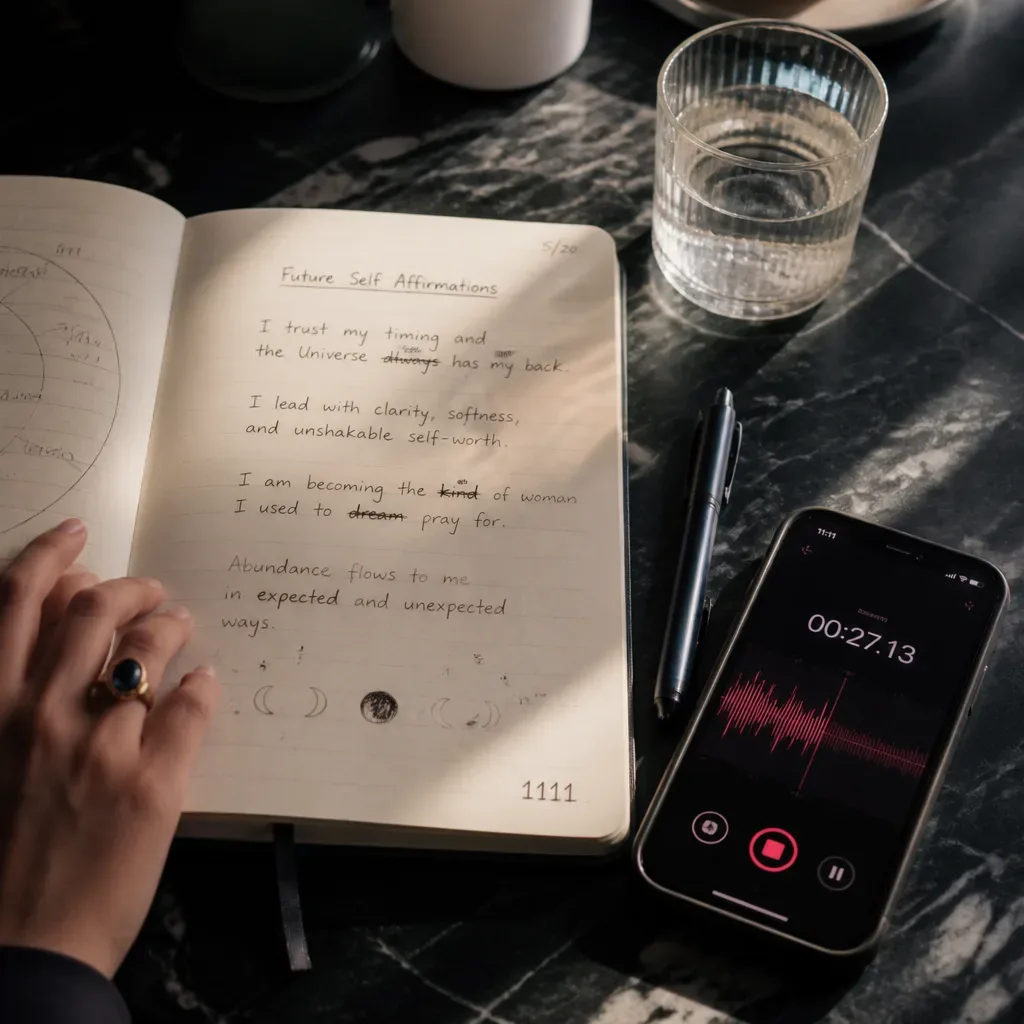
Here’s a small comparison to keep the words honest:
| Instead of this | Try this |
|---|---|
| I am fearless. | I can feel fear and still act gently. |
| Nothing bad will happen. | I can meet what happens one step at a time. |
| I never spiral anymore. | I know how to return sooner now. |
| I must stay calm. | I can soften my shoulders and begin again. |
A believable sentence is a bridge. A perfect sentence is often a wall.
What is the exact 3-minute practice?
The exact practice is to listen, breathe, repeat one line, and take one small action.
Set a timer if that helps, but don’t make the timer the boss. The point is not performance. The point is return. A 2022 Pew Research Center report found that 31% of U.S. adults said they go online “almost constantly,” which means many anxious moments now begin with a screen. Put the phone face down after you start the audio. Let it become a voice, not a feed.
Use this 3-minute shape:
- Minute 1: Arrive. Feel your feet. Let the first part of the audio name the real moment. Breathe out longer than you breathe in for 4 to 6 cycles.
- Minute 2: Hear the future self. Let the recording speak in present tense. “I know this feeling. I don’t rush to fix my whole life. I choose the next true thing.”
- Minute 3: Choose the next action. The audio ends with one small instruction. Stand up. Send the line. Wash the cup. Step outside.
If you use Aya, the Dream-Self Moment carries this part for you. The app also includes a daily affirmation and Manifestation Board, but those are complements. The listening is the practice. If you want to understand the wider structure, start with the AYA Method, then come back to this smaller anxiety version when you need it.
You can pair the audio with a breath pattern. Try inhaling through the nose, then taking a second small inhale, then a long exhale. Huberman calls this a physiological sigh, and lab work from Stanford-associated researchers has studied similar breathing patterns for stress. Do three rounds. No drama. Just air leaving.
The practice should end with movement. Anxiety loves unfinished loops. A small action tells the brain, we are not stuck. Even 2 minutes of walking can change state; sports medicine studies often show mood shifts after brief light movement, though effects vary. Your action doesn’t have to be impressive. It has to be real.
When should you use anxiety affirmations, and when should you get more help?
Use anxiety affirmations for daily regulation, not as a replacement for clinical care.
This distinction matters. If you’re having panic attacks, avoiding ordinary life, using substances to get through the day, or feeling unsafe with yourself, please speak with a licensed clinician or call local emergency support. The American Psychiatric Association notes that anxiety disorders are treatable, and common care includes cognitive behavioral therapy, medication, or both. A 3-minute audio can sit beside care. It should not stand in the place of care.
For ordinary worry, practice before the spike when you can. The brain learns from repetition. In habit research, a 2009 study by Lally and colleagues in the European Journal of Social Psychology found that forming a new habit took a median of 66 days, with wide variation. That number is useful because it lowers the fantasy of instant change. You listen today. You listen tomorrow. The path gets more familiar.
Good moments to use the audio:
- Before opening email or messages.
- Before a meeting, class, or hard conversation.
- During the first 10 minutes after waking.
- Before sleep, if nighttime worry is your pattern.
- After a body cue, like a tight chest or clenched hands.
If your worry has a seasonal or timing pattern, you may also like reading about astrology and manifestation as a reflective tool. Keep it gentle. A date, transit, or moon phase can be a prompt for attention, not a sentence about your fate.
There is no prize for doing this the hard way. If the audio makes you cry, pause. If a sentence feels false, change it. If silence feels safer today, use silence. Anxiety is already loud. Your practice doesn’t need to be.
How do you keep the practice working after the first week?
Keep it working by making it small, specific, and boring enough to repeat.
The first week often has a little shine. Then life arrives. A child spills milk. Work asks for one more thing. The laundry stays wet because you forgot it in the machine. This is where a real practice either becomes yours or becomes another tab you meant to close. The American Time Use Survey has repeatedly shown that care work and household tasks take hours each day for many adults, so your practice has to fit inside life, not compete with it.
Choose one cue. After brushing your teeth. After parking. Before opening the laptop. Behavior designer BJ Fogg has written that tiny habits attach best to existing routines because the cue is already there. You don’t need a new personality. You need a place where the audio can land.
You can refresh the script every 7 days. Not daily. Daily editing can become another anxious ritual. Once a week, ask three questions:
- What sentence helped my body soften this week?
- What sentence did my mind argue with?
- What small action do I need the audio to lead me toward now?
For more language, the affirmations pillar can help you shape sentences that don’t collapse under pressure. If your practice is part of a wider intention, the manifestation pillar gives the broader frame. And when you want the audio-first structure, return to the AYA Method. Quiet repetition is not nothing. It is how the body learns a room is safe enough.
Track lightly, if at all. A simple note is enough: listened, didn’t listen, listened again. In clinical settings, mood tracking can help some people notice patterns, but too much tracking can become its own worry loop. Use the least record that keeps you honest.
Three minutes. Then the room comes back to you.