affirmations
I Am Affirmations That Feel True in Audio
I am affirmations feel more believable when you hear them as future-self audio. Learn a quiet 10-minute method for words your body can trust.
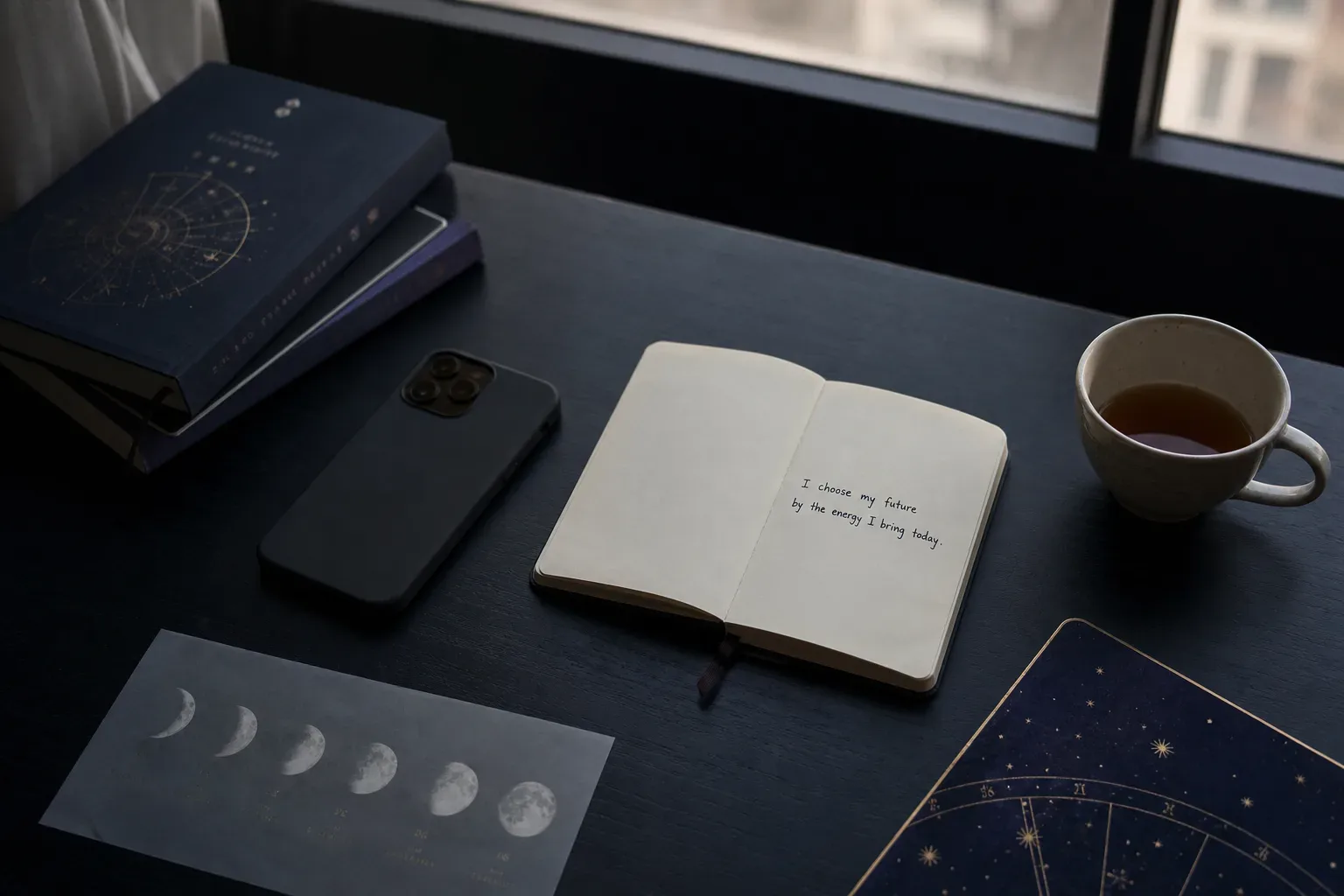
Your phone is face-down on the table. One sentence is waiting. I am affirmations feel true when they’re close enough to believe and specific enough to repeat. Future-self audio helps because you don’t have to push the words. You hear them spoken from the version of you who’s already living them.
Why do I am affirmations feel false in your mouth?
They feel false when the sentence asks your nervous system to skip too many steps.
A phrase like “I am rich,” “I am healed,” or “I am fully confident” can sound clean on paper. But if your body answers with no, the practice becomes a small argument. In a 2009 Psychological Science study, Joanne Wood, W.Q. Elaine Perunovic, and John Lee found that broad positive self-statements could make people with low self-esteem feel worse, not better. The words weren’t wrong. They were too far away.
An affirmation is not a performance of certainty. It’s a sentence you can return to without bracing. If your jaw tightens, if your chest gets hot, if you roll your eyes before you’ve finished reading it, the sentence needs to come closer. Not smaller. Truer.
Try this test. Say the sentence once. Then notice your body for 10 seconds. That’s long enough to catch the first honest response. Dr. Andrew Huberman often points to the role of state in learning and attention; the brain records differently when the body is under threat than when it’s steady. You don’t need a perfect state. You need a tolerable one.
A true affirmation doesn’t flatter you. It recognizes you.
The quiet fix is to write the bridge version. Not “I am fearless.” Maybe “I am learning to stay with myself when I feel afraid.” Not “I am successful.” Maybe “I am becoming available for steady, well-paid work.” The first version shouts. The second gives you somewhere to stand.
If you want the wider map of this practice, the Affirmations pillar holds the basics. Here, the work is narrower. You’re taking one I am sentence and letting it become sound.
What makes future-self audio different from reading a sentence?
Future-self audio lets the affirmation arrive through listening, which can feel less forceful than reading it alone.
Reading asks you to generate the sentence. Audio lets you receive it. That difference matters when you’re tired, resistant, or busy. A common speaking pace for clear narration is about 130 to 160 words per minute. A 90-second recording can hold 195 to 240 words, which is enough for one central affirmation, a few grounded details, and a clean ending.
This is where the AYA Method belongs in the room. The AYA Method is a daily audio manifestation practice. Each day you listen to a short personalized recording — your Dream-Self Moment — narrated from the version of you who has already manifested the life you intend. Listening is the practice. Repetition is the work. The audio is the method.
The distinction is simple. The daily affirmation can name the sentence. The Manifestation Board can give the sentence a visual home. But the listening is the method. The Dream-Self Moment carries the words in a voice that remembers where you’re going before the day starts asking for proof.
Neville Goddard called this kind of inner rehearsal “living in the end.” Joe Dispenza often speaks about rehearsing a future state until the body begins to know it as familiar. You don’t have to accept every claim from any teacher to use the practical part. Repeated inner rehearsal changes what you notice, choose, and tolerate. In behavioral science, repetition is not decoration. It’s how cues become easier to answer.
Audio gives the future self a human texture. It turns a sentence into a place.

How do you write I am affirmations your body can believe?
You write believable I am affirmations by starting with the truth, then moving one honest step forward.
Use a page, a notes app, or the back of an envelope. The tool doesn’t matter. The distance matters. Lally and colleagues published a 2010 study in the European Journal of Social Psychology showing that habit automaticity took a median of 66 days, with wide variation from 18 to 254 days. New identity sentences need repetition too. Give them words that can survive being heard many times.
Use this 5-step practice:
- Name the area. Choose one place: work, love, money, health, parenting, rest, or creativity.
- Write the current sentence. “I feel behind.” “I don’t trust myself with money.” “I keep disappearing in meetings.”
- Find the real desire. “I want to feel steady.” “I want to keep my word.” “I want to speak clearly.”
- Write the bridge I am. “I am learning to speak before I overthink.”
- Read it out loud once. If your body says no, soften it.
Here is the quiet comparison:
| If this feels false | Try this instead |
|---|---|
| I am rich | I am becoming steady with money |
| I am confident | I am practicing a clear voice |
| I am healed | I am safe enough to take the next good step |
| I am chosen | I am available for love that feels honest |
| I am successful | I am ready for work that respects my life |
A good affirmation has enough tension to matter and enough truth to land. If there’s no tension, it’s just a description. If there’s no truth, it’s just noise.
Research on self-affirmation from Geoffrey Cohen and David Sherman, summarized in a 2014 Annual Review of Psychology paper, suggests that affirming core values can reduce defensiveness under stress. That doesn’t mean every “I am” line works. It means the self needs to feel coherent. Your words need to fit the person you know yourself to be, even as they call you forward.
For more on how these sentences sit inside the wider practice, keep manifestation close but simple. The sentence is not a spell you throw at life. It’s a cue you repeat until you can act from it.
How do you turn one affirmation into a Dream-Self Moment?
You turn one affirmation into future-self audio by giving it a scene, a voice, and a short ending your body can remember.
Start with the affirmation. Then ask: what would be ordinary if this were already true? Not grand. Ordinary. If your sentence is “I am steady with money,” the scene might be opening your banking app without holding your breath. If it’s “I am ready to be seen at work,” the scene might be speaking in the first 10 minutes of a meeting.
A Dream-Self Moment doesn’t need to be long. Two minutes is often enough. At 150 words per minute, that’s about 300 words. In that space, you can name the future, locate it in a real day, and let the affirmation appear as something you already know.
Use this structure:
- Opening: “You wake up and remember who you are.”
- Scene: Put the future self in one ordinary moment.
- Body cue: Name the breath, shoulders, hands, or pace.
- I am sentence: Say it once or twice, not ten times.
- Proof of living: Show one small behavior that matches it.
- Closing: End before the mind starts negotiating.
Example:
You open the calendar and don’t shrink. There are meetings here, but there’s space too. Your hands are calm on the mug. You know what matters today. You don’t need to prove your worth before breakfast. I am clear. I am allowed to take up the right amount of room. I speak once, and I let that be enough.
This is where I am affirmations stop being floating text and become something your day can touch. Self-affirmation theory isn’t about pretending. Claude Steele’s early work in the 1980s framed affirmation as a way to preserve self-integrity under threat. The audio works best when it helps you remember your integrity before the threat arrives.
When should you listen so the words can settle?
Listen at a time you’re likely to repeat, not at the time that sounds most impressive.
Morning is useful because attention is less crowded. But if mornings belong to a child, a commute, medication, or a body that needs time, don’t turn the practice into another test. A 2019 Pew Research Center report found that 81% of U.S. adults owned a smartphone, and by 2024 Pew put smartphone ownership at 91%. The point is simple: the tool is already near you. The practice can be small.
You can listen:
- before getting out of bed
- while sitting in a parked car
- after brushing your teeth
- before opening email
- during a short walk
- at night, with the lights low
Pick one cue. Pair the audio with it for 7 days. Don’t judge the sentence after one listen. In memory research, spaced repetition works because the mind meets the same material across time. The same principle applies here in a softer way. You hear the sentence. You live a day. You hear it again. The words begin to have context.
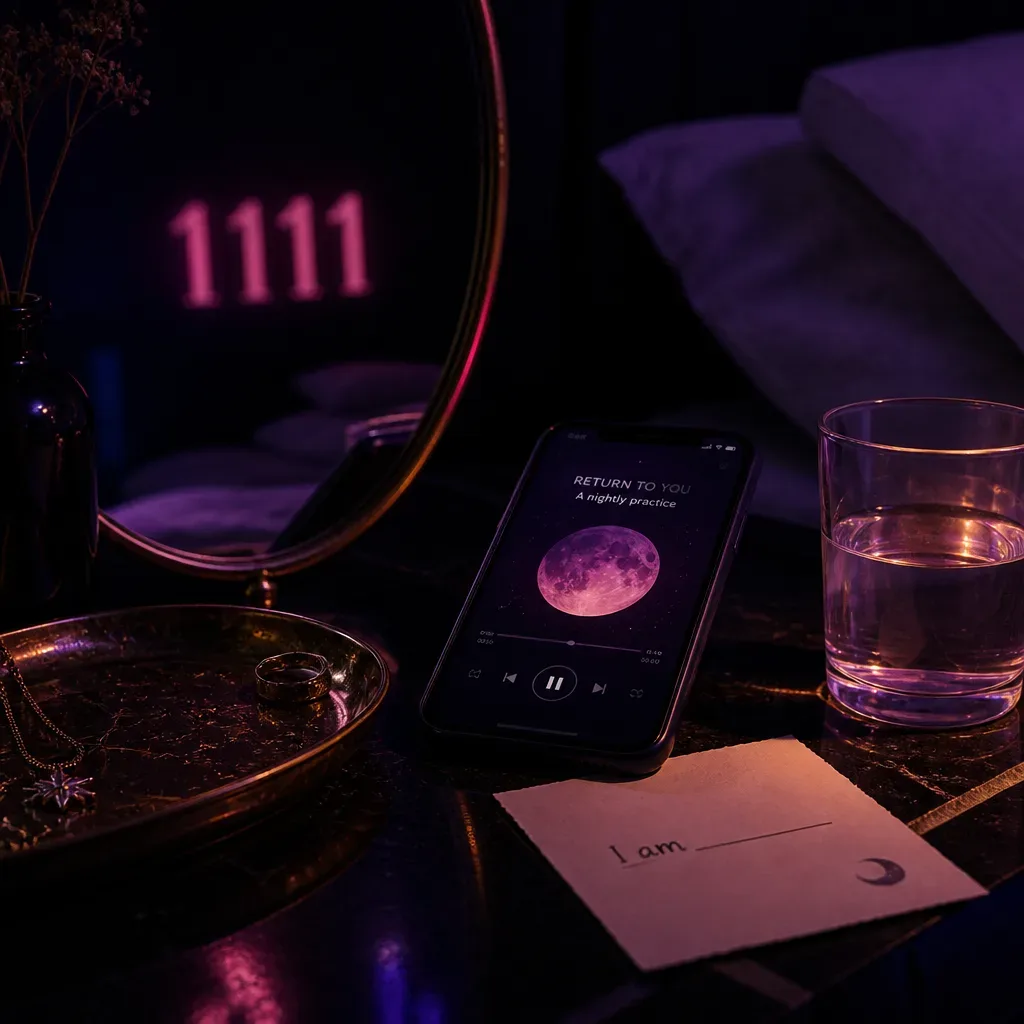
If you miss a day, don’t make a story out of it. Return the next day. A streak can help, but shame breaks rhythm faster than forgetting does. The AYA app’s daily structure is useful because it removes the question of what to do next. You listen. That’s it.
The practice is not more worthy because it’s hard. It becomes yours because you return.
If timing matters to you through lunar cycles, birth charts, or personal ritual, astrology and manifestation can give the practice a symbolic frame. Keep the center clear. The audio still does the work.
How do you know the affirmation is working?
You know it’s working when your choices begin to answer the sentence before your mood does.
Don’t look first for chills, tears, or sudden certainty. Those can happen, but they’re not the measure. Look for smaller evidence. You pause before sending the old text. You ask one cleaner question. You open the bill. You rest for 20 minutes without earning it first. Behavior is often the first proof that a sentence is becoming real.
David Creswell and colleagues published self-affirmation research in 2013 showing that brief value affirmation could reduce stress responses and improve problem-solving under pressure. The useful point is not that a sentence fixes life. It’s that a remembered self can behave differently inside pressure.
Track three things for 14 days:
- Did I listen today? Yes or no. No essay.
- What line stayed with me? One phrase only.
- What did I do differently by 1%? One observed action.
That 1% matters. James Clear popularized the idea of 1% gains in habit writing, but the deeper truth is older than any framework. Tiny repeated choices become a life you recognize. If your affirmation is “I am steady,” a 1% action may be putting the phone down before bed. If it’s “I am ready to be seen,” it may be sending the email without polishing it for the ninth time.
Use this small review table after 2 weeks:
| Signal | What it may mean |
|---|---|
| The sentence feels calmer | Your body is no longer arguing as much |
| You remember it during the day | The cue is becoming accessible |
| You act slightly sooner | The identity is meeting behavior |
| You feel resistance | The wording may need softening |
| You feel numb | The scene may need more concrete detail |
The Manifestation pillar can help if you want the larger frame. But keep your evidence close to the ground. The best signs are often ordinary enough to miss.
What should you do when the words stop feeling true?
When the words stop feeling true, edit the sentence without treating the pause as failure.
Some affirmations expire. Some need a gentler verb. Some were written for an old fear and have done their work. After 7 to 14 days, read the sentence again. If it still creates a clean yes, keep it. If it creates pressure, revise it. If it creates nothing, add detail.
Here are quiet edits that help:
- Change “I am” to “I am learning to” for a while.
- Change a broad noun into a specific behavior.
- Add a time marker, like “today” or “this week.”
- Remove words that sound borrowed.
- Put the affirmation inside a real scene.
- Let one sentence carry the practice instead of five.
Cascio and colleagues published a 2016 fMRI study in Social Cognitive and Affective Neuroscience suggesting that self-affirmation can activate brain systems linked with self-related processing and valuation, especially when future-oriented. That fits what you can feel without needing to overstate it. The future has to include you. Not a shinier stranger. You.
If the future self doesn’t sound like someone who would know your name, the affirmation is too far away.
The quietest version is often the strongest. “I am here.” “I am allowed to begin again.” “I am becoming steady.” These sentences don’t pretend the whole life is fixed by morning. They give you a place to stand while you make the next choice.
Return to the AYA Method when you want the affirmation held in a daily audio practice rather than left alone on a page. Let the app hold the rhythm. Let the Dream-Self Moment speak from the life you’re practicing until the words feel less like reaching and more like remembering.
Listen once, and let it be enough.