love manifestation
Anxious Attachment Affirmations as Future-Self Audio
Anxious attachment affirmations can become a calmer future-self audio practice for love, reassurance, and emotional steadiness.

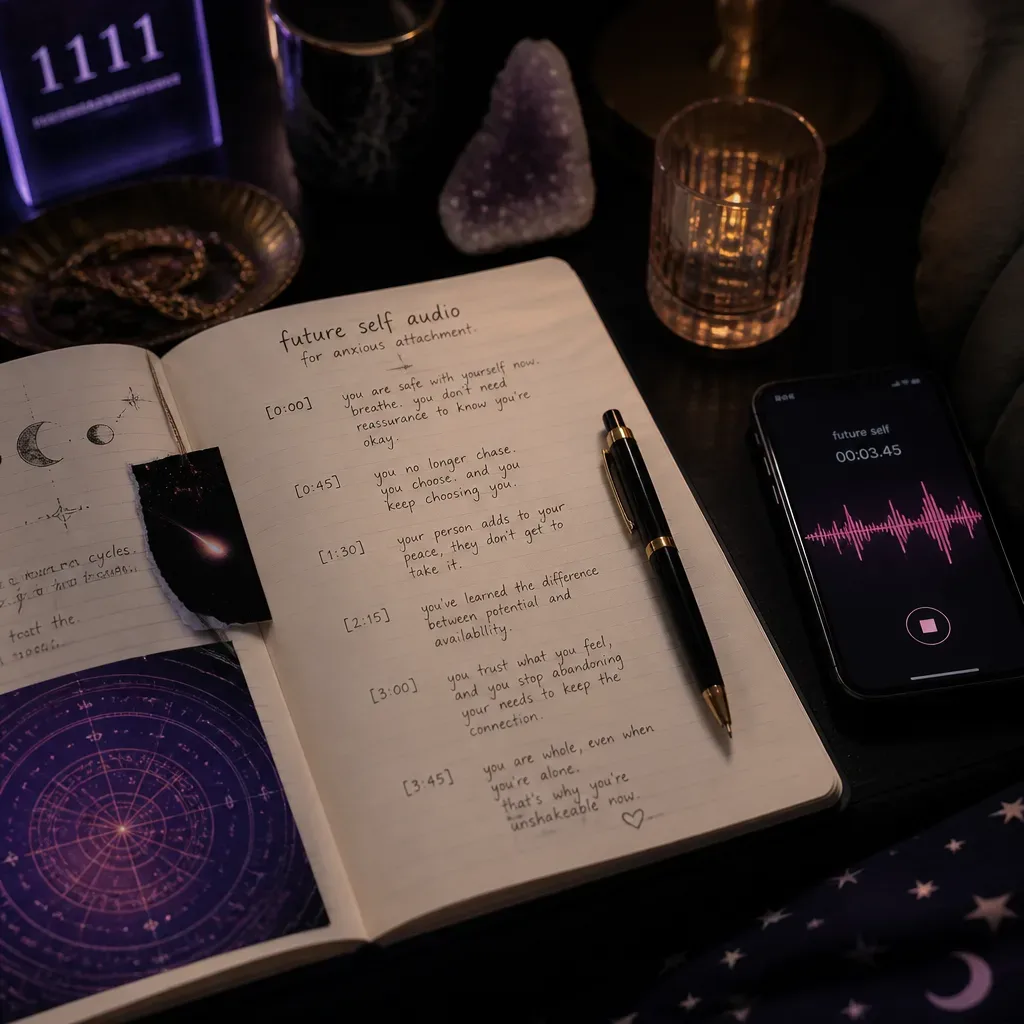
Your phone is face down. Your chest still knows it hasn’t buzzed. Anxious attachment affirmations help most when they become a short future-self audio: words you hear daily, before panic writes the script. The aim isn’t to make someone stay. It’s to help you stay with yourself.
What are anxious attachment affirmations meant to do?
Anxious attachment affirmations are meant to give your nervous system a secure sentence before it reaches for reassurance.
Anxious attachment is not neediness as a flaw. It’s a pattern of threat detection in closeness. John Bowlby’s attachment theory began in the 1950s, and Mary Ainsworth’s Strange Situation research in the 1970s gave language to anxious, avoidant, and secure patterns. In adult love, Cindy Hazan and Phillip Shaver’s 1987 study brought attachment into romantic relationships. The details differ, but the felt sense is familiar: silence can feel like loss before it is information.
A good affirmation does not argue with that fear. It speaks beneath it. It says, I can wait 10 minutes before I ask again. It says, I can want closeness and still keep my hands off the phone. It says, I do not have to turn every pause into a verdict. A secure sentence is not a spell. It’s a handrail.
This is where anxious attachment affirmations need care. If the wording is too big, your body rejects it. If you say, I never feel afraid, while your heart is racing at 110 beats per minute, the sentence may become another pressure. Sherman and Cohen’s 2006 work on self-affirmation theory suggests that affirming core values can reduce defensiveness, but the statement has to feel connected to what you can actually inhabit.
Use affirmations for the interval between trigger and behavior. Not for control. Not to get a text. Not to become perfectly calm. You are practicing the 30 seconds before you send the second message. That is where a different future can begin to sound real.
Why does future-self audio work differently from text?
Future-self audio works differently because you receive the words through listening, not effort.
When you’re activated, reading can feel like a task. Your eyes skim. Your mind negotiates. Audio enters another door. A 2021 review in neuroscience literature noted that auditory cues are closely tied to memory, emotion, and prediction; you know this already if one old song can return you to a whole year in 8 seconds. Voice carries timing. Breath. Pause. Permission.
The AYA Method is a daily audio manifestation practice. Each day you listen to a short personalized recording — your Dream-Self Moment — narrated from the version of you who has already manifested the life you intend. Listening is the practice. Repetition is the work. The audio is the method.
For anxious attachment, this matters. Your Dream-Self Moment can speak from the version of you who no longer abandons herself in the waiting. The app also includes a daily affirmation and a Manifestation Board, but those are complements. The method itself is the listening. One short recording. One return.
There is research to support the gentleness of this direction, though not as a promise of cure. In a 2007 UCLA study, Matthew Lieberman and colleagues found that naming emotion, often called affect labeling, reduced amygdala activity and increased activity in areas linked with regulation. Future-self audio can do something adjacent: it names the fear, then gives it a next sentence.
The voice you repeat becomes the room you keep entering. For love, that room should not be frantic. It should be honest. It should have a chair for longing, and another one for dignity.
How do you write the script without chasing reassurance?
You write the script around your behavior, not around another person’s response.
Start with the moment you know too well. Maybe it’s the 47 minutes after a message is left unread. Maybe it’s the morning after a tender date. Maybe it’s the sudden coolness in someone’s tone. Pew Research Center reported in 2023 that about 30% of U.S. adults have used dating apps or sites; modern love gives anxious systems endless tiny signals to read. Your script should not feed the reading. It should interrupt the spiral.
Use this simple structure:
- Name the moment. I notice the silence, and I feel my body reaching.
- Name the old move. I used to ask twice, check twice, disappear from myself.
- Name the secure choice. Today I wait, breathe, and speak only when I can speak clearly.
- Name the future self. I am someone who can love without leaving herself.
- Name the next action. I put the phone down for 10 minutes.
Keep it under 300 spoken words. At an average speaking pace of 130 to 150 words per minute, that gives you about 2 minutes. Short is not shallow. Short is repeatable.
| If your line says | Try this instead |
|---|---|
| They will text me because they love me | I can be steady while I wait |
| I am never anxious now | I can feel fear without obeying it |
| I don’t need anyone | I can need love and still respect myself |
| They won’t leave | I can ask for clarity when it’s time |
If you work with manifestation, keep the focus on the inner posture you are practicing. Manifestation is not a way to override consent, timing, or another person’s truth. Love cannot be manifested by tightening your grip. It has to include your own freedom, too.
What does the 12-minute practice look like?
The practice is a short daily listening ritual followed by one secure action.
Set a timer for 12 minutes. Not because 12 is magic. Because it is small enough to do before work, after a date, or while sitting on the edge of the bed. James Clear popularized the idea that habits survive when they are obvious and easy, but the older research is stronger: a 2009 study by Phillippa Lally and colleagues found that habit formation took 66 days on average, with wide variation. Your 30-day practice is a beginning, not a finish line.
Here is the quiet version:
- Minute 0 to 1: arrive. Sit down. Feel both feet. Put the phone where you can hear the audio but not check messages.
- Minute 1 to 4: listen. Play your future-self audio once. Let the words happen without testing whether you believe every line.
- Minute 4 to 6: breathe. Slow the exhale. Andrew Huberman often teaches extended exhales as a simple way to downshift arousal; even 5 breaths can change the body state.
- Minute 6 to 9: write one sentence. Today I will not use fear as my messenger.
- Minute 9 to 12: take one secure action. Drink water. Shower. Reply only if the reply is clear. Wait 10 minutes.
The daily affirmation can sit beside this as a small written cue. The Manifestation Board can hold an image of secure love, not a surveillance board of one person. If you use love manifestation, let it mature past longing. Let it ask: who am I when love is not an emergency?
A practice is working when you recover sooner, not when you never ache.
Which words should you use when your body wants a reply?
Use words that validate the ache and return authority to you.
The wrong words will shame you. The right words will steady you. In attachment research, Mario Mikulincer and Phillip Shaver have written for decades about the secure base: the felt sense that closeness can be safe enough for exploration and rest. Your future-self audio can become a rehearsed secure base in language. Not a replacement for people. A way to stop making one person your only regulator.
Try lines like these:
- I can miss someone and still remain here.
- A delayed reply is not a full story.
- I do not need to audition for care.
- I can ask directly when the time is right.
- My body is afraid; my adult self can lead.
- I can choose one clean message instead of five anxious ones.
- I am allowed to want closeness without chasing it.
Notice the pattern. Each line names your agency. It doesn’t claim mind-reading. It doesn’t make a guarantee about another person. A 2013 PLOS ONE study by Creswell and colleagues found that self-affirmation improved problem-solving under stress in a lab task. The point wasn’t pretending stress had vanished. The point was having more access to yourself while stress was present.
You can also borrow from astrology and manifestation if symbols help you remember timing. But keep it clean. The moon does not have to justify a text. A transit does not need to become a verdict. Use symbols as mirrors, not as excuses to abandon your own knowing.
How do you keep the practice kind, not compulsive?
You keep it kind by setting limits before the anxious part of you takes over.
A future-self audio should not become another reassurance loop. If you listen 17 times to check whether you are calm yet, the practice has quietly turned into checking. Many cognitive behavioral therapy approaches for anxiety make this distinction: reassurance can soothe for a minute while training the brain to ask again. The content may be soft, but the loop can still be sharp.
Set three rules:
- Listen once daily as your base practice.
- Listen one extra time during a trigger, only if you will take a grounded action after.
- Do not use the audio to avoid a needed conversation.
Relationships still require speech. If someone repeatedly disappears, dismisses your feelings, or keeps you in chronic uncertainty for weeks, your affirmation is not meant to make that acceptable. Secure attachment includes protest when something is not right. It includes boundaries. It includes leaving a dynamic that asks you to shrink.
Clinical language matters here. Anxious attachment is not the same as generalized anxiety disorder, obsessive-compulsive disorder, or trauma response, though they can overlap. If panic, intrusive thoughts, or unsafe relationship patterns are part of the picture, therapy can be a steadier container. In the United States, the National Institute of Mental Health estimates that about 31% of adults will have an anxiety disorder at some point in life. You are not strange for needing support.
The gentlest practice still needs honesty. If a ritual makes you smaller, it is not devotion. It is fear with a pretty voice.

What changes should you expect over 30 days?
Expect smaller pauses, cleaner choices, and a little more space between fear and action.
Thirty days will not rewrite every attachment pattern. It can, however, give you evidence. Track the evidence in plain numbers. How many times did you send a follow-up text from panic this week? How long did it take to return to your body after silence? Did you ask one direct question instead of building 12 private theories? Specific numbers keep the practice real.
Use a simple 30-day log:
| Measure | Day 1 | Day 15 | Day 30 |
|---|---|---|---|
| Reassurance texts sent from panic | |||
| Minutes before checking again | |||
| Times you named the feeling first | |||
| Clear conversations started |
This is also where affirmations become more than pretty sentences. They become measured rehearsal. A 2019 review of implementation intentions found that if-then plans can support behavior change across many domains. Pair your audio with one if-then line: If I want to send a second text, then I will listen once and wait 10 minutes.
You may still feel the old alarm. That does not mean you failed. Attachment patterns were built through repetition, often over years. They soften through repetition, too. The future self is not someone who never wants. She is someone who can want without vanishing.
For some readers, the change will be quiet: one unsent message, one honest ask, one evening not spent decoding a typing bubble. Small counts. In the AYA Method, repetition is the work because identity needs a familiar sound. Let the sound be steady enough to come home to.
Stay close to the voice that doesn’t make you beg.