love manifestation
Dating App Manifestation: 3-Minute Audio Reset
Dating app manifestation gets practical: a 3-minute audio ritual before swiping so you choose from self-respect, not urgency or old scripts.

Dating app manifestation is a 3-minute audio reset before you swipe, so your choices come from self-respect instead of urgency. You listen, name the standard, then open the app. The point is not to control strangers. The point is to enter the room already chosen by yourself.
Why use dating app manifestation before swiping?
You use dating app manifestation before swiping because the app rewards reaction, while love requires recognition.
At 11:11, the phone lights up. Not with destiny. With a match who wrote, hi, then disappeared for 6 days. Most people would call this normal app weather. I call it a diagnostic. The app is not neutral when you arrive tired, underfed, or looking for proof that you are still wanted.
Pew Research Center reported in 2023 that 30% of U.S. adults had used a dating site or app, and the number rises to 53% among adults under 30. That is not a niche ritual. That is a social gate with push notifications. A gate needs a way to enter.
The audio gives you that entrance. The AYA Method is a daily audio manifestation practice. Each day you listen to a short personalized recording, your Dream-Self Moment, narrated from the version of you who has already manifested the life you intend. Listening is the practice. Repetition is the work. The audio is the method.
For dating apps, that means you do not open the grid as a contestant. You open it as a witness. You have already heard the version of you who is loved without negotiating your nervous system into collapse.
The swipe is not the ritual. The state you bring to the swipe is the ritual.
This is also why the Manifestation pillar matters here. Manifestation is not pretending a stranger will text back by midnight. It is naming the inner position you will not abandon, even when the room gets quiet.
What should the 3-minute audio actually do?
The 3-minute audio should move you from seeking validation to recognizing fit.
A good pre-swipe audio is not syrupy. It does not beg the mirror to be nicer. It speaks from the future self who has already stopped confusing intensity with intimacy. That future self sounds calm, specific, and a little inconvenient to your old patterns.
Joe Dispenza often frames mental rehearsal as practicing a future state before external evidence arrives. Neville Goddard wrote in Feeling Is the Secret in 1944 that feeling is the condition through which an assumption takes form. You do not have to accept either teacher as doctrine to use the practical point: rehearse the identity before the decision, not after the spiral.
In 3 minutes, your Dream-Self Moment should include 3 signals:
- Identity: I am someone who is already worth choosing.
- Standard: I respond to clarity, consistency, and warmth.
- Action: I use the app briefly, then return to my life.
That last line is not decorative. The return matters. A 2023 Pew report found that 46% of online dating users said their experiences were at least somewhat negative. The app can stretch one unanswered message into a verdict if you hand it the whole evening.
This is where the Affirmations pillar can support the audio, but not replace it. A sentence such as I do not audition for unclear attention can be useful after the listen. Still, the audio carries the practice. The affirmation is a pin in the map.
A good audio does not make you more desirable. It helps you stop betraying what is already desirable.
How do you practice the 3-minute reset before opening the app?
You practice it by interrupting the swipe loop, listening once, naming one standard, and setting a short boundary around the session.
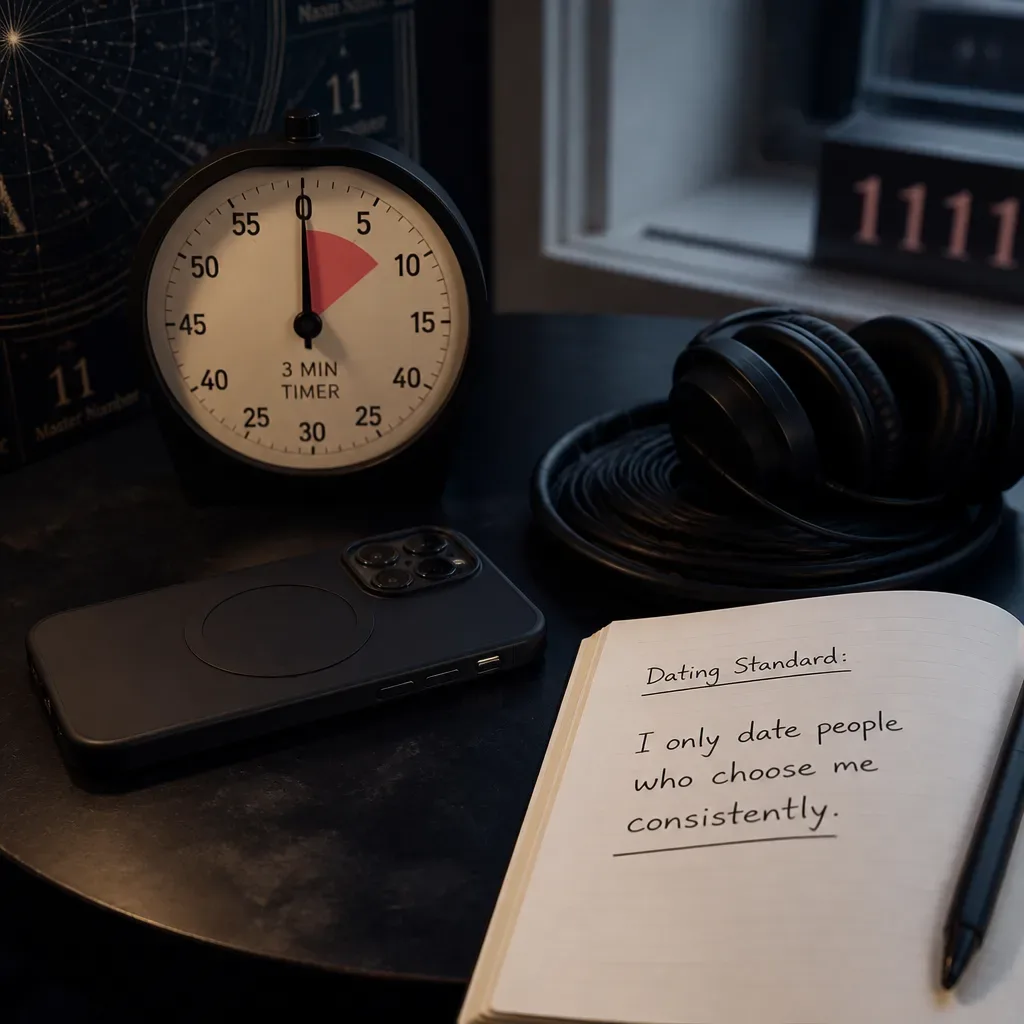
Here is the clean version. It is deliberately unimpressive, which is how you know it might survive past Tuesday. Put the phone face down. Use headphones if you can. Play your Dream-Self Moment. When it ends, say one standard out loud. Then open the app for 10 minutes, not indefinitely.
Dr. Andrew Huberman has popularized the physiological sigh, and a 2023 Cell Reports Medicine study by Balban and colleagues found that 5 minutes of cyclic sighing improved mood more than a matched mindfulness meditation in their sample. Your reset is shorter, but the principle is similar: state first, behavior second.
Use this exact sequence:
- 0:00 to 0:15: Put the phone down and take 3 slow breaths.
- 0:15 to 2:45: Listen to your Dream-Self Moment without checking the screen.
- 2:45 to 3:00: Name one standard for this session.
- After 3:00: Swipe for 10 minutes, then stop on cue.
The stop matters because dating apps are built on variable rewards, the same behavioral principle B. F. Skinner documented with reinforcement schedules in the 1950s. You do not know when the next match arrives, so the hand keeps moving. A timer is not unromantic. It is a boundary with a clock face.
If your standard is too complicated, you will not use it. Keep it sharp:
- I choose clear effort over clever ambiguity.
- I do not chase people who make me feel small.
- I answer from interest, not from panic.
- I leave when my body starts bargaining.
What profile choices change after the audio?
After the audio, your profile choices become less performative and more accurate.
This is the part recovering perfectionists hate. The profile is not a campaign. It is a signal. If the profile is built to be approved by everyone, it becomes almost useless to the person who would actually like you.
Dating app research keeps circling the same truth: people filter quickly. Tinder has publicly discussed swipe volume in the billions per day, and Match Group has reported tens of millions of paying users across its apps in annual filings. You are not writing for the entire crowd. You are writing for the 1 or 2 people who can recognize the real signal through the noise.
Use the audio, then audit the profile through this table:
| App choice | Panic version | Aligned version |
|---|---|---|
| First photo | What makes me look most impressive? | What looks like me on a true day? |
| Bio | Please like my range. | Here is the door I actually use. |
| Prompts | Clever enough to win. | Specific enough to be found. |
| Filters | I will accept almost anything. | I know the non-negotiables. |
| Messaging | I must keep this alive. | I can let weak signals end. |
The aligned version is not smaller. It is more legible. In relationship science, John Gottman is known for the 5-to-1 ratio of positive to negative interactions in stable couples. Dating is earlier and messier, but the hint applies: look for a felt pattern, not one glittering line.
This is where astrology and manifestation can become useful if you treat it as timing language, not a substitute for discernment. A Venus transit may describe a season. It does not excuse bad manners. The master number 11 may feel like a signal. It still has to meet behavior.
Synchronicity is not a permission slip to ignore evidence.
How do you swipe without turning desire into a performance?
You swipe cleanly by making fewer decisions and letting the standard do the sorting.
Desire becomes performance when you start asking, how do I become the person they would choose? The better question is colder and kinder: does this interaction meet the standard I already named? That question saves time. It also saves the face. I spent a decade doing makeup, and the best artists correct almost nothing. They find what is already working and let it lead.
Psychologist Peter Gollwitzer introduced implementation intentions in the 1990s: if situation X happens, I will do Y. A 2006 meta-analysis by Webb and Sheeran found implementation intentions had a medium-to-large effect on goal achievement across studies. Dating app manifestation becomes practical when you give it if-then bones.
Try these:
- If someone gives one-word answers twice, I stop carrying the exchange.
- If I feel my stomach drop after a message, I wait before replying.
- If the profile is all performance and no presence, I pass.
- If someone is clear and kind, I allow interest without overbuilding the story.
The old pattern wants a mood. The new pattern needs a rule. Not a rigid rule that turns dating into tax law, but a rule sturdy enough to hold you when chemistry starts playing drums in the hallway.
Pew also found in 2023 that 10% of partnered adults in the U.S. met their current partner through online dating, with the share higher among younger adults. So no, the app is not fake. It is just not wise enough to know your worth for you.
For more on naming desire without handing over your center, keep love manifestation close as a practice of identity, not pursuit.
What if the app brings up rejection, silence, or old patterns?
If the app brings up rejection, silence, or old patterns, pause the session and return to the audio before you interpret the story.
Silence is the app specialty. A match appears, the dial lights up, then nothing. The nervous system fills the blank with autobiography. This is where one unreturned message becomes every hallway where you were not picked.
Self-affirmation research is useful here. Claude Steele introduced self-affirmation theory in 1988, and Cohen and Sherman reviewed decades of evidence in the Annual Review of Psychology in 2014. The core idea is that reflecting on valued identity can reduce defensiveness under threat. In plain terms: remember the larger self before you make meaning from a small bruise.
That does not mean repeating pretty sentences until you go numb. It means stepping out of the app before you crown silence as truth. Listen again if needed. One listen is enough when you are steady. Two may be appropriate when the old room returns.

Use this small protocol:
- Close the app after the trigger.
- Put both feet on the floor for 30 seconds.
- Ask: what did this actually prove?
- Answer: usually, only that someone did or did not respond.
- Listen to the audio again before you decide what to do next.
The distinction is everything. Rejection may hurt. It does not get to author your identity.
If you use a Manifestation Board, let it be visual support after the fact: a reminder of the relationship quality you are practicing toward. Do not turn it into a courtroom exhibit against the person who failed to text.
How do you keep the practice small enough to repeat?
You keep it repeatable by making the audio non-negotiable and everything else optional.
This is where perfectionists accidentally ruin a good thing. We add tracking, candles, 9 journal prompts, a lunar calendar, a color-coded review, and suddenly the practice requires a project manager. Then we abandon it by February and call ourselves inconsistent.
The smaller version wins. Listen daily. Before swiping, listen once more if you need the reset. That is the spine. The daily affirmation can help. The Manifestation Board can remind. Neither needs to become a second job.
Behavioral consistency often depends on friction. In Atomic Habits, James Clear popularized the 2-minute rule for starting habits, adapted from broader behavioral design ideas: make the entry so small you stop negotiating. Your 3-minute dating app manifestation practice sits in that same family. Small enough to do. Sharp enough to matter.
You can keep a simple weekly check without turning it into surveillance:
| Weekly question | Useful answer |
|---|---|
| Did I listen before swiping? | Yes, no, or sometimes. No essay. |
| Did I respect my stated standard? | One example is enough. |
| Did I stop on cue? | The timer tells the truth. |
| Did the app shrink my life? | If yes, reduce sessions next week. |
Notice there is no column for whether someone chose you. That column is the trap. You are tracking your return to yourself, not the weather on someone else’s phone.
If you want the broader frame, read the Manifestation pillar and the Affirmations pillar together, then come back to the audio. The daily listen keeps the dial steady. The rest is punctuation.
Open the app only after you have arrived.