morning rituals
Burnout Morning Routine With 3-Minute Audio
A burnout morning routine for tired mornings: water, one check-in, and a 3-minute Dream-Self audio you can keep before work, care, and noise.
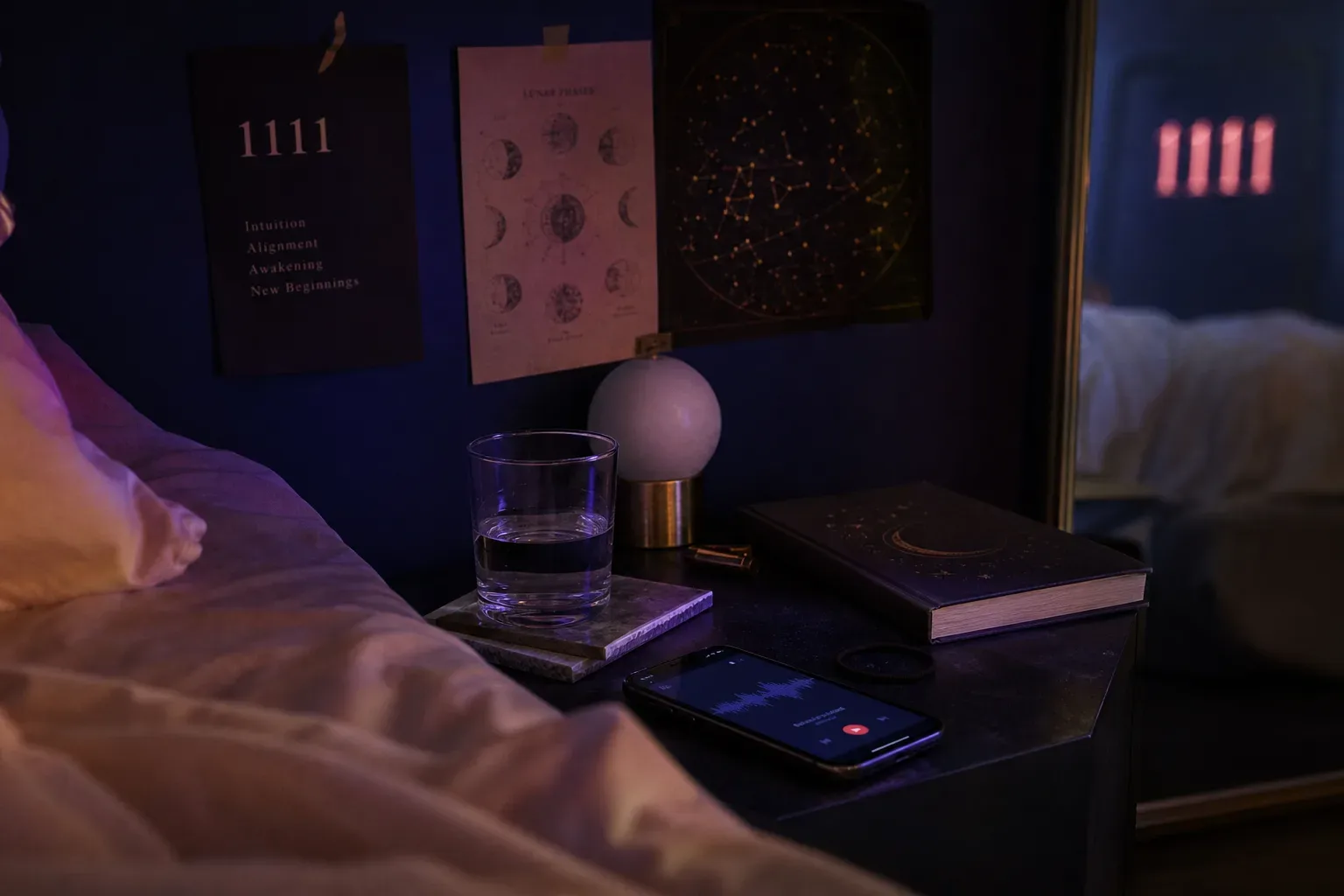
A burnout morning routine should be so small your tired body can actually keep it: water, one honest check-in, and a 3-minute Dream-Self audio before the day starts taking from you. The point isn’t to become a different person. It’s to remember the one who’s already here.
What belongs in a burnout morning routine?
A burnout morning routine needs fewer steps, fewer decisions, and one clear cue your nervous system can recognize.
Burnout is not laziness. The World Health Organization classified burnout in 2019 as an occupational phenomenon marked by exhaustion, mental distance from work, and reduced efficacy. That matters because the answer can’t be a 14-step ritual with dry brushing, journaling, sunlight, supplements, and a perfect breakfast. When you’re burned out, the first mercy is subtraction.
Use this as the base:
- Water within reach. Not a wellness performance. Just a glass beside the bed.
- One body check. Ask, “What is true in my body right now?” Name one thing.
- One 3-minute Dream-Self audio. Press play before you start proving yourself.
- One next action. Choose the smallest action that moves the morning forward.
The American Psychological Association reported in 2023 that 77% of adults had stress affect their physical health in the prior month. That number is not abstract when your shoulders are already near your ears at 6:42 a.m. A routine for burnout has to speak to the body before it speaks to ambition.
This is where the AYA Method comes in quietly. The AYA Method is a daily audio manifestation practice. Each day you listen to a short personalized recording — your Dream-Self Moment — narrated from the version of you who has already manifested the life you intend. Listening is the practice. Repetition is the work. The audio is the method.
A good burnout routine doesn’t ask you to rise above your life. It gives you one soft place to stand inside it.
Why is the Dream-Self audio only 3 minutes?
Three minutes is long enough to create a cue and short enough to survive a real morning.
When I was leaving agency work, I could not be trusted with a blank notebook before 8 a.m. I would turn one page into a trial. Was I grateful enough? Was I clear enough? Was I doing it right? A 3-minute audio removed the committee in my head. I pressed play. I listened. That was the whole practice.
Behavior researcher BJ Fogg has written for years about tiny behaviors and motivation waves: when a behavior is small, it needs less motivation to repeat. A 2020 version of his Tiny Habits model describes scaling habits down until they can be done even on hard days. Three minutes respects the hard day. It doesn’t wait for the rare day when you feel ready.
There is also a memory reason. Neuroscience educator Dr. Andrew Huberman often talks about state shifts through breath, attention, and sensory cues. You don’t need to borrow every protocol to see the point: repeated cues teach the body what comes next. If the first sound you hear each morning is your future self speaking calmly, the day begins with a different reference point than email.
Here is the quiet rule: the routine works because it is repeatable, not because it is impressive.
If you want more background on the wider practice, this manifestation guide gives language for intention without making your morning heavier. Keep the reading for later. In the morning, keep the audio first.
How do you do the routine without waking up earlier?
You do it by placing the routine inside minutes you’re already spending awake, not by stealing sleep.
The CDC has estimated that about 1 in 3 U.S. adults report not getting enough sleep. For a burned-out person, “wake up earlier” can be bad advice dressed as discipline. If you’re already under-rested, the kindest routine protects sleep and reduces morning friction.
Try this 7-minute version:
- Minute 0 to 1: drink water. Sit up or stay seated. No special posture.
- Minute 1 to 2: name the truth. Say, “My body feels ___.” Use one word if that’s all you have.
- Minute 2 to 5: listen to the Dream-Self audio. Eyes open or closed. No need to visualize perfectly.
- Minute 5 to 6: choose one next action. Make it visible and small.
- Minute 6 to 7: begin. Do not negotiate with the whole day. Start the one action.
| If your morning looks like this | Put the audio here | Keep it this small |
|---|---|---|
| You have a child awake early | While they eat or play nearby | One earbud, seated |
| You commute | Before starting the car or train ride | Audio first, messages after |
| You work from home | Before opening your laptop | Sit at the closed laptop |
| You wake anxious | Before checking the time twice | Hand on chest, press play |
Implementation-intention research by Peter Gollwitzer, including a meta-analysis of 94 studies, found that “if-then” plans make goal behavior more likely. So make the routine boringly specific: “If I touch my phone, then I play my Dream-Self audio before I open messages.”
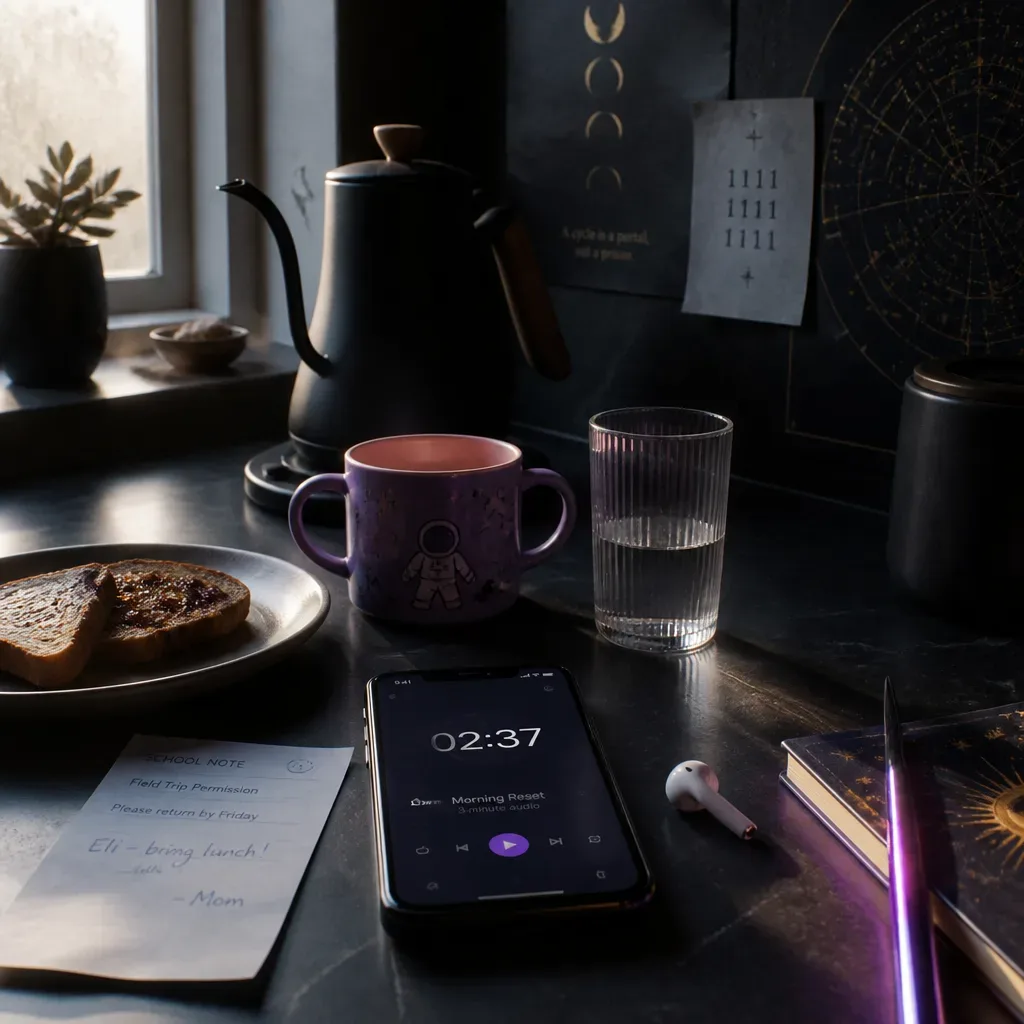
The morning gets easier when the first choice has already been made for you.
What if you’re too tired to manifest?
If you’re too tired to manifest, listen anyway and let the audio carry the practice for you.
This is the part nobody says clearly enough. Burnout can make manifestation feel like another assignment. You may not want to script, visualize, set goals, or write a bright sentence about the future. That doesn’t mean you are failing. It means your system is protecting what little capacity it has left.
A 2022 Gallup report found that employee stress reached record highs globally, with 44% of workers saying they felt stress a lot of the previous day. When stress becomes ordinary, effort-based practices can start to feel punishing. Audio lowers the entry cost. You don’t have to generate the words in the moment. You receive them.
This is also why the daily affirmation in Aya is a complement, not the center. If you have the steadiness to read one line, use it. If not, listen. Affirmations can be useful when they are believable, specific, and repeated, but burnout often needs less self-talk and more safe repetition.
You can make the 3-minute audio even softer:
- Listen under the blanket.
- Listen while your coffee brews.
- Listen with one hand on the sink.
- Listen after a difficult night.
- Listen without trying to feel anything.
In small studies on self-affirmation, including work published in Social Cognitive and Affective Neuroscience, values-based statements have been associated with activity in brain areas linked to self-processing. That does not mean words fix burnout. It means repeated self-reference can matter. The question is whether the words feel close enough to let in.
Manifestation isn’t a performance of certainty. Sometimes it is three minutes of not abandoning yourself.
How does this routine help your nervous system feel safe?
It helps by giving your body predictability before the day’s demands become loud.
The nervous system likes patterns it can trust. Same glass. Same seat. Same audio. Same first action. None of this needs to look spiritual. It can look like you sitting on the bathroom floor because that is the only quiet room in the house. The practice is not the setting. The practice is the return.
Habit researcher Wendy Wood has cited research suggesting that roughly 43% of daily actions are repeated in the same context. That number is useful here. You don’t need to argue your way into a new morning identity every day. You attach one small behavior to a context that already exists: waking, water, phone in hand, kettle on.
If you like symbolic timing, you might also enjoy astrology and manifestation later in the day. Some people use lunar or seasonal markers to reflect. In a burnout morning routine, though, don’t wait for the right date or chart. The smallest repeatable action is enough.
There is a reason the Dream-Self Moment is narrated from the version of you who has already manifested the life you intend. Your current self may be exhausted. Your future self can speak in full sentences. Audio lets that steadier voice enter before your inbox assigns you a role.
Try this script if your body resists:
I don’t have to believe everything today. I only have to listen for three minutes.
A 2018 review in the Journal of Behavioral Medicine noted that mindfulness-based approaches can reduce stress symptoms in varied groups, though effects differ by study design and dose. Your routine is not a clinical treatment. It is a daily cue of safety. Small cues count when they repeat.
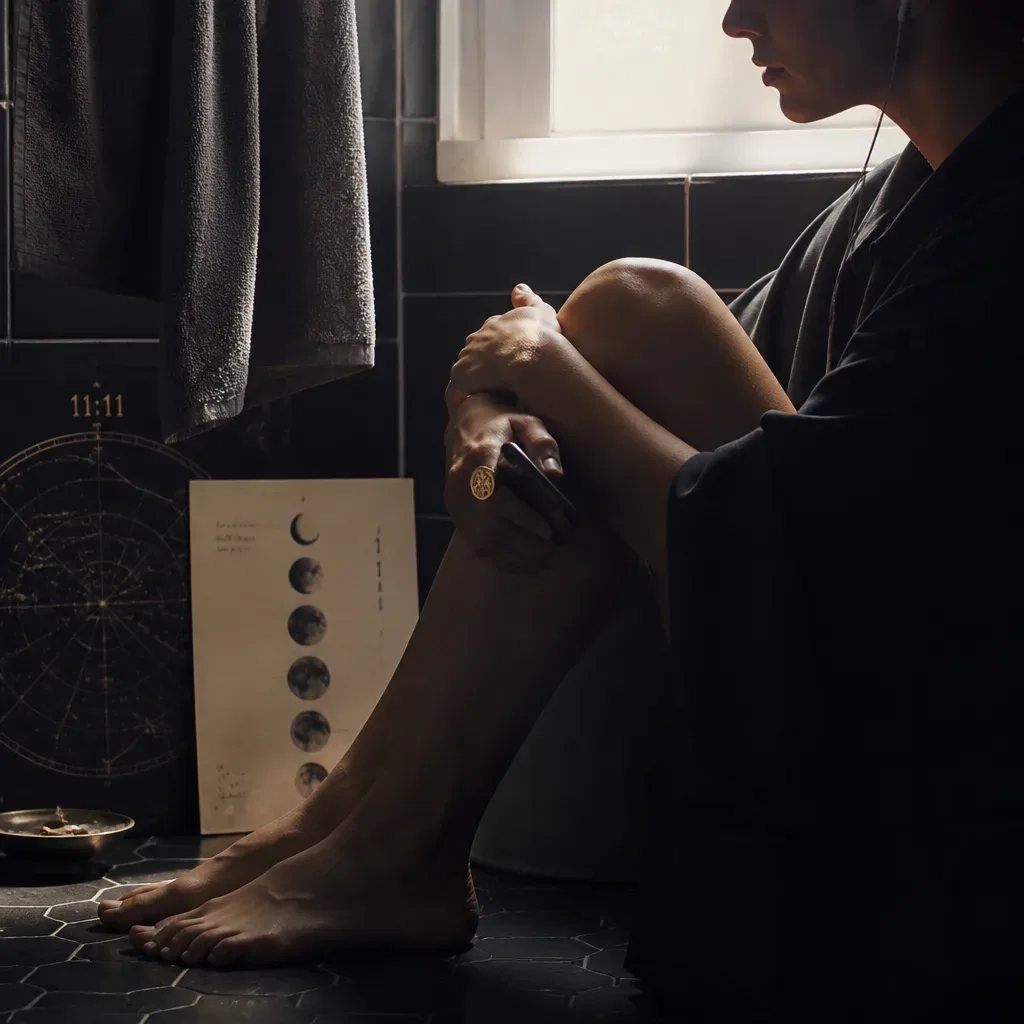
A safe morning is not one with no demands. It is one where you meet yourself before the demands do.
How do you keep the routine when work or motherhood interrupts it?
You keep it by making a minimum version and refusing to call that version failure.
Care work changes mornings. Tight calendars change mornings. Burnout changes mornings. If you have a child asking for socks, a client asking for revisions, or a body asking to lie down again, the routine has to bend without breaking. That is why the minimum version matters.
Use this rule for the next 14 days: if the full routine is not possible, do the 3-minute audio only. In a 2009 study in the European Journal of Social Psychology, Phillippa Lally and colleagues found habit formation took an average of 66 days, with wide variation from 18 to 254 days. Missing once did not ruin the habit. Repetition over time mattered more than perfection.
You can also make a visible cue. Put headphones on your pillow. Leave the app open. Place a note on your phone that says, “Audio before messages.” James Clear popularized cue design in habit writing, but the principle is older than any book: the less you have to remember, the more likely you are to return.
When you want more structure, read about the AYA Method outside the morning window. When you want a wider frame for desire and belief, save the manifestation overview for a calmer hour. The morning itself stays plain.
Here is a repair plan for interrupted days:
- If you miss the morning, listen at lunch. Do not punish the miss.
- If you miss lunch, listen before sleep. Keep the streak of return, not the streak of timing.
- If you miss the whole day, begin tomorrow with water. No speech, no shame.
The practice that survives your real life is the practice that can help you.
Soft is enough when soft is what you can keep.