morning rituals
Morning Meditation Routine With Dream-Self Audio
A quiet morning meditation routine using Dream-Self audio while you wash, dress, and make coffee, so the practice fits the life you already have.
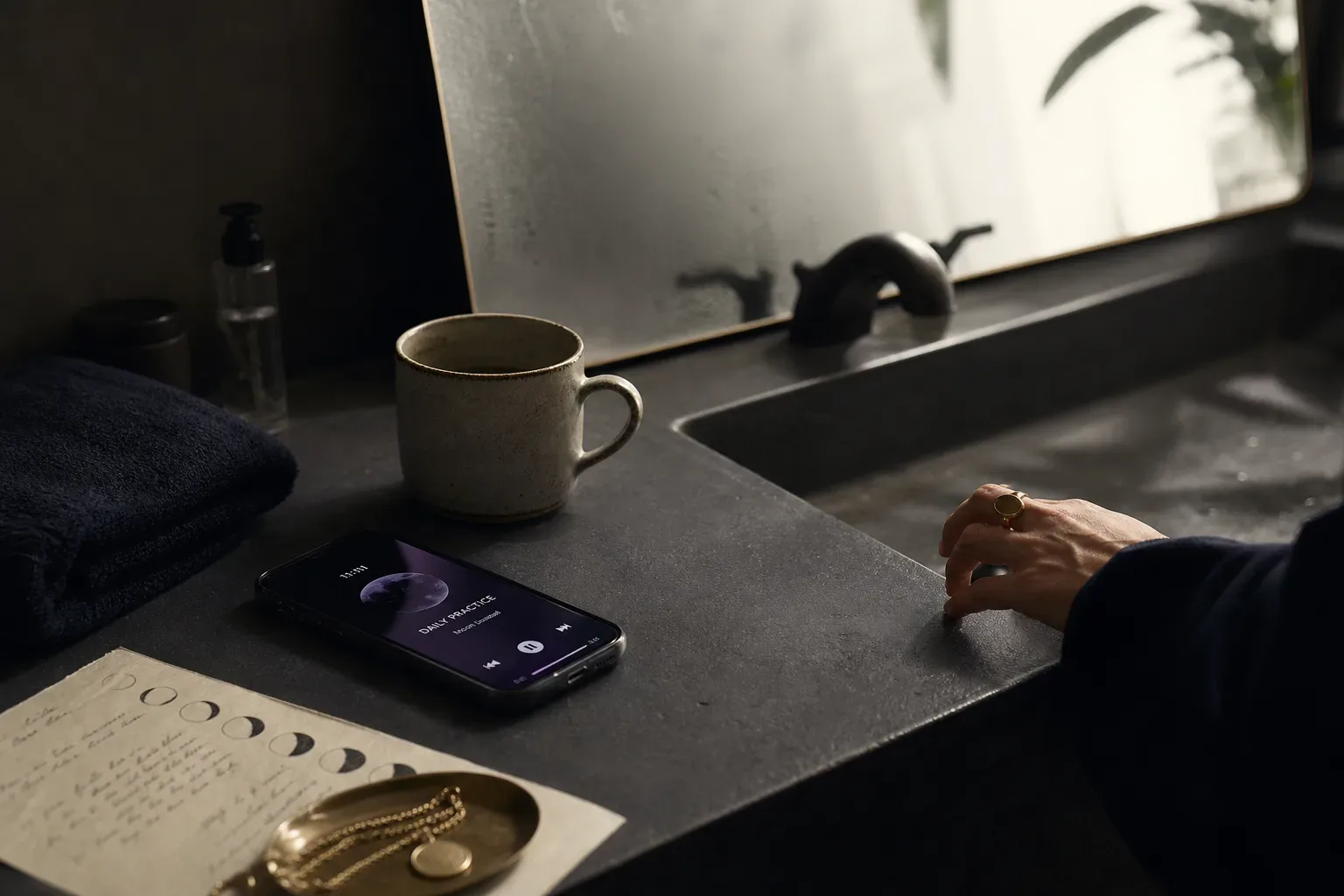
The kettle clicks, the mirror fogs, and your phone is already in your hand. A morning meditation routine can be as simple as listening to Dream-Self audio while you get ready. You do not need a cushion, a spare hour, or a quieter life. You need one repeated moment.
What makes this a morning meditation routine?
It becomes a morning meditation routine when one ordinary getting-ready action becomes the place where you listen on purpose.
That action can be small. Washing your face. Brushing your teeth. Sitting on the edge of the bed before socks. The practice begins when you pair that action with a short recording and return to it daily. In the European Journal of Social Psychology, Phillippa Lally and colleagues found that habits took a median of 66 days to become automatic, though the range ran from 18 to 254 days. The number matters because it softens the fantasy of instant devotion. Repetition is a body thing.
Here is the clean definition. The AYA Method is a daily audio manifestation practice. Each day you listen to a short personalized recording — your Dream-Self Moment — narrated from the version of you who has already manifested the life you intend. Listening is the practice. Repetition is the work. The audio is the method.
That last sentence is not decoration. It keeps the morning simple. The app also includes a daily affirmation and a Manifestation Board, but those are complements. They can help you remember what you heard. They are not the center. The center is listening.
A morning practice that survives is usually smaller than the fantasy of one. Pew Research Center’s 2024 mobile fact sheet lists smartphone ownership among U.S. adults at about 91%, which means the device is already present in most mornings. Instead of letting it choose the first voice you hear, you choose one. Quietly. Before the day starts naming you.
How do you set it up before the morning begins?
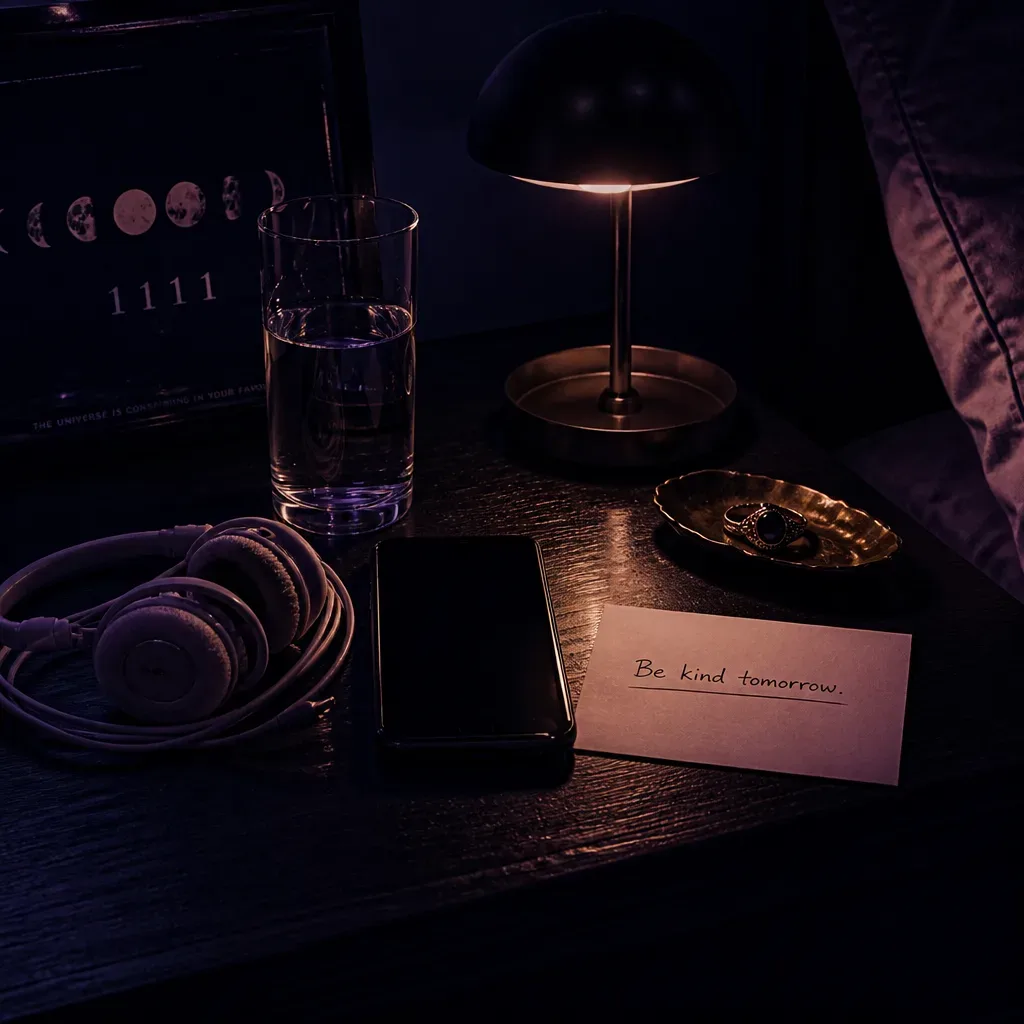
You set it up at night so the morning has fewer decisions to carry.
Decision-making gets thinner when you are tired or rushed. Researchers often call this cognitive load: the amount of mental work held at once. A 2010 Science paper by Matthew Killingsworth and Daniel Gilbert found that people’s minds wandered 46.9% of the time in their samples. Morning is not immune. The more steps you ask your mind to remember, the more easily the practice slips away.
Set up the routine in six quiet moves:
- Choose one anchor you already do every morning.
- Put your headphones, speaker, or phone beside that anchor.
- Choose the Dream-Self audio before sleep, not after waking.
- Keep the recording short, ideally 2 to 5 minutes.
- Decide what happens when it ends: one breath, then the next task.
- Repeat the same anchor for 7 days before changing anything.
This is not rigid. It is kind. Implementation-intention research from Peter Gollwitzer has shown that if-then plans can improve follow-through across many goals. The shape is simple: if I start the shower, then I press play. If I pick up my moisturizer, then I listen. If I pour coffee, then the first sound is my Dream-Self Moment.
You can make it even easier by lowering the volume of the rest of the morning. No news before the recording. No messages until after it ends. Dr. Andrew Huberman often recommends getting morning light soon after waking for circadian timing; if that fits your life, stand near a window while you listen. If it does not, do not turn the advice into another burden. The routine is not a test of devotion; it is a way back to yourself before the day speaks first.
Why does listening while getting ready still count?
It counts because meditation is attention, and attention can live inside motion.
Many people inherit an image of meditation that is completely still: legs crossed, eyes closed, room silent. That can be beautiful. It is not the only doorway. In mindfulness-based stress reduction programs, Jon Kabat-Zinn taught informal practice alongside formal sitting: bringing attention to walking, eating, washing, breathing. The point was not performance. The point was knowing where your mind is.
Dream-Self audio gives the mind one chosen place to rest while the body does familiar work. This matters. Familiar tasks use procedural memory, the kind of memory that lets you brush your teeth without relearning the movement each day. Because the task is already known, a small portion of attention can stay with the audio. Listening is not passive when it changes what you rehearse.
Use this table to choose your anchor:
| Morning anchor | Best audio length | Why it works |
|---|---|---|
| Washing your face | 2 minutes | The mirror gives immediate presence |
| Showering | 3 to 5 minutes | Water masks outside noise |
| Getting dressed | 3 minutes | Identity and choice are already in the room |
| Making coffee or tea | 4 minutes | Waiting becomes listening time |
| Walking to transit | 5 minutes | Repetition pairs with a known route |
A 2007 PNAS study by Yi-Yuan Tang and colleagues found that 5 days of integrative body-mind training improved attention and self-regulation measures in a small sample. That does not mean every short practice changes everything. It does suggest that brief, repeated attention training can matter. Your future self becomes believable by being ordinary enough to meet at the sink.
If you want the wider frame, read the Manifestation pillar and keep one thing clear: this routine is not wishing in front of a mirror. It is rehearsing a self-concept until it becomes easier to inhabit.
What should your Dream-Self audio actually say?
Your Dream-Self audio should speak in the first person, in the present tense, with details that feel true enough to return to.
The recording is not a pep talk. It is closer to a letter from the version of you who has already crossed a threshold. Neville Goddard often spoke of assuming the feeling of the wish fulfilled; you do not need to adopt every metaphysical claim to use the practical insight. The nervous system responds differently to a scene that feels lived than to a sentence that feels pasted on.
Keep the language concrete. Instead of, I am successful, you might hear: I wake without bargaining with myself. I answer the message I used to avoid. I choose the black jacket because I no longer dress for apology. The detail is the handle. In self-affirmation research, including work by David Creswell and colleagues, values-based reflection has been linked in small studies to lower stress responses and better problem-solving under pressure. The mechanism is still studied, but the direction is useful: the self needs evidence it can recognize.
A strong Dream-Self Moment often includes:
- One scene from an ordinary future morning.
- One sentence about how you carry yourself now.
- One specific relationship, room, task, or decision.
- One line that can become a daily affirmation after the audio ends.
- No grand claims your body rejects immediately.
If you are working with affirmations, let them come from the audio instead of competing with it. One line is enough. One remembered sentence can walk with you through a whole morning.
Joe Dispenza often talks about mental rehearsal paired with feeling; some of his larger health claims deserve careful reading, but rehearsal itself is well known in performance psychology. Athletes have used imagery for decades, and reviews in sport psychology have found stronger results when mental practice is paired with physical practice. Your morning is the physical practice. The audio gives it a voice.
How do you stay present when your mind runs ahead?
You stay present by returning to the next audible sentence, not by scolding yourself for leaving.
The mind will run ahead. It will rehearse the meeting, the school drop-off, the unread messages, the old conversation that still has teeth. That is not failure. Killingsworth and Gilbert’s 46.9% mind-wandering finding is useful here because it makes drifting ordinary. You are not uniquely bad at attention. You are human before breakfast.
When you notice you have drifted, do one small reset:
- Feel your feet on the floor.
- Name the object in your hand.
- Let your jaw soften.
- Hear the next sentence without trying to recover the last one.
- Take one breath when the recording ends.
This is where audio helps. A silent practice can leave some people alone with a crowd of thoughts. A spoken Dream-Self Moment gives the mind a thread to touch again. Dr. Andrew Huberman has often discussed the role of breath and visual focus in shifting arousal; you can use the simplest version by lowering your gaze for a breath while the audio continues.
Do not restart the recording unless you genuinely want to. Restarting can become a hidden form of punishment. The day does not need you to get every sentence perfect. It needs you to keep returning.
Some mornings, you will hear only one line. That line can be enough. In astrology and manifestation, timing is often treated as symbolic support; here, timing is also practical. Morning has a threshold quality. You are still close to sleep, close to the self that has not yet been explained by other people’s needs.
What if your morning is chaotic, shared, or not really yours?
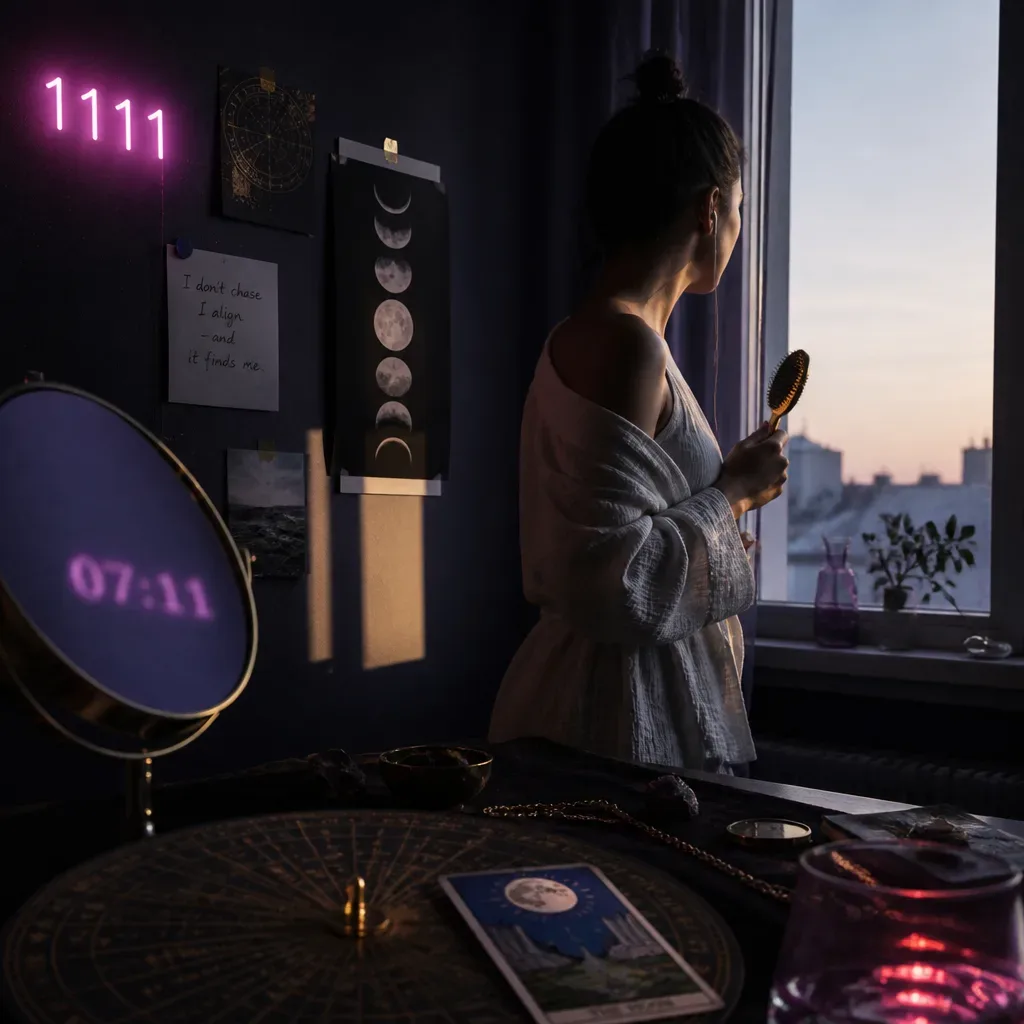
Then your morning meditation routine should become quieter, shorter, and harder to break.
Not every morning belongs to the person living it. Children call. Partners move through the room. A parent needs medication. A train schedule decides the shape of the hour. The American Psychological Association’s 2023 Stress in America report found that 27% of adults said they were so stressed most days that they could not function. A practice that ignores pressure will be abandoned by the people who need softness most.
Use three versions, not one perfect plan:
- Full version, 12 minutes: listen while washing, dressing, and making coffee, then pause for one breath.
- Small version, 5 minutes: listen during one fixed anchor, such as showering or walking.
- Minimum version, 90 seconds: play the first part of the Dream-Self Moment and carry one line with you.
The minimum version matters. It keeps the thread alive. Lally’s habit research also found that missing one day did not necessarily ruin habit formation. This is mercy disguised as data. You can miss. You can return. The practice is not made real by perfection.
If you like visual support, your Manifestation Board can sit nearby as a complement after listening. If you want a sentence for the day, choose one line and treat it as an affirmation. If you need the broader language of practice, return to The AYA Method and to the wider manifestation guide. But in the morning, keep the order plain: audio first, extras second.
You can also make the practice seasonal. On some days, the recording may speak to steadiness. On others, courage. On others, repair. If you keep a notebook, a single line after listening is enough. If you use a board, one image is enough. If you read about manifestation journaling, let the writing stay brief in the morning. The day is still opening.
Begin where your hands already are.