manifestation for life areas
Exam Manifestation: 3-Minute Dream-Self Audio
Exam manifestation becomes practical when you use a 3-minute Dream-Self audio to steady attention, rehearse identity, and then study well.
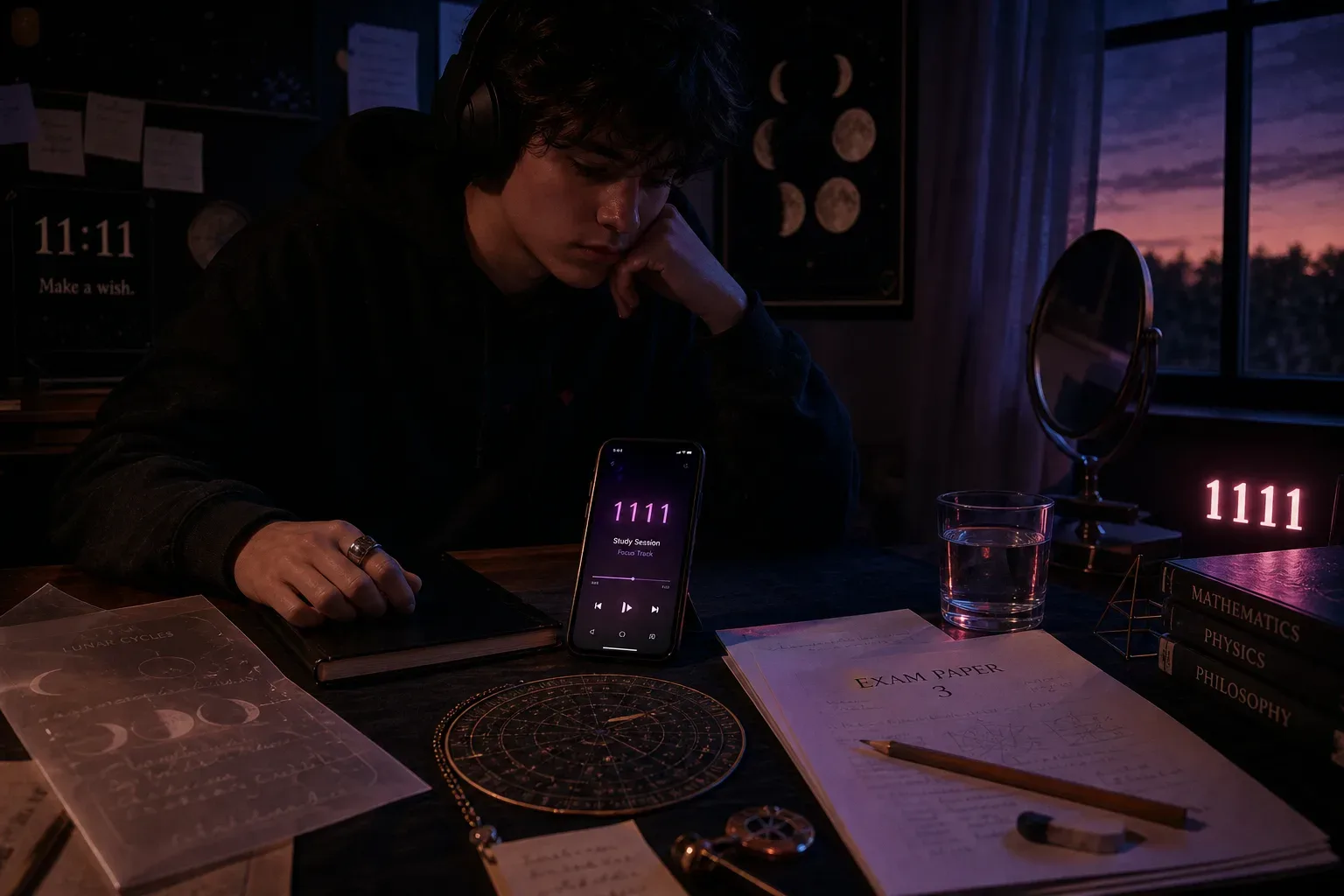
Exam manifestation works when it becomes a pre-study cue: three minutes of Dream-Self audio, one clear study action, then the book opens. It does not replace revision. It names the identity you are practicing, steadies the nervous system, and points attention toward evidence you can create today.
What is exam manifestation before studying?
Exam manifestation before studying is the practice of rehearsing the student-state you intend to occupy, then proving it through a specific study action.
There is a difference between naming an outcome and outsourcing the work. The first is useful. The second is how people end up staring at pastel notes at 11:11 and calling it preparation. A cleaner definition helps: exam manifestation is a psychological and symbolic cue before a concrete revision block. It belongs near the desk, not instead of the desk.
On Manifest 11, manifestation is never treated as wishing with better lighting. The broader Manifestation pillar frames it as attention, identity, repetition, and evidence. That matters for exams because academic performance is built through repeated retrieval. In a widely cited review, Dunlosky and colleagues in Psychological Science in the Public Interest rated practice testing and distributed practice as high-utility study techniques in 2013. Highlighting, rereading, and last-minute cramming did not fare nearly as well.
The manifestation part is the dial. The studying part is the signal becoming visible. If your audio says, “I am calm in the room,” the next move is not to float around the apartment feeling chosen. It is to sit down and do 10 questions under ordinary conditions.
A good pre-study practice has three jobs:
- It reduces friction. You begin before your mind can hold a committee meeting.
- It names the role. You are not “panicking about exams.” You are the person who studies the next right thing.
- It connects identity to evidence. Every completed question becomes a witness.
Test anxiety is common enough to be ordinary, not a character flaw. The American Test Anxieties Association has often cited estimates around 16 to 20 percent of students experiencing high test anxiety, with another portion experiencing moderate symptoms. Exact numbers vary by sample, age, and country, but the pattern is clear: nerves arrive for many capable people. The practice is not to become nerveless. The practice is to stop treating nerves as prophecy.
A signal is not proof that the exam will be easy. A signal is the moment you remember who is studying.
Why use a 3-minute Dream-Self audio first?
A 3-minute Dream-Self audio works because it is short enough to repeat daily and specific enough to shift your attention before resistance takes the room.
This is where the AYA Method fits cleanly. The AYA Method is a daily audio manifestation practice. Each day you listen to a short personalized recording, your Dream-Self Moment, narrated from the version of you who has already manifested the life you intend. Listening is the practice. Repetition is the work. The audio is the method.
Before studying, that matters. A written ritual can become another assignment. A vision page can become a tiny museum of pressure. Audio asks less. You put it on, listen, and let the future-self voice describe the posture, the pace, the calm return to the page. Three minutes is not magic. It is a gate.
Brief audio and mindfulness practices have been studied in many forms. In a 2010 study in Consciousness and Cognition, Zeidan and colleagues found that brief mindfulness training over four days improved some measures of attention and cognition in a small sample. That does not mean every 3-minute recording changes every brain on cue. It does suggest that short, repeated attention practices can matter when they are used consistently.
Here is the clean comparison:
| Pre-study cue | Time cost | Best use | Risk |
|---|---|---|---|
| 3-minute Dream-Self audio | 3 minutes | Entering the student identity quickly | Listening, then not starting |
| Written affirmation | 1 to 5 minutes | Naming one belief or behavior | Polishing the sentence forever |
| Visualization | 3 to 10 minutes | Rehearsing the exam room calmly | Floating away from the task |
| No cue | 0 minutes | Already-regulated days | Letting panic choose the first move |
The audio has one advantage perfectionists quietly need: it ends. A timer finishes. The track closes. There is no better version to design at 7:42 a.m. Cleo note from the recovering perfectionist desk: a small practice you actually repeat beats an elegant practice you abandon by Thursday.
The best exam ritual is not the one that looks sacred. It is the one that gets you to question one.
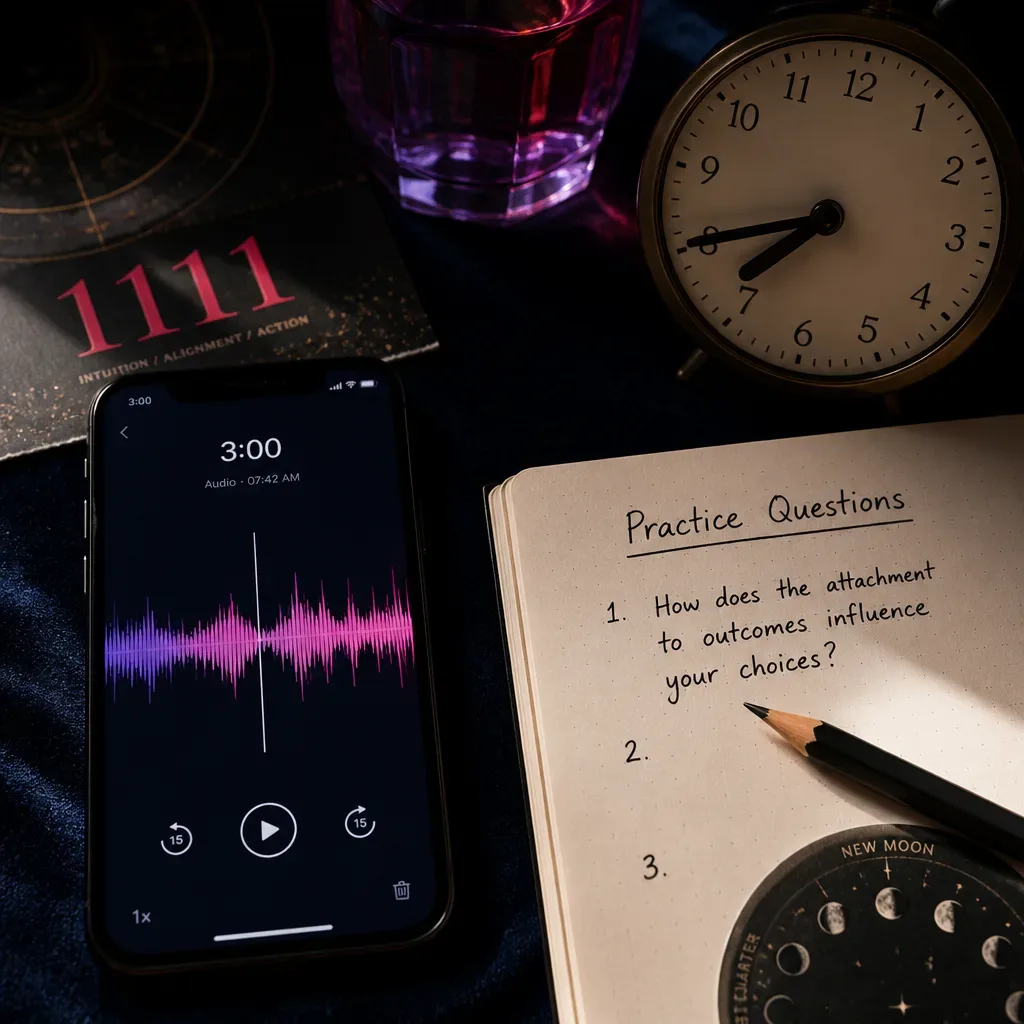
How do you do the 3-minute practice before studying?
Do the practice by listening once, choosing one concrete study action, and beginning before you can renegotiate with yourself.
Use the same sequence each time. Repetition lowers the number of decisions, and decision fatigue is not a myth invented by people with too many notebooks. In a 2011 study in PNAS, Danziger, Levav, and Avnaim-Pesso found that judges’ favorable parole decisions varied across the day, a famous and debated example often used in discussions of decision depletion. The broader takeaway for students is simple enough: fewer unnecessary choices before studying is usually kinder to the brain.
Try this 3-minute sequence:
- Minute 0:00 to 0:20: Set the room. Put your phone face down except for the audio. Open the notebook or past paper before pressing play.
- Minute 0:20 to 2:40: Listen. Let the Dream-Self voice name the version of you who studies steadily, not perfectly.
- Minute 2:40 to 3:00: Choose the first move. Say it in plain language: “I will do questions 1 to 10.”
- After the audio: Start within 30 seconds. No checking messages. No waiting for a better feeling.
- After the study block: Record one evidence line. “I corrected six mistakes in organic chemistry.” That is enough.
If you like written support, use one line from the Affirmations pillar as a complement after the audio. Keep it modest. “I return to the page” is stronger than a sentence that tries to carry your entire future on its back.
A common study block is 25 minutes, popularized by the Pomodoro Technique, though the exact interval is less important than the boundary. Some students do better with 45 or 50 minutes, especially for past papers. The 3-minute audio should not swell to fill the session. It is the bell before the round.
One more rule: do not track the ritual like a courtroom case. If you miss a morning, return at the next session. The signal is allowed to be ordinary. The student who passes is usually not the one who felt aligned every day. It is the one who returned often enough for the material to recognize them.
What should your Dream-Self audio say for exams?
Your Dream-Self audio should describe observable study behavior, calm exam-room cues, and the identity of someone who keeps returning to the work.
The wording should be specific enough that your body knows what to do next. “I am successful” is too vague before a statistics chapter. “I read the question twice, underline the command word, and write the formula before solving” gives the mind a route. Cognitive science likes routes. In 2006, Roediger and Karpicke showed in Psychological Science that retrieval practice improved long-term retention more than repeated studying, even when students felt less confident immediately after testing. Feeling fluent is not the same as being ready.
Use present tense, but keep it believable. The future-self voice is not shouting from a golden balcony. It is sitting across from you, calm because the work has been repeated. It might say:
- “I begin before I feel fully ready.”
- “I use mistakes as instructions, not verdicts.”
- “I know the exam room because I have rehearsed it in ordinary mornings.”
- “I finish one question, then the next. That is the gate.”
If you track timing through lunar cycles, angel numbers, or exam dates, keep that symbolism in service of behavior. The Astrology and manifestation guide is useful for readers who notice timing, seasons, and returns. Still, a full moon will not solve calculus. A master number can mark the moment; it cannot write your essay plan.
Synchronicity is not an excuse to stop working. It is a cleaner way to notice when you are ready to begin.
The audio can include sensory details from the exam room: the chair, the paper, the first breath, the sound of other pens beginning. Exposure-based approaches have long used safe rehearsal to reduce fear responses, and while a Dream-Self audio is not clinical treatment, it can borrow the principle gently. Name the room before the room names you.
Keep the recording around 250 to 450 spoken words for three minutes, depending on pace. That is enough space for identity, behavior, and one calm image of completion. Anything longer risks becoming a lecture. Students already have enough lectures.
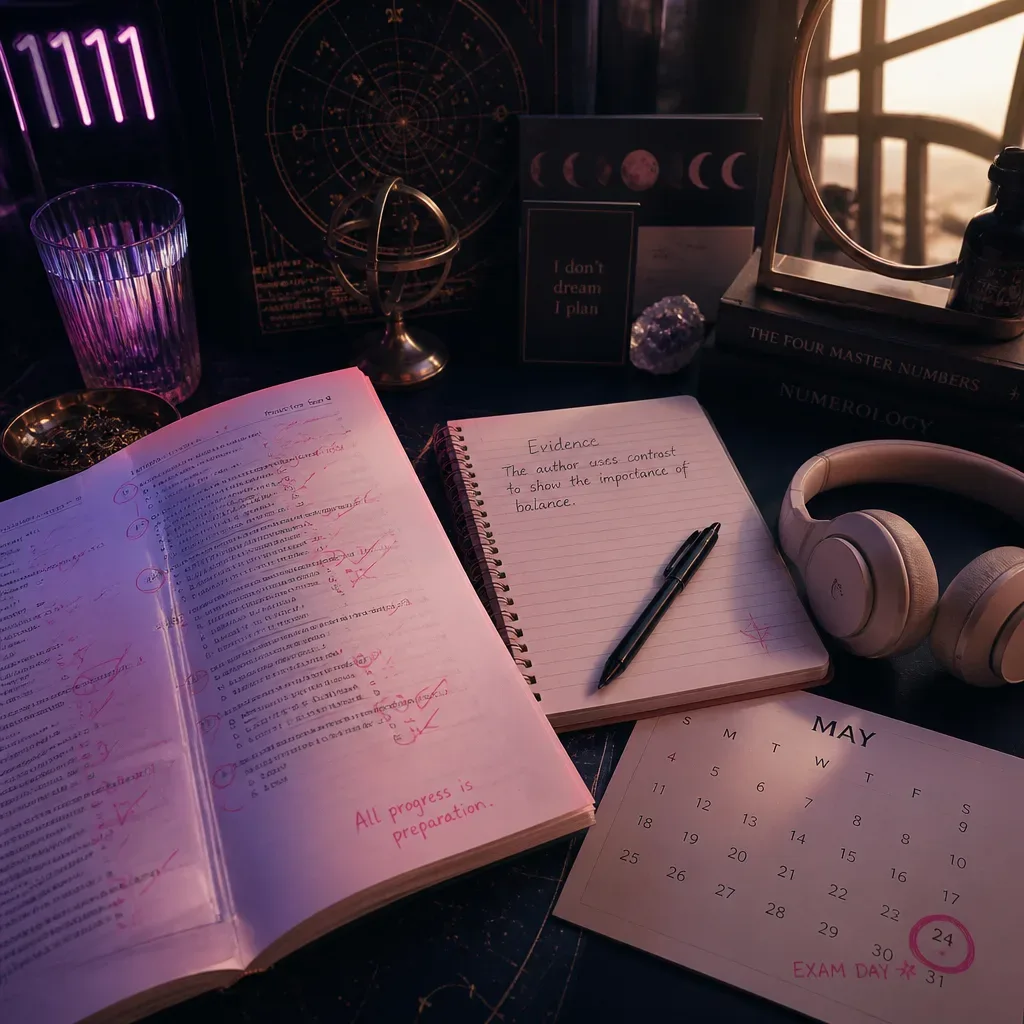
How do you pair exam manifestation with real study technique?
Pair exam manifestation with active recall, spaced repetition, and past-paper practice so the identity you rehearse has evidence behind it.
The audio opens the gate. The study method carries you through. In a 2006 review in Psychological Bulletin, Cepeda and colleagues found strong evidence for spaced learning across many memory tasks. The spacing effect is one of the more reliable findings in learning research: material reviewed over time is generally remembered better than material crammed into one heroic night.
Use this simple pairing table:
| If the exam is… | After the audio, do this | Evidence line to write |
|---|---|---|
| Multiple choice | 20 timed practice questions | “I corrected the pattern in questions 7, 12, and 18.” |
| Essay-based | One 10-minute outline from memory | “I built a thesis with three points.” |
| Math or physics | Five problems without notes first | “I found the step where I usually drift.” |
| Language | 15 minutes of recall, then speaking or writing | “I used 12 verbs without checking.” |
| Law or medicine | One case or scenario under timed conditions | “I named the rule before reading the answer.” |
This is also where a Manifestation Board can help as a complement, not the method. Put the exam date, the study blocks, and one sentence about the student you are practicing becoming. The board is a witness. The audio is the daily practice. The work is still the work.
For a wider map of belief, attention, and action, the Manifestation pillar gives the bigger architecture. If you want a sibling practice after the audio, the Affirmations pillar can help you choose one line that does not turn into a performance.
A useful ratio is 3 minutes of audio to at least 25 minutes of study. That keeps the ritual in proportion. If the preparation becomes mostly preparation-for-preparation, the dial has slipped. The moment should be beautiful if it wants to be. It should also be brief.
Your future self is not impressed by how long you prepared to begin. She is watching whether you began.
What if anxiety or skepticism shows up?
If anxiety or skepticism shows up, treat it as weather in the room and continue with the next measurable study action.
Skepticism is not a problem. It may even be useful. It stops the practice from becoming theatrical. You do not have to believe every sentence with cinematic certainty. You only have to listen, choose the first task, and collect evidence. The body often believes repetition before the mind signs the form.
Anxiety needs a different kind of respect. Dr. Andrew Huberman has discussed physiological sighing, a breathing pattern involving two inhales followed by a long exhale, as a fast way to reduce autonomic arousal; a 2023 paper by Balban and colleagues in Cell Reports Medicine found that cyclic sighing improved mood and reduced respiratory rate more than some comparison practices over a month. Before the audio, one physiological sigh can be enough to lower the volume.
Tara Brach’s RAIN practice, widely used in mindfulness communities, also gives students a humane sequence: Recognize, Allow, Investigate, Nurture. You can compress it before studying: “Fear is here. It can be here. What does it need? One question at a time.” That takes less than 60 seconds when kept plain.
Use this repair plan when the ritual goes sideways:
- If you feel numb, lower the task to five minutes.
- If you feel frantic, breathe once and copy the first question by hand.
- If you feel behind, choose the highest-yield topic by marks, not guilt.
- If you keep checking signs, write one evidence line from yesterday.
- If you missed three days, restart without a speech.
There is also the quiet matter of sleep. The American Academy of Sleep Medicine recommends 8 to 10 hours for teenagers and at least 7 hours for adults. Memory consolidation is tied to sleep, and no manifestation practice gets to bully biology without consequences. The most aligned thing at 12:38 a.m. may be closing the laptop.
For readers who notice numbers, exam season can become crowded with signals: 11:11 on the phone, 22 pages left, 33 days until the paper. Fine. Name the signal, then return to the study block. The number is punctuation. The sentence is what you do next.
Name the signal, press play, open the book.