manifestation for life areas
Job Interview Manifestation in 3 Quiet Minutes
Job interview manifestation can be a 3-minute audio practice that steadies your body, rehearses clear answers, and helps you speak as yourself.

Your shoes are by the door. Your notes are open. Job interview manifestation works best as a 3-minute Dream-Self audio that helps your body rehearse being calm, clear, and already chosen before you answer real questions. It doesn’t replace preparation. It helps preparation speak.
What is job interview manifestation when it’s only 3 minutes?
Job interview manifestation is a short rehearsal of identity, not a wish that someone else will hand you the role.
Three minutes is small enough to use before a call, in a parked car, or beside a sink while someone in the house asks where the blue cup went. That matters. The most useful practice is the one you can repeat when life isn’t clean. Research on habit formation from Phillippa Lally and colleagues at University College London found that automaticity took a median of 66 days, with wide variation from 18 to 254 days. Small and repeatable beats heroic and rare.
A 3-minute Dream-Self audio gives the mind a scene to enter. You hear yourself after the interview has gone well. Not because you faked charm. Because you breathed, answered directly, told the truth, and remembered your examples. This kind of mental rehearsal has roots in sport psychology and performance research. A 2019 review in Psychology of Sport and Exercise noted that imagery practice can support confidence and execution when paired with physical or behavioral practice.
The AYA Method is a daily audio manifestation practice. Each day you listen to a short personalized recording — your Dream-Self Moment — narrated from the version of you who has already manifested the life you intend. Listening is the practice. Repetition is the work. The audio is the method.
That last line matters for interviews. You don’t need twelve steps at 6 a.m. You need one honest recording, heard enough times that your first answer doesn’t have to fight your nervous system. A calm body gives your answers somewhere to land.
Why does hearing your future self help before an interview?
Hearing your future self helps because the brain responds to vivid self-relevant cues before you consciously explain them.
In neuroscience, self-referential processing has been studied for decades. A 2007 paper by Northoff and colleagues in NeuroImage reviewed evidence that medial cortical regions are active when people process information related to the self. Plainly: when a message sounds like it belongs to you, the mind treats it differently than generic advice. “You’re prepared” is one thing. Hearing, “I answer the first question slowly, and I let the pause be there,” is another.
Interview anxiety is not rare. A 2013 study in the International Journal of Selection and Assessment found that interview anxiety can affect how candidates are rated, partly because anxious people may appear less warm or less assertive. That’s a cruel loop. You may know the work, but your body may speak fear before your mouth speaks competence. Manifestation here is not pretending fear is gone. It’s giving fear a smaller chair.
A Dream-Self audio also narrows attention. Dr. Andrew Huberman has often discussed how vision, breath, and speech cues can shift alertness; the research behind slow exhalation and autonomic settling is broader than any one teacher. A 2017 review in Frontiers in Human Neuroscience found that slow breathing practices are associated with changes in heart rate variability and emotional control. For an interview, this can mean one extra second before answering.
Use that second. The second is not empty. It’s where the better sentence arrives.
How do you write the 3-minute Dream-Self script?
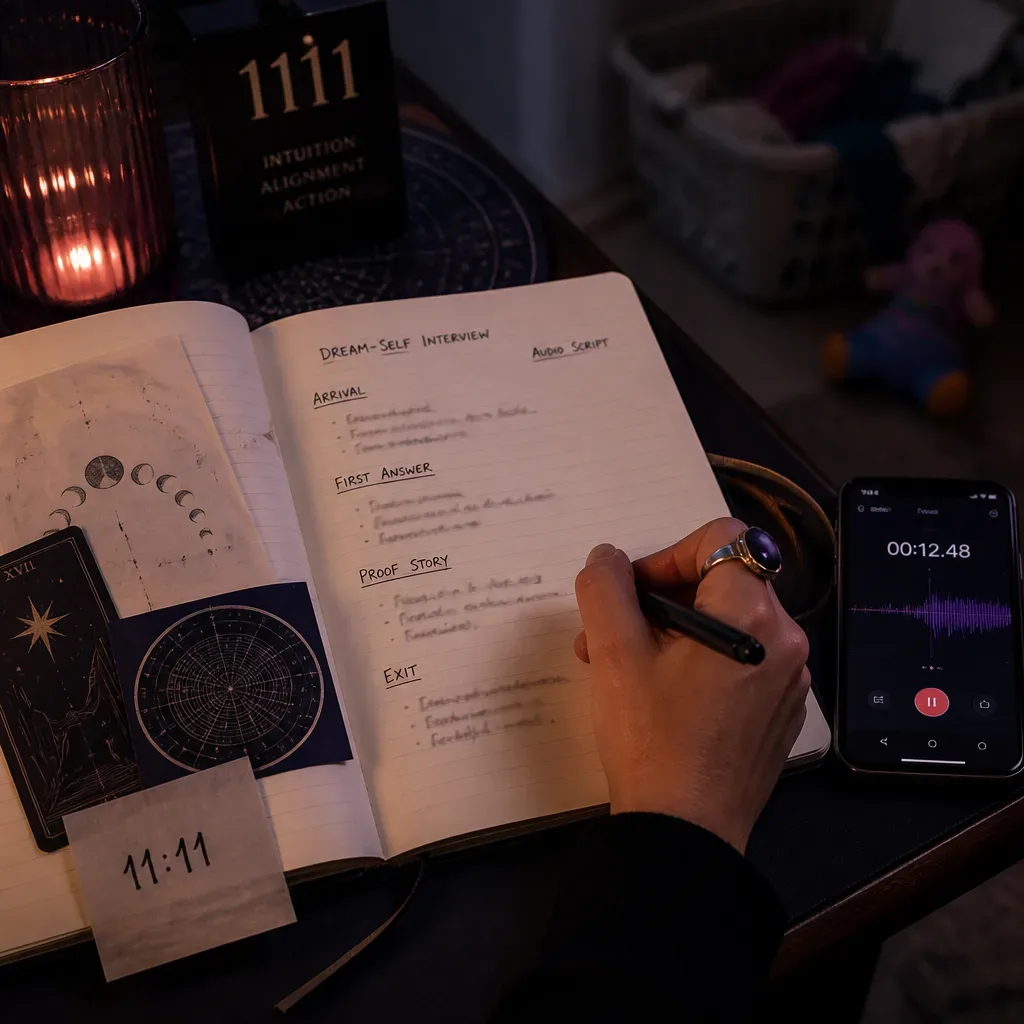
Write it as a present-tense note from the version of you who has just left the interview with self-respect.
A 3-minute spoken script is usually about 250 to 420 words. The National Center for Voice and Speech often places conversational speech near 150 words per minute, though nervous speech can be faster. For this practice, slower is better. You’re not trying to impress the recording. You’re trying to let it into your body.
Start with the exact room. Name the laptop, the chair, the waiting screen, the glass of water, the folder. Specificity lowers the fog. Then name the first action: “I feel my feet. I let the first breath finish. I smile because I’m here.” This is close to what psychologist Peter Gollwitzer called implementation intentions. In a meta-analysis of 94 studies, implementation intentions showed medium-to-large effects on goal achievement because “if this happens, then I do that” makes action easier under pressure.
Then add one proof story. Not your whole career. One clean example. Interview coaches often use STAR: situation, task, action, result. It’s not sacred, but it’s useful. If you led a project, say what was broken, what you did, and what changed. If you’re changing fields, say what skill crossed over. If you were laid off, say what you learned without making your pain perform.
Here’s a simple structure:
- Arrival: I enter the room or call with my breath low and my notes simple.
- First answer: I answer the opening question in 60 to 90 seconds.
- Proof story: I give one example with a clear result.
- Connection: I ask one question that shows I’ve listened.
- Exit: I leave knowing I showed up as myself.
You can support the audio with one line from the affirmations practice, but keep it as a complement. One affirmation. That’s enough. The audio carries the scene.
What should you avoid putting in the audio?
Avoid language your body doesn’t believe, because disbelief becomes another task to manage.
If you record, “They beg me to take the job,” some part of you may roll its eyes. That small inner refusal matters. Research from Gabriele Oettingen on mental contrasting, often known through WOOP, suggests that positive fantasy works better when paired with a real obstacle and a plan. In other words, don’t erase the hard part. Name it gently. “When my voice shakes, I slow down and answer the question in front of me.” That’s usable.
Also avoid scripts that depend on controlling other people. You can’t script the hiring manager’s mood, budget, or hidden candidate list. The U.S. Bureau of Labor Statistics reported that hiring decisions vary across sectors and cycles; even strong interviews can meet timing, salary bands, or internal shifts. Your practice should return power to what is yours: preparation, presence, clarity, and follow-up.
Use this small table when editing:
| Don’t say | Say this instead |
|---|---|
| “They have to choose me.” | “I let them see how I think and work.” |
| “I’m not nervous.” | “My nerves can come with me, and I can still answer.” |
| “This job fixes everything.” | “This role is one true door, not my whole worth.” |
| “I’ll be perfect.” | “I’ll be clear, prepared, and human.” |
A job can matter without becoming your god. That sentence may save you from sounding desperate and from feeling erased if the answer is no.
This is also where broader manifestation needs a clean spine. It’s not control. It’s relationship with the future you’re practicing until your behavior starts to recognize it. The interview is a doorway. You still have to knock.
When should you listen before the interview?
Listen once during preparation and once 10 to 20 minutes before the interview, then stop.
More is not always better on the day itself. Cramming can make the mind brittle. A 2013 review in Psychological Science in the Public Interest found that distributed practice is one of the more reliable learning techniques, while last-minute rereading is often less effective. For interviews, that means you rehearse over days if you can, then keep the final listen quiet.
The day before, play the audio and answer three common questions out loud. “Tell me about yourself.” “Why this role?” “Tell me about a time something went wrong.” According to LinkedIn’s hiring content and many recruiter surveys, these broad questions remain common because they reveal judgment, communication, and fit. Your audio doesn’t answer for you. It puts you in the state where your answer can arrive in order.
On the day, listen somewhere ordinary. A bathroom. A stairwell. A corner of the parking lot. I’ve listened to voice notes while one child shouted about toast and another tried to wear my shoe. Real life is not a clean studio. Your practice has to work there.
A simple timing plan:
- 24 hours before: Listen, then practice three answers out loud.
- 2 hours before: Review the role description and your questions.
- 20 minutes before: Listen once, slowly.
- 5 minutes before: Put the phone down. Feel your feet. Sip water.
- Afterward: Send the thank-you note while the details are fresh.
The phone goes quiet before you do. That’s part of the practice.
Can manifestation and practical interview prep sit together?
Yes, the practice is strongest when the inner rehearsal and the outer preparation keep each other honest.
You still need to read the job description. You still need two or three examples. You still need to know why you want the role beyond rent, though rent is a very real answer. The National Association of Colleges and Employers has repeatedly ranked communication, teamwork, and problem-solving among top attributes employers seek. Those are not mystical traits. They show up in stories, tone, and how you listen.
Manifestation can help you stop treating prep as punishment. You’re not studying because you’re behind. You’re studying because your future self deserves material. If your Dream-Self audio says, “I speak clearly about the project I led,” then your next task is to write that project in five lines. If it says, “I ask a thoughtful question,” then you draft two. The future self asks for receipts.
The app also includes a daily affirmation and a Manifestation Board, but they are complements. If visuals help you, a board can hold the company name, the role title, or a photo that reminds you of steadiness. Read more about the Manifestation Board if you want the visible piece. Then return to the audio.
Some readers also time interviews around mood, season, or meaning. If that’s you, astrology and manifestation can be a reflective layer, not a substitute for action. A calendar can hold symbolism. It can’t answer the behavioral question for you.
Use this pairing:
| Inner cue | Outer action |
|---|---|
| “I’m steady in the opening.” | Practice your first 90 seconds twice. |
| “I tell the truth about my work.” | Write one STAR story with numbers. |
| “I listen before replying.” | Prepare one clarifying question. |
| “I leave with respect for myself.” | Draft a brief thank-you note. |
You don’t manifest instead of preparing. You manifest the self who prepares without abandoning herself.
What if you don’t get the job?
If you don’t get the job, the practice still counts if it helped you speak more truly than fear wanted.
This is the part nobody likes to put on the pretty page. Sometimes they choose someone else. Sometimes the job was half-decided before you arrived. Sometimes you were close, and close still doesn’t pay the invoice. Pew Research Center reported in 2023 that many workers see a job or career as central to identity, especially when financial pressure is present. Rejection can hit more than pride. It can hit the story you were using to stay hopeful.
So build the audio with a life bigger than one answer. “I leave knowing I represented myself well.” “I follow up with grace.” “I keep my notes for the next room.” This is not consolation candy. It’s emotional accuracy. In Journal of Behavioral Medicine and related mindfulness research, acceptance-based practices have been associated in small to moderate ways with lower stress and better coping. Acceptance doesn’t mean liking the result. It means staying with yourself after it arrives.
After the interview, write down three things within 30 minutes:
- The question you answered well.
- The question you’d answer differently next time.
- One sentence you’re proud you said.
Then let the ritual end. Don’t replay every facial expression until midnight. Don’t turn the hiring manager’s “nice to meet you” into a courtroom transcript. If you need another practice tomorrow, make another Dream-Self Moment for the next true door.
The quiet win is not always the offer. Sometimes it’s hearing your own voice and knowing you didn’t leave it outside.
May your next answer arrive slowly, and yours.