manifestation 101
Gratitude Manifestation With a 3-Minute Audio
Gratitude manifestation becomes easier when you listen to a 3-minute future-self audio each day. Learn a small practice for memory, belief, and action.

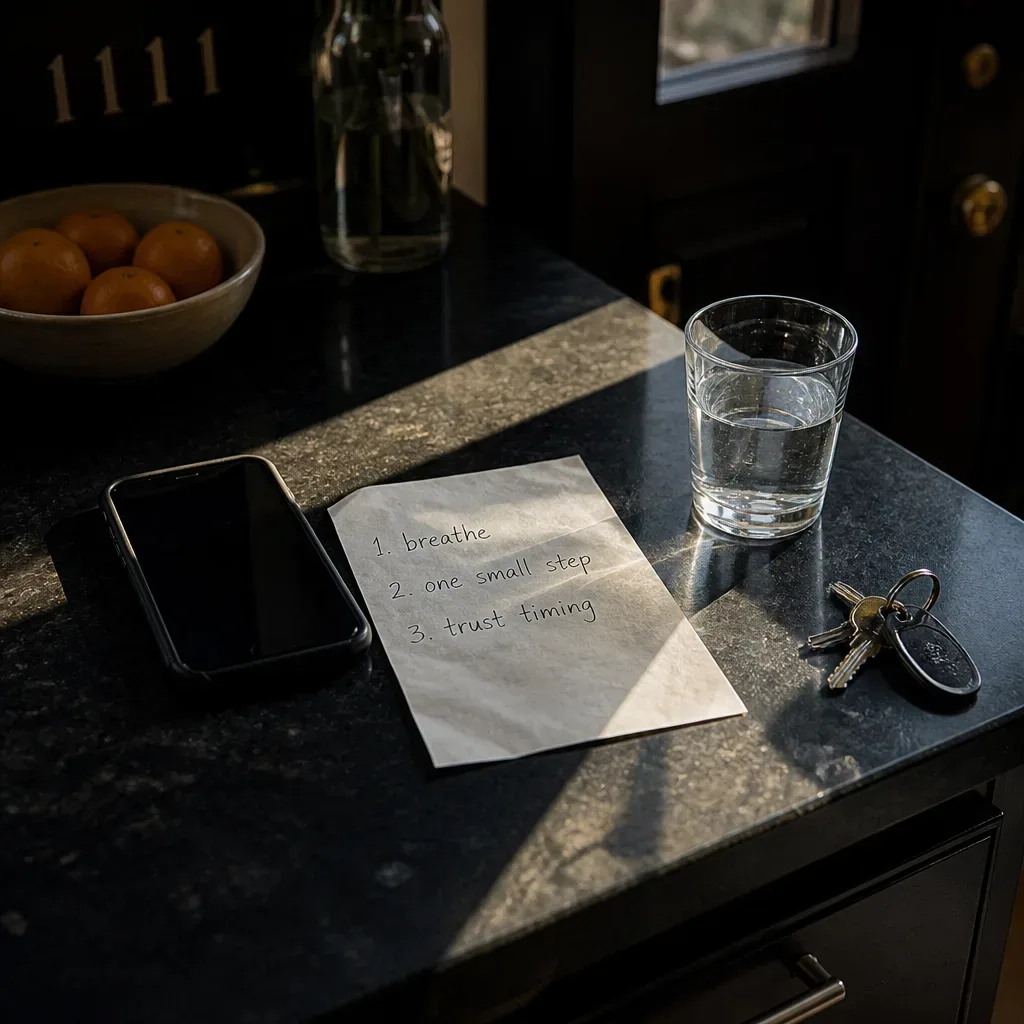
Your phone is face down. Three minutes is enough for gratitude manifestation when the audio is specific, repeated, and tied to one small action. You listen to your future self speak from the life you’re practicing. Then you thank what is already here, and move one inch toward what is next.
What is gratitude manifestation when it isn’t forced positivity?
Gratitude manifestation is thanking what is true now while rehearsing the self you’re becoming next.
It isn’t a demand that you feel good on command. It isn’t a way to decorate a hard season. Gratitude gets useful when it becomes precise. Not: I’m grateful for everything. More like: I’m grateful I answered the message. I’m grateful I didn’t quit on Tuesday. I’m grateful my body carried me through another plain morning.
Robert Emmons and Michael McCullough published one of the better-known gratitude studies in 2003. In their work, participants who wrote weekly gratitude lists reported higher well-being than comparison groups over 10 weeks. The number matters because it was not a single mood lift. It was repetition. A repeated note. A repeated turning of attention.
Manifestation, when it’s honest, also works by repetition. You give your mind a scene to return to. You practice being the person who would choose from that scene. If you’re new to the wider frame, the Manifestation pillar lays out the difference between fantasy and practice. Fantasy asks life to change while you stay the same. Practice asks you to become easier to find.
Gratitude is not a performance. It is a way of noticing the evidence you keep missing.
A 3-minute future-self audio makes this easier because it gives gratitude a shape. You don’t have to invent a new sentence every morning. You listen. You hear a future version of you describe an ordinary moment with care. The rent is paid. The body is calmer. The work has a different tone. The relationship feels honest. Specificity gives the nervous system something to believe.
Why use a 3-minute future-self audio instead of a long ritual?
Use 3 minutes because a practice you can repeat is stronger than a ritual you admire but avoid.
Long rituals can be beautiful. They can also become another place to fail. I know that room. I used to build systems with 14 steps, then blame myself when work, weather, or plain fatigue broke them by Thursday. A 3-minute audio is not less serious. It is less dramatic. That is its strength.
In habit research, repetition and context matter more than intensity. A 2009 study by Phillippa Lally and colleagues at University College London found that habit formation varied widely, with an average of 66 days for a new behavior to become more automatic. The takeaway is not that you need exactly 66 days. It’s that the body learns through return.
The AYA frame is built around that return. The AYA Method is a daily audio manifestation practice. Each day you listen to a short personalized recording — your Dream-Self Moment — narrated from the version of you who has already manifested the life you intend. Listening is the practice. Repetition is the work. The audio is the method.
That last line matters. The daily affirmation and Manifestation Board can support the practice, but they are complements. The audio is the place you come back to. When you only have 3 minutes, you do not need a candle, a perfect mood, or a clean desk. You need a voice that reminds you what you’re practicing to remember.
Here is the simple comparison:
| Practice type | Time needed | Best use | Risk |
|---|---|---|---|
| 3-minute future-self audio | 3 minutes | Daily identity rehearsal | Skipping because it feels too simple |
| Gratitude journal | 5 to 10 minutes | Naming present evidence | Writing the same vague lines |
| Vision board | 15 to 30 minutes | Seeing symbols and goals | Making it pretty but not lived |
| Long meditation | 20 minutes or more | Nervous system settling | Avoiding it on busy days |
The smaller door is often the one you actually walk through.

How do you prepare before pressing play?
Prepare by choosing one honest gratitude cue and one future-self theme before the audio begins.
You don’t need much. Sit down. Stand by the sink. Stay in the parked car for one more minute. The setting matters less than the cue. Behavioral scientists often describe cues as triggers for automatic routines. In BJ Fogg’s behavior model, a behavior becomes more likely when motivation, ability, and prompt meet at the same time. A 3-minute audio keeps ability high because the ask is small.
Try this before you listen:
- Put one hand somewhere steady, like your chest, ribs, or thigh.
- Name one thing that is already real.
- Name the future-self theme for today.
- Press play before you start negotiating.
- After the audio, choose one matching action.
The first gratitude cue should not be poetic unless poetry is natural to you. Use plain language. I’m grateful I have a room. I’m grateful I can read this. I’m grateful I still care. In clinical psychology, gratitude interventions are often brief for a reason. A 2010 review by Alex Wood and colleagues connected gratitude with well-being across multiple studies, but the useful point is simple: attention can be trained.
Your future-self theme is the lane for the audio. It might be work, love, money, health, home, or courage. Pick one. If you try to hold 12 desires at once, the mind gets loud. One theme gives the recording a center. One true sentence gives the body somewhere to land.
If affirmations help you, keep them close but simple. The Affirmations pillar can help you shape a sentence that doesn’t feel fake. Still, don’t let the sentence replace the listening. In this method, the affirmation is a small companion. The Dream-Self Moment is the daily practice.
What should the 3 minutes sound like?
The audio should sound like your future self describing a believable day with sensory detail, gratitude, and one clear identity shift.
Believable does not mean small. It means your body doesn’t reject it in the first 10 seconds. If the audio says, I own five houses by Friday, and your jaw locks, the practice becomes theater. If it says, I wake in a home that feels calm, I check my account without flinching, and I know what to do first, the nervous system has more room to listen.
Neuroscience research often points to mental rehearsal as a real form of practice. Dr. Andrew Huberman has discussed visualization as most effective when paired with action and when the imagined steps are concrete. The same principle fits here. Your audio should not only name the prize. It should name the posture, the choice, the room, the conversation, the small evidence.
A useful 3-minute arc can look like this:
- First 30 seconds: arrive in the future-self scene.
- Next 60 seconds: notice what has changed in daily life.
- Next 60 seconds: feel gratitude for specific evidence.
- Final 30 seconds: choose the identity you will practice today.
A good future-self audio doesn’t shout at you. It recognizes you.
Here is a sample structure, not a script to copy word for word:
You are standing in your kitchen. The morning is quiet. You look at your calendar and there is space around the work. You have learned to answer one thing at a time. You’re grateful for the way your life no longer asks you to abandon yourself to be safe.
Notice the details. Kitchen. Calendar. One thing at a time. Gratitude is attached to evidence, not decoration. This is where the AYA Method is different from repeating a line until you go numb. You listen to a scene narrated from the self who already knows how to live it.
How do you listen so gratitude becomes embodied?
Listen with the body first, because gratitude that never reaches the body stays abstract.
You don’t have to feel a rush. You don’t have to cry. In fact, chasing a big feeling can make the practice harder to keep. Look for smaller signs. A slower exhale. A slight softening in the forehead. A sentence that makes your shoulders drop by 2 percent. That counts.
The American Psychological Association has repeatedly noted the link between stress and physical symptoms in its Stress in America reporting, including sleep disruption and muscle tension. A manifestation practice that ignores the body can become another thinking loop. The point of listening is not to think better thoughts only. It is to let the future-self cue settle into your breathing, posture, and next choice.
Use this during the audio:
- When a sentence feels true, repeat it silently once.
- When a sentence feels too far away, soften it with the word becoming.
- When your mind wanders, return to the next sound instead of starting over.
- When gratitude appears, locate it in the body.
- When nothing happens, finish anyway.
There is dignity in finishing a small practice on a flat day.
Some days, gratitude will feel warm. Some days, it will feel like a fact with no feeling attached. Both are usable. In mindfulness research, practice effects are often linked to consistency rather than perfect sessions. A 2014 JAMA Internal Medicine review found meditation programs showed moderate evidence for improving anxiety, depression, and pain. Your 3-minute audio is not medical care, but it can borrow that lesson: return matters.
What do you do after the audio ends?
After the audio ends, take one small action that proves you heard it.
This is the part most people skip. They listen, feel better for a minute, then re-enter the old day with no bridge. Build the bridge while the recording is still fresh. If your future self sounded financially steady, open the banking app and look without drama. If your future self sounded loved, send the honest message. If your future self sounded healthy, drink water before the second coffee.
Implementation intention research gives this shape. Psychologist Peter Gollwitzer found that if-then plans can improve follow-through across goals because they connect a cue to an action. The format is plain: If it is 7:30, then I listen. If the audio ends, then I take one matching step. No speech. No ceremony. Just a bridge.
Here are examples:
| Future-self theme | Gratitude sentence | Matching action |
|---|---|---|
| Work | I’m grateful I can choose one clean task. | Write the first email draft. |
| Money | I’m grateful I can look directly. | Check one balance. |
| Love | I’m grateful I can tell the truth kindly. | Send one clear message. |
| Health | I’m grateful my body is still speaking. | Walk for 5 minutes. |
| Home | I’m grateful this room can support me. | Clear one surface. |
The action should be almost too small to respect. That is often why it works. In a 2020 review of behavior change techniques, self-monitoring and action planning appeared again and again as practical supports. Manifestation without action becomes fog. Action without inner rehearsal can become force. Together, they make a quieter kind of evidence.
If you use a Manifestation Board, place one image or phrase where you’ll see it after listening. But keep the order clear. The board supports the audio. The audio leads the practice. The same is true for a daily affirmation. It can echo the recording, not replace it.
How do you keep gratitude manifestation honest when life is hard?
Keep it honest by refusing to use gratitude as a way to silence pain.
This matters. Gratitude can become cruel when it says, other people have it worse, so stop wanting what you want. That is not practice. That is self-erasure. A clean gratitude manifestation practice lets two truths stand in the same room: this is hard, and something in me is still willing.
Neville Goddard wrote often about assuming the feeling of the wish fulfilled. Some readers take that as pressure to deny current reality. I don’t. The useful part is rehearsal. You practice the inner posture of the person who can receive, choose, and stay. You do not need to lie about the unpaid bill, the breakup, or the body that hurts.
If astrology is part of how you reflect, use it as timing language, not as a prison. The Astrology and manifestation guide offers a softer way to pair cycles with intention. Still, no chart removes your agency. No transit does your listening for you. The recording is still yours to return to.
A hard-day version can be this simple:
- Name the truth: This is a hard day.
- Name the gratitude: I’m grateful I haven’t left myself.
- Listen to the 3-minute audio.
- Choose one action small enough to do while tired.
Pew Research Center has reported that many adults use spiritual or reflective practices outside formal religious settings, with prayer, meditation, and personal rituals often overlapping in daily life. That tracks with what I see as a coach: people need practices that fit real kitchens, real commutes, real grief.
You don’t need to become a brighter person. You need a repeatable way to come home to what is true.
For the wider map, return to manifestation as a daily practice, then keep the audio small enough to do again tomorrow. Gratitude manifestation is not about proving you’re fine. It’s about letting the future self speak kindly until the present self can take one honest step.
Put the phone down. Let it be enough.