manifestation 101
Law of Assumption: Practice It With Dream-Self Audio
Learn the law of assumption through Dream-Self audio: a practical daily method for rehearsing the identity you intend to inhabit.

The law of assumption is practiced by repeatedly occupying the inner identity of the person who already has what you intend. Dream-Self audio makes that practice concrete: you listen daily to the future self until the state becomes familiar, then you act from it in ordinary hours.
What is the law of assumption, really?
The law of assumption is the practice of accepting a desired state as internally true before the outer evidence has finished arriving.
Neville Goddard made the phrase famous in the mid-20th century, especially in lectures from the 1940s and 1950s. His central claim was not that you should chant harder. It was that consciousness, accepted as natural, becomes the mold for experience. You assume the state, then you persist until the dial catches.
That sounds mystical until you watch ordinary human behavior. A person who assumes they are unwanted reads a late text as rejection. A person who assumes they are trusted reads the same late text as timing. The event has 1 timestamp; the meaning has several doors.
Modern psychology would not phrase it like Goddard, but it recognizes related mechanics. Cognitive schemas, studied heavily since Aaron Beck’s work in the 1960s and 1970s, shape what people notice, predict, and repeat. Self-fulfilling prophecy research, including Robert Rosenthal’s 1968 Pygmalion studies, showed that expectation can alter behavior in measurable ways.
Assumption is not pretending the room is different. Assumption is deciding which version of you gets to enter the room.
On Manifest 11, we place this inside the broader Manifestation pillar: intention, identity, repetition, and action. The law of assumption is the identity gate. It asks one blunt question: who are you being while you wait?
The answer cannot remain decorative. If you assume wealth but behave like every number is a threat, the body heard the threat. If you assume love but keep rehearsing abandonment at 2:11 a.m., the mirror is not confused. It is faithful.
Why use Dream-Self audio instead of willpower?
Dream-Self audio helps because it turns assumption into a repeatable sensory practice instead of a mood you must manufacture.
Willpower is useful, but it is a terrible landlord. It raises the rent under stress. A 2011 review in the journal Psychological Science noted that self-control fluctuates with attention, emotion, and fatigue, which anyone with a baby monitor at 5:33 a.m. could have submitted as evidence. Audio lowers the entry cost.
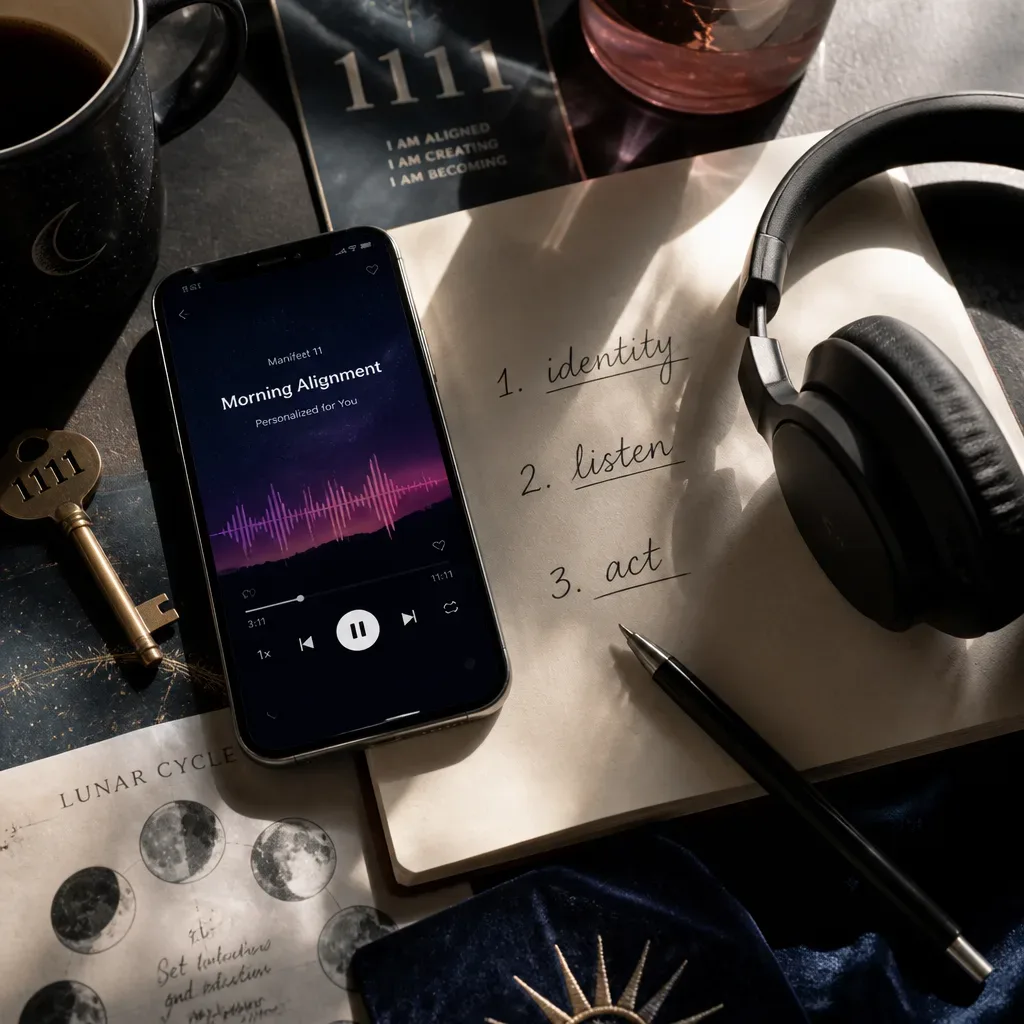
The AYA Method is a daily audio manifestation practice. Each day you listen to a short personalized recording, your Dream-Self Moment, narrated from the version of you who has already manifested the life you intend. Listening is the practice. Repetition is the work. The audio is the method.
I like that because it behaves like music. When I toured, we did not become tighter by discussing the bass line in a hotel lobby. We played it 80 nights until the hands stopped asking permission. A groove is a promise kept at tempo. Assumption works the same way.
There is research adjacent to this. Mental rehearsal has been studied in sport psychology for decades; a 1994 meta-analysis by Driskell, Copper, and Moran found mental practice had a positive effect on performance, especially when combined with physical practice. Audio does not replace action. It rehearses the state from which action becomes less strange.
Dream-Self audio also gives the mind a stable cue. Dr. Andrew Huberman often discusses state-dependent learning in neuroscience education: the brain retrieves and repeats patterns more easily when cues are consistent. Same chair. Same walk. Same headphones. The moment starts to know you.
Useful when the numbers keep tapping the glass. You see 11:11 twice in a day, then 22 on the receipt, then a message lands at 3:33. You do not need to crown every number as prophecy. Sometimes synchronicity is simply attention becoming organized.
How do you practice the law of assumption with audio?
You practice by listening daily, entering the assumed identity through the audio, and taking one small action that matches it.
Keep the practice small enough to repeat. BJ Fogg’s behavior model at Stanford, published in 2009 and expanded in Tiny Habits in 2019, argues that behavior happens when motivation, ability, and prompt meet. The prompt matters. Put the audio where life already has a hinge.
Here is the simplest sequence:
- Choose one assumption. Not 17 wishes. One identity. “I am the person who receives steady creative work.”
- Listen once daily. Five to eight minutes is enough for most mornings. If you miss the morning, use the school pickup queue or the kitchen after dishes.
- Name the body shift. Notice the breath, jaw, shoulders, and pace. The body keeps receipts.
- Take one congruent action. Send the pitch, open the savings app, make the appointment, close the tab.
- Record one signal. Write down a choice, timing, contact, or synchronicity that matched the state.
The signal log is not there to make you obsessive. It is there because humans forget change while it is happening. Pew Research Center reported in 2022 that 31% of U.S. adults are online “almost constantly.” That is a lot of noise competing with a subtle internal return.
| Practice piece | What it does | Time needed |
|---|---|---|
| Dream-Self audio | Rehearses the assumed identity | 5–8 minutes |
| One written sentence | Names the day’s state | 30 seconds |
| Congruent action | Proves the state in behavior | 2–20 minutes |
| Weekly review | Tracks pattern and timing | 10 minutes |
The daily affirmation can help here, especially if your mind likes a clean sentence. The Affirmations pillar is useful for shaping language, but do not mistake the sentence for the spine. In this practice, the audio carries the state; the affirmation supports it.
The sentence is a match. The audio is the fire you return to.
What should you assume when the evidence looks opposite?
Assume the identity, not the denial of facts.
This is where many people get theatrical and then blame the method. The bill is real. The quiet inbox is real. The breakup conversation happened at 9:14 p.m., which is cruelly specific. The law of assumption does not require you to call pain fake. It requires you to stop calling pain final.
Neville Goddard used the phrase “living in the end,” but that does not mean abandoning the middle. The middle is where you pay rent, apologize, learn the software, update the CV, and drink water because the body is not a decorative object. A 2021 American Psychological Association report found that money, work, and health were among the top stressors for many adults. Assumption has to survive those categories or it is only wallpaper.
Try this when the evidence pushes back:
- Fact: “The client has not replied in 6 days.”
- Old assumption: “I am being ignored.”
- Chosen assumption: “I am the kind of person whose work is considered seriously.”
- Next action: Send one clean follow-up, then return to the audio.
That is not passive. It is disciplined. The nervous system gets to panic; it does not get to drive every car.
Tara Brach’s RAIN practice, widely taught in mindfulness settings, begins with recognizing what is present. That matters here. Recognition stops assumption from becoming spiritual bypassing. You can say, “Fear is here,” and still refuse to crown fear as identity.
A fact can be urgent without being sovereign.
If a day collapses, use the minimum dose. One listen. One breath. One honest action. In household terms, that is the version of practice that fits between a crying child and wet laundry. Not glamorous. Very useful.
How do affirmations and boards support the audio without taking over?
Affirmations and the Manifestation Board support the law of assumption when they reinforce the audio, not when they compete with it.
People love adding tools because tools feel like progress. I understand. Musicians buy pedals when what they need is practice. A board, a sentence, a candle, a notebook: all fine. But if every tool becomes a new altar, the practice loses tempo.
The audio is the method. The daily affirmation and Manifestation Board are complements. Keep the hierarchy clean. Your Dream-Self Moment gives you the assumed state in voice, pacing, and emotional tone. The affirmation gives you a portable line. The board gives you a visual witness.
Research on affirmations is mixed and useful. A 2009 study by Wood, Perunovic, and Lee found that positive self-statements can backfire for people with low self-esteem when the statement feels too unbelievable. That is why audio matters. A personalized narrative can approach belief sideways, through scene and identity, rather than shouting a sentence the body rejects.
Use this simple support structure:
- Audio first: Listen before you start adjusting words or images.
- Affirmation second: Choose 1 sentence that matches the recording.
- Board third: Add 1 image or phrase only when it sharpens the state.
- Action always: Let the assumed identity make a choice before noon if possible.
There is room for timing too. If you work with lunar cycles, numerology, or master numbers, use them as punctuation, not permission slips. The Astrology and manifestation guide is best read this way: cycles can help you notice seasons, but they do not do the listening for you.
A new moon can be a clean gate. 11 can be a signal. 22 can remind you to build. 33 can ask for a wider service. Still, the practice returns to Tuesday morning with headphones on.
How do you make the assumption feel believable?
You make an assumption believable by reducing resistance, adding sensory detail, and repeating it until the identity feels less theatrical.
The mind often rejects giant statements because they arrive wearing a costume. “I am a millionaire” may trigger an internal heckler before breakfast. A better assumption is often more immediate: “I am a person who handles money calmly and receives well-paid work.” The body can begin there.
Specificity helps. Neuroscience research on memory has long shown that multisensory cues improve recall; the classic encoding-specificity principle from Tulving and Thomson in 1973 still holds up as a useful frame. Your Dream-Self audio should sound like a life, not a slogan. The door. The email. The room. The calm after the decision.
If belief feels far away, use the bridge state:
- “I am willing to hear this as possible.”
- “I am practicing the state daily.”
- “I am becoming familiar with this version of me.”
- “I can take one action from that identity today.”
That sequence is less dramatic, which makes it harder for the nervous system to reject. In small clinical studies of visualization and exposure-based approaches, gradual contact with a feared or desired state often works better than forcing intensity. The lesson is not timid. It is precise.

Believability also rises when you stop arguing with every old thought. Joe Dispenza often frames repetition as a way of changing the body’s memorized emotional state. You do not have to accept every claim around his work to recognize the practical point: repeated feeling becomes familiar.
The assumed self does not need to shout. It needs to become normal.
That is the whole game. Not a lightning strike. A return.
How do you know the law of assumption is working?
You know it is working when your choices, reactions, attention, and timing begin to match the assumed identity before the full result arrives.
Do not measure only the headline outcome. That is like judging a song by the final chord and ignoring the groove. Track the smaller shifts because they usually arrive first. You stop checking the message 40 times. You send the proposal without apologizing for existing. You sleep instead of rehearsing disaster.
A 2010 study on implementation intentions by Gollwitzer and Sheeran reviewed 94 independent tests and found that if-then planning reliably improved goal achievement. That matters because assumption must become behavior. “If I feel ignored, then I listen again and send one clean message” is more useful than “I will stay positive,” which collapses by lunch.
Watch for 4 categories:
- Attention: You notice opportunities that used to blur past.
- Regulation: You recover faster when evidence looks delayed.
- Action: You make choices the old identity avoided.
- Synchronicity: Timing begins to feel oddly on cue, without needing to prove it in court.
Princeton’s PEAR lab and Global Consciousness Project remain debated, and they should be held with discernment. Still, their decades of inquiry into intention, attention, and random systems show one thing clearly: serious people have been willing to ask strange questions for a long time. Manifestation is not made stronger by pretending every question is settled.
For a broader foundation, keep the Manifestation pillar close. For the daily practice, return to the AYA Method. The method is not there to make you superhuman. It is there so your assumed self has a morning appointment.
Here is a 7-day starter rhythm:
| Day | Listen for | One action |
|---|---|---|
| 1 | The exact identity being named | Write the assumption in 1 sentence |
| 2 | The emotional tone | Adjust posture for 60 seconds |
| 3 | The future room | Clear one physical space |
| 4 | The voice of certainty | Send one aligned message |
| 5 | The body response | Notice resistance without obeying it |
| 6 | The next gate | Make one practical decision |
| 7 | The pattern | Review 3 signals from the week |
The law of assumption is not a performance for the sky. It is a private agreement with the self you are willing to rehearse until life recognizes the voice.
Put the headphones on. The dial is already moving.