audio manifestation
Manifestation Without Visualization: Listen Instead
Manifestation without visualization is possible when you stop forcing mental pictures and listen to a Dream-Self Moment that your body can remember.

The house is quiet for eight minutes. Not ten. Not a perfect morning. Manifestation without visualization means you stop forcing pictures in your mind and use sound instead: a short, repeated Dream-Self Moment that lets your attention hear where you’re going before your eyes can see it.
Why can manifestation work without seeing pictures in your mind?
Manifestation can work without mental pictures because attention, emotion, memory, and identity are not only visual.
Some people close their eyes and see a full scene. Some see a blur. Some see black. In 2015, neurologist Adam Zeman and colleagues helped name aphantasia: the inability, or near inability, to form voluntary mental images. Later estimates often place it around 2% to 4% of people, though the number changes by method and sample. That means a classroom of 30 may have one person quietly wondering why everyone else is pretending to see things.
You may not have aphantasia. You may just be tired. You may be a parent with wet laundry and a child who has decided that sleep is a rumor. The mind doesn’t always produce cinema on command. That doesn’t make you less capable. It makes the method matter.
Visualization has a long place in performance psychology. A 1967 study by Alan Richardson on free throws is often cited for mental rehearsal, though it was small and not the final word. More recent sports psychology reviews still suggest imagery can support skill when paired with action. But imagery is one route. It is not the whole road.
Sound reaches memory differently. You know this. A song from 2009 can put you back in a van, outside a venue, eating chips at midnight because dinner was a myth. The National Institutes of Health notes that music and rhythm can be used in clinical settings to support movement, speech, and mood. Voice is not decoration. Voice is a cue.
If a picture won’t come, don’t punish the dark. Listen for the next true sentence.
For a wider grounding in the practice, the manifestation basics page gives the broader frame. Here, the practice gets smaller. You are not trying to win a private art contest behind your eyelids. You are learning to return.
What should you listen to instead?
You should listen to a short future-self recording that names the life you intend in language your body can believe.
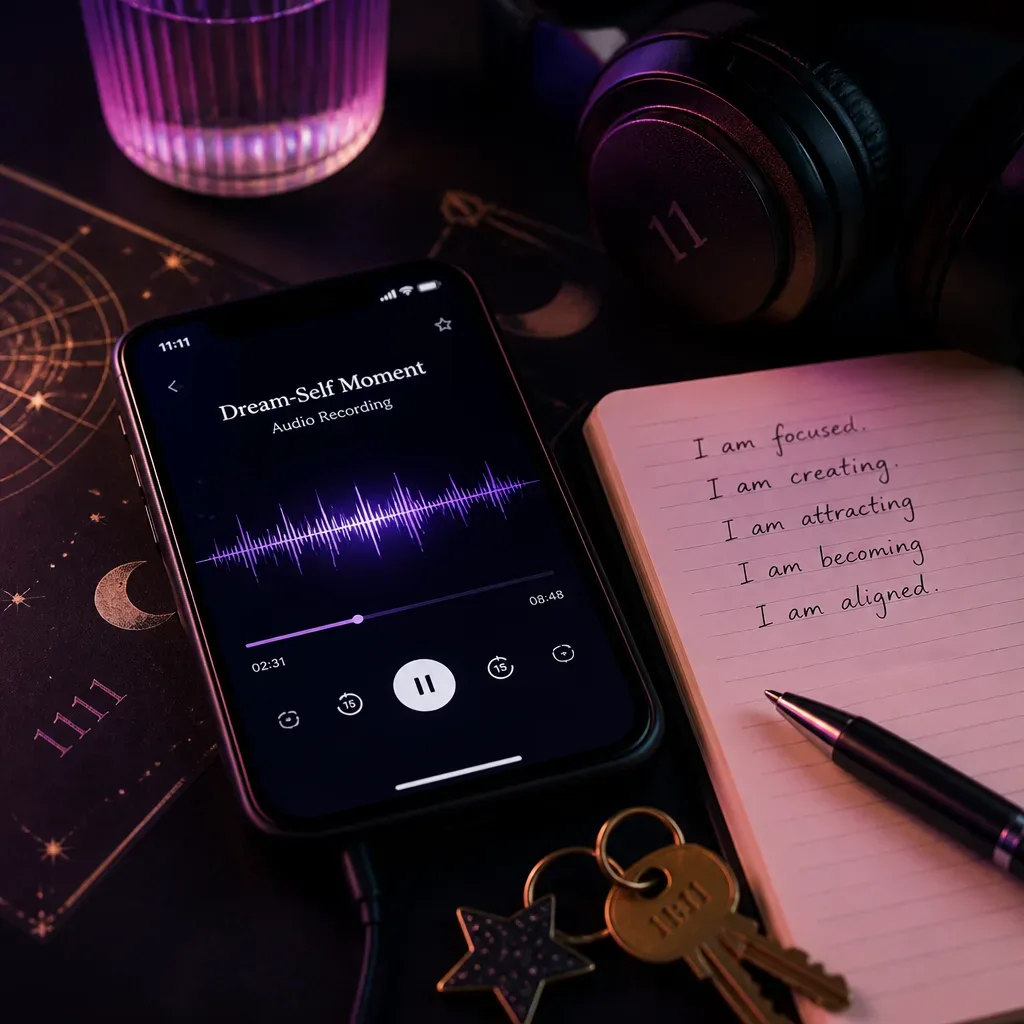
The AYA Method is a daily audio manifestation practice. Each day you listen to a short personalized recording — your Dream-Self Moment — narrated from the version of you who has already manifested the life you intend. Listening is the practice. Repetition is the work. The audio is the method.
That last sentence matters. The audio is not a mood track behind the real work. It is the work. A daily affirmation can help. A Manifestation Board can help. But they sit beside the listening. They do not replace it. If you can only do one thing today, listen.
A good Dream-Self Moment is usually short. Two to five minutes is enough. Cognitive load research has shown for decades that working memory is limited; George Miller’s famous 1956 paper suggested about 7 items, plus or minus 2, though later researchers often argue the number is closer to 4. Either way, your mind doesn’t need a long speech. It needs a clear signal.
Use present-tense detail. Not a fantasy parade. A few ordinary facts.
- The email has been sent.
- The rent is handled.
- The body feels rested enough.
- The studio is quiet before the first client arrives.
- The child is asleep, and you didn’t spend the whole night blaming yourself.
Neville Goddard often taught that you enter the feeling of the wish fulfilled. You don’t need to agree with every sentence he ever wrote to use the practical point. The state matters. For visual people, that state may arrive through a scene. For you, it may arrive through a voice saying, calmly, this is who you are now.
There is mercy in audio. It keeps speaking when your focus flickers.
How do you make a Dream-Self Moment feel true?
You make it feel true by writing it close to the ground, with details you can recognize and words you would actually say.
The mistake is to make the future too shiny. If your nervous system hears a sentence and immediately says no, don’t argue with it for 20 minutes. Adjust the sentence. In acceptance and commitment therapy, practitioners often use values-based language that can be acted on today. The same principle helps here. A true sentence should have a handle.
Try this comparison before recording or choosing your audio:
| Forced line | Truer line |
|---|---|
| I have everything I’ve ever wanted | I know what matters today, and I act on one piece of it |
| I never doubt myself | Doubt can come with me, but it doesn’t drive |
| Money is always easy | I meet money clearly, one honest decision at a time |
| I am perfectly calm | I return to my breath faster than I used to |
A Dream-Self Moment is not a lie with good lighting. It is a rehearsal of belonging to the life you’re practicing.
Joe Dispenza often speaks about rehearsing a new inner state before the outer evidence arrives. You don’t have to adopt his whole framework to notice the common thread: repetition changes familiarity. In habit research, Wendy Wood has written that behavior becomes easier when it is repeated in stable contexts. A 2009 study by Phillippa Lally and colleagues found habit formation took a median of 66 days, with wide variation from 18 to 254 days. So no, one perfect listen isn’t the point.
Here is a simple way to shape the audio:
- Name one area: work, love, health, home, money, or creative life.
- Write 6 to 10 sentences from the version of you who is already living it.
- Add 2 sensory cues that are not visual, such as breath, sound, temperature, or weight in the body.
- Keep one ordinary action inside the script.
- End with a line you can carry into the day.
If you want to pair the audio with written language, the affirmations guide can help you keep the sentence clean. But don’t let writing become a delay tactic. Record. Listen. Return tomorrow.
What is the five-minute practice for manifestation without visualization?
The five-minute practice is to listen once, let one sentence land, and take one small matching action.
Keep it almost embarrassingly simple. I used to think practice had to look serious. Then I had children. Now I respect anything that can survive a spoon falling under the fridge. Five minutes survives.
Here is the practice:
- Minute 1: Arrive. Sit, stand, or lie down. Put on headphones if you can. Take 3 slow breaths. Dr. Andrew Huberman has spoken often about physiological sighs, and Stanford research on cyclic sighing published in 2023 found five minutes a day improved mood and lowered respiratory rate more than mindfulness meditation in that study.
- Minutes 2 to 4: Listen. Play the Dream-Self Moment once. Don’t grade your belief. Don’t pause to fix yourself. Let the voice finish.
- Minute 5: Choose one action. Ask, what does this version of me do next? Make it small enough to do today.
The action matters because the body learns from evidence. The Journal of Behavioral Medicine has published many studies linking self-monitoring and small repeated behaviors with health outcomes. The point isn’t that audio magically pays a bill. The point is that the recording can help you become the person who opens the bill, calls the office, and stops hiding from the envelope.
If you like structure, use this small checklist:
- Same cue each day: after coffee, after prayer, before school pickup, before bed.
- Same audio for at least 7 days.
- One sentence written down after listening.
- One action completed within 24 hours.
- One weekly note on what feels easier.
The AYA Method is built for this kind of repetition. It doesn’t ask for a grand mood. It asks for return. In my house, that is the only kind of practice I trust.
What if your mind wanders while you’re listening?
If your mind wanders, you keep listening and return to the next sentence without making the wandering a problem.
Attention moves. That is what attention does. A 2010 paper by Killingsworth and Gilbert in Science used an iPhone app to sample daily thoughts and found people’s minds wandered about 47% of the time. You are not uniquely undisciplined. You are human with a nervous system and, possibly, a grocery list.
Audio helps because it continues while you drift. With visualization, if the image disappears, the whole practice can feel lost. With listening, the recording is still there when you come back. You missed one line. You hear the next. That is enough.
Use a return phrase. Something plain.
- Here.
- Again.
- I can hear this.
- One sentence.
- Stay soft.
Do not turn the session into a courtroom. No witness stand. No cross-examination. The part of you that wandered is not an enemy. It may be tired, scared, bored, or trying to protect you from wanting something too much.
Princeton’s Global Consciousness Project is sometimes mentioned in manifestation circles, but its claims are debated and not a stable basis for daily practice. You don’t need contested data to justify listening. You can stand on simpler ground: repeated attention affects choices; language shapes perception; small actions compound. Those claims are easier to test in your own week.
The practice is not perfect focus. The practice is a gentle return.
If a line in the audio irritates you every time, change it. Irritation can be useful data. Maybe the sentence is too far from true. Maybe the desire is borrowed. Maybe the old self is asking for proof. Listen closely, but don’t quit quickly.
How do affirmations and a Manifestation Board fit if audio is the method?
Affirmations and a Manifestation Board can support the listening, but the daily audio remains the central practice.
This distinction keeps the practice clean. When every tool becomes equally important, the day becomes crowded. Then you miss one piece and feel as if you’ve failed the whole thing. You haven’t. If the recording was heard, the practice happened.
A daily affirmation is useful when it carries the core sentence from the audio into the day. It is like a bass line. I say that as someone who spent a decade playing bass for people who did not always notice the bass until it stopped. The line holds the song. One sentence can hold the day.
A Manifestation Board is useful when you want to see the direction without needing to visualize internally. That can be especially kind for people who don’t make mental pictures easily. You can place 3 to 9 images or words on it. Keep it edited. More is not always more. Design research often points to the value of reducing choice and clutter; too many cues can make attention weaker, not stronger.
Here is the order I would use:
| Tool | Role | Time |
|---|---|---|
| Dream-Self Moment | Main daily practice | 2 to 5 minutes |
| Affirmation | One sentence to carry | 10 seconds |
| Manifestation Board | Visual reminder outside the mind | 1 minute |
If the affirmation is the topic you need next, read the affirmations pillar. If timing, seasons, or birth charts are part of your personal language, astrology and manifestation can sit beside the practice too. Just keep the order clear. The listening leads. The other tools echo it.
There is freedom in fewer pillars. A practice can be small and still be real.
How do you know the listening is working?
You know the listening is working when the desired self becomes easier to remember during ordinary decisions.
Don’t measure only by the big result. Some things take time because other people, money, health, law, and plain logistics are involved. Measure the near signs too. Are you avoiding less? Are you speaking more clearly? Are you recovering faster after doubt? Are you taking the small action within 24 hours more often than last month?
Use a 30-day note. Not a dramatic journal. A note. Once a day, write 1 line after listening. At the end of 30 days, look for evidence. A 2018 Pew Research Center report found that many adults track health, habits, or goals informally, and behavior-change research often uses self-monitoring because it makes patterns visible. You are not trying to become a spreadsheet. You are trying to see what your life is already telling you.
Track these four signs:
- Recall: You remember one line from the audio without trying.
- Regulation: You return to yourself a little faster after stress.
- Choice: You make one decision that fits the Dream-Self Moment.
- Proof: You can name one real-world change, however small.
The change may be quiet. You send the invoice on time. You stop rehearsing the old argument. You sleep before midnight twice in one week. You speak to yourself with less contempt. These are not side notes. These are the place where a life starts to turn.
If you want the bigger frame again, return to manifestation. If you want the daily form, return to the audio. The method is not asking you to see what you can’t see. It is asking you to hear what is already yours to practice.
Listen once. Let the next true sentence find you.