affirmations
Morning Affirmations for Women: 3-Minute Audio Reset
Morning affirmations for women can work in three minutes when they are specific, recorded in your own voice, and repeated before the day grabs the mic.

Morning affirmations for women work best when they are short, specific, and heard before the day starts negotiating your worth. A three-minute audio practice can steady your self-concept, interrupt the “I’m behind” loop, and give your attention one clean signal to follow.
Why do morning affirmations for women work better as audio?
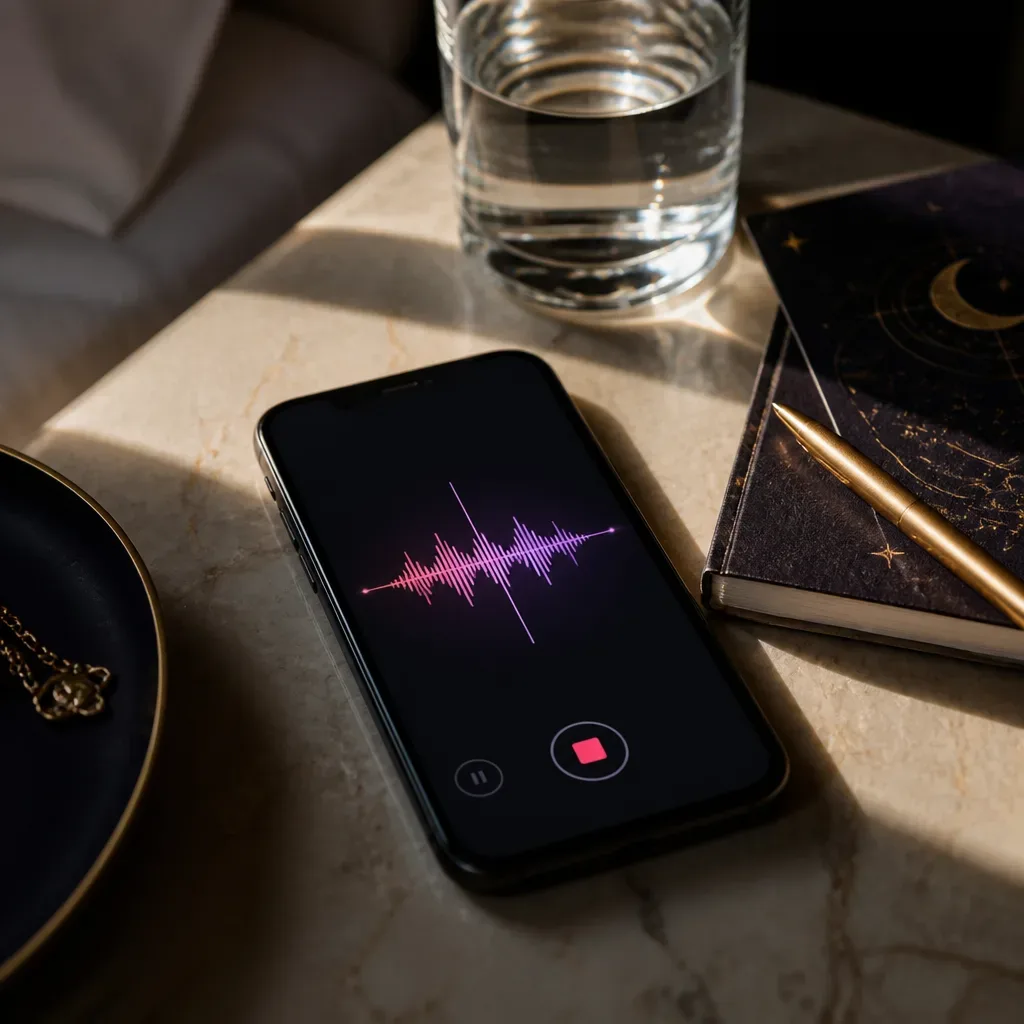
Audio works because it reduces friction: you do not have to find a notebook, sit perfectly, or become a new person before 7:11 a.m.
Most women I know are not resisting affirmation because they dislike the idea. They are resisting one more instruction. One more elegant habit stacked onto a morning already occupied by school forms, Slack pings, medication reminders, and a body that did not sleep enough. The Centers for Disease Control and Prevention has reported that roughly 1 in 3 U.S. adults does not get the recommended 7 hours of sleep. That number matters. A tired brain does not need a 40-minute ceremony. It needs a usable gate.
This is where audio earns its place. You can listen while the kettle boils. You can listen with one shoe on. You can listen in the parked car before walking into the room where everyone expects the old version of you to show up on cue. The practice does not require a perfect morning. It requires a repeatable moment.
Self-affirmation research is not new. In a widely cited 2014 review in the Annual Review of Psychology, Geoffrey Cohen and David Sherman described self-affirmation as a process that can help people preserve a sense of adequacy under threat. Not fantasy. Adequacy. That word has less glitter and more use.
If you are new to manifestation language, start with the broader frame in the Manifestation pillar. Manifestation is not a demand placed on reality. It is a disciplined relationship with attention, identity, action, and timing. Audio gives that relationship a pulse.
A morning practice that cannot survive an ordinary Tuesday is decoration, not practice.
What should a three-minute affirmation actually say?
A three-minute affirmation should name the identity you are practicing, the next behavior that proves it, and the emotional tone you are choosing to rehearse.
The mistake is trying to fit your entire desired life into one recording. A three-minute audio is not a legal contract with the cosmos. It is a dial setting. It tells the mind what to notice first. Cognitive scientists have studied attentional bias for decades; what we repeatedly attend to becomes easier to detect. That does not mean every thought becomes an event. It means repeated cues can train perception.
Use this five-part structure for a three-minute recording:
- Opening breath, 20 seconds: “I am here. This morning counts.”
- Identity line, 30 seconds: “I am the woman who takes the next clean step.”
- Evidence line, 45 seconds: name one proof from yesterday, even if it was tiny.
- Future-self line, 60 seconds: speak as the version of you who has already steadied the area that hurts.
- Action line, 25 seconds: choose one behavior you will do before noon.
That is it. No velvet curtain. No twenty-seven declarations while your toast burns.
The Affirmations pillar goes deeper into wording, repetition, and self-concept, but the short version is this: a strong affirmation is believable enough to enter the nervous system and brave enough to stretch it. Tara Brach often teaches the value of naming what is present before softening around it. The same principle applies here. “I feel behind, and I still belong in my own life” will often land better than “Everything is perfect.”
Three minutes is not small when it is repeated for 30 mornings. That is 90 minutes of identity rehearsal in a month, delivered at the exact hour when the day is most suggestible.
Which seven affirmations help when you feel behind?
The best affirmations for feeling behind replace comparison with evidence, timing, and one doable next step.
Feeling behind has a strange arithmetic. Someone else posts the promotion, the pregnancy, the move, the clean kitchen, the body, the book deal, the second income stream. Suddenly your own life looks late. Pew Research Center has reported that social media use is common across adult age groups, and platform exposure can intensify comparison for many users. The clock gets loud.
Use these seven lines as a script bank. Record one, or stitch three together. Speak slowly enough that your body can catch up.
| Feeling | Morning affirmation | Tiny proof to pair with it |
|---|---|---|
| Career delay | “My pace is still a pace.” | Send one email before noon. |
| Money pressure | “I can make one honest decision with what I have.” | Check one number, not all of them. |
| Motherhood guilt | “My child does not need a flawless mother. My child needs my return.” | Repair one moment. |
| Body comparison | “My body is not a public project.” | Eat breakfast without commentary. |
| Dating fatigue | “I do not audition for attention.” | Decline one low-quality exchange. |
| Creative block | “I can make badly for ten minutes.” | Open the document. |
| General lateness | “Nothing real is missed when I come back to myself.” | Put both feet on the floor. |
I like affirmations that leave fingerprints on the day. If a line cannot become a behavior, it may still be beautiful, but it is not yet useful. The Journal of Behavioral Medicine has published multiple studies connecting self-regulation practices with stress-related outcomes; the exact mechanism varies, but repetition plus behavior tends to beat mood alone.
Try recording this 45-second sequence three times:
- “I am not late to the life that is mine.”
- “I can stop measuring my morning against someone else’s edited hour.”
- “Today, I take the next clean step before I ask for a sign.”
That last line matters. Signs are elegant. Action is the receipt.
Comparison makes a false calendar and then charges you rent for living inside it.
How can you use the AYA Method without making mornings harder?
Use the AYA Method by listening first, then letting any written affirmation or board act as a complement, not the spine.
The AYA Method is a daily audio manifestation practice. Each day you listen to a short personalized recording — your Dream-Self Moment — narrated from the version of you who has already manifested the life you intend. Listening is the practice. Repetition is the work. The audio is the method.
That definition is important because women are often sold a practice that quietly becomes a second job. A board. A journal. A candle. A seven-step routine. A new pen. A new identity by Friday. I have a small child and a calendar with teeth; if a method needs the morning to behave, I do not trust it.
The AYA Method works because it gives the morning a central signal. The daily affirmation can sharpen that signal. The Manifestation Board can give it imagery. But they are complements. They are not the load-bearing wall.
Here is a three-minute version for women who feel behind:
- Press play before you check messages. Even 180 seconds before the inbox changes the order of authority.
- Let one sentence land. Do not hunt for the perfect reaction. Notice the line that stays.
- Name one matching action. If the audio says you are steady with money, open the banking app for two minutes.
- Keep the streak humane. A missed morning is data, not a moral collapse.
Joe Dispenza often speaks about rehearsing a future self until the body recognizes the state as familiar. You do not have to accept every claim around that work to use the practical idea: repetition teaches the body what to expect. In advertising, we called that frequency. In practice, it is devotion with a timer.
For a wider view of how audio, identity, and intention fit together, revisit the Manifestation pillar. The useful question is not “Did I do it perfectly?” The useful question is “Did I give my attention a direction before the day did?”

What if astrology, angel numbers, or 11:11 keep showing up?
Treat signs as timing cues, not instructions that replace your own discernment.
She kept seeing 11:11. Not once. Three times in two days, then a receipt total that landed at 22.22. Most people would call it coincidence. I would call it a moment worth witnessing, then I would still ask what action it points toward. Master numbers 11, 22, and 33 have long been treated in numerology as intensified signals: intuition, building, service. They are symbols, not supervisors.
Pew Research Center reported in 2018 that about 29% of U.S. adults said they believe in astrology. That is not fringe behavior; it is a common language people use to sort timing, personality, and cycles. The trouble starts when a sign becomes an excuse to avoid the next step. A number can mark the gate. You still have to walk through it.
If your morning affirmations happen during a lunar return, a Saturn transit, or a week when 11:11 keeps arriving on cue, use the symbolism cleanly. The Astrology and manifestation guide can help you connect cycles with practice without handing your agency to the sky.
A simple script:
- “I notice the signal.”
- “I do not outsource my choice.”
- “I take the grounded step that matches the message.”
Doreen Virtue popularized angel-number language for a generation of readers, though her later relationship to that work changed significantly. That history is a useful reminder: symbols can be meaningful without becoming doctrine. Your practice should make you more honest, not more dependent.
A sign is not the work. A sign is the room getting quiet enough for you to hear the work.
How do you know your morning affirmations are working?
You know affirmations are working when your reactions, choices, and self-talk begin to shift before your circumstances fully catch up.
Do not measure the practice only by the biggest outcome. Measure the first return. Did you pause before sending the sharp text? Did you ask for the fee instead of apologizing for it? Did you eat breakfast without turning your body into a committee meeting? These are not small. They are the early weather.
Psychologist Peter Gollwitzer’s work on implementation intentions found that “if-then” planning can improve goal follow-through across many contexts. Pair that with affirmations and you get something sturdier than mood: “If I start comparing before 9 a.m., then I press play and take one clean action.” The affirmation names the identity. The plan gives it a door.
Track seven mornings, not forever. Use a tiny scorecard:
| Morning marker | Yes/No | Note |
|---|---|---|
| Listened before checking messages | ||
| Chose one sentence to carry | ||
| Took one matching action | ||
| Noticed a comparison spiral sooner | ||
| Recovered after interruption |
Seven days is long enough to spot a pattern and short enough that your inner perfectionist cannot build a cathedral around it. In small habit studies, consistency is often less about intensity and more about cue stability. Same time, same trigger, same first step. The dial learns where to turn.
If you want the fuller affirmation frame, return to the Affirmations pillar. If you want the daily audio spine, keep the AYA Method where it belongs: before the noise.
Three minutes is still a gate.