aya method deep dive
Personalized Manifestation App: Intake to Audio
A personalized manifestation app works best when intake becomes daily Dream-Self audio: specific, repeatable, emotionally true, and easy to hear.

Your phone is face down beside the bed. A personalized manifestation app should take what you name in intake and turn it into a short Dream-Self Audio you can hear daily. The aim is not more content. It is one specific recording that helps your future feel remembered.
What should a personalized manifestation app actually do?
A personalized manifestation app should turn your stated intention into a repeatable practice that sounds like it belongs to your life.
The generic version is easy to spot. It gives you ten bright lines about money, love, or confidence. You read them once. Maybe twice. Then the words become furniture. They sit there. They don’t ask anything of you. Personalization begins when the app asks for the shape of your actual life: what you want, what you keep doing instead, what scares you, and what would feel normal when the change is real.
Pew Research Center reported in 2024 that 97% of U.S. adults own a cellphone, and about 90% own a smartphone. That means the practice will often live in the same place as messages, banking, weather, and noise. A good app has to be quieter than the phone it lives inside. It has to reduce choice, not add another room of buttons.
This is where the AYA Method begins: The AYA Method is a daily audio manifestation practice. Each day you listen to a short personalized recording — your Dream-Self Moment — narrated from the version of you who has already manifested the life you intend. Listening is the practice. Repetition is the work. The audio is the method.
Here is the simple difference:
| App type | What it gives you | What you repeat | What can go wrong |
|---|---|---|---|
| Generic affirmation app | Prewritten statements | Text on a screen | It may not feel true |
| Goal tracker | Tasks and streaks | Checking boxes | You may perform instead of listen |
| Personalized manifestation app | Intake-based Dream-Self Audio | A specific future-self recording | It needs honest input |
Manifestation is not just wishing. At its cleanest, manifestation is attention, identity, and repeated action held in the same direction. The app should help you return to that direction when the day gets loud. A true practice doesn’t flatter you. It remembers you.
What should the intake ask before it writes anything?
The intake should ask for one clear desire, the feeling of the fulfilled life, and the honest resistance that keeps showing up.
I used to run finance teams. Intake, in that world, meant numbers before decisions. You didn’t build a forecast from a mood. You asked what was true. A manifestation intake works the same way, only softer. It gathers facts of the inner kind: the sentence you believe, the sentence you want to believe, and the proof your body keeps asking for.
A strong intake does not need 80 questions. In behavior research, friction matters. A 2019 review in Frontiers in Psychology noted that self-monitoring tools are more likely to be used when the recording burden stays low. If the intake feels like paperwork, you’ll start editing yourself. If it feels like a small lamp, you’ll tell the truth.
Good intake questions often include:
- What are you calling in, in one plain sentence?
- Where does this already exist in small form?
- What old story still argues with it?
- What will your ordinary Tuesday look like when it is real?
- What will you stop proving?
- What does your future self know that you keep forgetting?
The old story matters. Not because it deserves the lead role, but because denial makes bad audio. If the app writes, “I am completely calm with money,” while your chest tightens around every bill, the recording may feel false. A better line might be, “I open the bill, breathe once, and answer from steadiness.” One is decoration. One is usable.
Small studies in self-affirmation research, including work by Cascio and colleagues in Social Cognitive and Affective Neuroscience in 2016, suggest that future-oriented self-affirmation can engage brain regions linked with valuation and self-processing. That doesn’t prove magic. It does suggest that words about the self land differently when they feel personally relevant.
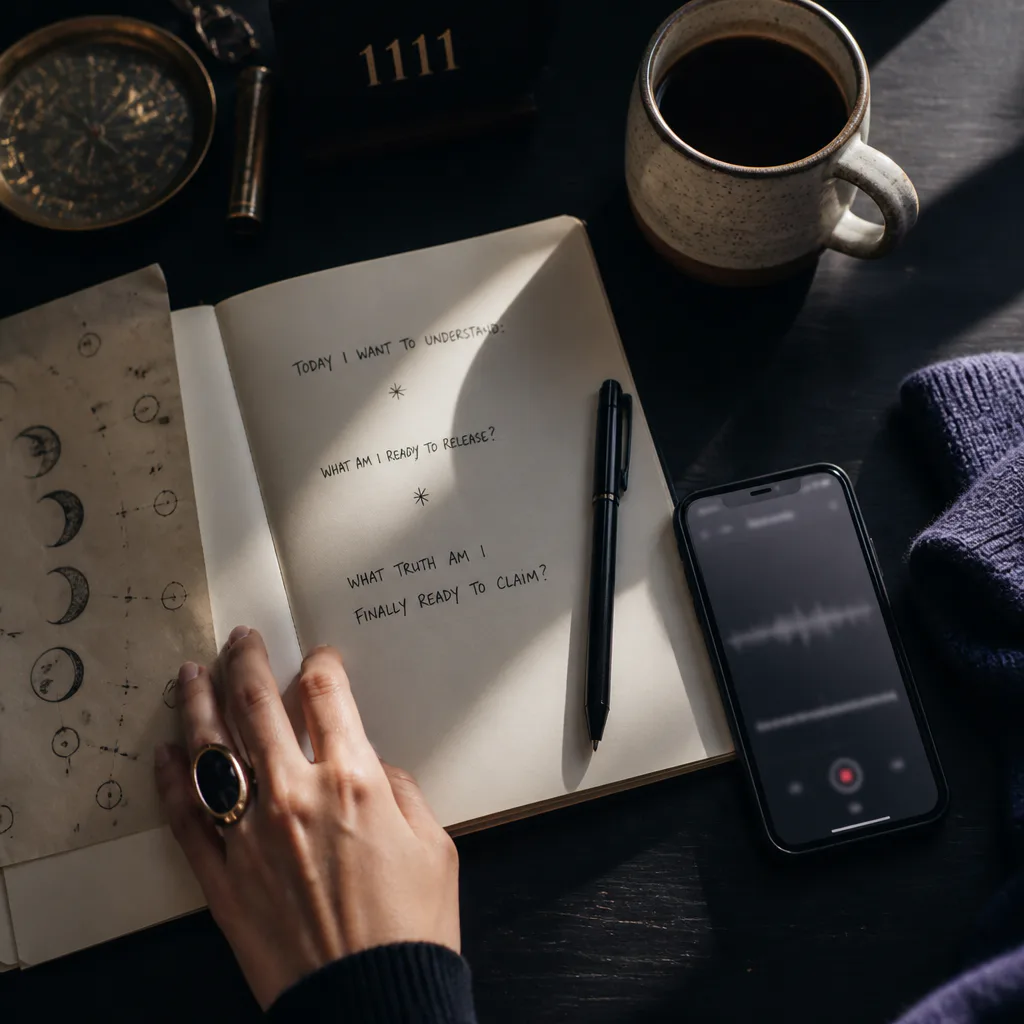
How does intake become Dream-Self Audio?
Intake becomes Dream-Self Audio when the app translates your answers into a narrated moment from the version of you who already lives the change.
This is the part that matters. The app is not simply filling your name into a script. It is shaping a scene. Your future self is not shouting at you from a stage. They are close. They are calm. They speak from after the decision has become ordinary. You hear what changed, how you move now, and what no longer owns the room.
The best audio usually has 4 parts:
- Recognition. It names where you are without making you wrong.
- Future-self voice. It speaks from the life already being lived.
- Specific sensory proof. It includes ordinary details: the inbox, the kitchen table, the walk home.
- Return cue. It gives you one line to carry after listening.
That structure matters because memory likes cues. In 2009, Phillippa Lally and colleagues at University College London found that habit automaticity took 66 days on average, though the range was wide: 18 to 254 days. Repetition is not glamorous. It is how the mind learns what to expect next.
A weak recording says, “You are successful. Everything is yours.” A stronger recording says, “You open the proposal, read it once, and don’t shrink. Your calendar has space because you stopped saying yes from fear.” The second one gives the nervous system somewhere to stand. Specificity is kindness. It keeps the practice close enough to enter.
If you already know the AYA Method, you know the Dream-Self Moment is not a bonus feature. It is the center. The app may also hold a daily affirmation or a Manifestation Board, but those are complements. The audio is where the repetition lives. The audio is the room you return to.
How should you listen once the audio is ready?
You should listen once a day at a time you can repeat without making your life smaller.
Morning works for some people. Night works for others. The correct time is the one that survives real life. If you have a child, an early meeting, or a nervous dog that barks at delivery trucks, do not build a practice that requires a perfect dawn. A fragile ritual becomes another way to fail.
Use this small sequence:
- Put the phone where you can hear it without holding it.
- Take one normal breath, not a ceremonial one.
- Press play.
- Let one sentence find you.
- After it ends, do the next honest thing.
The practice is not to feel something big. The practice is to return. Dr. Andrew Huberman has often described the nervous system as learning through repeated cues, timing, and state. You do not need to force a state. You give it a cue, often enough that the cue becomes familiar.
A 2022 meta-analysis in Health Psychology Review found that habit formation interventions tend to work better when tied to stable contexts. That can be as plain as “after brushing teeth” or “before opening email.” Context does some of the remembering for you. The fewer decisions required, the more likely you are to keep going.
Here is a quiet test: if the practice makes you dramatic, shorten it. Three minutes heard daily will do more than twenty minutes avoided for a week. The self you are becoming does not need theatrics. It needs contact.
What role do affirmations and the Manifestation Board play?
Affirmations and the Manifestation Board can support the audio, but they should not replace the daily listen.
A short affirmation is useful when you need a line you can carry into a meeting, a hard text, or the five seconds before you say no. If you want a fuller foundation on that, the affirmations guide is a good place to begin. Still, an affirmation is usually one sentence. Dream-Self Audio gives the sentence a room, a body, and a future memory.
The Manifestation Board is visual. It helps you see the life you keep hearing. That can matter. Research on mental imagery, including applied work in sport psychology, has shown for decades that rehearsal can support performance when paired with action and feedback. The board is not proof. It is a reminder. A picture can hold your attention, but listening tells you how to inhabit it.
Some readers also track timing, seasons, and personal cycles. If that is you, astrology and manifestation can be used as a reflective calendar, not a command system. The point is not to hand your choices away. The point is to notice when a question keeps returning.
Think of the tools this way:
| Tool | Best use | Place in the practice |
|---|---|---|
| Dream-Self Audio | Daily identity rehearsal | Core method |
| Daily affirmation | A sentence to carry | Complement |
| Manifestation Board | Visual remembering | Complement |
| Journal note | Tracking what changed | Optional support |
If the app asks you to do everything every day, it is probably asking too much. A practice should have a center. In Aya, the center is listening. Everything else stays near it, like a cup on the bedside table.

How do you know the personalized audio is working?
You know the audio is working when your next small action starts to match the self you keep hearing.
Do not measure the practice only by mood. Mood moves with sleep, food, weather, hormones, money, and the last message you read. Measure it by behavior. Did you send the email with less apology? Did you pause before the old yes? Did you recover faster after the familiar doubt? Those are not fireworks. They are evidence.
The Journal of Behavioral Medicine has published repeated findings linking self-regulation practices with better adherence when the goal is specific and monitored. The useful word is monitored. Not judged. Watched. You are looking for small proof that your inner rehearsal is touching your outer day.
Try a 14-day review. Keep it plain:
- Day listened: yes or no.
- One sentence that stayed.
- One action that matched it.
- One place the old story returned.
- One edit needed in the next intake.
After 14 days, look for patterns. If the same line keeps landing, keep it. If one part feels false, revise the intake. If nothing moves, get more specific. “I am worthy” may be true, but your system may need, “I state my rate and stop filling the silence.” The right sentence often has a calendar, a doorway, or another person in it.
This is also where manifestation practice becomes practical. You are not waiting for a sign. You are watching for changed contact with life. Less bargaining. More truth. A softer no. A cleaner yes. One real action is worth more than a beautiful script you don’t believe.
When should you change your intake and make new audio?
You should change your intake when the recording stops feeling true, specific, or slightly ahead of you.
Personalized does not mean permanent. Your first intake may name the doorway. Your third may name the room. As life answers back, the audio should change with you. The point is not to keep worshipping the original sentence. The point is to keep listening for what is now honest.
A useful rhythm is every 30 days, or sooner if there is a clear shift. Thirty days is long enough to notice repeated cues, but short enough to prevent the recording from going stale. In workplace learning research, spaced repetition tends to beat single exposure because recall strengthens through return. Your audio follows the same human rule: come back, then refine.
Change the intake when:
- the desire has become more precise;
- the old fear has a new shape;
- the audio feels too easy and no longer asks for courage;
- the audio feels too far away and your body rejects it;
- your real life has already moved.
There is no shame in revision. I believe in second drafts because I have lived several of them. Finance to coast. Boardroom to surf lesson. Skeptic to listener. Not because every sentence came true, but because the right sentence made the next action harder to avoid.
A personalized manifestation app is only as honest as the intake and only as useful as the daily return. Keep the audio close. Keep the promise small. Let the future self speak in a voice you can believe from here.
Press play. Then let the room stay quiet.