manifestation 101
Two Cup Method Manifestation With Dream-Self Audio
Two cup method manifestation can become calmer and more repeatable when you pair the water ritual with a 3-minute Dream-Self audio.
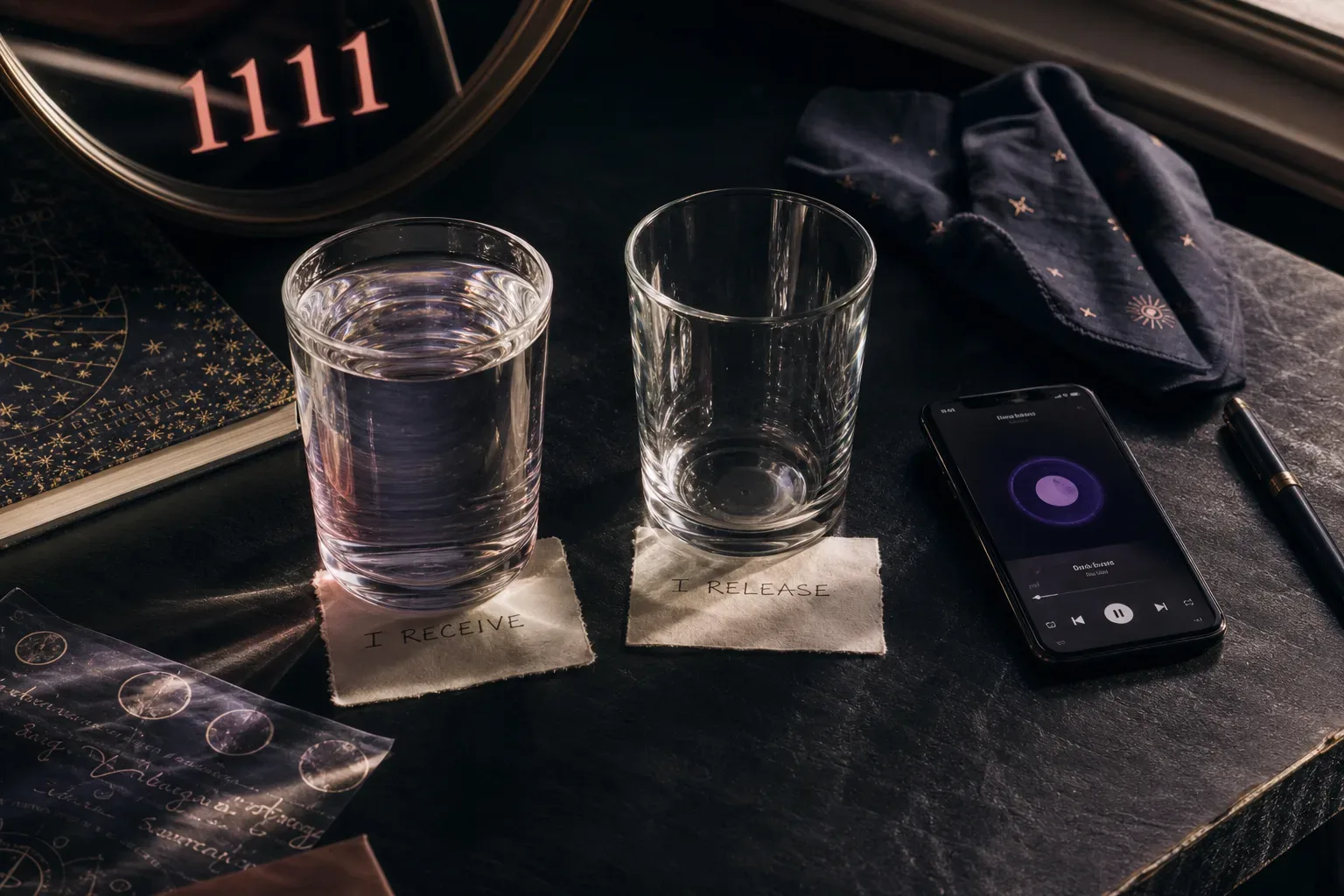
Two cups sit on the table, one for the life you’re done rehearsing, one for the self you intend to become. Two cup method manifestation works best when the symbolic act is followed by one short Dream-Self audio, because the body needs a cue it can repeat tomorrow.
What is the two cup method, really?
The two cup method is a symbolic reset: you name a current state, name an intended state, then move water from one cup to the other.
It is simple enough to look a little silly. That may be why it works for some people. A ritual does not need drama. It needs a clear beginning, a clear action, and a clear ending. Anthropologists have studied ritual for more than 100 years, and one repeated finding is that ritual can reduce uncertainty by giving the nervous system a sequence to follow. In a 2016 study in Organizational Behavior and Human Decision Processes, pre-performance rituals helped reduce anxiety and improve performance in stressful tasks.
For this practice, one cup holds the sentence you are tired of living inside. Maybe it says: waiting for permission. Maybe it says: always behind. The other cup holds the sentence you want your day to obey. Maybe it says: I act before I feel ready. Maybe it says: I’m safe to be seen. The water is not magic on its own. The act is a line in the room.
A ritual is a decision the body can understand.
This is why two cup method manifestation sits close to older manifestation teachings, but it should not replace action. Neville Goddard wrote about the felt sense of the wish fulfilled in 1944. Joe Dispenza has also spoken often about rehearsing a future self. You don’t have to accept every claim around these teachers to use the practical part: the mind remembers what you rehearse.
Why pair the cups with a 3-minute Dream-Self audio?
You pair them because the cup ritual makes the choice once, and the audio helps you remember the choice daily.
A single ritual can feel clean. Then breakfast burns, your child cannot find a shoe, and the old self is back by 8:12. That is not failure. It is just repetition doing what repetition does. In 2009, Phillippa Lally and colleagues at University College London found that habit formation took 66 days on average, with a wide range from 18 to 254 days. One beautiful cup ritual is not usually enough to outvote years of rehearsal.
This is where the AYA Method comes in quietly. The AYA Method is a daily audio manifestation practice. Each day you listen to a short personalized recording — your Dream-Self Moment — narrated from the version of you who has already manifested the life you intend. Listening is the practice. Repetition is the work. The audio is the method.
Three minutes matters because it is small enough to survive a real day. Dr. Andrew Huberman often points to the value of repeated nervous-system cues, especially when paired with breath, attention, and rest. You do not need a 45-minute ceremony to begin. You need one clean sound your body can recognize.
A daily affirmation can help too, and the app includes one as a complement. If you want the wider frame, the Affirmations pillar explains why words work best when they are repeated with feeling and specificity. But here, the audio leads. The cup points. The voice carries.
How do you do two cup method manifestation in five minutes?
You do it by keeping the ritual short, specific, and followed by listening before you touch your phone again.
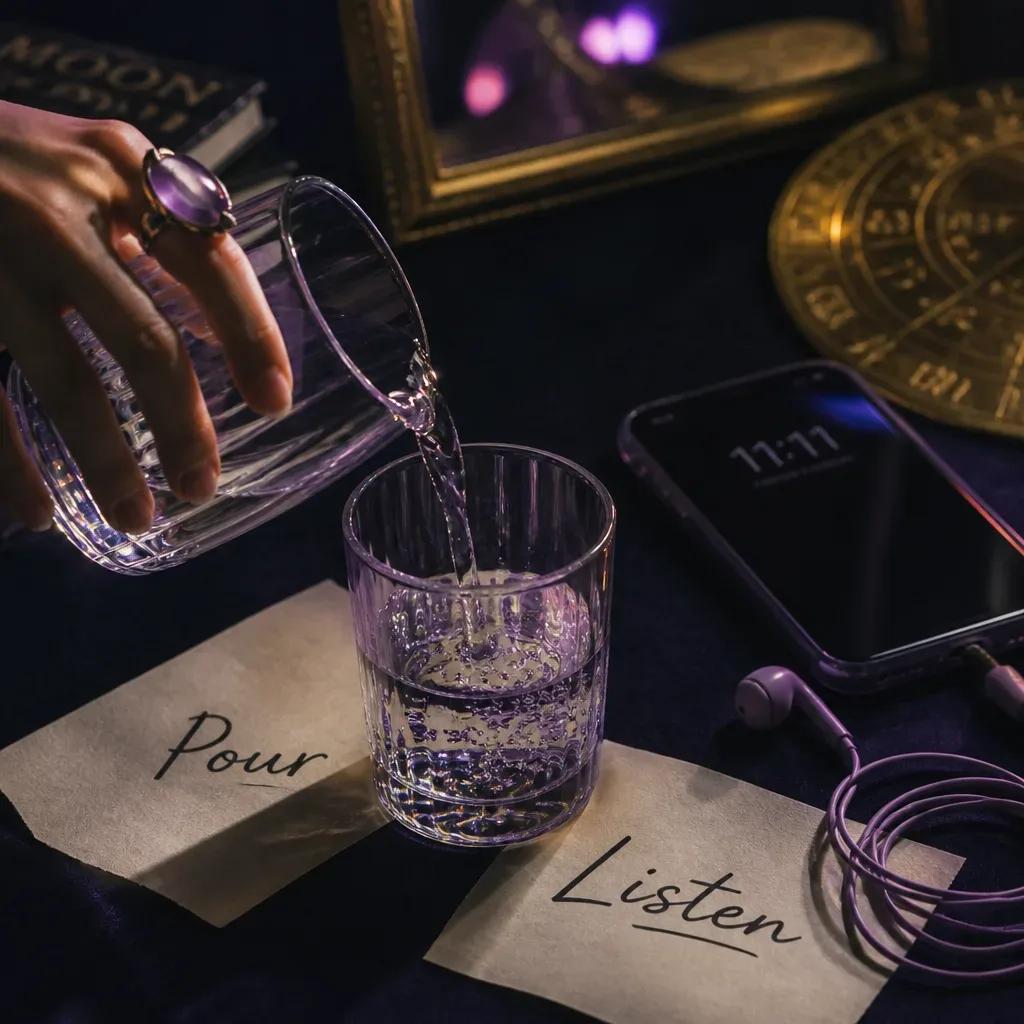
Set up two cups and one small piece of paper for each. You can write directly on the cups if they are washable. Use water, not because water is special proof, but because drinking gives the body a sensory ending. Sensory cues are sticky. In memory research, context and physical cues can help recall, a pattern studied since Godden and Baddeley’s 1975 work on context-dependent memory.
Here is the five-minute version:
- Write the current state. Use plain words: avoiding money, afraid to speak, waiting to be chosen.
- Write the intended state. Use present-tense words: I answer clearly, I send the invoice, I choose myself today.
- Fill the first cup. Let it stand for the pattern you are done practicing.
- Pour into the second cup. Move slowly. Don’t perform. Notice.
- Drink the water. Let the act close.
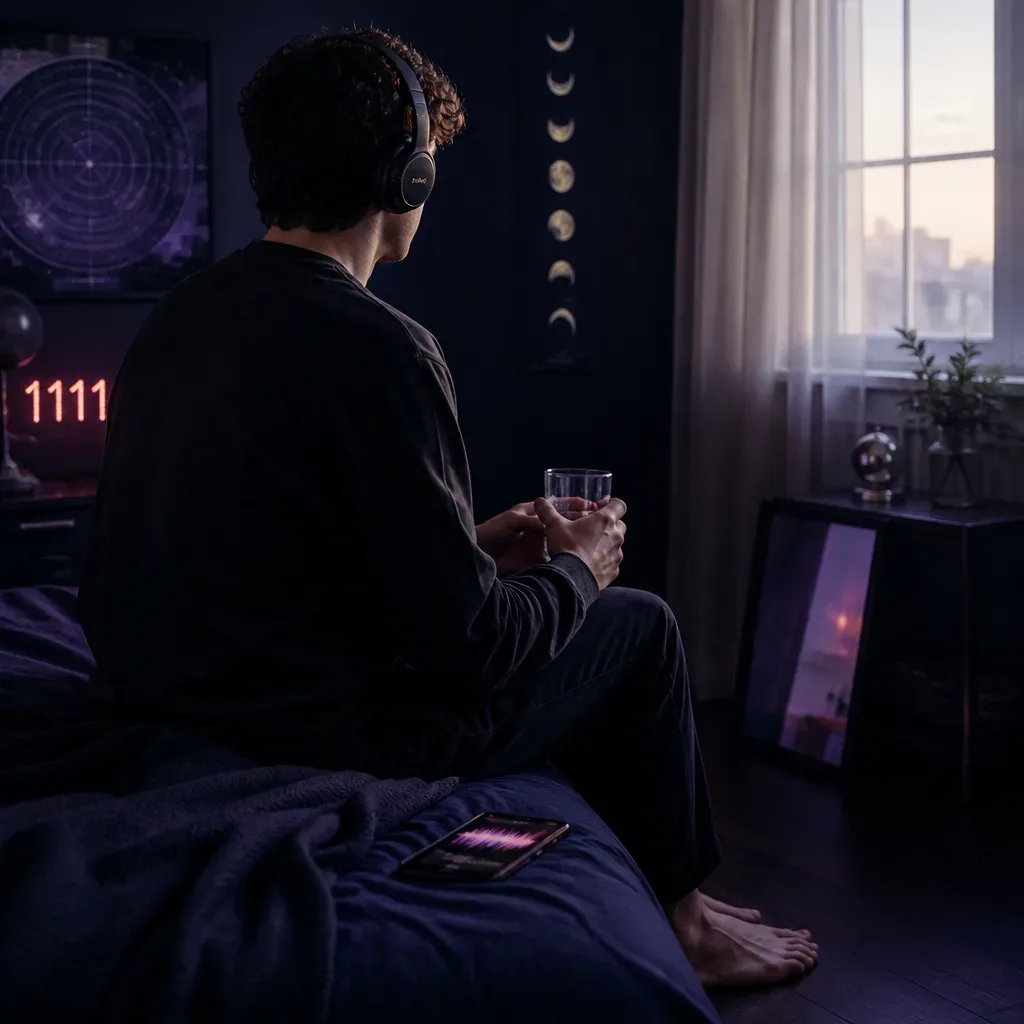
- Listen to your 3-minute Dream-Self audio. Sit still if you can. If not, stand at the sink. That counts.
Specificity is kinder than grandeur. Gabriele Oettingen’s research on mental contrasting, later shaped into the WOOP method, shows that naming both the wish and the obstacle can support goal-directed action better than fantasy alone. So don’t write rich and happy if your real next state is I send three proposals this week. The smaller sentence may be truer.
| Part of the ritual | What it does | Keep it simple by asking |
|---|---|---|
| Current cup | Names the loop | What am I done repeating? |
| Intended cup | Names the self | What would I practice today? |
| Pouring | Marks the shift | Can I feel this choice in my hands? |
| Drinking | Closes the act | Can this be enough for now? |
| Dream-Self audio | Repeats the identity | What does my future self sound like? |
The cup is the doorway. The listening is the room you keep returning to.
What should you write on the two cups?
Write the truth you can bear on the first cup and the next believable identity on the second.
There is a temptation to make the second cup too grand. I know that temptation. I have written sentences that sounded like a man with a villa and a six-pack, while my actual life included wet laundry and a toddler holding a banana like a weapon. The body knows when you are pretending. It also knows when you are telling the next true thing.
A useful second-cup sentence has 3 qualities:
- It is present tense. I speak with steadiness.
- It is behavior-linked. I send the message before noon.
- It is emotionally believable. I can be nervous and still act.
Self-affirmation research is relevant here, though not identical. A 2013 review by Geoffrey Cohen and David Sherman in Annual Review of Psychology found that self-affirmation can reduce defensiveness and support adaptive behavior under threat. The key was not empty praise. It was contact with valued identity. Your cup label should do the same. Not flatter you. Remind you.
If your intention has a spiritual timing piece, keep it grounded. Some people like to choose a moon phase or birthday week. That can be comforting. The Astrology and manifestation guide can help you use timing as a reflective cue, not as a reason to wait forever. The cup does not need the stars to approve it.
Here are better labels:
- Current: checking for proof every hour. Intended: I act from quiet trust today.
- Current: hiding my work. Intended: I share one finished thing.
- Current: bracing for rejection. Intended: I let the answer arrive.
- Current: making money feel dangerous. Intended: I receive and respond clearly.
One honest sentence can do more than ten pretty ones.
How does the Dream-Self audio change the practice?
The Dream-Self audio changes the practice by turning a one-time symbol into a repeated inner rehearsal.
Most people do not fail because they cannot set an intention. They fail because the old self has a better schedule. It wakes up with them. It speaks first. It has a chair at the table. A 3-minute recording gives the new self a recurring appointment. This is why audio matters. You can close your eyes and be addressed by the version of you who has already crossed the line you are standing at.
There is no need to overclaim the science. Princeton’s Engineering Anomalies Research program ran from 1979 to 2007 and reported small mind-matter effects, while many scientists disputed the interpretation. That debate is not the foundation here. The steadier foundation is attention, language, emotion, and repetition. Cognitive psychology has shown for decades that repeated mental rehearsal can shape performance, especially when paired with concrete behavior.
In the wider Manifestation pillar, manifestation is treated as practice, not wishful waiting. Audio fits because it is hard to argue with a voice for too long. You listen. You hear a future self speak in completed language. Then your day asks for one matching act.
Try this after the cup ritual:
- Sit or stand with both feet on the floor.
- Press play on the 3-minute Dream-Self audio.
- Let the voice speak before you analyze it.
- When it ends, name one action you can take in 24 hours.
- Do that action before you repeat the ritual.
The app may also show a daily affirmation or a Manifestation Board. Use them as gentle complements if they help. But do not confuse the extras for the method. The audio is the method.
What mistakes make the two cup method feel anxious?
The practice feels anxious when you use it to check, force, or bargain instead of choosing and repeating.
The first mistake is doing the full cup ritual every time you feel doubt. That trains doubt to become the doorway. If you repeat the cups five times in one week because you are scared it did not work, the ritual becomes a checking behavior. In anxiety research, reassurance-seeking can briefly lower distress while keeping the loop alive. The International OCD Foundation describes this pattern often in compulsive checking, though your manifestation practice may be much lighter than clinical OCD.
The second mistake is making the intended state too far from the life you can touch. If your current cup says unemployed and terrified, and your intended cup says globally famous by Friday, your body may reject the sentence before the water moves. This is not because you are small. It is because the nervous system likes believable steps. BJ Fogg’s behavior model, published in 2009, argues that behavior happens when motivation, ability, and prompt meet. If ability feels like zero, motivation has to scream.
The third mistake is skipping action. Manifestation without action becomes theater. Quiet theater, maybe. Still theater. The 24-hour action after listening can be small:
- send the email
- open the savings account
- rehearse the conversation for 5 minutes
- apply for the role
- tidy the desk where the work happens
If you want more structure, return to the AYA Method guide and treat listening as the daily anchor. You do not need to keep proving your desire. You need to practice being the person who can receive, choose, and respond.
How do you keep the ritual real after today?
You keep it real by doing the cups once, listening daily, and letting one small action confirm the new identity.
Choose a period before you begin. Seven days is enough to feel the pattern. Thirty days is enough to notice resistance. The 66-day habit average from Lally’s 2009 study is useful, but it should not become another stick to hit yourself with. Start with one week. A week has 7 mornings, 7 evenings, and many chances to return without making a speech about it.
You can track the practice in a small note. Not a perfect journal. Just 3 lines:
- What did I hear in the audio today?
- What did the old self try to repeat?
- What is my one matching action?
This makes the practice measurable without making it cold. In implementation-intention research, Peter Gollwitzer found that if-then plans can improve follow-through across many goal types. So write one: If I finish listening, then I send the message. If I doubt the intention, then I take one ordinary step. If I miss a day, then I return the next day without drama.
The two cups give your hands something to do. The Dream-Self audio gives your attention somewhere to live. The action gives the world a place to meet you.
You can revisit the cup ritual when the intention changes, or when the old label is no longer true. That may be in a month. It may be after one honest conversation. Do not rush to make it sacred. A practice becomes sacred by being kept.
The water is gone. The voice is still here.