manifestation 101
Visualization Technique: 3-Minute Future-Self Audio
A quiet visualization technique using a 3-minute future-self audio to make mental rehearsal easier, repeatable, and real enough to return to daily.
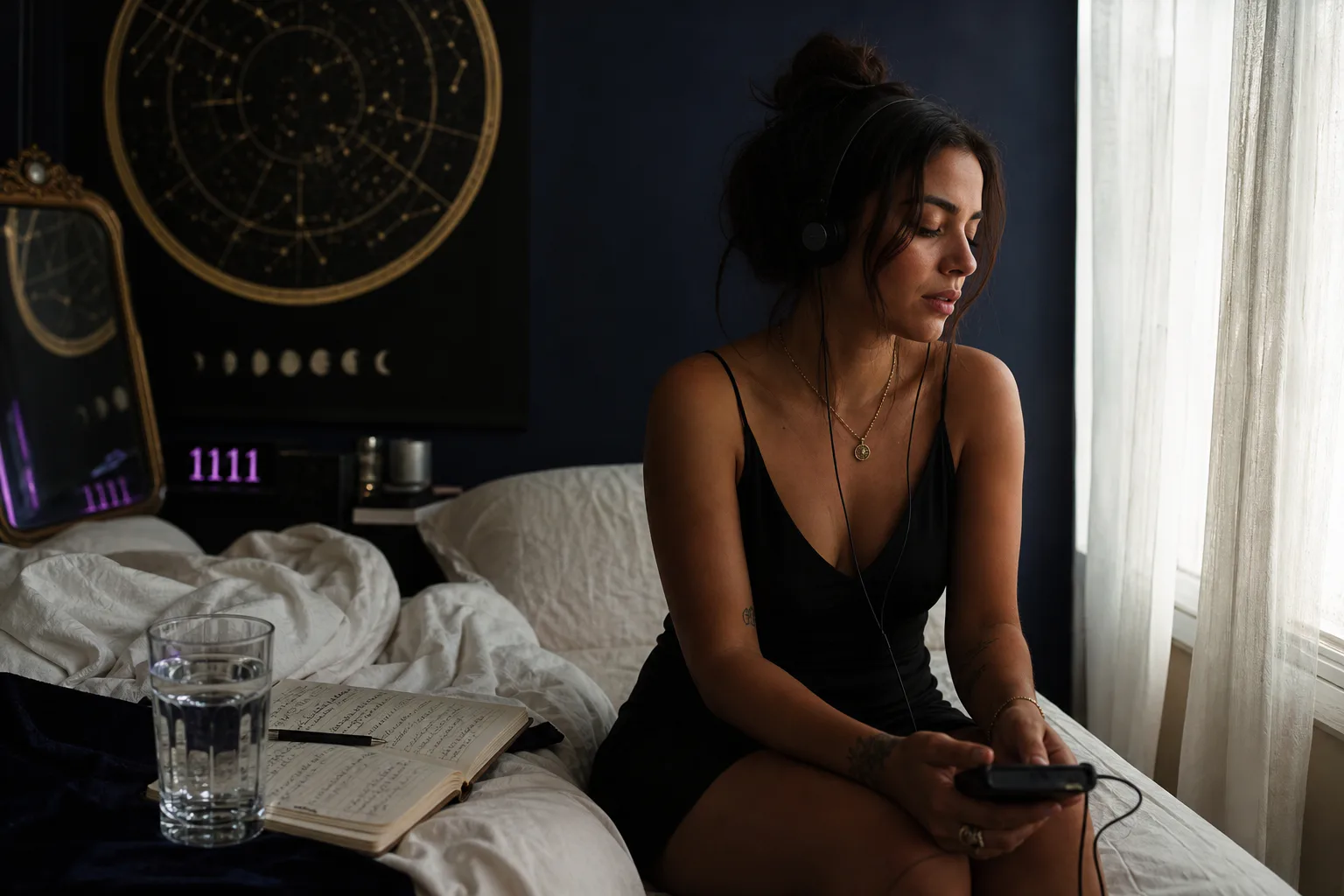
A visualization technique works better when it gives your mind something simple to return to. A 3-minute future-self audio does that. You listen to one clear scene, narrated from the you who already lives it, then take one small action that agrees with what you heard.
Why add audio to a visualization technique?
Audio helps because it removes the strain of trying to hold a picture in your mind by force.
Some people can close their eyes and see a room, a face, a number on a paycheck, the exact coat hanging by the door. Some can’t. In a 2015 paper, cognitive scientist Adam Zeman and colleagues described aphantasia, a variation where people have little or no voluntary visual imagery. Estimates vary, but later surveys often place it around 2 to 4 percent of people. That matters. A visualization technique should not punish you for having a different kind of mind.
A future-self audio gives the practice a voice, a pace, and a beginning. Instead of asking, “What do I see?” you can ask, “What do I know is true here?” That single shift softens the work. The picture can come later, or not at all. Sound is enough.
The AYA Method is a daily audio manifestation practice. Each day you listen to a short personalized recording — your Dream-Self Moment — narrated from the version of you who has already manifested the life you intend. Listening is the practice. Repetition is the work. The audio is the method. You can read the full practice here: the AYA Method.
This is also why audio fits so well inside manifestation basics. It moves manifestation away from vague hoping and toward repeated attention. Dr. Andrew Huberman has often described mental rehearsal as a way the brain can prepare for action, especially when the imagined act is specific. The key word is specific. Not a whole new life in one recording. One scene. Three minutes. One return.
A good visualization technique does not ask you to believe harder. It asks you to return more clearly.
What should your 3-minute future-self audio include?
Your audio should include one future scene, present-tense narration, sensory detail, emotional steadiness, and one next action.
Three minutes sounds small until you write it. At a calm speaking pace of about 130 words per minute, 3 minutes gives you roughly 390 words. That is not much room for drama. Good. The limit keeps the practice honest. If the scene can’t be held in 390 words, it is probably too wide for daily use.
Start with a moment, not a lifetime. You are not recording the entire arc of your career, relationship, health, home, and inner peace. Choose one moment where the change has become ordinary. You are standing at the kitchen counter after paying off the card. You are opening your calendar and seeing white space. You are leaving work on time and your body believes you.
A simple structure helps:
- Name the place. One room, street, desk, car, or doorway.
- Name the evidence. One visible proof that the change is real.
- Name the body cue. Breath, shoulders, hands, jaw, posture.
- Name the inner sentence. What you know now.
- Name the next action. The small thing you do after listening.
In the Journal of Behavioral Medicine, studies on guided imagery have linked repeated imagery practices with changes in stress and coping, though results differ by method and population. That is a useful reminder. Your audio does not need to be mystical to matter. It can be a nervous system rehearsal. It can be a decision rehearsal. It can be a way to hear your own life spoken without panic.
Keep the words plain. If you would never say, “I am a radiant magnet for everything I desire,” don’t put it in the recording. Your mind knows when you’re performing. A true sentence lands quietly.
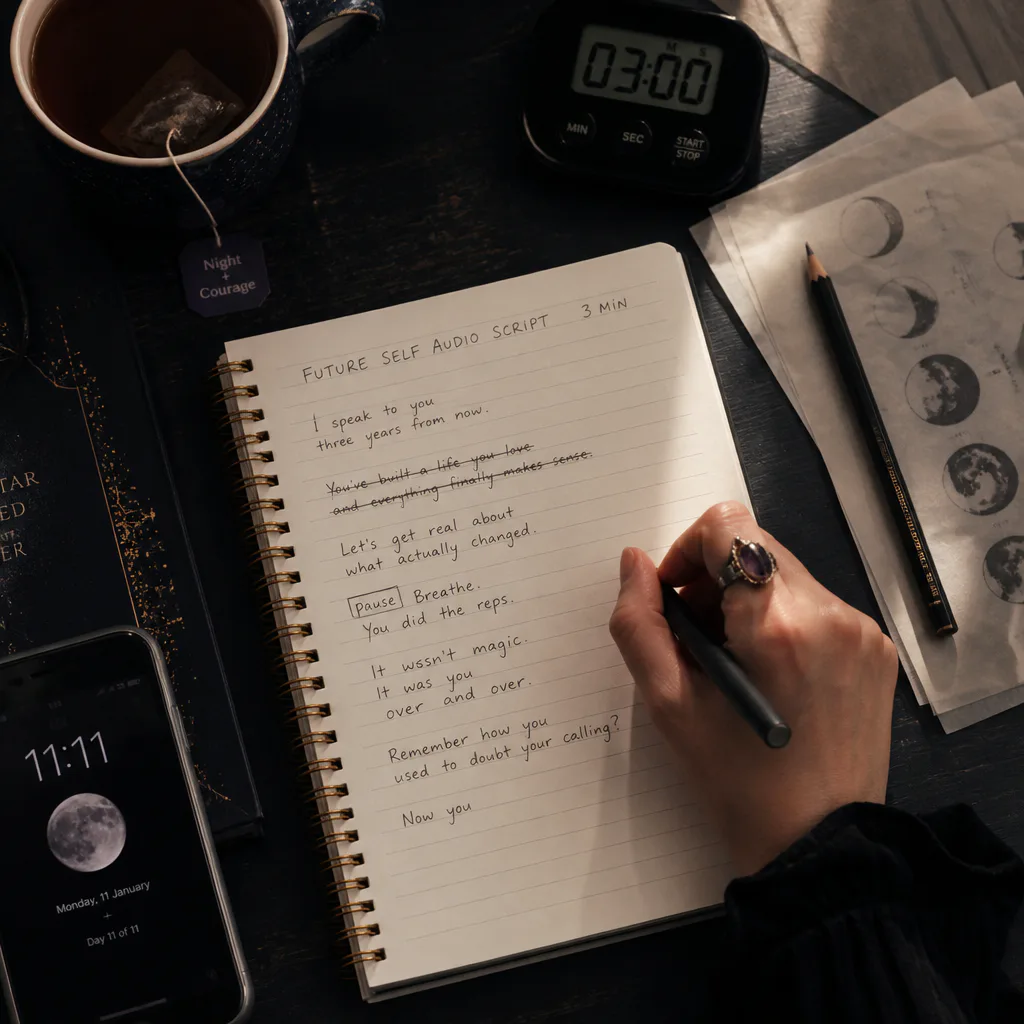
How do you write the script without making it fake?
Write the script as if you are describing a normal day after the change has settled.
This is the place where many visualization practices go too shiny. You add the perfect house, the perfect body, the perfect inbox, the perfect mood. Then your real life gets up at 6:40, steps on a toy, and needs coffee. The gap becomes too loud. A useful visualization technique respects the life you actually have.
Try this table before you write:
| Instead of writing | Write this |
|---|---|
| ”Everything is perfect now." | "The morning is still busy, but I am not bracing." |
| "I never doubt myself." | "Doubt comes, and I answer it faster." |
| "Money flows easily." | "I check the account without holding my breath." |
| "I am fully healed." | "I keep the appointment and listen to my body.” |
Specific beats glossy. Neville Goddard taught imaginal acts as scenes that imply the wish fulfilled, often using a short inner event rather than a long fantasy. You do not have to borrow his whole worldview to use the precision. One scene can imply the change. One hand on one door can tell the mind enough.
You can also borrow from implementation-intention research. Psychologist Peter Gollwitzer’s work has shown that “if-then” plans can improve follow-through across many behavior studies. After the audio, add one line: “When I open my eyes, I send the message.” Or, “When the audio ends, I put my shoes by the door.” This keeps the practice from floating away.
Use these writing rules:
- Use “I am” and “I know” more than “I want.”
- Include one ordinary imperfection, so the scene feels livable.
- Keep the outcome ethical, yours, and not dependent on controlling another person.
- End with a small act you can do in under 10 minutes.
The future self becomes believable when she still has dishes in the sink.
When should you listen so it becomes daily?
Listen after an existing cue, because a practice attached to something you already do has less friction.
BJ Fogg’s behavior model at Stanford is often summarized as behavior happening when motivation, ability, and a prompt meet. A 3-minute audio scores well on ability. It is short. It is contained. What it needs is a prompt that already exists. Brushing teeth. Starting the kettle. Parking the car. Closing the laptop. One cue is kinder than a new routine with 11 steps.
The famous 21-day habit idea is too neat. In a 2009 European Journal of Social Psychology study by Phillippa Lally and colleagues, automaticity took 18 to 254 days, with a median of 66 days. That range should make you breathe easier. Missing one day did not ruin the habit in that study. Repetition mattered more than perfection.
Here is a quiet 6-minute setup for the first week:
- Minute 1: Put headphones where the cue happens.
- Minute 2: Open the audio before you need it.
- Minutes 3 to 5: Listen without multitasking.
- Minute 6: Do the one next action.
If mornings are crowded, don’t force morning. June Calloway, mother of one, would like to state this clearly: not every practice belongs before sunrise. Some days, the cleanest cue is the school pickup line. Some days, it is the 3 minutes before you walk into work. Some days, it is sitting on the floor outside the bathroom because that is the only door that closes.
The AYA app also includes a daily affirmation and a Manifestation Board, but they are complements. If you are using affirmations, let one short sentence echo the audio. If you use images, let them point back to the scene. The listening stays central.
What happens in the mind when you repeat it?
Repetition makes the future-self scene easier to access when real choices arrive.
Mental rehearsal is not the same as doing the thing. It is not a replacement for sending the proposal, having the conversation, saving the money, or making the appointment. Still, repeated rehearsal can shape readiness. Sports psychology has used imagery for decades, often pairing it with physical practice. A 1994 meta-analysis by Driskell, Copper, and Moran found mental practice had a positive effect on performance, with stronger effects for tasks involving cognitive elements.
Your life is full of cognitive elements. You decide whether to answer the email with fear or clarity. You decide whether to spend the 20 minutes scrolling or preparing. You decide whether to speak up in the meeting, leave on time, or ask for the number you have been avoiding. A repeated audio gives those moments a reference point.
You are not rehearsing a fantasy. You are rehearsing recognition.
There is also a memory effect. The more often you pair a cue with the same internal scene, the more available the scene becomes. Not guaranteed. Not magic. Available. Princeton’s Global Consciousness Project is sometimes brought into manifestation conversations, but its claims are debated and should be held with care. You do not need disputed evidence to justify a grounded practice. Behavioral science already gives you enough: attention, cueing, repetition, and small action change behavior.
If your mind wanders while listening, that is not failure. In many meditation studies, attention returning is part of the training, not a sign that the session failed. Notice the drift. Return to the voice. Let the scene receive you again.
For readers who connect manifestation with timing, seasons, or sky patterns, astrology and manifestation can become a reflective layer. Keep it secondary. A moon phase can be a cue. The listening is still the practice.

How do you know if the visualization technique is working?
You know it is working when your choices begin to resemble the person in the audio.
Look for small evidence. Not fireworks. Evidence. You pause before saying yes. You apply for the role after 4 months of waiting. You open the debt spreadsheet without leaving your body. You stop asking everyone else to confirm what you already know. These are quiet markers, and they count.
Track 7 days first. A week is long enough to see friction and short enough not to become another self-improvement project. Use three measures, each scored from 1 to 5:
- Return: Did I listen today?
- Belief: Did any sentence feel true enough to hold?
- Action: Did I take one small matching step?
After 7 days, revise the script if the belief score stays at 1 or 2. That does not mean your desire is wrong. It may mean the scene is too large, too polished, or written in someone else’s language. In small studies of self-affirmation, benefits often depend on whether the statement connects to values that feel personally real. Your future-self audio follows the same rule. It has to sound like yours.
Be careful with using mood as the only measure. Mood changes with sleep, hormones, money pressure, parenting, food, and weather. Pew Research has reported high levels of stress among parents in recent years, and anyone raising a child could have told them for free. A practice that only “works” when you feel calm is too fragile. A better test is whether you return even when the day is plain.
The proof is not that you feel certain. The proof is that you come back.
You can read more about the wider practice of manifestation, but keep your test simple: Did the audio help you act like the future is real enough to practice today?
What is a simple script you can record today?
Use a short present-tense script that names one future-self moment and ends with one action.
Before recording, set a timer for 3 minutes. Speak more slowly than you think you should. Most people rush when recording themselves. A calm narration at 120 to 140 words per minute will feel more spacious than a packed script. Leave 2 or 3 seconds of silence between the scene and the final action cue.
Here is a template you can adapt:
I am here now.
It is [time of day], and I am in [specific place].
I notice [one visible proof that the change has happened].
My body knows before my thoughts catch up.
My shoulders are [soft / lower / steady].
My breath is [slower / easier / deeper].
I remember the days when this felt far away.
Now it is ordinary.
I still have real things to do, but I am not moving from fear.
I choose the next right action.
When this audio ends, I will [one action under 10 minutes].
This is how I return.
If you are using the AYA Method guide, the app shapes the Dream-Self Moment for you so you are not writing from scratch. That can help when your mind is tired. The daily affirmation can support the sentence you most need to remember. The Manifestation Board can hold a visual echo of the scene. Still, the audio leads.
Record one version. Do not spend 45 minutes editing breath sounds. A clean enough recording used for 7 days will teach you more than a perfect recording never used. If your voice feels strange, let it. Many people dislike hearing themselves at first. That usually softens after a few listens.
A final note for this visualization technique: choose consent, reality, and care. Do not script someone else’s feelings as if they belong to you. Script your steadiness. Your choice. Your next brave sentence. That is plenty.
Return to the voice that sounds like home.