audio manifestation
Voice Manifestation: Hear Your Dream Self Daily
Voice manifestation is a daily audio practice for hearing your Dream Self clearly, using repetition, timing, and a quiet five-minute ritual.

Your phone sits by the sink. Voice manifestation is a daily listening practice where you hear a spoken version of the life you intend, then let that voice guide one ordinary choice. Five quiet minutes can be enough when the audio is personal, repeated, and tied to a cue you already keep.
What is voice manifestation, really?
Voice manifestation is manifestation practiced through spoken audio, so your attention can hear the self you are choosing before your day begins to contradict it.
Writing has its place. So does stillness. But sound enters differently. A sentence on paper waits for your eyes. A voice comes toward you. It has pace, warmth, breath, and timing. In cognitive psychology, auditory information is often processed with strong links to memory; a 2010 review in Nature Reviews Neuroscience notes that repeated sensory cues can strengthen recall pathways over time.
The AYA Method is a daily audio manifestation practice. Each day you listen to a short personalized recording — your Dream-Self Moment — narrated from the version of you who has already manifested the life you intend. Listening is the practice. Repetition is the work. The audio is the method.
That last sentence matters. The audio is not decoration. It is not a soundtrack for another technique. In the AYA Method, the voice is the place where you return. The daily affirmation and Manifestation Board can support you, but they sit beside the practice. They do not replace it.
Voice manifestation works best when it stays small enough to keep. A 2009 study by Phillippa Lally and colleagues in the European Journal of Social Psychology found that new habits took a median of 66 days to become more automatic, with wide variation from 18 to 254 days. That is why the recording should be short. You are not trying to win one heroic morning. You are teaching tomorrow where to find you.
A voice can become a room you know how to enter.
Why does hearing your Dream Self help the practice feel real?
Hearing your Dream Self helps because the brain responds to imagined scenes, repeated language, and emotional salience as cues for future action.
Mental rehearsal is not magic theater. Athletes, musicians, and clinicians have studied it for decades. A 1995 paper by Pascual-Leone and colleagues found that mental practice of a piano exercise produced measurable changes in motor cortex maps, though physical practice remained stronger. The point is not that thinking equals doing. The point is that rehearsal prepares the system that later chooses.
Voice adds an important layer. When you hear words spoken to you, you do not only process information. You receive tone. Tone tells the body whether to soften or brace. Dr. Andrew Huberman has often discussed the role of state, breath, light, and repetition in learning; the nervous system does not learn in abstraction. It learns while you are standing in a kitchen, waiting for water to boil, hearing the same sentence again.
Your Dream Self should not sound like a stranger giving orders. It should sound like you, already home in the life you intend. This is why manifestation becomes more grounded when it names ordinary behavior. Not only, I am successful. More like, I answer the email before noon. I eat before I become sharp. I tell the truth while my voice is still kind.
There is a difference between fantasy and rehearsal. Fantasy asks you to leave the room. Rehearsal teaches you how to stand inside it.
Small studies on guided imagery in health psychology have linked repeated imagery practices with reduced stress and improved coping, though results vary by method and sample size. You do not need to overclaim it. You only need to notice this: when the voice is believable, your next action often becomes less dramatic.
How do you build a five-minute voice manifestation ritual?
You build it by attaching one short recording to one existing cue, then protecting the first action that follows.
Start with time. Five minutes is not symbolic. It is practical. Pew Research Center reported in 2024 that about 90% of U.S. adults own a smartphone, which means the tool is usually already within reach. The risk is not access. The risk is making the ritual too large to repeat on a tired Tuesday.
Use this simple structure:
- Choose the cue. Coffee brewing. Shoes by the door. The first parked minute before work. A cue that already happens is stronger than a cue you must invent.
- Play the Dream-Self Moment. Do not multitask with messages. If your hands need something to do, hold the cup. Let that be enough.
- Name one sentence. After listening, choose the line that felt most true, not the line that sounded most impressive.
- Take one matching action. Send the note. Drink water. Open the document. Put the fruit in your bag.
- Return tomorrow. The practice is not a verdict on your worth. It is a place you come back to.
Here is the quiet table I give myself when I start over:
| If you have | Do this | Why it helps |
|---|---|---|
| 2 minutes | Listen to the first half only | A partial return protects the habit |
| 5 minutes | Listen once, then choose one sentence | Enough time for attention to settle |
| 10 minutes | Listen, breathe, then write one line | Writing can seal what the voice opened |
| No privacy | Use headphones and face a wall or window | Less visual input can reduce self-consciousness |
Implementation intention research from Peter Gollwitzer, widely cited since 1999, shows that if-then plans can raise follow-through by linking a cue to an action. Your cue might be: after I rinse my cup, I listen. That is plain. Plain is good.
A ritual does not become sacred because it is elaborate. It becomes sacred because you keep meeting it honestly.
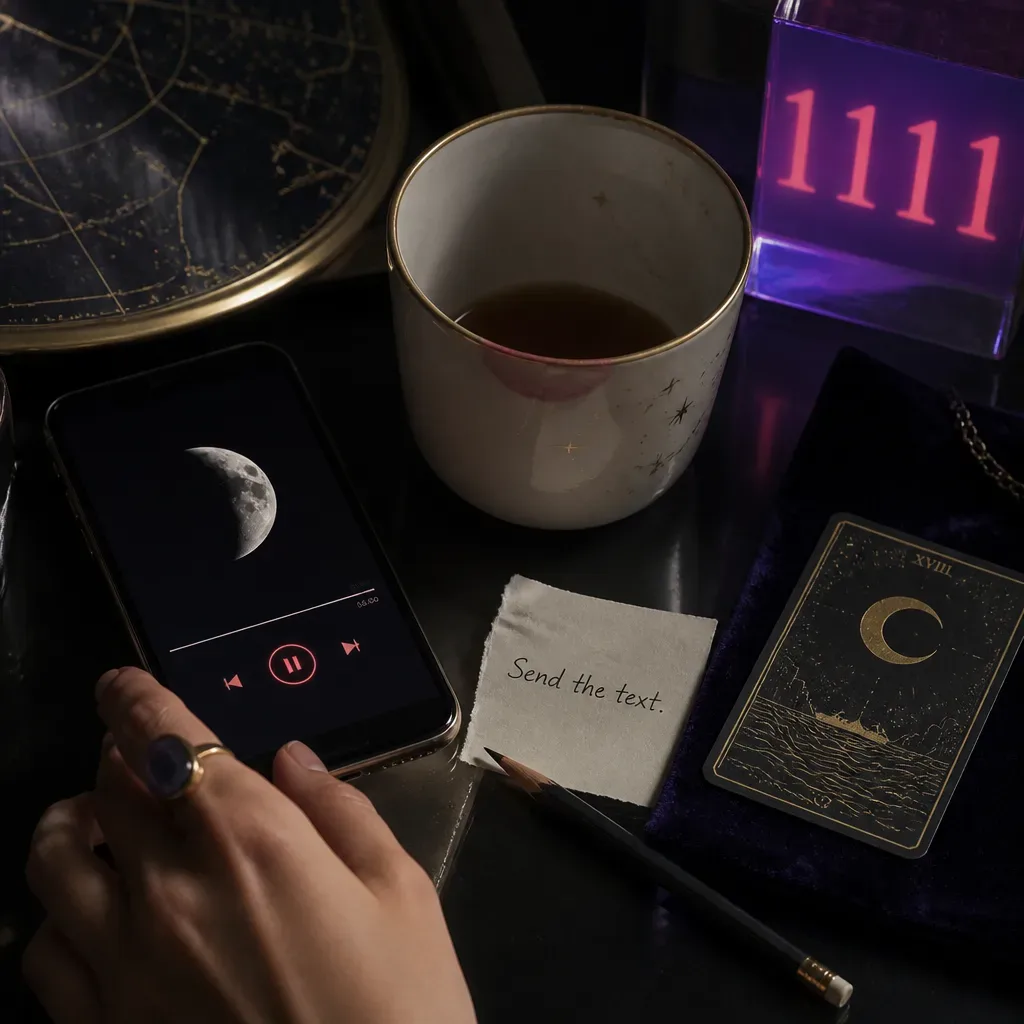
What should your Dream-Self Moment actually say?
Your Dream-Self Moment should speak in concrete present-tense language from the life you intend, with enough detail to feel specific and enough softness to feel believable.
Avoid language that makes your body argue. If the sentence feels too far away, it will become noise. Neville Goddard often taught that assumption matters, but assumption is not the same as strain. In practice, the cleanest line is often the one your nervous system can almost accept today.
Try this shape:
- Where you are: I am standing in my quiet kitchen before the day asks for me.
- Who you are being: I move like someone who trusts her own timing.
- What you do next: I choose the first task and finish it before I check for approval.
- What is already true: I know how to begin without making the beginning loud.
A good manifestation audio does not flatter you. It recognizes you.
If you use affirmations, let them be short companions rather than the center. One affirmation after the audio can help the mind remember the whole scene. For example: I keep one promise today. That is enough. In a 2015 paper in Social Cognitive and Affective Neuroscience, self-affirmation was associated with activity in brain regions linked to valuation and self-processing, though the study looked at specific lab conditions, not every daily practice.
As a food writer, I think of the recording like broth. Too much salt and the whole pot tightens. Too little and nothing carries. Your words should be seasoned for the life you can actually taste. If your Dream Self is calm, let her speak calmly. If she is brave, let bravery sound like a normal voice.
Keep the recording between 3 and 7 minutes if you can. That range is long enough to create a scene and short enough to repeat. The first measure of a good audio is not whether it moves you once. It is whether you can return without resistance.
When should you listen so it becomes a daily habit?
You should listen at the same natural hinge in the day, preferably when your attention is already changing states.
Morning works because the day has not fully gathered its claims. Evening works because the mind is reviewing what mattered. A lunch break works because it interrupts momentum. There is no single blessed hour. There is only the hour you can keep at least 5 days out of 7.
Sleep researchers often describe the minutes before sleep and after waking as state transitions, with attention less defended than during task-heavy hours. That does not mean you must practice half-awake. It means you can respect softness. Listen before email if you can. Listen before the feed. A 2023 DataReportal overview estimated that people spend more than 2 hours daily on social media on average worldwide; taking 5 minutes before that is not a time problem. It is a boundary.
You can also pair voice manifestation with cycles you already honor. Some people mark a new moon, a birthday, or a Sunday night reset. If timing helps you listen, use it. If it becomes another way to delay, simplify. Astrology and manifestation can be a thoughtful companion when it points you back to practice, not away from it.
Here are quiet times that tend to hold:
- After brushing your teeth, before leaving the bathroom.
- While coffee or tea is brewing, before the first message.
- In the car after parking, before opening the door.
- During a walk, using the same first block each day.
- In bed, before the room goes dark.
The best time is the one with the least performance in it.
If you miss a day, do not make a ceremony of guilt. Resume at the next cue. Lally’s habit research found that one missed opportunity did not erase automaticity when the person returned. This is mercy with data under it.

How do you know voice manifestation is working?
You know it is working when your daily choices begin to resemble the voice before your mood catches up.
Do not measure only by sudden outer change. Measure by the first honest shifts: you pause before answering, you choose the task you used to avoid, you stop rehearsing the old insult, you feed yourself before you become impossible to live with. These are not small because they are ordinary. Ordinary is where a life gets built.
A practical tracking method is to note one action after each session. Not a page. One line. In behavior-change research, self-monitoring is repeatedly associated with improved follow-through, especially when the tracked behavior is specific. A 2011 review in Psychological Bulletin on self-regulation found that monitoring progress can support goal pursuit, though it works best with clear feedback.
Use three simple markers for 14 days:
- Did I listen? Yes or no. No drama.
- What sentence stayed? Write the exact line.
- What action matched it? Name one visible thing you did.
After 2 weeks, read the list. You are looking for resemblance. Maybe the audio says, I care for my body before I ask it to carry me, and you notice four breakfasts where there used to be none. Maybe it says, I let my work be seen, and you sent two drafts. That is not imaginary. That is evidence.
For a wider frame, return to the manifestation guide when you need language for intention, belief, and action. Return to the AYA Method when you need the practice itself. The distinction is kind. One helps you understand. One helps you listen.
The voice is working when it becomes easier to keep a promise in private.
You do not need to feel certain every day. Certainty is not the price of entry. Repetition is. In small clinical and coaching settings, practices that combine cue, repetition, and reflection tend to be easier to sustain than practices built on mood alone. Mood changes. The cue waits.
What gets in the way, and how do you return softly?
What gets in the way is usually not failure, but friction: too much length, too much perfection, too little privacy, or language you do not believe.
Begin by removing one piece of friction. If the recording is 15 minutes and you keep skipping it, make it 5. If the words feel too grand, make them plainer. If morning is crowded with children, listen after they leave or while you wash the last spoon. A practice that cannot survive your real life is not ready yet.
Here is the repair list:
- If you feel silly: lower the volume and let the voice be almost private.
- If you feel resistant: use a gentler recording for 7 days.
- If you forget: place headphones beside the cue object.
- If you want proof too soon: track actions for 14 days before judging.
- If the words feel false: rewrite them closer to what you can know now.
The Princeton Engineering Anomalies Research program and later Global Consciousness Project are often mentioned in manifestation circles, but their findings remain debated and are not proof that thought alone changes events. You do not need that claim for voice manifestation to matter. The daily value is simpler and sturdier: attention rehearses identity, identity shapes choices, choices gather into a life.
This is where food taught me. You do not become someone who cooks for her family by admiring the idea of soup. You wash the pot. You cut the onion. You salt, taste, wait, and return. The same is true here. The voice names the self. The day gives you a spoon.
If you want a complement, glance at your Manifestation Board after listening. Let it show you one image, not thirty demands. If you use a daily affirmation, choose one sentence only. The audio stays first. The rest helps the voice land.
Come back small. Come back before you are ready. Come back while the kettle is still warm.
Listen once, then let the day find you softer.