audio manifestation
Walking Manifestation Meditation for a 10-Minute Reset
A walking manifestation meditation uses short audio, steady steps, and a Dream-Self Moment to help your future feel specific in 10 minutes.

Your shoes are by the door. A walking manifestation meditation is a 10-minute audio practice where you listen to your Dream-Self Moment while moving at an easy pace. The walk gives your body a rhythm, the audio gives your mind a future, and the short length makes it repeatable.
What is a walking manifestation meditation?
A walking manifestation meditation is manifestation audio carried by simple, steady movement.
You do not need a perfect path. You need ten safe minutes, headphones, and a recording that speaks in the voice of the life you are practicing. In the AYA Method, the definition is exact: The AYA Method is a daily audio manifestation practice. Each day you listen to a short personalized recording — your Dream-Self Moment — narrated from the version of you who has already manifested the life you intend. Listening is the practice. Repetition is the work. The audio is the method.
Walking changes the texture of that listening. A chair can make the future feel like an idea. A path can make it feel like direction. The Centers for Disease Control and Prevention recommends 150 minutes of moderate movement each week for adults; a 10-minute walk is one small, real piece of that number. You are not trying to make exercise out of the practice. You are giving your nervous system a familiar container.
Manifestation is often spoken about as if it only happens in the mind. It does not. The body keeps score in quieter ways: the jaw, the breath, the pace, the tiny decision to keep going. If you are new to this language, the manifestation pillar gives the wider frame. Here, the frame is narrow on purpose. Ten minutes. One route. One recording.
The future becomes easier to believe when your body has already walked beside it.
Why does walking help the audio feel more real?
Walking helps because rhythm lowers the pressure to force belief.
A 2014 Stanford study by Marily Oppezzo and Daniel Schwartz found that walking increased creative output by about 60 percent compared with sitting in several tests. That does not mean every walk gives you a new life by lunchtime. It means movement can loosen thought. It can make room. When your Dream-Self audio says a sentence your sitting mind might argue with, your walking mind may simply hear it, step once, and keep listening.
There is also the matter of bilateral movement. Walking alternates left and right. Some therapists use bilateral stimulation in specific clinical methods such as EMDR, though a casual walk is not therapy and should not be treated as a substitute. Still, many people know the plain truth of it: pacing helps when the mind is crowded. A 2022 review in Sports Medicine noted that even brief walking breaks can improve mood and reduce fatigue markers in sedentary adults.
The point is not to become someone who performs calm beautifully. The point is to give your intention a tempo. Joe Dispenza often writes about rehearsing a future state until the body begins to recognize it as familiar. Neville Goddard called this living in the end. You do not have to take either teacher as proof. You can take ten minutes as a test.
The walk also removes the altar feeling. I grew up in a kitchen where intentions were tucked into ordinary acts: salt in the palm, beans rinsed three times, a pot watched until it answered. Walking audio is like that. It is not grand. It is repeatable. Repeatable is where a practice becomes yours.
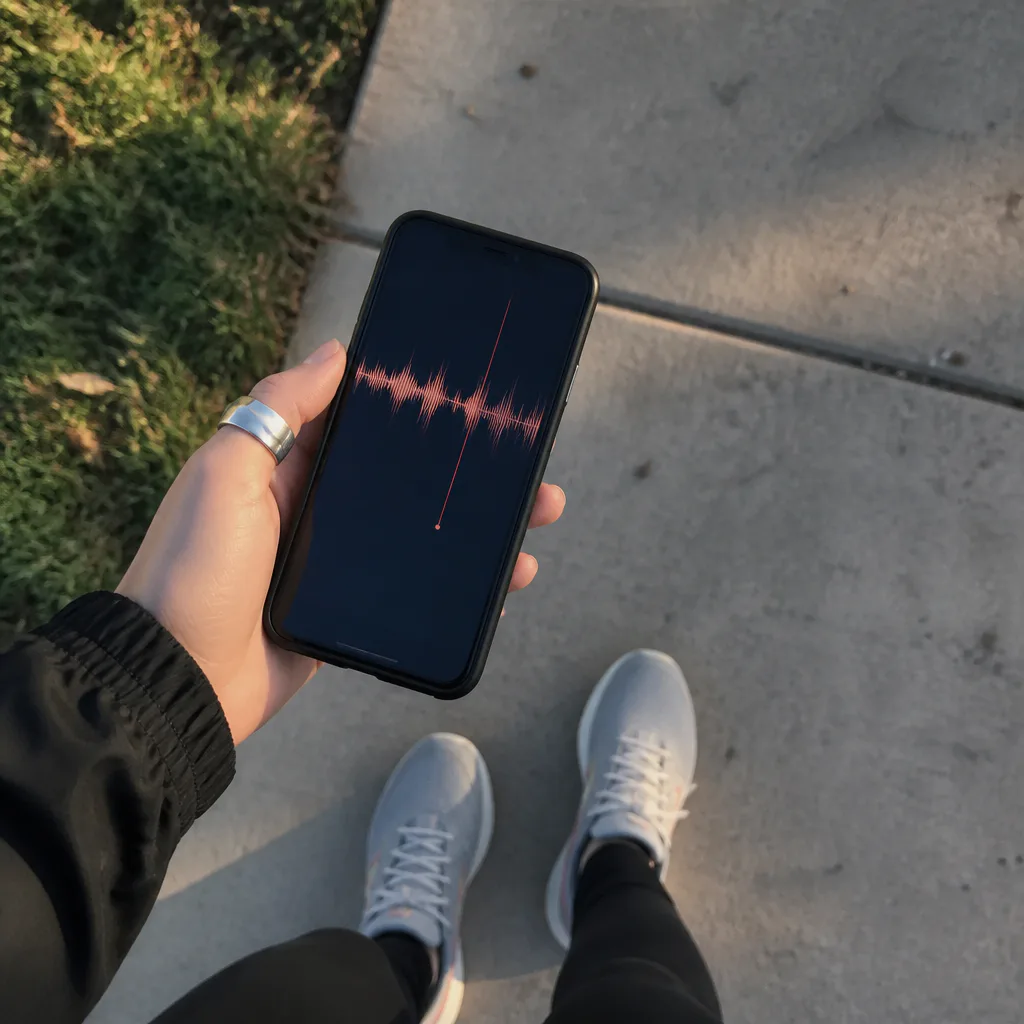
How do you do the 10-minute Dream-Self reset?
You do the reset by dividing the walk into arrival, listening, and return.
Set a timer for 10 minutes or choose a route that naturally takes about that long. The World Health Organization notes that some movement is better than none, and that benefits can begin below formal weekly targets. That matters here. You are not earning the practice through effort. You are meeting it through contact.
Use this simple structure:
- Minute 0 to 1: arrive. Stand still or begin slowly. Feel the ground. Notice one color, one sound, and one point of contact, such as your heel inside your shoe.
- Minute 1 to 8: listen. Play your Dream-Self Moment. Let the words pass through without checking whether you believe every line.
- Minute 8 to 10: walk in quiet. Pause the audio or let it end. Keep one sentence with you. Ask what small action belongs to that sentence today.
This is where the AYA Method stays clean. The audio is not background music for wishing. It is the method itself. The daily affirmation can support it afterward. The Manifestation Board can help you see the direction. But on the walk, the listening is the center.
A small table can help if your mind likes clear edges:
| Time | What you do | What you listen for |
|---|---|---|
| 0:00-1:00 | Begin walking slowly | Your breath and surroundings |
| 1:00-4:00 | Let the audio lead | A future that sounds specific |
| 4:00-8:00 | Keep an easy pace | One sentence that feels true enough |
| 8:00-10:00 | Walk without fixing | One small next action |
If ten minutes feels too long, begin with six. If it feels too short, do not lengthen it first. Repeat it for 7 days. Behavioral research often shows that consistency is easier when the action is small and tied to an existing cue. The cue might be after coffee, after school drop-off, after closing your laptop, or before cooking dinner.
A practice that fits your life will outlast a practice that flatters your ambition.
What should you listen for while you walk?
Listen for the sentence your body can almost accept.
Not the biggest line. Not the prettiest line. The one that lands with a small yes. In a Dream-Self Moment, that might sound like: I speak clearly in the room. I keep the promise I made to myself. I receive care without making it strange. Your mind may object. Fine. The line does not need to win an argument in one lap around the block.
Self-affirmation research can help here. A 2015 paper in Social Cognitive and Affective Neuroscience found that self-affirmation activated brain regions linked with valuation and future orientation, especially when people thought about personally meaningful values. This is one reason affirmations work best when they are not hollow slogans. A sentence should have a place to live.
While you walk, use the body as a truth filter. Does your breath soften on one line? Do your shoulders lower? Do you feel resistance in your throat? None of this is proof. It is information. Dr. Andrew Huberman has often described vision and movement as strong inputs to the nervous system; when you look forward and move forward, the body receives a different message than when you sit still and stare down.
Here are quiet things to notice:
- A word you want to reject, because it may name a place you are still protecting.
- A future detail that feels ordinary, like clean sheets, paid bills, a calm voice, or breakfast at the table.
- A sentence you want to repeat later, while washing a cup or unlocking the door.
- A change in pace when the audio names something you care about.
The right sentence does not shout. It returns.
How do you keep the walk safe and ordinary?
You keep it safe by choosing awareness over intensity.
Manifestation does not require you to disappear from the street. If you are outside, use one earbud or low volume. The National Highway Traffic Safety Administration reported 7,522 pedestrian deaths in the United States in 2022, a number that makes attention feel less optional. Choose daylight when you can. Cross at familiar places. Let the practice be soft, not risky.
If you walk indoors, the same rule applies. Do not close your eyes on stairs. Do not use a route with clutter if you are listening closely. A hallway, courtyard, quiet office loop, or kitchen path can work. My grandmother could walk twenty steps between stove and sink and still know exactly what prayer lived in the pot. The size of the path is not the size of the intention.
Use these boundaries:
- Keep the volume low enough to hear footsteps behind you.
- Avoid new routes during the audio portion.
- Do not practice while driving, cycling, or crossing complex traffic.
- If you feel dizzy, anxious, or unsteady, stop and return to your breath.
- If trauma material comes up, consider support from a licensed clinician.
The ordinary nature of the walk protects the practice from becoming theater. There is no need to film it. No need to dress for it. No need to prove that you are becoming someone else. You are listening, walking, and letting repetition do what repetition does. Princeton Engineering Anomalies Research, often called Princeton PEAR or GEO-related consciousness research, remains debated and should be held carefully. But one useful lesson from decades of intention research is simple: attention changes behavior first.
Attention is not magic. Attention is where your next choice begins.

How can you connect the reset to the rest of the day?
You connect it by choosing one small action that matches the audio.
The final two minutes matter because they prevent the practice from floating away. When the audio ends, ask a plain question: What would the version of me in this recording do in the next hour? Not next year. Not when everything is fixed. In the next hour. Research on implementation intentions by psychologist Peter Gollwitzer has shown that if-then plans can improve follow-through across many goals. Small specificity helps the mind act.
Your action can be almost embarrassingly modest. Send the email. Put the invoice in the folder. Drink water before coffee. Open the document for 5 minutes. Text the person you have been avoiding. Put beans to soak. If the Dream-Self Moment names a calmer home, wipe one counter. If it names a braver voice, write the first sentence before you speak.
This is also where the app’s complements can be useful. A daily affirmation gives you one line to carry. A Manifestation Board gives the eyes a place to return. But they are not the pillars. The audio remains the method. If you want to pair timing with meaning, some readers also use astrology and manifestation as a calendar language, though the practice does not depend on the sky being perfect.
Try this 3-part return:
- Name the line. Choose the sentence that stayed with you.
- Name the action. Make it small enough to do within 60 minutes.
- Name the place. Attach it to a real location: the sink, the desk, the doorway, the bus stop.
A 2021 American Psychological Association report found that stress was affecting daily decisions for many adults, with money, work, and health among the common sources. That is why tiny actions matter. A future self is not only built from vision. It is built from the next clean choice you can make while the kettle heats.
What if you only have a hallway, a lunch break, or a tired body?
You can still practice if the walk is small, slow, or adapted.
A walking manifestation meditation does not require a scenic route. It can happen in a hallway, around a kitchen table, across a courtyard, or beside a bed. If your body is tired, reduce the distance. If walking is not available to you, use seated rhythmic movement: hands opening and closing, feet pressing the floor, a gentle chair sway. The core is still listening.
This matters because access is part of truth. The U.S. Census Bureau has estimated that more than 40 million Americans live with some type of disability, and many more move through injury, pregnancy, grief, illness, or exhaustion at different times. A practice that demands one ideal body is too narrow. The Dream-Self Moment should meet you where you are.
If your lunch break is the only opening, keep it simple. Put on the audio after you eat or before you return to work. Walk for 5 minutes if that is what you have. The repetition counts. Many habit researchers, including BJ Fogg at Stanford, argue that tiny behaviors are easier to keep when they are anchored to something you already do. After I close my lunch container, I press play. That is enough of a gate.
If emotions rise, slow down. Place a hand on your chest if that feels right. Look at the nearest real object. A doorframe. A tree. A spoon. Manifestation should not pull you away from your life. It should return you to it with a clearer next step.
The walk can be ten blocks or ten breaths.
Walk softly. Let the next step be yours.