mindset
Fear of Success: 3-Minute Dream-Self Audio Practice
Fear of success can make your next level feel unsafe. Use a 3-minute Dream-Self audio to rehearse being seen, steady, and ready.

At 11:11, fear of success can sound strangely practical: stay smaller, answer later, do not be seen yet. A 3-minute Dream-Self audio helps by making success feel familiar before it arrives. You rehearse the outcome, regulate the body, and give your future self a voice you can return to daily.
What is fear of success really protecting you from?
Fear of success is usually protecting belonging, safety, rest, or identity, not failure.
The phrase sounds glamorous until it shows up in ordinary clothes. You delay sending the proposal. You keep adjusting the recipe after the guests are already hungry. You say you want the room, then become very interested in cleaning the drawer no one opens. The dial lines up, and you look away.
Psychologist Matina Horner brought fear of success into academic conversation in 1968, studying how achievement could be linked with social cost. The language of that era was limited, especially around gender, but the signal still matters: people do not only fear losing. They can fear what winning will ask of them.
A 2023 American Psychological Association Stress in America report found that 24% of adults rated their average stress between 8 and 10 on a 10-point scale. That number matters here because success often increases exposure, decisions, and perceived responsibility. Your nervous system may read the promotion, launch, or public praise as more demand, not more freedom.
Fear of success often hides behind intelligent explanations:
- I need more time.
- I need one more certification.
- I am waiting for the right season.
- I do not want to seem arrogant.
- I work better under pressure.
- I will be ready after this next cycle.
Some of those sentences may be true. The question is whether they are also useful. A reason can be accurate and still be a cage.
In a kitchen, fear of success looks like refusing to serve the dish because the garnish is not perfect. But food has a time stamp. Rice overcooks. Mole separates. Guests notice love before they notice symmetry. Success is not a personality test. It is a plate leaving your hands.
Why does manifestation stir up fear instead of confidence?
Manifestation can stir fear because naming a desire makes the consequences visible.
The moment you write the intention down, the room changes. Before, the desire was vapor. After, it has edges. The Manifestation pillar names this beautifully: manifestation is not pretending reality has already obeyed you. It is training attention, choice, and identity toward the life you intend.
That training can expose every place you are loyal to an older self. Neuroscientist Dr. Andrew Huberman often discusses neuroplasticity as attention plus repetition plus nervous-system state. In practical terms, the brain changes more readily when the cue is repeated and the body is available, not flooded. Three minutes is small enough to enter.
Joe Dispenza speaks often about rehearsing a future emotional state before the outer evidence appears. You do not have to accept every claim around his work to understand the useful part: mental rehearsal has a long research history. Sports psychology studies have used imagery for decades, and a 1994 meta-analysis by Driskell, Copper, and Moran found mental practice had a positive effect on performance across many tasks.
Still, manifestation is not a demand that you become fearless. Fearlessness is often theater. Regulation is better. You are not trying to erase the alarm; you are teaching it that the bell can ring without burning down the house.
This is where synchronicity can be helpful if you keep your feet on the floor. Seeing 11:11 three times in a day does not prove your outcome. It can, however, act as a witness. A master number is a punctuation mark, not a substitute for practice. Notice the signal. Then return to the work.
The work is not to become someone else. The work is to stop treating your own expansion as a threat.
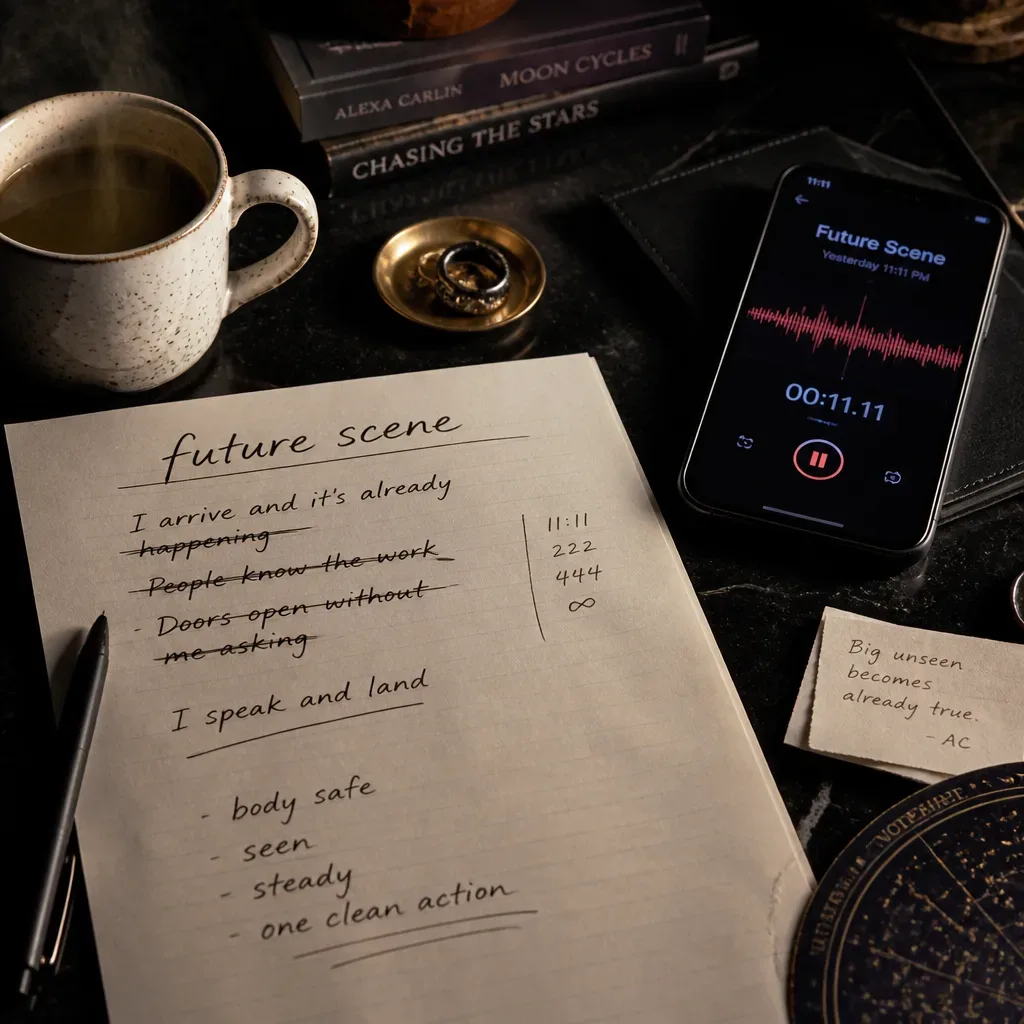
How does a 3-minute Dream-Self audio calm the success alarm?
A 3-minute Dream-Self audio calms the alarm by pairing future identity with present safety.
The AYA Method is a daily audio manifestation practice. Each day you listen to a short personalized recording, your Dream-Self Moment, narrated from the version of you who has already manifested the life you intend. Listening is the practice. Repetition is the work. The audio is the method.
This matters because fear of success is rarely solved by a louder pep talk. The body does not relax because you scold it with ambition. It relaxes when a future scene becomes familiar enough to stop being treated as a threat.
Three minutes has a useful constraint. It is long enough for breath to slow, imagery to form, and one new identity statement to land. It is short enough to repeat before coffee cools. In behavioral design, BJ Fogg of Stanford has argued for tiny habits because small actions reduce friction. A practice that takes 3 minutes has fewer excuses than one that asks for 45.
Your Dream-Self audio should sound like a voice note from the version of you who made it through the gate. Not a performance. Not a sermon. A steady report from the other side.
A useful 3-minute structure looks like this:
- First 30 seconds: locate the body and breath.
- Next 60 seconds: describe the success as already integrated.
- Next 60 seconds: name the old fear and show it is no longer in charge.
- Final 30 seconds: return to one clean sentence for the day.
Neville Goddard called this kind of inner rehearsal living from the end. His language came from another century, but the instruction still has a pulse: do not beg at the door of the desired life. Practice standing inside it.
The audio becomes a private room where success is not shocking. That is the whole gate.
How do you write the Dream-Self script without making it fake?
You make it believable by writing from evidence, sensory detail, and calm authority.
Start with the success you keep circling. Be specific enough that your nervous system knows what you mean. More money is vague. Sending the proposal by Friday is a door. Being visible is vague. Speaking on the panel without shrinking your voice is a door.
Then ask the kitchen question: what ingredient is missing? Most fear of success scripts fail because they season only with glamour. Add ordinary details. The mug on the desk. The email already sent. The shoulders lowered. The first honest breath after the decision. In memory research, sensory cues are strongly linked with recall; a 2015 review in Frontiers in Psychology notes that autobiographical memory is deeply tied to sensory and emotional context.
Use this table to build the script:
| Script piece | What to write | Example |
|---|---|---|
| The scene | One concrete moment after success | I am reading the signed agreement at my kitchen table |
| The body | A physical signal of safety | My jaw is soft and my hands are warm |
| The old fear | Name it without drama | I used to think being seen meant being judged |
| The new response | Show the nervous system a choice | I can be visible and still choose my pace |
| The daily cue | One sentence to carry | I let success arrive without making it a crisis |
Keep the language close to your mouth. If you would never say radiant empire in real life, do not put it in the audio. Your subconscious has taste. It knows when the seasoning is wrong.
A strong Dream-Self line might be: I can receive more without becoming less available to myself. Another: Being recognized does not mean being consumed. Keep one line that can survive a hard morning.
If you use a written affirmation, keep it as a complement, not the spine. The Affirmations pillar can help you choose clean phrasing, but the listening carries this practice. The voice matters. Your future self should not remain trapped on paper.
What is the exact 10-minute setup for a 3-minute audio?
The setup is simple: name the fear, write the future scene, record slowly, and attach listening to a daily cue.
You need a phone, a quiet corner, and 10 honest minutes. I often do this at the counter with coffee cooling beside me. My grandmother used to say no one should stir a pot while angry. I think recording works the same way. If you are harsh with yourself, wait 90 seconds and breathe first.
Here is the full setup:
- Minute 1: write the success. Use one sentence. I submitted the application. I raised the rate. I accepted the invitation. I launched the offer.
- Minute 2: write the feared cost. Success will make people expect too much from me. Success will make me visible. Success will separate me from my family pattern.
- Minutes 3 to 6: draft the future scene. Use present tense, first person, and sensory detail.
- Minutes 7 to 9: record slowly. Aim for 2:30 to 3:30. Speak 15% slower than normal.
- Minute 10: choose the cue. Attach it to coffee, a walk, washing your face, or closing your laptop.
The habit cue matters. A 2009 study by Lally and colleagues found that new habits took 18 to 254 days to become automatic, with an average of 66 days. That range is wide, almost rude, but it tells the truth: repetition is personal. Eleven days is a good first cycle because 11 is a signal number here, and because 11 days is long enough to reveal your excuses.
Do not overproduce the recording. A little background sound is fine. The spoon against the mug. The street outside. The dog deciding this is also his practice. Perfection can become another hiding place.
If your voice shakes, keep recording. A shaking voice is still a voice arriving.

When should you listen, and what should you do afterward?
Listen once a day at the same cue, then take one small action that agrees with the audio.
Morning works because attention has not yet been rented out by messages. Evening works because the brain consolidates memory during sleep; the National Institute of Neurological Disorders and Stroke notes that sleep supports learning and memory consolidation. Before a visibility moment also works, especially before calls, launches, meetings, or sending the thing you have been polishing past usefulness.
The key is not the mystical hour. It is consistency. If 11:11 appears and you can listen then, beautiful. If your real life offers 6:42 with a child asking for socks, use 6:42. The gate opens where you stand.
After listening, do one action that proves success is survivable. Not ten. One.
- Send the email.
- Post the offer.
- Ask the direct question.
- Accept the compliment without shrinking it.
- Put the price on the page.
- Tell one trusted person the real number.
This is where manifestation becomes honest. Attention without action becomes decoration. Action without regulation becomes force. Together, they give the desire a body.
Some readers like timing practices with the moon or personal numerology. Use that if it steadies you, not if it makes you postpone. The Astrology and manifestation guide is useful for reading cycles, but a cycle is a container, not a permission slip. The new moon can hold the intention. Tuesday can still get the email.
If you are tracking the practice, keep it plain. Mark an X for each day you listen. Write one sentence after the action: what did my body learn? In small clinical studies, expressive writing has been associated with reduced stress markers, though results vary by person and protocol. The point is witnessing, not creating paperwork.
How do you know fear of success is losing its grip?
You know it is losing its grip when success starts feeling inconvenient but not dangerous.
Do not wait for cinematic confidence. The early signs are quieter. You recover faster after being seen. You answer praise with thank you instead of a confession. You notice the old delay pattern and choose one clean step anyway. The room may still feel bright, but it no longer feels like a trap.
Use this comparison as a mirror:
| Old success alarm | New success response |
|---|---|
| I disappear after praise | I receive it and stay present |
| I overwork to prove worth | I let the result stand |
| I delay the visible step | I take the next 10-minute action |
| I confuse pressure with purpose | I check my pace before saying yes |
| I fear people will need more from me | I set terms before resentment arrives |
A 2020 review in the Journal of Contextual Behavioral Science found that psychological flexibility is linked with better mental health outcomes across many studies. That is the skill you are building. Not permanent certainty. Flexibility. You can feel fear, notice it, and still move in the chosen direction.
One of the most reliable signs is reduced bargaining. You stop making private deals with avoidance. You do not need the perfect mood, the perfect transit, the perfect playlist, or the perfect courage. You need the next aligned action and enough steadiness to take it.
Return also to the wider Manifestation pillar when you need the philosophy behind the practice. Return to the Affirmations pillar when your language gets muddy. But for this fear, keep listening. The audio teaches the body that success can enter without breaking the furniture.
What if fear of success comes back after progress?
If fear comes back, treat it as a returning weather pattern, not a verdict.
Progress is rarely a clean staircase. It is more like dough rising: warmth matters, time matters, and sometimes the room cools without asking permission. A new level of visibility can reactivate an old alarm. That does not mean the practice failed. It means the next gate is louder.
When fear returns, do three things. First, lower the scale. If the big action floods you, choose the smallest honest version. Second, update the audio. A Dream-Self Moment recorded for one threshold may not fit the next. Third, add support. A therapist, coach, mentor, accountant, or practical calendar can make success less abstract.
Clinical language matters here. Fear of success is not a formal diagnosis in the DSM-5-TR. If the fear includes panic attacks, trauma responses, depression, or severe avoidance, professional care is not optional seasoning. It is part of the meal. The National Institute of Mental Health estimates that about 19.1% of U.S. adults experience an anxiety disorder in a given year, so you are not rare for needing help.
You can also make the practice more bodily. Listen while walking. Listen with one hand on the counter. Listen after making tea. Tara Brach often teaches the power of naming what is present with kindness. Name it plainly: fear is here. Then add the second sentence: fear is here, and I am still allowed to be seen.
Fear of success gets smaller when success stops being a stranger.
Keep the volume low enough to hear the gate open.