mindset
Procrastination Manifestation: 3-Minute Audio
Use procrastination manifestation with a 3-minute audio reset before starting: clear the next action, lower resistance, and begin on cue.

Procrastination manifestation means using a short identity-based audio cue before a delayed task so you start from signal, not self-argument. Three minutes is enough to name the task, settle the body, hear your Dream-Self Moment, and take the first visible action before resistance rebuilds the room.
Why does procrastination need a manifestation practice at all?
Procrastination needs a manifestation practice because avoidance is often an identity problem wearing a time-management coat.
I used to treat procrastination like bad math. Add a better calendar, subtract distractions, divide the task into parts. Useful, yes. Complete, no. Piers Steel’s 2007 meta-analysis in Psychological Bulletin described procrastination as a common self-regulation failure, with estimates often placing chronic procrastination near 15% to 20% of adults and much higher among students. That tracks. The issue is rarely ignorance. Most people know what they are avoiding by 9:11 a.m.
The stranger part is that procrastination can feel protective. If you do not begin the proposal, you cannot prove the proposal is weak. If you do not open the tax folder, the number has not arrived yet. If you do not write the first page, the mirror stays fogged. Avoidance buys emotional credit at brutal interest.
This is where Manifestation pillar thinking becomes practical instead of theatrical. You are not claiming the task is done by wishing at it. You are rehearsing the state of the person who can begin it. The nervous system often responds better to a cue than to a lecture. Dr. Andrew Huberman has said repeatedly on his Stanford-affiliated podcast that state shifts influence behavior because action and physiology are linked, not separate departments.
A three-minute audio before you start gives procrastination a gate. It says: the debating chamber is closed; the first move is open. That is not magic. That is design.
Procrastination is not laziness. It is a nervous system asking for a cleaner entrance.
What is the 3-minute audio doing before you start?
The three-minute audio gives your attention a script, your body a signal, and your task a beginning.
The method works because the first minute of work is rarely about work. It is about crossing from delay into contact. Temporal Motivation Theory, developed by Steel and König in 2006, suggests that motivation rises when expectancy and value increase, and delay and impulsiveness decrease. A short audio cue helps on both sides: it raises expectancy by letting you hear the capable identity, and it shrinks delay by making the next action immediate.
This is why I use the AYA Method as the spine, not as decoration. The AYA Method is a daily audio manifestation practice. Each day you listen to a short personalized recording — your Dream-Self Moment — narrated from the version of you who has already manifested the life you intend. Listening is the practice. Repetition is the work. The audio is the method.
For procrastination, the Dream-Self Moment should be specific. Not “I am productive.” Too thin. Try: “I open the document before I feel ready. I write the first rough line. I let the clean version arrive later.” That is a better signal because it names the actual gate.
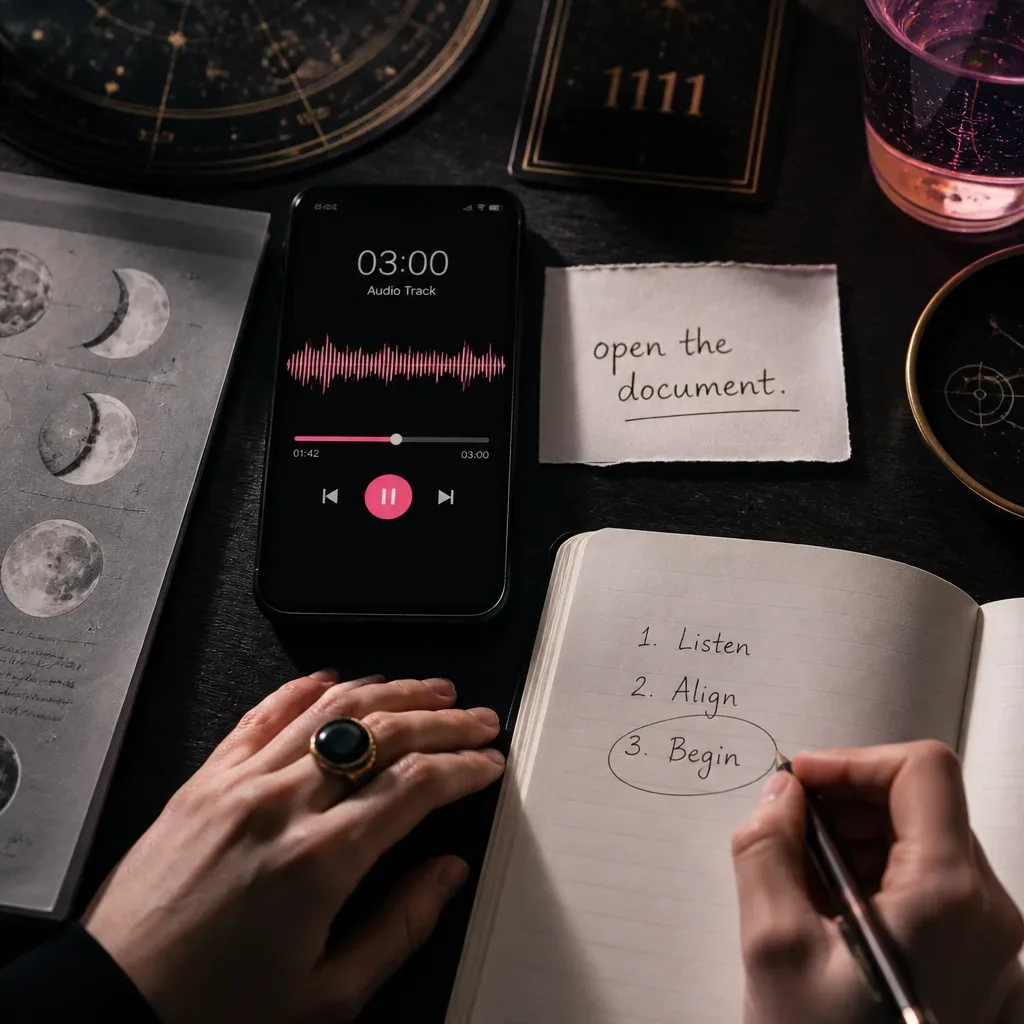
Here is the three-minute structure I use with clients and, reluctantly at first, with myself:
- 0:00–0:30: Settle the body. Feet on floor. Jaw unclenched. One task named.
- 0:30–2:30: Listen to the Dream-Self Moment. No multitasking. No checking the dial.
- 2:30–3:00: Choose the first move. One click, one sentence, one call, one object moved.
- At 3:00: Act within ten seconds. The signal decays if you negotiate.
The daily affirmation can help after the audio, especially if your mind likes a line to carry. The Affirmations pillar is useful here. But the affirmation is a complement. The audio is the method.
How do you set up the task so the audio can work?
You set up the task by turning a vague burden into one physical action the audio can deliver you into.
A delayed task usually arrives in costume. “Fix my finances.” “Get healthy.” “Start the business.” These are not tasks. They are weather systems. In David Allen’s Getting Things Done, the next-action principle asks for the visible behavior required to move a project forward. That distinction matters. “Open the spreadsheet and label the September expenses” is a task. “Deal with money” is a haunted house.
Before the audio, write the task in one sentence. Keep it under 12 words if you can. Specificity is not a productivity fetish; it reduces the brain’s need to search while anxious. In implementation-intention research, Peter Gollwitzer found that “if-then” planning reliably improves goal follow-through across many studies. A 2006 meta-analysis by Gollwitzer and Sheeran reported medium-to-large effects across 94 independent tests.
Use this table before you press play:
| Avoided label | Startable action | First ten seconds |
|---|---|---|
| Finish presentation | Open deck and title slide 1 | Open Keynote or PowerPoint |
| Get in shape | Put shoes by the door | Stand up and change socks |
| Write article | Draft the first bad paragraph | Open document |
| Handle taxes | Find last month’s statement | Open bank app |
| Apply for job | Paste role link into notes | Open saved listing |
The point is not to make the task tiny forever. The point is to make contact. Surf taught me this better than any planner did: you do not negotiate with a wave from the parking lot. You paddle into position, then read what is actually in front of you.
A task becomes startable when the first move is visible enough to embarrass your resistance.
What should your Dream-Self Moment say when you procrastinate?
Your Dream-Self Moment should speak from the identity that starts before certainty arrives.
Most procrastination scripts are secretly shame scripts. “Why are you like this?” “You always do this.” “Other people would have finished.” That voice has data, but no leadership. Tara Brach’s work on mindfulness and self-compassion often points to the same turn: naming what is happening with less aggression creates more room for wise action. Shame narrows the room. A good audio practice widens it just enough.
Write the Dream-Self Moment in present tense, but keep it believable. Neville Goddard taught the power of assuming the feeling of the wish fulfilled; the useful version for procrastination is not grand theater. It is embodied evidence. You hear yourself as the person who opens the file, answers the message, makes the first imperfect attempt, and remains in the chair for 15 minutes.
A strong procrastination manifestation audio usually includes 4 parts:
- A direct identity cue: “I am the person who begins cleanly.”
- A body cue: “My shoulders drop; my breath steadies.”
- A task cue: “I open the document and write the first rough line.”
- A continuation cue: “I stay for one honest block, then reassess.”
Keep the recording short. Three minutes is not a compromise; it is the point. BJ Fogg’s behavior-design work at Stanford popularized the idea that tiny behaviors scale because they are easier to repeat. A 3-minute ritual repeated 20 times has more practical force than a 30-minute ceremony performed once and then admired from a distance.
If you track synchronicities, use them lightly. Seeing 11:11 before you start can be a signal if it helps you begin. It is not proof you can avoid the work. For a grounded look at timing, cycles, and symbolic cues, Astrology and manifestation is a better frame than outsourcing your calendar to omens.
A sign is useful only if it returns you to the action you already knew was yours.
What is the exact 3-minute process before a hard task?
The exact process is to name the task, listen without multitasking, choose one move, and start before the mind reopens the case.
I like processes that survive bad mornings. This one does. It does not require incense, a perfect desk, or a personality transplant. It requires a timer, headphones if you have them, and the willingness to make the first move small enough to be real. Research on habit formation by Phillippa Lally and colleagues at University College London found that automaticity took a median of 66 days to develop, with a wide range from 18 to 254 days. Repetition matters more than mood.
Use this version when the task has weight:
- Write the task. One line. “Send the overdue invoice.” Not “be better with clients.”
- Mark the first move. Circle the action you can do in ten seconds.
- Press play. Listen to the 3-minute Dream-Self Moment. Do not clean the room while listening.
- Let the final line cue action. End the audio with something like: “When this ends, I begin.”
- Move immediately. Touch the keyboard, lift the phone, open the folder.
- Work for 11 minutes. Long enough to cross the gate; short enough to avoid drama.
The 11-minute block is not sacred, but it is memorable. Master number 11 is often associated with intuition and signal in modern numerology, including traditions popularized in the late 20th century by writers such as Doreen Virtue, whose angel-number work is influential but should be read with discernment. Use the number as punctuation, not doctrine.
If you want a broader mindset frame, keep Manifestation pillar nearby. If you want the daily audio practice itself, return to the AYA Method. Different tools. Different jobs.
How do you know if procrastination manifestation is working?
You know it is working when your start latency drops and your first action happens with less debate.
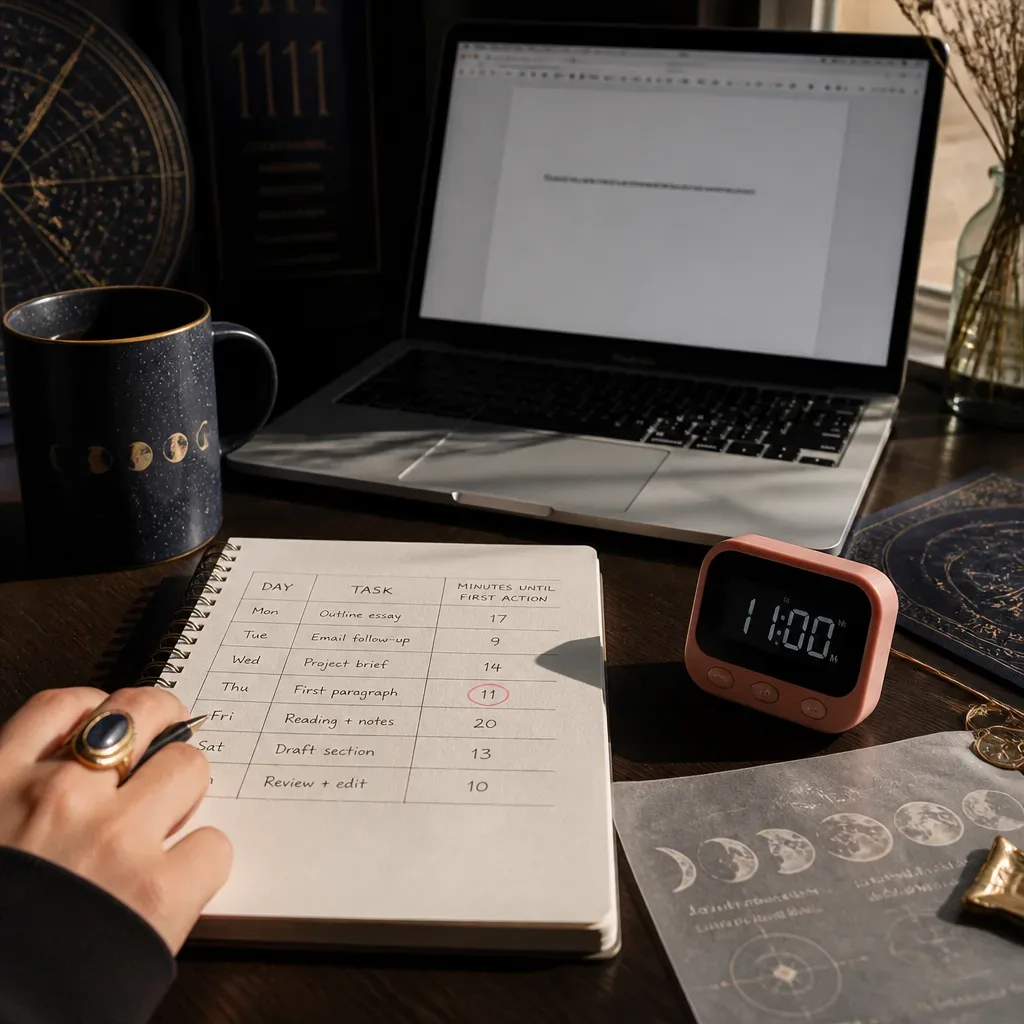
Do not measure this by how inspired you feel. Inspiration is a terrible accountant. Measure behavior. In my old finance life, I trusted leading indicators because outcomes arrive late and tell partial stories. For procrastination, the leading indicator is start latency: the number of minutes between deciding to begin and taking the first visible action.
Track 7 days. Nothing elaborate. Use three columns:
| Day | Task | Minutes until first action |
|---|---|---|
| Monday | Open invoice folder | 4 |
| Tuesday | Draft intro paragraph | 2 |
| Wednesday | Put shoes on | 1 |
| Thursday | Send follow-up email | 3 |
If the number falls from 25 minutes to 5 minutes, that counts. If you still dislike the task but begin anyway, that counts even more. The Journal of Behavioral Medicine has published multiple studies linking self-regulation practices with health behaviors, and the pattern is plain across fields: the win is not a permanent mood. The win is a repeatable bridge from intention to action.
Also track completion honestly. A 3-minute audio will not turn a poor plan into a good one. It will not fix burnout, unclear priorities, ADHD, depression, or a workplace built like a slot machine. If procrastination is persistent and costly, get clinical or structural support. Manifestation practice should not be used to spiritualize a solvable constraint.
That said, the small signal matters. The Princeton Engineering Anomalies Research program, often called PEAR, studied mind-matter questions for decades and remains debated. I cite it carefully because the stronger everyday evidence is simpler: attention changes choices, and choices change the next hour.
The most honest manifestation metric is not what you intended. It is what you did next.
What should you avoid so the practice stays clean?
You should avoid turning the audio into another delay ritual.
Procrastination is talented. Give it a candle and it becomes a ceremony. Give it a notebook and it becomes a planning system. Give it a manifestation practice and it may try to become a new way to avoid the first sentence. The signal is clean only when it points to action.
The most common mistakes are predictable:
- Recording a 20-minute audio for a 2-minute start problem.
- Changing the script every day instead of repeating it long enough to condition the cue.
- Using affirmations to soothe yourself after not starting.
- Waiting for the “right” mood before pressing play.
- Tracking cosmic signs but not tracking start latency.
- Making the Manifestation Board the main event when the work needs an audio gate.
The Manifestation Board can be a useful visual witness. Keep it in the room if it helps you remember the bigger season you are building. But again, for this practice, the audio leads. The board and the daily affirmation support the signal after it has already been heard.
There is also a language mistake. Do not say, “I am going to finish everything.” The brain knows when you are lying. Say, “I begin with the first visible move.” In small studies on self-talk and performance, instructional self-talk often helps more than vague motivational self-talk, especially for precision tasks. Specific beats grand.
I still procrastinate. Anyone selling total immunity has not met a hard spreadsheet, a blank page, or a government form. But the mornings I use the audio, I usually make one cleaner decision before noon. Slightly better compounded is still the only kind of better I trust.
Press play. Cross the gate.