manifestation for life areas
Manifest Moving Abroad With a 3-Minute Audio
Manifest moving abroad with a 3-minute Dream-Self audio that trains attention, identity, and daily decisions toward your new country.

To manifest moving abroad, use a 3-minute Dream-Self audio as a daily rehearsal of identity, then pair it with one concrete relocation action. The audio gives your mind a repeated signal: this is who I am becoming, this is where I live, and this is how I move today.
Why can a 3-minute audio help you manifest moving abroad?
A 3-minute audio helps because repetition turns a distant relocation into a familiar internal instruction.
Moving abroad usually begins as a tab left open. Lisbon visa requirements. Berlin rent maps. Seoul language schools. Then the tab gets buried under groceries, invoices, and the friend who asks if you are “still doing that abroad thing.” A short audio cuts through that drift. Three minutes is not theatrical. It is small enough to repeat, and repetition is where the dial starts to move.
In behavioral psychology, implementation intentions have been studied for more than 20 years; Peter Gollwitzer’s research found that “if-then” planning can significantly increase follow-through across goals. The same principle is useful here. If coffee is brewing, then I listen. If I finish listening, then I take one relocation action. The gate is ordinary, which is why it works.
This is where the AYA Method gives the practice its spine: The AYA Method is a daily audio manifestation practice. Each day you listen to a short personalized recording — your Dream-Self Moment — narrated from the version of you who has already manifested the life you intend. Listening is the practice. Repetition is the work. The audio is the method.
A relocation fantasy says, “One day I’ll live there.” A Dream-Self audio says, “I am the person who books the appointment, learns the sentence, saves the amount, and belongs in the room.” The difference is not volume. It is authority.
The brain does not need a 90-minute ceremony to receive a new signal. It needs a signal it can trust, repeated on cue.
What should your Dream-Self audio actually say?
Your audio should describe one ordinary scene abroad, narrated by the future self who already lives there.
Do not start with the airport. Airports are cinematic, but they are not a life. Start with a Tuesday. Start with the chipped mug in your rented kitchen, the tram stop you know by muscle memory, the folder where your residence documents sit in order. Specificity makes the scene less like decoration and more like instruction.
A useful 3-minute script is usually 350 to 450 spoken words, depending on your pace. The National Center for Voice and Speech often places conversational speech around 150 words per minute, which means you have room for detail but not drama. The edit matters. If the audio tries to hold every wish, it becomes fog. One country. One season. One self.
Use this structure:
- Name the place. “I live in Porto now,” or “I wake up in Montreal.”
- Name the identity. “I am someone who handles paperwork calmly.”
- Name the daily scene. Describe the street, desk, kitchen, commute, or class.
- Name the proof. Mention the visa appointment, signed lease, remote contract, language lesson, or savings milestone.
- Name the feeling. Use grounded words: steady, clear, welcomed, prepared.
- Name today’s bridge. End with one line that points back to action now.
Here is the tilt: the future self should not sound breathless. She should sound like she has already arrived and slept well. Joe Dispenza often speaks about rehearsing an elevated future state before evidence appears; you do not need to adopt every claim to see the practical use. A rehearsed identity changes what you notice, and what you notice changes what you choose.
Keep the audio intimate. No performance voice. No sales pitch. You are not persuading the universe. You are giving your attention a forwarding address.
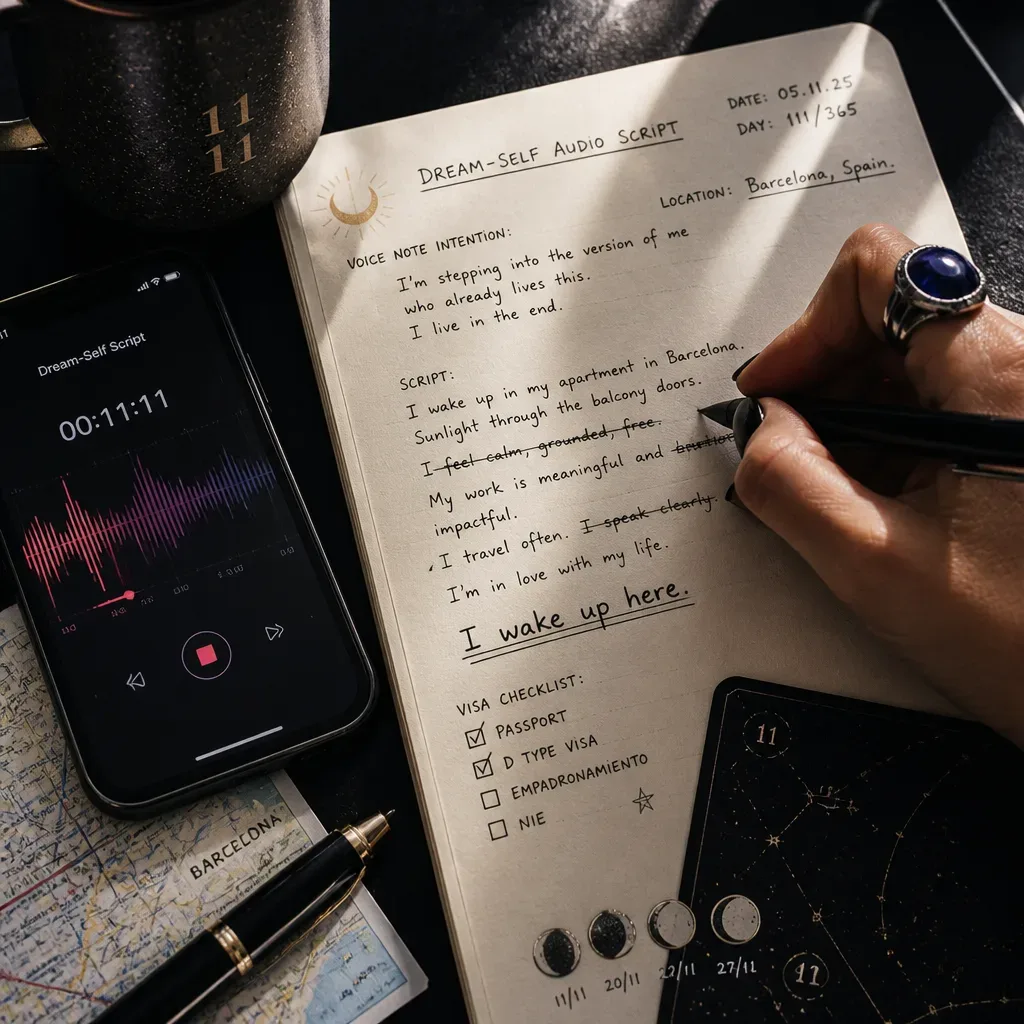
How do you record the 3-minute Dream-Self audio?
Record it simply, slowly, and in your own voice, because credibility matters more than production.
Open the voice memo app on your phone. Sit somewhere neutral. Read the script once silently, then record it at a pace that feels like a letter, not a command. If you stumble, begin again. Three minutes is short enough to redo without turning it into a project.
A 2022 Pew Research Center report found that 85% of U.S. adults owned a smartphone, and global smartphone access has made voice recording one of the lowest-friction tools we have. Use that. No studio. No microphone hunt. The point is daily contact with the self ahead, not perfect sound design.
Record with these choices in mind:
- Speak in present tense: “I live,” “I walk,” “I receive,” “I choose.”
- Use your name once, especially if it steadies you.
- Avoid exaggerated certainty that your nervous system rejects.
- Include one practical relocation marker: visa, savings, work, housing, language, community.
- End with a sentence that returns you to today’s next move.
| Audio element | Weak version | Stronger version |
|---|---|---|
| Place | “I’m abroad.” | “I wake up in Valencia in late September.” |
| Identity | “Everything works out.” | “I handle each document one page at a time.” |
| Proof | “My dream is real.” | “My appointment confirmation sits in my email.” |
| Feeling | “I’m excited forever.” | “I feel calm enough to keep going.” |
| Action bridge | “It is done.” | “Today, I take the next clear step.” |
Neville Goddard called imagination “the real and eternal world,” a phrase people quote because it has voltage. Still, the practical reading is cleaner: rehearse the state until your behavior stops arguing with it. For moving abroad, that behavior may be calling a consulate, asking your employer about remote status, or pricing a storage unit.
Your recording can be imperfect and still be potent. A cracked voice is not a bad omen. Sometimes it is the sound of the old address losing authority.
When should you listen, and what should you do after?
Listen at the same daily cue, then take one relocation action before the day swallows the signal.
Morning is useful because it catches the mind before the room gets loud. Dr. Andrew Huberman has discussed how early light, routine, and timed cues can support alertness and behavioral consistency; the relevant point here is simple. The nervous system likes a pattern it can predict. Pair the audio with an existing cue and you reduce the number of decisions required.
You might listen before coffee, after brushing your teeth, on the first walk of the day, or before opening your laptop. If mornings are chaos, choose night. The clock is not sacred. The repeat is.
After listening, take one action small enough to finish in 10 to 20 minutes. This protects the practice from becoming mood-only manifestation. The Manifestation pillar is clear on this: attention is powerful, but it needs a channel. Moving abroad has channels with names: visa class, budget line, housing search, language plan, professional network.
Use a daily menu:
- Read one official visa page, not five opinion threads.
- Move a set amount into a relocation account, even $11.
- Send one message to someone in the city.
- Study 10 phrases you will actually use.
- Compare two neighborhoods by commute, cost, and safety.
- Update one paragraph of your CV or portfolio.
- Remove one possession you will not take.
The number can be modest. BJ Fogg’s behavior design research at Stanford popularized the idea that tiny habits work because they reduce friction. A $11 transfer will not fund a move. It will, however, keep the identity alive on a day when you might have done nothing.
The audio opens the gate. The action walks through it.
How do affirmations and a Manifestation Board fit without taking over?
Use affirmations and a Manifestation Board as complements, while the audio remains the method.
This distinction matters. A daily affirmation can sharpen the line you need to remember. A Manifestation Board can keep the destination visible. But for this practice, the listening does the heavy lifting because it places you inside a scene and lets your future self speak in a full voice. The board is a mirror. The affirmation is a pin. The audio is the daily appointment.
If you already use affirmations, choose one sentence from your script and repeat it after the audio. Keep it plain. “I handle the move one clear step at a time.” Better than, “Everything is magically perfect.” The first sentence gives you a body. The second gives you glitter and nowhere to stand.
For a board, avoid making a collage of borrowed glamour. Use images that tell the truth of the life you are claiming: a transit card, a government office, a small apartment, a neighborhood market, a language notebook, a weather report. A 2011 study in the Journal of Experimental Social Psychology found that positive fantasies alone can sometimes reduce effort because the mind feels prematurely satisfied. That does not mean vision boards are useless. It means they need friction.
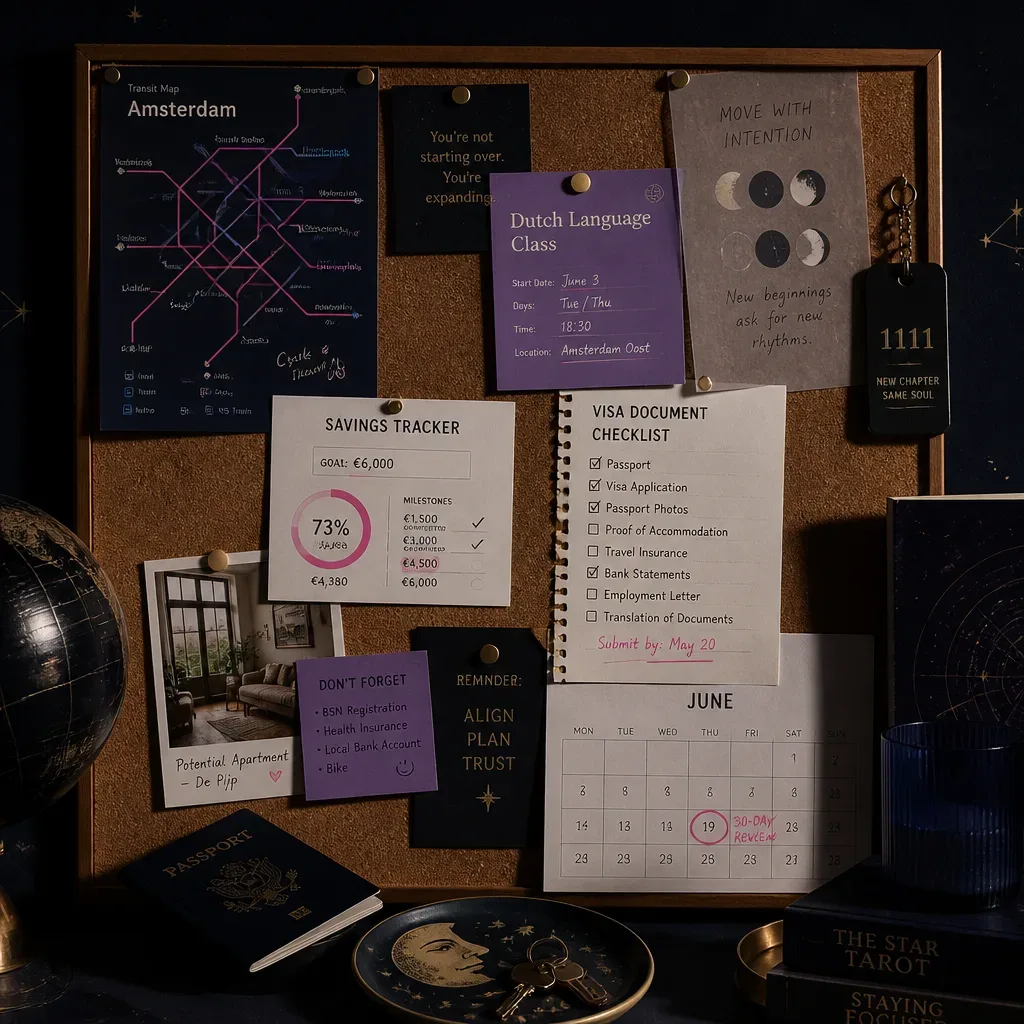
A strong board for moving abroad includes:
- Place evidence: map, street, train line, neighborhood name.
- Administrative evidence: visa category, appointment date, document checklist.
- Daily-life evidence: grocery store, desk, walking route, gym, class.
- Community evidence: one group, contact, event, or language exchange.
- Money evidence: target number, savings tracker, income plan.
The board should make the move feel real enough to respect. Real dreams have paperwork. That is not a punishment. It is a sign that the idea has entered the room.
What if signs, numbers, or astrology keep showing up?
Treat signs as timing cues, not substitutes for decisions.
You may start seeing 11:11 when you research apartments. A flight price lands at $333. Someone mentions the same city twice in one afternoon. The editorial mind notices. So does the anxious mind. The difference is what you do next.
In numerology, 11 is considered a master number associated with intuition and signal; 22 is often linked with building; 33 with service or teaching. Doreen Virtue helped popularize angel number language in the 2000s, though her later relationship to that work changed. Keep appropriate distance. A number can be meaningful without becoming your manager.
If the numbers arrive, use them as prompts:
- 11:11: listen to the audio or write one honest line.
- 22: take a building action, such as savings or documents.
- 333: ask for help, feedback, or a contact.
- 444: check the structure: budget, lease, timeline, visa.
- 555: review what is changing and what must be released.
For lunar timing, a 29.5-day lunar cycle can be a clean container. Use the new moon to write or refresh the script. Use the first quarter to take a visible action. Use the full moon to review what has surfaced. Use the final quarter to remove clutter, debt, delay, or fantasy. If you like this language, astrology and manifestation can give the timing a richer frame without handing your agency to the sky.
Princeton’s Global Consciousness Project has explored correlations between human attention and random event generators, and its claims remain debated. That is useful context. Not every signal needs to become proof. Sometimes the better question is not “Was this sent?” but “Did it make me braver and more precise?”
Synchronicity is most useful when it returns you to the next honest action.
How do you track progress for 30 days?
Track inner steadiness and outer movement, because moving abroad requires both.
Use a simple 30-day log. You are not trying to grade your worth. You are watching whether the daily signal changes what you do. Thirty days is long enough to reveal patterns and short enough to stay close. Many habit studies vary widely, but the often-cited 2009 study in the European Journal of Social Psychology found habit formation averaged 66 days, with a broad range. A 30-day review is a checkpoint, not a verdict.
Create four columns:
| Day | Listened? | One action taken | Signal noticed |
|---|---|---|---|
| 1 | Yes | Read Portugal D7 visa page | Saw 11:11 after saving link |
| 7 | Yes | Moved $50 to relocation account | Friend mentioned Lisbon |
| 14 | No | None | Felt avoidant, rewrote script |
| 21 | Yes | Booked language assessment | Dreamed of apartment keys |
| 30 | Yes | Sent CV to two contacts | Felt calm, not rushed |
Missed days are data. If you avoid listening, ask why. Maybe the country is wrong. Maybe the timeline is borrowed. Maybe the script sounds too polished and not enough like you. The future self does not need flattery. She needs accuracy.
Review these questions on day 30:
- Did I listen at least 20 out of 30 days?
- Did I take at least 10 concrete relocation actions?
- Do I know more about the visa, money, work, and housing than I did on day 1?
- Does the audio still feel alive, or does it need a new scene?
- What did I stop tolerating because this move became real?
If you want a wider frame for the practice, return to the AYA Method and refine the Dream-Self Moment rather than adding more noise. You can also revisit the broader manifestation guide when you need principles instead of another tab.
The point is not to force the border to open on your schedule. The point is to become the person who can meet the opening when it appears, passport located, documents named, nervous system steady.
Keep listening until the new address starts answering back.