audio manifestation
Manifestation Meditation Audio for Your Commute
Use manifestation meditation audio on your commute without closing your eyes, with a safe 12-minute practice built for trains, buses, and cars.

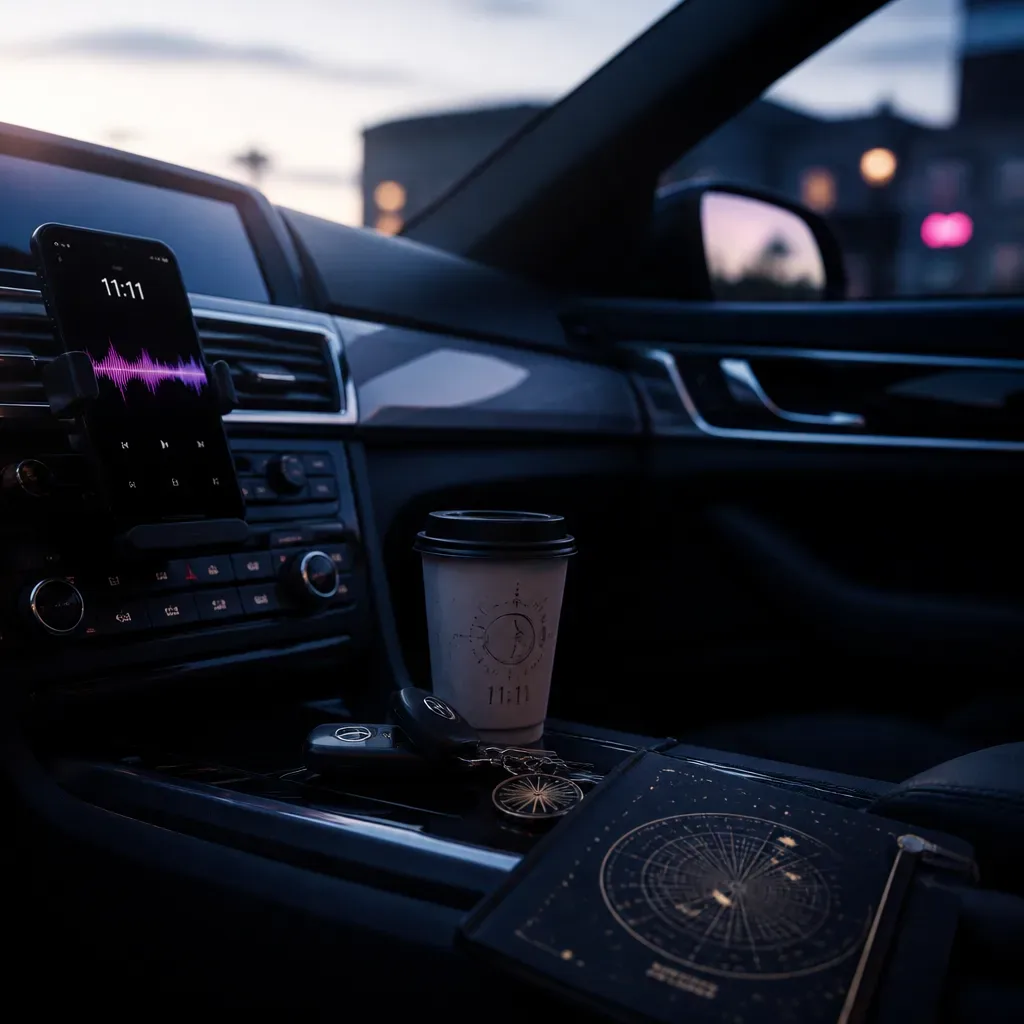
The cup holder is full. The keys are cold in your hand. Manifestation meditation audio can be used on a commute if it keeps your eyes open, your attention available, and your practice simple: listen before or during a safe stretch, let one future-self sentence land, and arrive without forcing anything.
What makes manifestation meditation audio safe for a commute?
Safe commute audio keeps your body oriented to the road, the platform, the sidewalk, and the people near you.
The first rule is plain. You do not close your eyes. You do not drift so far inward that you miss a brake light, a station announcement, or a cyclist passing your door. The National Highway Traffic Safety Administration reported 3,308 people killed in distraction-affected crashes in the United States in 2022. That number is enough to make the practice humble.
A commute is not a retreat. It is a moving room. It asks for a different kind of devotion. Your gaze stays outside. Your listening turns inward only as much as safety allows. The recording should feel like a hand on the back of a chair, not a hand over your eyes.
For driving, use speakers if that is safer and legal where you live. Set the track before the car moves. If you are on a train or bus, keep the volume low enough to hear announcements. The World Health Organization has noted that long exposure above 80 decibels can raise hearing risk over time, so quiet is not only a mood. It is care.
A safe commute practice has four marks:
- It is short, usually 5 to 12 minutes.
- It never asks you to close your eyes.
- It uses simple language, not complicated instructions.
- It leaves decision-making clear.
The road gets your first attention. The audio gets what remains. That is enough.
If you are new to this, begin with parked listening or transit listening before using audio while driving. The U.S. Census Bureau has reported an average American one-way commute near 26.8 minutes, which means a 7-minute practice can live inside the ride without taking it over. Small is not lesser. Small is repeatable.
How is this different from regular meditation?
Commute manifestation audio is meditation shaped for motion, not stillness.
Traditional meditation often asks you to sit, soften the gaze, or close the eyes. Many clinical mindfulness protocols, including Mindfulness-Based Stress Reduction, were first taught in sessions lasting 30 to 45 minutes. That container can be beautiful. It is also not the container you have when the bus is late or the lane beside you is full.
This practice uses listening as the doorway. You hear a short recording that speaks from the life you intend. You do not have to build a perfect mental picture. You do not have to make your breath special. You let one line become familiar enough that your body recognizes it during the day.
The AYA Method is a daily audio manifestation practice. Each day you listen to a short personalized recording — your Dream-Self Moment — narrated from the version of you who has already manifested the life you intend. Listening is the practice. Repetition is the work. The audio is the method.
That last sentence matters. The audio is the method. The daily affirmation and Manifestation Board can support the practice, but they do not replace the listening. If you want the wider frame, the Manifestation pillar holds the full language of intention, repetition, and becoming real in ordinary time.
Research gives this softness a backbone. A 2010 Science study by Killingsworth and Gilbert found that people reported mind-wandering in 46.9 percent of sampled moments. A commute is one of the places where the mind wanders most easily: into emails, old conversations, money, dinner, shame. Audio gives the mind one true place to return.
Here is the quiet difference:
| Practice type | Eyes | Best setting | Main action | Commute fit |
|---|---|---|---|---|
| Seated meditation | Often closed | Home, studio, retreat | Observe breath or thought | Low for driving |
| Visualization | Often closed | Private quiet room | Build mental imagery | Low for driving |
| Affirmations | Open or closed | Anywhere | Repeat one statement | Medium |
| Manifestation meditation audio | Open for commute | Car, train, bus, walk | Listen and remember | High when safe |
One sentence can become a room you carry with you.
How do you set up the audio before you leave?
Set up the audio before movement begins, so the practice never asks your hands to choose while your body is in motion.
This is where I think of my grandmother grinding garlic with salt before the beans went on. The meal began before the flame. Your commute practice begins before the engine, before the turnstile, before the first step into wet morning air. Preparation is part of the listening.
Use this 5-minute setup once, then repeat it with less thought tomorrow:
- Choose one recording between 5 and 12 minutes.
- Download it if your route has weak service.
- Set volume at a level where outside sound remains clear.
- Put the phone somewhere you will not touch it.
- Choose one anchor sentence to notice.
- Decide where the practice ends.
If you drive, the end point might be the first parking lot turn. If you ride a train, it might be one stop before yours. If you walk, it might be the bakery corner or the crosswalk with the long light. Specific endings help the brain. In a 2006 meta-analysis, psychologist Peter Gollwitzer and Paschal Sheeran found that implementation intentions, the if-then plans people make beforehand, had a medium-to-large effect on goal follow-through across 94 studies.
Your if-then can be simple: if I sit down on the train, then I press play once. If I finish the school drop-off, then I listen on the straight road. If I reach the bridge, then I let the final minute play.
Keep the phone out of your hand. In many places, handheld phone use while driving is restricted or banned; the Insurance Institute for Highway Safety tracks laws that now cover most U.S. states in some form. Even when the law allows a tap, the nervous system pays for divided attention. Do not make your manifestation practice another small theft of attention.
The setup is not there to make you rigid. It is there to make you free from choosing again.
What should you listen for while your eyes stay open?
Listen for the sentence that your body can believe by one percent.
Not the grandest sentence. Not the prettiest. The one that makes your shoulders drop without bargaining. In the AYA Method, that sentence often comes from your Dream-Self Moment: the version of you who speaks from already being inside the life you intend. It might sound plain. I speak clearly in rooms. I leave on time. I earn well and rest well. I feed my people without disappearing.
The mind may argue. That is normal. In cognitive science, the brain is often described as predictive: it uses past information to guess what comes next. Lisa Feldman Barrett and other affective science researchers have written about prediction as central to how the brain organizes perception and feeling. Repeated audio gives the mind new material to predict from, softly and over time.
You are not trying to convince yourself with force. Force is brittle. You are giving the nervous system a repeated pattern it can know. In small studies on mental imagery and future thinking, people often show stronger motivation when they can picture or rehearse specific future actions rather than vague wishes. The commute gives you a daily cue, and daily cues matter.
Try listening in three layers:
- The outer layer: road, doors, footsteps, announcements, weather.
- The middle layer: the narrator, pacing, the line that repeats.
- The inner layer: the small physical sign that something feels true.
That sign may be a slower jaw. A warmer chest. Less hurry in the hands. Dr. Andrew Huberman often speaks about the body shaping the mind through breath, vision, and autonomic state; you do not need a lab to notice that your body tells the truth early. Still, the lab helps you respect it. Slow exhale breathing has been associated in controlled studies with shifts in heart-rate variability, a marker often used for stress regulation.
The sentence you can believe by one percent is not small. It is the door that opens without noise.
For more language-based support, you can pair the audio with one written line from the Affirmations pillar. Keep the order clear. Listen first. Write later if it helps.
What if your commute is noisy, short, or stressful?
Use the commute you actually have, not the one a calm person on the internet pretends you have.
Some mornings are loud. A child spills milk on your sleeve. The bus sighs past without stopping. The car in front of you brakes too late. Your practice should be able to survive ordinary life. If it cannot survive ordinary life, it is decoration.
For a noisy commute, lower the demand. Use one earbud only if safe and legal, or use a low speaker in the car. If noise covers the narration, let rhythm do part of the work. Research on music and mood regulation has found that people commonly use audio to manage arousal and attention; a 2013 review in Frontiers in Psychology described music listening as a frequent self-regulation tool. Spoken audio can work in a similar daily way when it is steady and familiar.
For a short commute, use the first 3 minutes. Not every practice has to be complete. A 2021 review in Applied Psychology: Health and Well-Being noted that brief mindfulness practices can show benefits for attention and stress, though effects vary by study design and habit length. The honest part is the habit. The humble part is knowing 3 minutes counts when it is repeated.
For a stressful commute, remove anything that makes you less safe. No intense visualization. No breath holds. No tears if you are driving. Save deeper emotional work for when you are parked, seated at home, or walking somewhere quiet. The audio manifestation guide can help you choose practices by setting, not fantasy.
Use this simple adjustment table:
| Commute problem | Safer adjustment | Time needed |
|---|---|---|
| Heavy traffic | Play only the first half after merging | 4 minutes |
| Crowded train | Listen with low volume and eyes open | 6 minutes |
| Walking in rain | Use one anchor sentence without headphones | 2 minutes |
| Late start | Skip the track and repeat yesterday’s line | 1 minute |
| Emotional morning | Wait until parked or seated | 5 minutes |
Your practice does not fail because the morning is human. It becomes real there.

How do you make it a seven-day commute practice?
Repeat the same audio for seven days before judging it.
Seven days is not magic. It is a clean container. Long enough for the recording to become familiar. Short enough that you do not turn it into a new obligation. Habit researchers often point out that repetition in a stable context matters more than intensity. In a 2009 European Journal of Social Psychology study, Phillippa Lally and colleagues found that automaticity took a median of 66 days to form, with wide variation from 18 to 254 days. Seven days is only the first soft stitch.
Here is the structure:
- Day 1: Listen only. Do not analyze.
- Day 2: Notice the line your mind remembers.
- Day 3: Let your body choose the anchor sentence.
- Day 4: Keep listening even if you feel nothing.
- Day 5: Notice one choice you make differently after arrival.
- Day 6: Repeat the final sentence before sleep.
- Day 7: Write three words about what felt true.
The app may also include a daily affirmation or a Manifestation Board, and those can be tender complements. They are not the center here. Audio is the daily practice. If you only have one commute minute, give it to listening.
You can make a small note after arrival. Not a full journal entry. Three words. Calm at meeting. Less braced. Asked clearly. Bought oranges. The body likes evidence that fits in a pocket. A 2018 Pew Research Center report found that 77 percent of U.S. adults said they went online daily, and many checked devices several times a day. A three-word note interrupts that automatic reach with something more yours.
If you like timing with natural cycles, you might also read Astrology and manifestation for a softer way to name beginnings. But do not wait for the sky to be perfect. Your Tuesday commute is already enough.
A practice becomes trustworthy when it keeps meeting you in the same small place.
How do you know the audio is working?
You know it is working when your next ordinary choice becomes a little more like the self you keep hearing.
Do not look first for fireworks. Look for the email you answer without shrinking. The breakfast you eat before coffee turns you sharp. The boundary you state with a normal voice. The bill you open. The walk you take after work. Manifestation is often less dramatic than the mind wants and more exact than the body expects.
The Manifestation pillar says the larger practice is not wishful thinking. It is attention, repetition, and lived choice. Audio helps because it enters through hearing, and hearing is hard to close. Even with eyes open, a sentence can find you. Neuroscience research on auditory processing shows that spoken language can shape attention within fractions of a second; exact timing varies by study, but the speed is real enough to respect.
Use these signs after one week:
- You remember the anchor sentence without pressing play.
- You feel less braced at one repeated moment of the day.
- You make one choice that supports the life named in the audio.
- You stop changing practices every morning.
- You feel safe enough to keep it simple.
Not feeling something every day is not failure. In meditation research, effect sizes are often modest and depend on consistency, teacher quality, and the person practicing. The Journal of Behavioral Medicine has published mindfulness reviews showing benefits for stress and well-being, but no honest study says every session feels clear. Some days are only beans in the pot. Still dinner.
If the audio makes you anxious, distracted, or less safe, change it. Choose a slower recording, shorter length, or parked-only listening. If you have trauma symptoms, panic, or dissociation, work with a licensed clinician and keep commute practice very grounded. The practice should bring you closer to the present, not farther away from it.
The true test is not whether the commute felt mystical. The true test is whether you arrived more available to the life you say is yours.
The road is here. So are you.