morning rituals
Wake Up Manifestation Before You Touch Your Phone
Wake up manifestation works best when your first input is chosen, not fed to you. Learn a quiet 7-minute listening practice before your phone.

The phone is on the chair, not in your hand. Wake up manifestation is simple: before you touch the screen, listen to a short audio of the future self you’re becoming, then take one small action that agrees with it. Seven quiet minutes is enough.
Why does the first thing you hear matter?
The first thing you hear matters because morning attention is unusually available, and it becomes the tone-setter for what you notice next.
Before coffee, before weather, before anyone asks for anything, your mind is still coming online. Sleep inertia research often describes the first 15 to 30 minutes after waking as a period of reduced alertness and slower decision-making. That is not a flaw. It is a doorway. You are suggestible in the plainest sense: less defended, less edited, more likely to receive the first cue as important.
Most mornings, the first cue is the phone. Pew Research Center reported in 2024 that about 90% of U.S. adults own a smartphone, and many people keep it within reach at night. The device is not evil. It is simply full. It carries work, love, bills, weather, grief, strangers, photos, urgency, and other people’s opinions. If you touch it first, you may begin the day by responding before you remember what you chose.
A manifestation practice works best when it is not vague. It needs a felt image, a repeated phrase, and a behavioral bridge. Neville Goddard called this living from the end. Joe Dispenza often frames it as rehearsing a new inner state before the old day starts. I would say it even more plainly: your first input becomes your first instruction.
The morning does not need to be won. It needs to be protected for a few minutes.
This is why the AYA Method starts with listening. The AYA Method is a daily audio manifestation practice. Each day you listen to a short personalized recording — your Dream-Self Moment — narrated from the version of you who has already manifested the life you intend. Listening is the practice. Repetition is the work. The audio is the method.
How do you set up wake up manifestation the night before?
You set it up by removing the morning argument before it starts.
At night, you still have more choice than you think. In the morning, the body reaches for what is closest. A 2023 Reviews.org survey found that many Americans check their phone within the first 10 minutes of waking; even if the exact percentage changes by study, the pattern is familiar. Distance matters. Put the phone on a chair, dresser, or shelf. If you use it as an alarm, place it where you must stand to stop it.
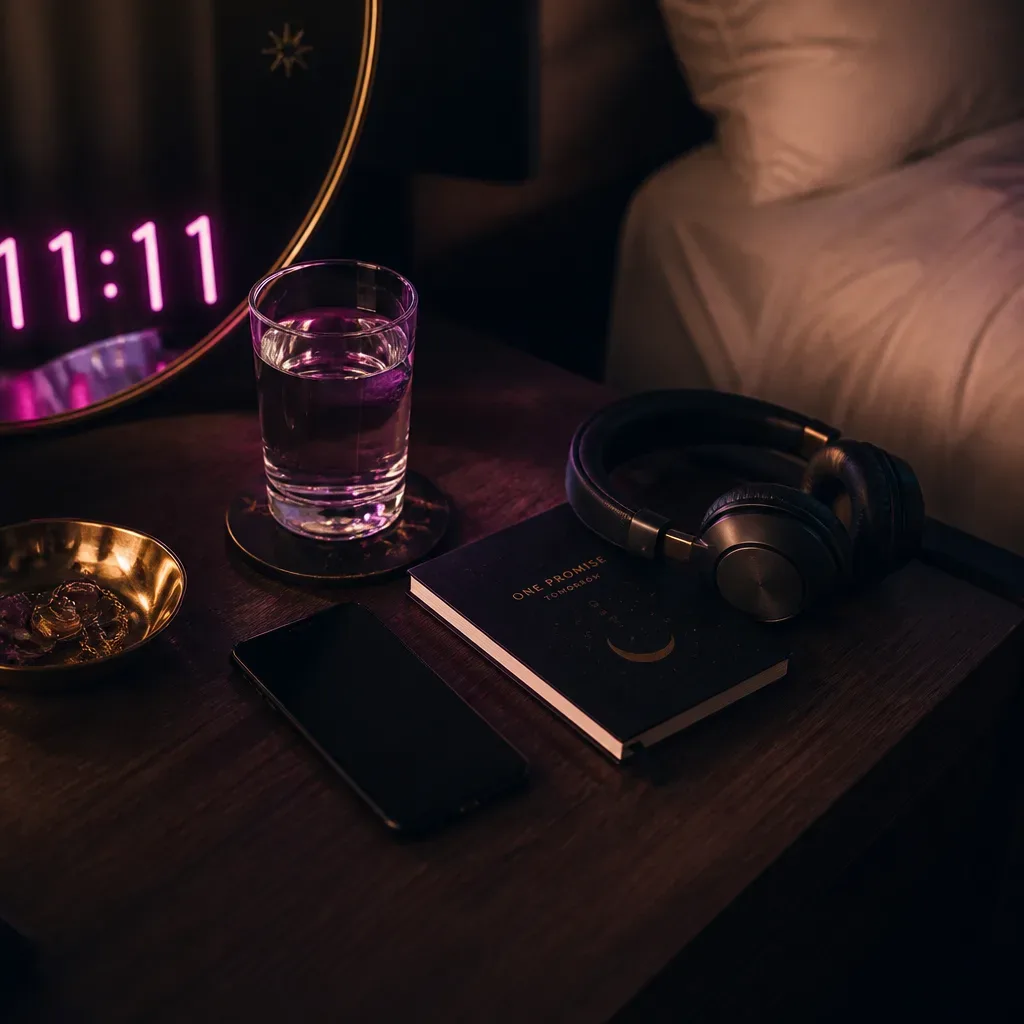
Then make the listening practice frictionless. Open the audio before sleep if you can. Lower the volume. Put headphones beside the bed, or choose speaker mode if you sleep alone. The aim is not discipline theatre. The aim is fewer decisions while the room is still dark.
Use this small checklist:
- Phone on Do Not Disturb or Sleep Focus.
- Audio ready, not buried behind three apps.
- One glass of water beside the bed.
- A notebook or single card nearby.
- No social apps on the home screen if you can bear it.
Stanford behavior researcher BJ Fogg writes that tiny habits grow when they attach to an existing prompt. Waking is already the prompt. You do not need to invent motivation at 6:42 a.m. You need a clear next move.
Here is the whole setup in order:
- Place your phone away from the bed.
- Decide that listening comes before checking.
- Prepare the audio.
- Sleep.
- Wake, stay still, and press play.
The quieter the setup, the more likely you are to keep it. A practice that requires a new personality by morning is not a practice. It is a wish with better lighting.
What exactly do you do in the first seven minutes?
You listen first, then let one line become one action.
Minute one is nothing fancy. Stay in bed. Feel the sheet. Notice the room. If your alarm is on the phone, turn it off without opening anything else. The American Academy of Sleep Medicine has warned for years that phones near bedtime can interfere with sleep, partly because of light and stimulation. Morning is the other side of that boundary. Keep the first light soft when possible.
Minutes two through five are for the Dream-Self Moment. Press play. Do not test whether you believe every line. Do not grade the narrator. Listen as if someone you trust is speaking from a room you are slowly learning to enter. In The AYA Method, the audio is not background. It is the practice itself.
Minute six is for one sentence. Choose the line that stayed. Maybe it is about calm leadership. Maybe it is about being loved without chasing. Maybe it is about earning cleanly, speaking clearly, or caring for your body without punishment. Say it once. Quietly.
Minute seven is the bridge. Name the first visible action that matches the self you just heard. Send the clean email. Drink water. Stand up without bargaining. Put on the shoes. Open the document. The action should be small enough to do today and specific enough to prove you were listening.
| Minute | Practice | Why it helps |
|---|---|---|
| 1 | Stay still | Reduces automatic phone reach |
| 2-5 | Listen to the audio | Gives the mind a chosen first cue |
| 6 | Repeat one line | Turns listening into memory |
| 7 | Choose one action | Connects identity to behavior |
Dr. Andrew Huberman has often pointed to morning light and repeated cues as ways to support circadian rhythm and alertness. You do not have to make this medical. Just understand the pattern: the body learns what comes first.
What if your mind wanders while you listen?
If your mind wanders, keep listening anyway; the return is part of the practice.
A wandering mind does not mean the audio failed. It means you are human. A 2010 Harvard study by Killingsworth and Gilbert, published in Science, found that people’s minds wandered often during daily life, and that mind-wandering was linked with lower reported happiness. The point here is not to shame the wandering. It is to notice the return.
When I first started, I treated distraction like evidence against manifestation. I came from finance teams and spreadsheets. If the mind moved, I assumed the practice was soft. I was wrong. Surf teaching changed my mind before any book did. Beginners look away from the wave. Then they look back. That is how they learn. Not by never drifting, but by returning in time.
Use three quiet repairs:
- If you drift into a task list, place one hand on your chest and keep the audio playing.
- If you start arguing with the words, say, “Maybe,” and keep listening.
- If you fall asleep again, shorten the practice tomorrow and sit up.
The words do not need to hit hard every morning. Repetition does quieter work. The Journal of Behavioral Medicine has published research linking self-affirmation practices with reduced stress responses in some settings, though effects vary by person and context. That is a fair reading. This is not magic by demand. It is a daily pattern of attention, identity, and action.
For more on how language supports the practice without becoming the whole practice, read the Affirmations pillar. The daily affirmation can help you carry one line into the day. It is a complement. The listening remains the center.
You do not have to feel certain. You have to stay near what is true.
How is this different from scrolling for motivation?
Scrolling gives you more inputs; wake up manifestation gives you one chosen inner cue.
Motivational content can be useful. A quote, a clip, a teacher, a note from someone further along. But the feed is built to keep offering the next thing. Your Dream-Self Moment is built to repeat the right thing. There is a difference between being stirred and being steadied.
Social platforms are designed around attention. In 2023, DataReportal estimated that the average internet user spent more than 2 hours a day on social media, though usage varies widely by age and country. That is not a moral failure. It is a design fact. If you open the feed before you hear yourself, you hand the morning to an algorithm that does not know your life.
Manifestation is often misunderstood as wishing. It is closer to rehearsed recognition. You practice knowing the shape of the life you intend, then you behave in ways that make it less foreign. The audio helps because it speaks in a first-person future that feels close enough to remember.
Here is the difference in plain terms:
| Morning input | What it trains | Common result |
|---|---|---|
| Notifications | Reactivity | You answer before you choose |
| News feed | Comparison | Your mood depends on the scroll |
| Motivational clips | Excitement | A quick rise, then another search |
| Dream-Self Moment | Recognition | You return to one intended self |
There is a reason many contemplative traditions protect the first minutes after waking. The wording differs, but the structure is old: silence, repetition, remembrance, action. You are not trying to become someone else. You are practicing being less forgetful of what you already know.

What should you do after the audio ends?
After the audio ends, do one small thing that makes the recording more believable by noon.
Do not float around waiting for a sign. Choose a clean action. If your Dream-Self Moment says you are steady with money, open the account and look at the number for 60 seconds. If it says you are a writer, write 100 words before inbox. If it says you are loved, do not text from panic. The body learns through evidence.
Implementation intention research by psychologist Peter Gollwitzer found that “if-then” plans can increase follow-through across many goals. The format is simple: if X happens, then I will do Y. Use it here. If I finish listening, then I will stand, drink water, and open the document. If I reach for the phone, then I will press play first.
The app also includes a daily affirmation and a Manifestation Board. They can support the audio. The affirmation can give you one sentence to carry. The board can give your eyes an image to return to. But they are not co-equal with the method. Listening is the practice. The other pieces help the listening land.
If you like working with timing, symbols, and personal cycles, you may enjoy Astrology and manifestation. Use it as a mirror, not a command. The morning still asks for a human action: the email sent, the walk taken, the apology made, the draft opened.
A future self becomes real through small proofs repeated in ordinary rooms.
Keep the first action almost embarrassingly doable. Two minutes counts. One paragraph counts. A glass of water counts if your future self is someone who keeps promises to their body. The point is not scale. The point is agreement.
How do you keep the practice honest after the first week?
You keep it honest by tracking repetition, not mood.
The first three days may feel clean. Day four may feel dull. Day seven may be interrupted by a child, a dog, a message from work, or your own tired mind. That does not mean the practice is gone. Habit studies are often misquoted as “21 days,” but a 2009 study from University College London found habit formation averaged 66 days, with wide variation. Let that humble you. Let it also relieve you.
Track only what matters:
- Did I listen before touching the phone?
- Did I choose one line?
- Did I take one matching action?
Three checkmarks. No drama. If you miss a morning, return the next one. Do not turn the missed day into an identity. It is data. Nothing more.
You can also make a weekly note. On Sunday, write down what changed. Not miracles. Details. Did you check messages later? Did you speak differently in one meeting? Did you spend less time comparing yourself to someone online? Small evidence protects the practice from fantasy.
For a wider base, keep the AYA Method close and let the Manifestation pillar give language to the bigger pattern. If you are working with words, the Affirmations pillar can help you refine the sentence you repeat. If timing matters to you, Astrology and manifestation can sit beside the practice without taking it over.
The phone will still be there after seven minutes. The news will still update. The inbox will still ask. But you will have heard yourself first.
Stay here a little longer.