affirmations
Work Affirmations Before Slack: 3-Minute Audio Reset
Use work affirmations before opening Slack with a 3-minute audio reset that steadies attention, lowers reactivity, and names your day.
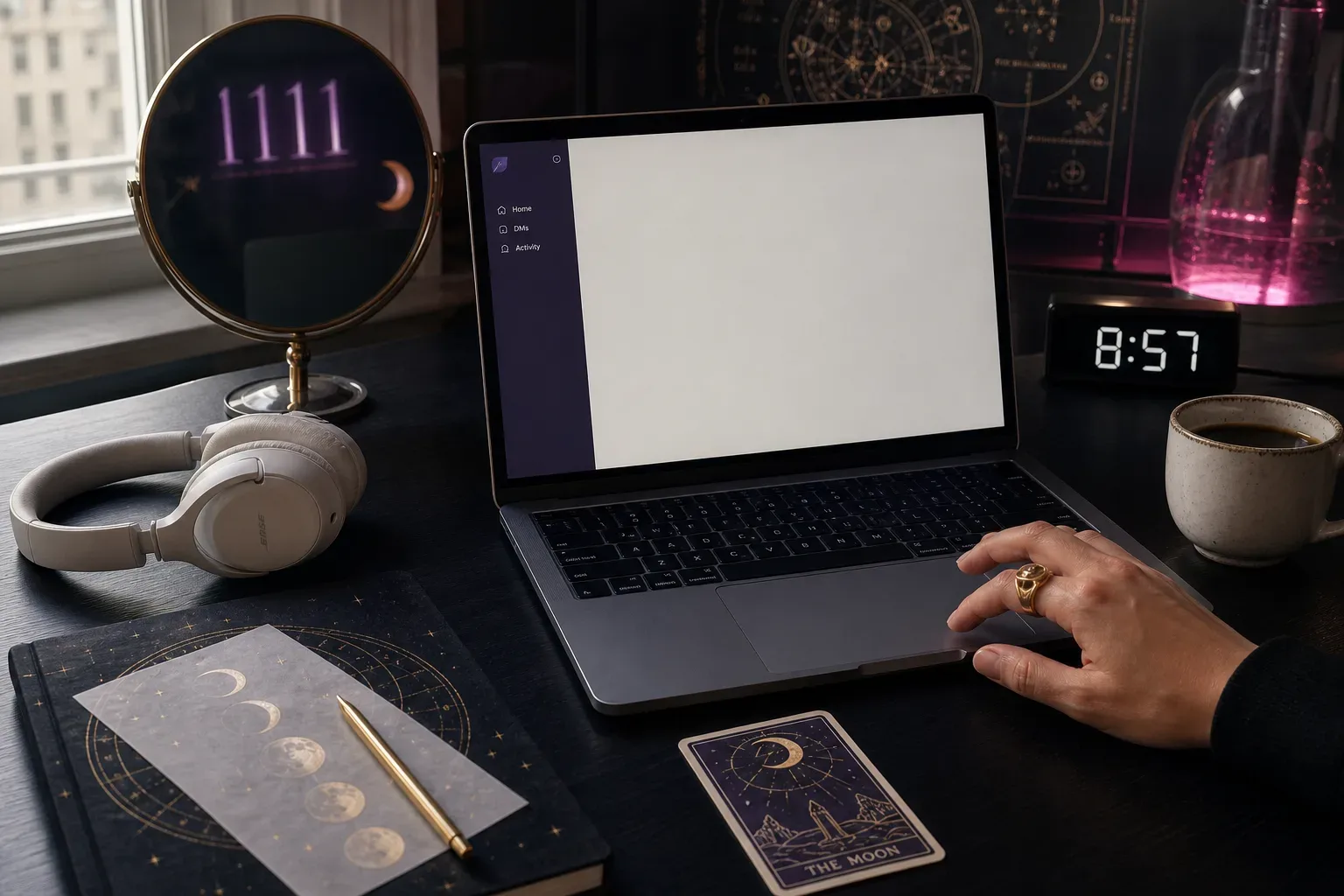
Work affirmations work best before Slack because that is the last clean minute before other people’s priorities enter the room. A 3-minute audio reset gives your nervous system a cue, your attention a direction, and your future self the first word. The dial matters. Open Slack after you name the day.
Why do work affirmations land better before Slack opens?
They land better before Slack because your attention has not yet been assigned by notifications, channels, and other people’s deadlines.
At 8:57, the laptop is open but Slack is not. This is the tiny gate. Most people walk through it half-awake, coffee in hand, already bracing. I used to call that being prepared. It was actually being pre-interrupted. The first ping became the weather.
The American Psychological Association’s 2023 Work in America survey reported that 77% of workers experienced work-related stress in the previous month. That number is not mystical. It is logistical. Work arrives through screens now, and screens are very good at pretending every signal is equal.
Work affirmations before Slack do one clean thing: they establish a state before the room gets a vote. They are not meant to deny the sprint review, the client note, or the 47-message thread that somehow began at 6:12. They are meant to keep your body from treating each one as an emergency.
Your first work thought is a gate, not a verdict.
Gloria Mark, a researcher at the University of California, Irvine, has reported that average attention on a screen has fallen sharply over the past two decades, with recent observations around 47 seconds before attention shifts. You can argue with the exact number. You probably cannot argue with the feeling.
The practice is simple: speak or listen before you scroll. If you want the wider foundation of affirmation work, keep the affirmations pillar open for later. Not before Slack. Later.
What should a 3-minute audio reset include?
A useful 3-minute reset includes one breath cue, three believable work affirmations, one future-self line, and one response rule.
Three minutes is not a ceremonial hour. It is 180 seconds, which is exactly why it survives a real morning. Mine has survived a child asking where the blue cup is, a calendar ambush, and the very specific dread of a message preview that begins, “Quick question.”
Use this structure:
- 0:00–0:30: Arrive in the body. One slow inhale, one longer exhale, one line naming where you are.
- 0:30–1:45: Hear three work affirmations. Keep them direct and occupational, not grand.
- 1:45–2:30: Hear your future-self line. One sentence from the version of you who handles work without disappearing into it.
- 2:30–3:00: Choose a response rule. Decide how you will enter Slack.
Andrew Huberman has often discussed the role of longer exhales in shifting the body toward parasympathetic calm; the “physiological sigh” research he popularizes comes from respiratory physiology, not office folklore. You do not need to become a breathing expert. You need one cue your body recognizes on cue.
Here is the difference between a weak reset and a useful one:
| Reset piece | Weak version | Strong version |
|---|---|---|
| Breath cue | “Calm down.” | “Inhale once. Exhale longer. Let the shoulders drop.” |
| Work affirmation | “Everything is perfect.” | “I answer one message at a time.” |
| Future-self line | “I am unstoppable.” | “I do not trade my whole morning for one thread.” |
| Response rule | “Be productive.” | “Open one channel first, then pause.” |
A written line can help. A sticky note can help. A Manifestation Board can visually remind you of the season you are claiming. But for this reset, audio carries the signal. The ear gets there before the argument does.
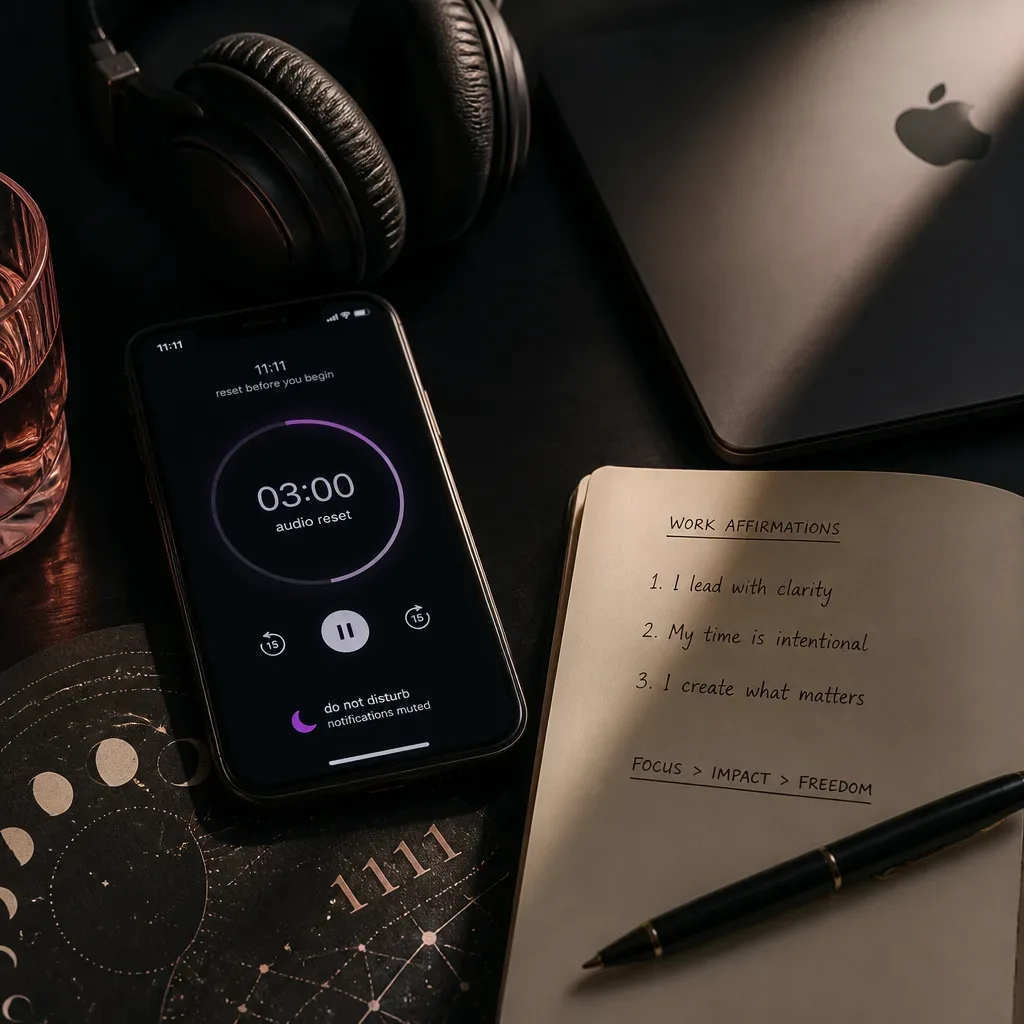
How do you write work affirmations that do not sound fake?
Write work affirmations that are specific enough to believe and steady enough to repeat when the calendar tilts.
The mistake is writing affirmations for a person with no inbox, no rent, and no history. “I am completely free from stress” may sound glossy, but if your chest is tight before the stand-up, your body knows you are lying. In a 2009 study by Joanne Wood and colleagues, positive self-statements sometimes made people with low self-esteem feel worse, likely because the gap felt too large.
That does not mean affirmations fail. It means the sentence has to be close enough for the nervous system to step onto it. Neville Goddard wrote often about occupying the state of the wish fulfilled. In work language, that means you do not perform panic and call it ambition. You rehearse the state that can actually answer.
A good affirmation is not a costume. It is a room you can stand in.
Try these work affirmations before opening Slack:
- “I can read urgency without becoming urgency.”
- “I answer from sequence, not panic.”
- “My worth is not measured by response speed.”
- “One clear reply beats five anxious ones.”
- “I can be direct without being hard.”
- “The thread is information, not identity.”
Self-affirmation theory, reviewed by Geoffrey Cohen and David Sherman in the 2014 Annual Review of Psychology, suggests that reflecting on core values can reduce defensiveness and support adaptive behavior under threat. That is the quiet mechanism here. The affirmation reminds you who is answering.
If you want a fuller map of how this sits inside manifestation practice, read the Manifestation pillar after work. The order is part of the spell: practice first, research later, Slack last.
What is the exact 3-minute routine before opening Slack?
The exact routine is to close all work apps, play the audio, repeat the strongest line once, choose one response rule, then open Slack deliberately.
The routine needs a boundary or it becomes decorative. Do not play the reset while Slack is already open in the corner. That is like trying to hear a whisper while someone is counting your money out loud. Close Slack. Close email. If your workplace uses Microsoft Teams instead, same gate, different logo.
Here is the 3-minute reset I use when the morning is tight:
- Put the phone face down for 10 seconds. This is not moral purity. It is friction.
- Press play on the audio. Headphones if possible. Speaker if not.
- Let the first breath cue finish before thinking about tasks. Thirty seconds is enough to shift the dial.
- Repeat one affirmation out loud. Quietly counts. A parked car counts.
- Name the response rule. Example: “I will read the manager channel first, then pause.”
- Open Slack. Not before. Not during. After.
Microsoft’s 2022 Work Trend Index reported a steep rise in digital collaboration since 2020, including far more meetings and chats for many knowledge workers. The exact mix depends on the company, but the pattern is familiar: more pings, more context switching, fewer clean starts.
The reset does not make work smaller. It makes you less available to false urgency.
For a 3-minute audio, keep the script around 360 to 420 words if spoken slowly, or shorter if there is space between lines. Many meditation teachers use 120 to 150 words per minute as a comfortable spoken pace. I prefer fewer words. Silence is not wasted space. It is where the sentence lands.
If you track timing through lunar cycles, master numbers, or the odd little wink of 11:11 on the kitchen clock, keep it grounded. Astrology and manifestation can help you read timing as a pattern, not an excuse to avoid the inbox.
How does the AYA Method fit with work affirmations?
The AYA Method fits by making the affirmation audible, personal, and repeatable before the workday starts speaking over you.
Here is the exact reference point: the AYA Method is a daily audio manifestation practice. Each day you listen to a short personalized recording — your Dream-Self Moment — narrated from the version of you who has already manifested the life you intend. Listening is the practice. Repetition is the work. The audio is the method.
That matters for work affirmations because most work stress is not only cognitive. It is tonal. A message has a tone. A boss has a tone. A late-night thread has a tone. If your first tone of the day comes from Slack, you have let the room tune you.
Joe Dispenza often talks about mental rehearsal as a way to condition the body toward a chosen future state. You do not have to accept every claim around his work to use the basic principle: repetition teaches the body what to expect. Audio gives that repetition a human temperature.
In my own morning, the Dream-Self Moment is the spine. A daily affirmation may sit beside it. A Manifestation Board may remind me what season I am in. They are complements. They are not the pillars. The audio carries the practice because I can listen when I cannot write, plan, or become the sort of person who owns matching storage jars.

A work affirmation inside your audio might sound like this:
“I enter the room already claimed. I do not audition for calm. I answer clearly, I pause before speed, and I let one message be one message.”
That is not a productivity hack. It is a signal repeated until the signal becomes familiar.
What if you forget and open Slack first?
If you open Slack first, close it as soon as you notice and run a shortened reset without turning the mistake into a story.
This is where perfectionism tries to dress up as discipline. It says the gate is missed, the day is ruined, the practice does not count. Very dramatic. Very inefficient. Close Slack. Take one longer exhale. Listen for 90 seconds if three minutes is gone. Return to the line.
Behavior-change research is clear that consistency beats intensity. BJ Fogg’s tiny habits model, developed at Stanford, emphasizes making behaviors small enough to repeat in real conditions. A reset that only works on a silent morning is not a practice. It is a prop.
Use the recovery version:
- Close Slack for 90 seconds.
- Put both feet on the floor.
- Play the middle section of your audio.
- Repeat one line: “I can restart without punishment.”
- Reopen Slack and answer only the first true priority.
A Pew Research Center report from 2023 found that 35% of workers with jobs that can be done remotely were working from home all the time, while many more were hybrid. That means the office gate is often gone. No commute. No elevator. No hallway. You have to build the threshold yourself.
A broken streak is not a broken identity. It is data with better lighting.
This is why I like work affirmations before Slack. They are small enough to keep, and when you miss them, small enough to return to. The master number people will appreciate the pattern: 11:11 is not powerful because it forces anything. It is powerful because you notice, name it, and change your posture toward the next minute.
If you want to keep building the language of your practice, use the affirmations pillar as your reference shelf. If you want the whole practice architecture, return to the AYA Method. Just do not read either while Slack is waiting open like a small, blinking judge.
The first signal can still be yours.